The semiconductor boom is spreading: from GPU dominance to resonance across the entire industry chain — Samsung Bloomberg Global Semiconductor ETF (3132 HK) helps you fully capture the next wave of AI dividends.

Over the past month, the AI semiconductor industry has been sending an increasingly clear signal: the beneficiaries of the computational power race are expanding outward from Graphics Processing Units (GPUs) to bottleneck areas across the entire industry chain. From structural shortages in High Bandwidth Memory (HBM), new demand for Central Processing Units (CPUs) and Dynamic Random Access Memory (DRAM) driven by intelligent AI agents, to capacity bottlenecks in Ajinomoto Build-up Film (ABF) substrates and wafer foundries — this semiconductor feast driven by artificial intelligence has entered a new phase of multi-point blossoming.
For investors, the challenge is no longer 'whether or not to buy semiconductors,' but rather 'which segment to invest in.'And$Samsung Bloomberg Global Semiconductor ETF (03132.HK)$ Tracking the top 20 global semiconductor leaders across the entire value chain from design, manufacturing to equipment, provides a comprehensive solution that doesn’t require betting on a single trend.
I. Explosive Performance: Strong demand for AI chips triggers comprehensive boom among leading manufacturers
In early April,$SAMSUNG EL 144 (SSNGY.US)$In early April, preliminary Q1 2026 earnings were released: operating profit soared to KRW 57.2 trillion, increasing more than 7.5 times year-on-year, surpassing the company's total profits for the previous year. Analysts pointed out that the demand for AI memory chips is pushing Samsung into a historic profitability phase, with supply expected to remain tight until 2027. [1]
Meanwhile,$Taiwan Semiconductor (TSM.US)$Taiwan Semiconductor’s 3nm and 5nm process capacities are also fully saturated. Currently, Taiwan Semiconductor’s 3nm process has 'almost reached its limit,' with capacity for 2026 to 2027 already fully booked. Taiwan Semiconductor has raised its 2026 capital expenditure guidance to between USD 52 billion and USD 56 billion, accelerating expansion further.$Micron Technology (MU.US)$Q2 revenue reached USD 23.86 billion, nearly tripling year-on-year, with gross margin surging to 75%, surpassing market expectations, while signing its first five-year strategic customer agreement. [1]
When downstream giants scramble for production capacity and sign long-term agreements, it reflects strong semiconductor demand, supporting manufacturers’ profit growth.
II. New Bottleneck: HBM Memory Supply-Demand Gap to Persist Until 2027
The defining feature of this semiconductor upcycle isn’t 'price hikes' but 'allocation' — whoever secures supply first gains the upper hand in the computing power race.
According to Counterpoint Research, to alleviate the current shortage, the industry needs to achieve an average annual 12% growth in DRAM capacity by 2027, but current plans only account for about 7.5%, leaving a staggering gap. AI demand is voraciously consuming HBM capacity, with the three major manufacturers prioritizing advanced processes for high-margin AI memory, squeezing out general-purpose DRAM capacity. By the end of 2027, DRAM supply is expected to meet only about 60% of global demand, with shortages and price increases set to continue for several years. [2]
This structural gap directly drives explosive earnings for memory chipmakers while also passing pricing pressure down to consumer electronics, forcing downstream players to seek alternatives. In the short term, the three major manufacturers remain the biggest winners; in the mid-to-long term, whoever overcomes technological bottlenecks like advanced packaging and Through-Silicon Via (TSV) will continue to benefit.
III. New Growth Drivers Emerge: Agent AI Reshapes Industry Dynamics
Morgan Stanley’s latest report offers a new perspective on semiconductor investment: as AI shifts from 'generating content' to 'autonomously performing tasks,' CPUs now account for 50% to 90% of the orchestration time in agent workflows. The CPU-to-GPU ratio is expected to shift from the traditional '1:12' to '1:2' or even reverse.
Morgan Stanley estimates that by 2030, the total potential server CPU market will reach $82.5 billion to $110 billion, with agent AI adding an additional $32.5 billion to $60 billion in demand for CPUs. This will also spur an additional 15 to 45 exabytes (EB) of DRAM demand, equivalent to 26% to 77% of the industry's total annual supply by 2027. Enabling sectors such as ABF substrates, wafer foundries, and memory interfaces — which are 'slowest to expand production and face the deepest bottlenecks' — will become new profit pools. [3]
This means that beneficiaries of AI infrastructure are expanding from a few GPU giants to the entire global semiconductor supply chain.
IV.$Samsung Bloomberg Global Semiconductor ETF (03132.HK)$: One-Click Capture of Full Industry Chain Growth Dividends
As the focus shifts from single chips to the entire industry chain, the right strategy is not to predict the next hotspot but to fully deploy across the entire ecosystem by holding a portfolio of global semiconductor leaders.
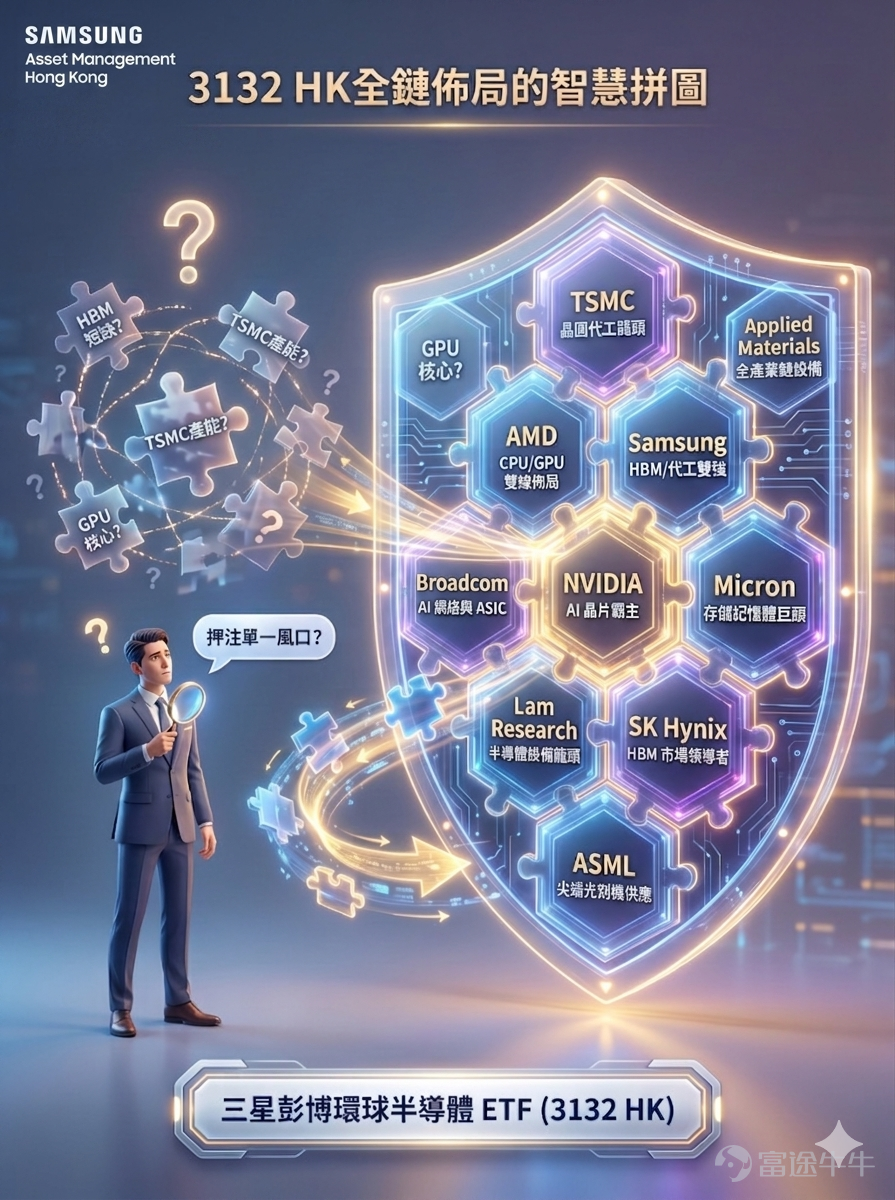
Samsung Bloomberg Global Semiconductor ETF (3132 HK) Tracks the 'Bloomberg Global Semiconductor Top 20 Index,' selecting the top 20 global semiconductor companies with the highest revenue, covering the entire industry chain from chip design and manufacturing to equipment supply.

$Samsung Bloomberg Global Semiconductor ETF (03132.HK)$The core advantage lies in:
 A truly global layout: Covers top companies in North America, Asia, and Europe, avoiding volatility from a single marketFull industry chain coverage: From design ( $NVIDIA (NVDA.US)$ 、 $Broadcom (AVGO.US)$ 、 $Advanced Micro Devices (AMD.US)$ ), manufacturing ( $Taiwan Semiconductor (TSM.US)$ , Samsung) to equipment ( $ASML Holding (ASML.US)$ 、 $Applied Materials (AMAT.US)$ ), capturing bottleneck profits at every stage without blind spotsRisk-diversified allocation: A single stock weight cap of 15% is set to balance concentration
Whether the market is favoring HBM memory chips, advanced process foundry services, lithography equipment, or AI-driven CPUs and memory interfaces for intelligent agents, $Samsung Bloomberg Global Semiconductor ETF (03132.HK)$ It can systematically capture this wave of structural growth in semiconductors through its broad portfolio of global leaders.
[1] Bloomberg, as of April 21, 2026
[2] Cnyes News Center, as of April 20, 2026
[3] Wall Street News, as of April 21, 2026
Disclaimer and Important Notice
• Investment involves risks. Past performance is not indicative of future results. The price of funds can go up as well as down, and investors may suffer all or substantial losses of their investments. Investors should not make investment decisions solely based on this material.
• The Samsung Bloomberg Global Semiconductor ETF may be exposed to key risk factors such as: investment risk, new index risk, stock market risk, concentration risk, semiconductor industry risk, emerging market risk, risks associated with depositary receipts, currency risk, securities lending transaction risk, other currency distribution risks, risks of distributions being paid from capital or effectively from capital, passive investment risk, trading risk, risks arising from different trading hours, reliance on market makers, tracking error risk, and termination risk.
• The above fund has been authorized by the Securities and Futures Commission of Hong Kong (SFC). Authorization does not imply official endorsement of the product. This material is for reference only and does not constitute an offer or solicitation to any person to buy, sell, or adopt any investment strategy.
• The Manager may, at its discretion, make cash distributions to unit holders from capital or total income (while charging all or part of the Fund's fees and expenses to the capital or paying them from the capital), thereby increasing distributable income for payment of distributions, which actually amounts to a distribution from capital.
• Distributions paid or effectively paid out of capital amount to a return of part of an investor's original investment or withdrawal of part of the original investment or capital gains attributable to that original investment. Any practice involving distributions being paid out of the capital of the product or effectively paid out of the capital of the product may result in an immediate reduction in the per-unit net asset value.
• This document has been prepared by Samsung Asset Management (Hong Kong) Limited (SAMHK) and has not been reviewed by the Securities and Futures Commission or any other regulatory authority. Investors should determine whether any investment product or strategy is suitable based on their individual financial situation, investment experience, and objectives. If you have any questions regarding the relevant information, you should seek advice from a professional advisor as needed.
• Certain information contained herein is compiled from third-party sources. SAMHK has made efforts to ensure the accuracy, completeness, and timeliness of such information and taken measures to verify and reproduce it accurately. However, SAMHK assumes no responsibility or liability for the accuracy of the data, any use thereof, or reliance on it. This content may contain forward-looking statements based on SAMHK’s opinions, expectations, and projections. SAMHK has no obligation to update or revise any forward-looking statements, and actual results may differ materially from those anticipated in forward-looking statements. All copyrights for the contents of this material (including all information, images, computer codes, text, logos, and designs) are owned by SAMHK. Without SAMHK’s consent, the information provided herein must not be reproduced or redistributed.
Risk Disclaimer: The above content only represents the author's view. It does not represent any position or investment advice of Futu. Futu makes no representation or warranty.Read more


Comments
to post a comment
4
2