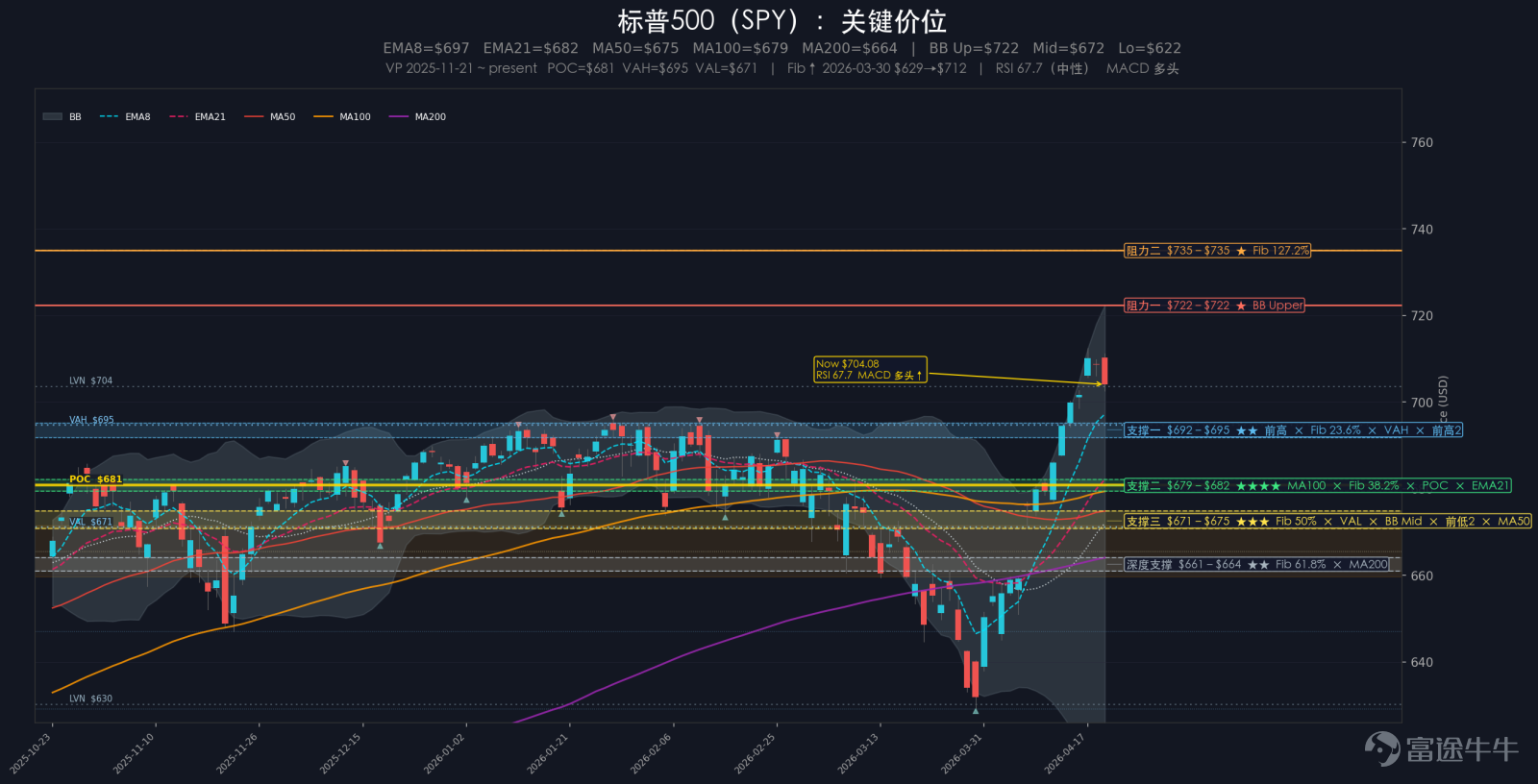

The Nasdaq and S&P continue to reach new highs. Have you hopped on board yet?
Wall Street Daily (April 22): US stocks retreated collectively on Tuesday as the market shifted from a relatively optimistic to a cautious tone, with geopolitical risks regaining pricing dominance; oil prices surged, gold plummeted, and high-volatility/small-cap stocks faced pressure.
Summary: On Tuesday, US stocks retreated collectively, with the S&P 500 down 0.63%, Nasdaq down 0.59%, Dow Jones down 0.59%, and Russell 2000 down 1.00%. All four indices weakened simultaneously, with high-volatility and small-cap sectors under more pronounced pressure. The VIX rose to 19.50, increasing by 3.34% from the previous day, reflecting a shift in sentiment from optimism to caution. The market's key pricing drivers that day centered around two main points: first, although the ceasefire between the US and Iran was extended, negotiations made little progress, and the risk related to the Strait of Hormuz resurfaced; second, Kevin Warsh attended the Federal Reserve Chair nomination hearing. Sector-wise, energy outperformed, while real estate, utilities, and communications were pressured; tech remained internally differentiated. In major asset classes, the US Dollar Index rose 0.34%, gold fell 2.12%, crude oil surged 5.04%, and Bitcoin dropped 0.43%.

I. Major Events
1. Uncertainty about the extension of the ceasefire regained market dominance.
The chain of events where Vance canceled his Pakistan trip, the second round of negotiations was suspended, and Trump announced an indefinite extension of the ceasefire but maintained blockades became the most sensitive geopolitical variable in the market on Tuesday. The focus also shifted from 'whether the ceasefire would be nominally extended' to three more practical questions: whether negotiations could resume, whether the blockade might ease, and whether risks associated with the Strait of Hormuz would recur.
2. Warsh's hearing brought the Fed framework issue back to the forefront.
Wash made it clear at the Senate nomination hearing that he had not been pressured by the White House to cut interest rates, placing emphasis on lowering inflation and upholding the independence of the Federal Reserve. For the market, the focus of this hearing was not about an immediate stance being 'hawkish or dovish,' but rather how the next Fed Chair might interpret 'independence' and 'anti-inflation priority.' This was the first time their policy framework was publicly scrutinized.
3. Apple officially enters the CEO transition period
After Apple announced that Tim Cook would step into the role of Executive Chairman and John Ternus would become the new CEO, the market began to digest these changes more concretely on Tuesday. For investors, this is not just about a change in leadership, but also signals that Apple's execution capabilities in AI, hardware strategy, and governance transition will enter a phase of 'being repriced' sooner.
II. Major Trends
Tuesday’s intraday structure initially reflected a synchronized pullback. All four major indexes closed lower, with the Russell 2000 down 1.00%, underperforming the S&P 500’s 0.63% and Nasdaq’s 0.59% drop, indicating higher pressure on high-elasticity and small-to-mid cap directions. This appears more like a rebalancing following a short-term rise in risk premiums, rather than a reversal of the dominant trend.
Over a two-week and three-month timeframe, technology-heavy stocks remain the dominant force. QQQ rose 9.47% over two weeks, outpacing DIA's 5.51% gain; over three months, QQQ climbed 4.68%, significantly leading DIA’s 0.50%. Therefore, Tuesday's pullback seems more like a rhythm adjustment after the prior rebound, insufficient to overturn the phase structure driven by tech-heavy stocks.
The breadth recovery remains sluggish. Over two weeks, SPY gained 6.81%, surpassing RSP’s 4.68% increase, showing that weighted assets still contribute more significantly to index performance. Meanwhile, DIA, IWM, RSP, SPYV, MAGS, and XMAG have generally remained weak over three months but rebounded synchronously in the past two weeks, suggesting the market is indeed repairing earlier structural cracks, albeit on a still shaky foundation.
III. Market Sentiment
Sentiment has shifted from slightly optimistic to somewhat cautious. The VIX closed at 19.50, rising 3.34% from the previous trading day, indicating increased demand for protection. The CNN Fear & Greed Index stood at 68, down from 71 previously, showing that risk appetite remains within optimistic territory but has cooled marginally.
On the options side, the latest Cboe total Put/Call ratio stands at 0.83, with the index Put/Call at 1.07 and equity Put/Call at 0.72, reflecting a slight uptick in institutional hedging demand compared to previous days. Combined with market performance, sentiment has not yet entered panic territory, but the market is demanding higher risk compensation. A return to a steeper upward trajectory would require clearer policy or fundamental catalysts to rebuild consensus.
IV. Market Scan
1. Index ETFs
In the ETF space, QQQ fell 0.38%, while IWM dropped 1.02%. Both declined, but smaller-cap stocks saw deeper losses, indicating that in a window of uncertainty, capital tends to first reduce exposure to high-elasticity and small-cap positions. Overall, there was no unilateral rotation such as 'growth completely shifting back to value' or vice versa, but rather a broader move to reduce risk.
2. Sector Performance
Industries showed noticeable re-stratification. XLE rose 1.45%, making it the strongest sector of the day, while XLRE fell 1.93%, the weakest. Additionally, XLU dropped 1.75%, XLI fell 1.41%, XLC declined 1.34%, and XLV slipped 1.02%. These figures point to the same structure: it wasn't defensive sectors broadly outperforming, but rather energy, driven by a sharp rise in oil prices, becoming one of the few sectors able to 'expand against the wind,' while most other sectors came under pressure and retreated.
3. Seven tech giants
The seven major tech stocks continued to diverge internally. MSFT rose by 1.46%, maintaining relative strength, while AAPL fell by 2.52% and NFLX dropped by 2.37%, becoming the main drags within the group. Capital preferences within the tech sector are becoming clearer: favoring assets with more certain profitability and stronger downside protection, while taking profits in high-volatility and crowded trades. The main trend remains intact, but trading enthusiasm is cooling.
4. Chinese Equities
Chinese概念股 faced overall pressure with significant declines. FUTU's drop of 1.29% made it relatively resilient within the group, while BILI fell by 6.41%, PDD by 5.00%, TME by 4.85%, BABA by 3.42%, BIDU by 3.33%, KWEB by 2.91%, NTES by 2.88%, and JD by 2.71%. Overall, this appears to reflect a valuation contraction driven by reduced risk appetite rather than structural divergence triggered by events at individual companies.
5. Cryptocurrencies
Cryptocurrencies and high-volatility correlated assets weakened simultaneously. Bitcoin fell by 0.43%, CRCL plummeted by 9.72%, and PLTR edged up only slightly by 0.05%. Amid rising macroeconomic and geopolitical uncertainty, capital has not prioritized high-beta assets as primary investments but instead moved to reduce volatility exposure first. Although no signs of collapse have emerged in the crypto space, there has been a noticeable shift away from the earlier emphasis on high elasticity plays.
$S&P 500 Index (.SPX.US)$ $SPDR S&P 500 ETF (SPY.US)$ $NASDAQ 100 Index (.NDX.US)$ $Invesco QQQ Trust (QQQ.US)$ $Dow Jones Industrial Average (.DJI.US)$ $State Street® SPDR® Dow Jones Industrial Average® ETF Trust (DIA.US)$ $Russell 2000 Index (.RUT.US)$ $iShares Russell 2000 ETF (IWM.US)$ $Roundhill Magnificent Seven ETF (MAGS.US)$ $USD (USDindex.FX)$ $U.S. 10-Year Treasury Notes Yield (US10Y.BD)$ $iShares 20+ Year Treasury Bond ETF (TLT.US)$ $XAU/USD (XAUUSD.CFD)$ $SPDR Gold ETF (GLD.US)$ $CBOE Volatility S&P 500 Index (.VIX.US)$ $Bitcoin (BTC.CC)$ $BTC/USD (BTCUSD.CC)$ $Ethereum (ETH.CC)$ $ETH/USD (ETHUSD.CC)$ $iShares Ethereum Trust ETF (ETHA.US)$ $NVIDIA (NVDA.US)$ $Tesla (TSLA.US)$ $Meta Platforms (META.US)$ $Amazon (AMZN.US)$ $Alphabet-C (GOOG.US)$ $Microsoft (MSFT.US)$ $Apple (AAPL.US)$
Risk Disclaimer: The above content only represents the author's view. It does not represent any position or investment advice of Futu. Futu makes no representation or warranty.Read more


Comments
to post a comment
9