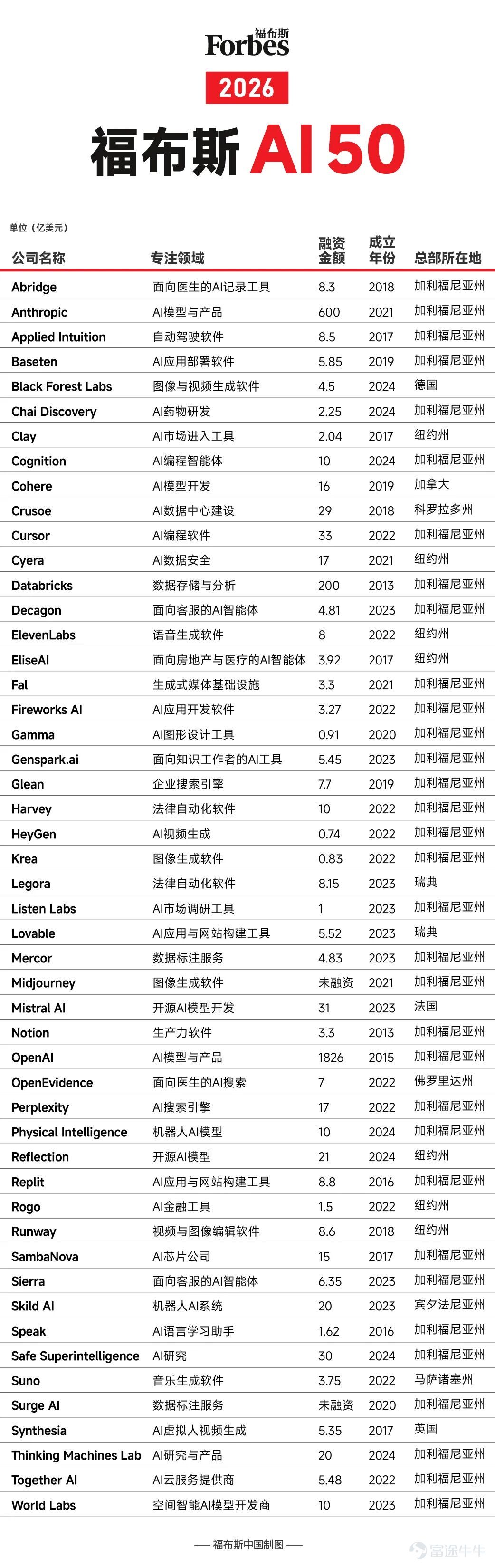

2026 Forbes AI 50 List Released
Author, Source: Forbes
Artificial intelligence has deeply integrated into daily life, playing an increasingly central role in people’s work, information retrieval, and creative expression. Over the past year, the startups leading this paradigm shift have secured massive funding from venture capital firms, creating various applications serving hundreds of millions of users across industries like law, software engineering, banking, and even music. Three years into the AI boom, startups have begun proving they can turn grand visions into sustainable business models—a fact vividly highlighted in Forbes’ eighth annual AI 50 list, which focuses on the world’s most promising private AI enterprises.
Industry leaders like OpenAI and Anthropic remain the giants on the list, receiving unprecedented funding from top Silicon Valley venture capitalists and tech giants, and are reportedly preparing for significant IPOs. These two AI giants have collectively raised $2.426 trillion, accounting for about 80% of the total funding of $3.056 trillion for companies on this year’s AI 50 list. The widespread adoption of their products has driven strong revenue growth: as of the end of February, OpenAI’s annualized revenue reportedly exceeded $250 billion; in early April, Anthropic announced its revenue run rate surpassed $300 billion. With products like Claude Code and OpenAI Codex, these two AI labs dominate markets like programming, forcing companies like Cursor, valued at $29.3 billion, to innovate to survive.
These two giants are not the only ones dedicated to model training.
San Francisco-based Physical Intelligence has raised 1 billion USD to collect data by controlling humanoid robots in real-life scenarios such as kitchens and bedrooms via human remote operators, training foundational robot models. Mistral, a French startup, sells its open-source weight models not only to large enterprises like Cisco but also to European government agencies, with its local background becoming a core competitive advantage. Cambridge AI startup Suno is targeting the entire creative industry with its music generation model.
This year’s list includes 20 newly listed companies, including Reflection, valued at 8 billion USD, which is building an open-source model to compete with companies like DeepSeek; Gamma, an AI presentation tool valued at 2.1 billion USD, where the 50-person company has already achieved an annualized revenue of over 100 million USD; Chai Discovery, founded two years ago with a valuation of 1.3 billion USD, which is leveraging AI to develop new drugs and accelerate drug discovery; and Rogo, headquartered in New York, whose AI software is used by around 25,000 bankers and investors for data analysis.
The list also features four female-led enterprises, including Thinking Machine Labs (which has raised 2 billion USD), founded by former OpenAI CTO Mira Murati, and World Labs (focused on spatial intelligence, having raised over 1 billion USD), established by legendary Stanford computer science professor Fei-Fei Li. Additionally, Fireworks AI, valued at 4 billion USD, helps developers easily access cutting-edge models without worrying about technical backend issues.
Over the past year, the AI industry landscape has undergone significant changes. Three companies from the 2025 AI 50 list have either been acquired by tech giants or had their talent absorbed by them. Alexandr Wang, CEO and co-founder of data labeling company Scale AI, joined Meta to lead the creation of its superintelligence lab; Elon Musk's AI startup xAI was acquired by SpaceX, with the merged entity valued at 1.25 trillion USD; Google spent 2.4 billion USD to bring in the co-founder team of AI programming startup Windsurf and gained access to its technology licensing; Cognition, a programming agent company valued at 10 billion USD appearing on the list for the first time this year, acquired the remaining assets of Windsurf.
1. Anthropic
CEO: Dario Amodei
Headquarters: San Francisco
Funding: 60 billion USD
Established: 2021
In February, Anthropic made several high-profile moves. First, it launched Claude Cowork, capable of automating common business processes, causing market shockwaves and wiping out 285 billion USD in market value from SaaS, IT, and legal services stocks. Then, its latest coding model, Claude Opus, went live, disrupting the software engineering field. Later, the company publicly clashed with the US government: due to refusing to compromise on safety guarantees related to autonomous weapons and large-scale domestic surveillance, Anthropic was blacklisted by the Pentagon. However, this made CEO and co-founder Dario Amodei a hero in the AI world, with rivals like OpenAI and Google speaking out in his support. The company continues to thrive, generating 4.5 billion USD in revenue last year; in February, Claude surpassed ChatGPT to become the most downloaded app on the App Store. Currently, Anthropic is valued at 380 billion USD.
2. EliseAI
CEO: Minna Song
Headquarters: New York
Funding: $392 million
Founded: 2017
Over 80% of large property management companies in the US use EliseAI's chatbot to efficiently handle repetitive administrative tasks such as maintenance request tracking, apartment viewing appointments, and lease renewals. Before founding the company in New York in 2017, Minna Song worked as a receptionist at a real estate firm, where she understood the industry's pain points. At the time, she struggled to convince investors to bet on an AI company focused on real estate. But now, at age 35, Song says, 'When we meet with investors today, they are the ones pitching partnership opportunities to us.' In 2023, the company expanded into another key sector—healthcare—applying its technology to assist with processes like insurance verification, appointment scheduling, and billing inquiries.
3. Gamma
CEO: Grant Lee
Headquarters: San Francisco
Funding: $91 million
Established: 2020
Former investment banker Grant Lee once spent hours formatting PowerPoint slides and designing graphics. Today, his startup Gamma can quickly generate high-quality financial presentations, social media visuals, and even complete websites with just simple text input from users. Recalling the first version launched in 2020, the 42-year-old Lee noted its poor reception, with one investor calling it “the worst idea I’ve ever heard.” However, the AI boom completely transformed Gamma’s fate: the company has been profitable since 2023 and is now valued at $2.1 billion. Over 100 million users have tried its tools at least once, with more than 600,000 paying regular customers subscribing to plans ranging from $9 to $100 per month.
4. Reflection
CEO: Misha Laskin
Headquarters: Brooklyn
Funding: $2.1 billion
Established: 2024
Open-source AI models from Chinese AI companies like DeepSeek (where the underlying code is visible and modifiable by clients) are globally leading. The Trump administration is eager to support American domestic models. Reflection, headquartered in Brooklyn, New York, was founded just two years ago and has already raised $2.1 billion, reaching a valuation of $8 billion. Its investors include NVIDIA, Sequoia Capital, Lightspeed Venture Partners, and 1789 Capital, where Donald Trump Jr. serves as a partner. While the company has yet to publicly release its self-developed AI product, it is investing billions of dollars to build data centers in South Korea and develop customized AI models for Korean enterprises. The company was co-founded in 2024 by former Google DeepMind researchers Misha Laskin and Ioannis Antonoglou, who were instrumental in the early development of Gemini.

Risk Disclaimer: The above content only represents the author's view. It does not represent any position or investment advice of Futu. Futu makes no representation or warranty.Read more
Comments
to post a comment
1