
DJI Mic Mini 2 Review: Dual Noise Cancellation + Ecosystem Direct Connection, a Game-Changer in the Hundred-Dollar Range!
DJI has released a new product.
This time, Lei Technology got its hands on the DJI Mic Mini 2 in advance, which is the updated version of the Mic Mini from two years ago. Initially, Lei Technology didn't have high expectations for this new product since DJI's Mic series is already quite mature, leaving little room for improvement.
So, how does this DJI Mic Mini 2 fare? Let’s dive into the experience now.
Still compact, but more 'youthful'
At first glance, whether it’s the design, size, or the magnetic attachment method on the back, the Mic Mini 2 looks strikingly similar to last year's Mic 3. The only differences are the microphone port on top and the color change from gray translucent to white translucent.

(Image Source: Lei Technology Photography)
However, upon closer inspection, Xiaolei noticed an obvious notch at the bottom of the Mic Mini 2. By gently prying it upwards, the protective shell can be removed.
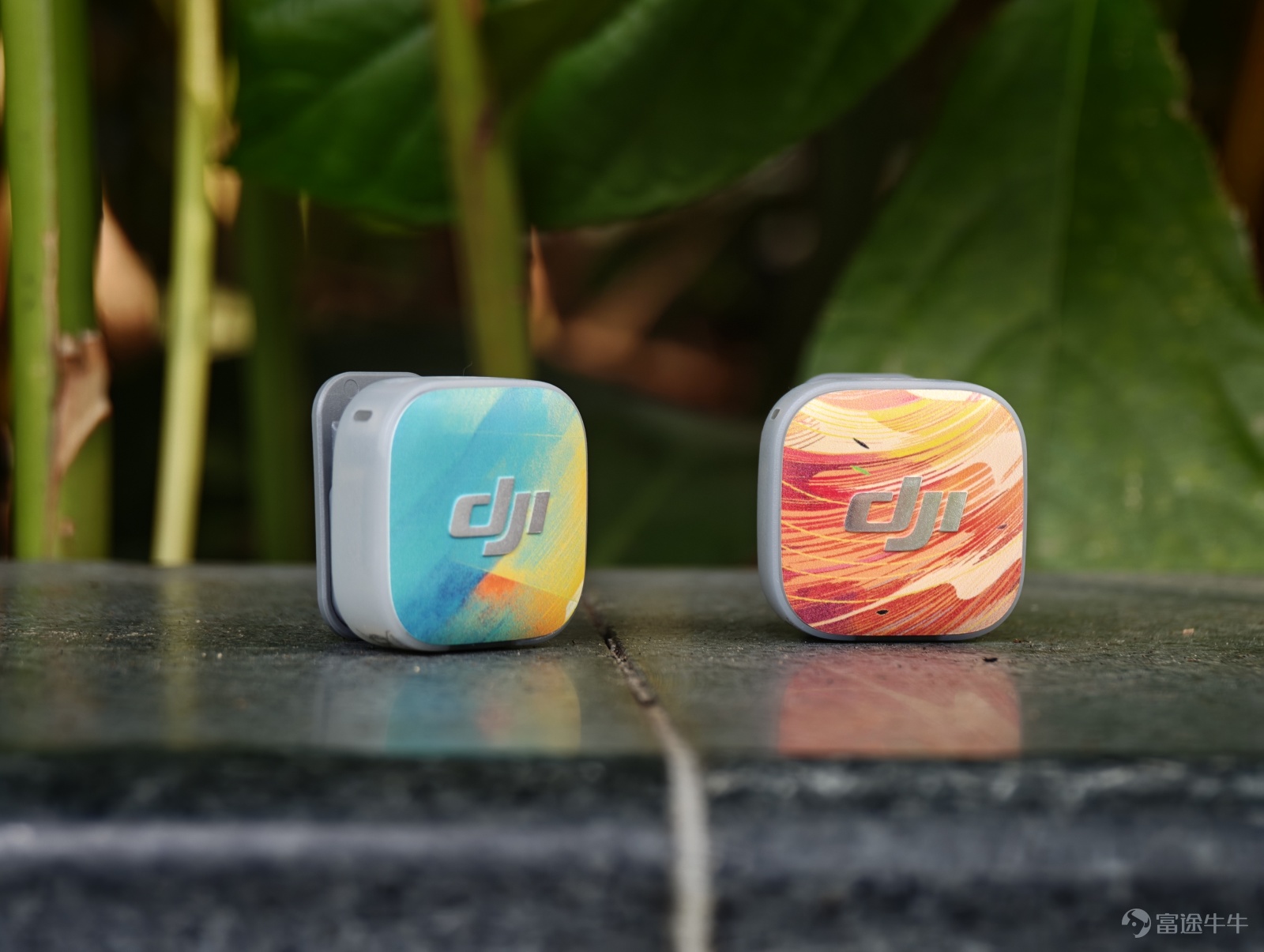
Yes, the surface protective shell of the Mic Mini 2 is replaceable. Inside the product packaging, DJI provides eight magnetic interchangeable front covers in pink, orange, yellow, green, cyan, blue, indigo, and purple.

(Image Source: Lei Technology Photography)
In addition, DJI launched a collaboration with four well-known illustrators under the 'Time Series' artist collection, featuring magnetic front covers called Dawn Glow, Green Gallop, Fiery Bloom, and Refined Gold.
Moreover, the Mic Mini 2 also comes with windshields in five different colors, aiming simply to make the otherwise plain Mic Mini 2 appear more 'youthful and vibrant.'
Seeing this, some readers may wonder why a wireless microphone would need such flashy designs. Indeed, Lei Technology acknowledges that part of the reason is aesthetics, but another key aspect is improving recognition.

(Image Source: Lei Technology Photography)
If you have some experience with public interviews, you must have seen three, five, or even more DJI Mics clipped to the interviewee's collar. In such cases, everyone can only rely on their memory to identify which Mic belongs to them. However, the customizable shell of the Mic Mini 2 can fundamentally solve this problem.
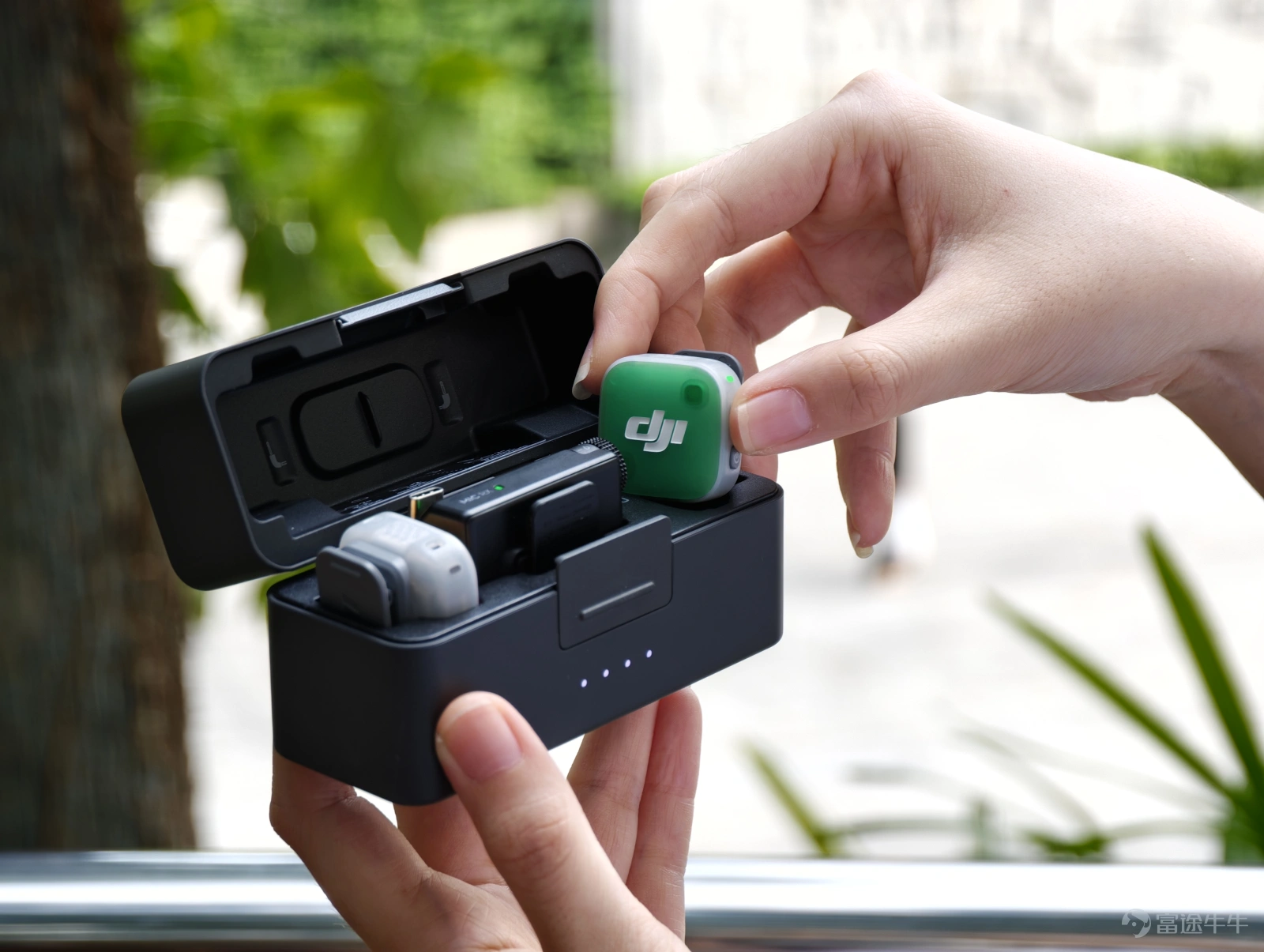
After talking about the main unit, the charging case of the Mic Mini 2 still adopts a push-to-unlock design, containing two MIC transmitters, one receiver, and a USB-C hot shoe extension port.Of course, if you have the need, you can also purchase the Lightning adapter exclusive to older models of iPhones on the official website.
(Image Source: Lei Technology Photography)
Certainly, since it's called Mini, the weight of its transmitter body has been ruthlessly compressed to about 11 grams, providing an almost 'imperceptible' wearing experience.Whether you use the conventional clipping method or utilize magnetic attraction to fix it at any position on your clothing, it won't cause deformation due to weight issues.
More interestingly, its magnetic back clip features a detachable rotating design. During actual shooting, whether it is clipped inside the collar for concealment or attached to a backpack strap, it allows flexible adjustment of the microphone direction, ensuring the sound inlet accurately targets the sound source.
When opening the charging case, both microphones and the receiver will automatically power on; just take them out and they are ready to use without any learning curve. Similarly, after placing the microphones back into the charging case, the case will automatically charge the microphones, and closing the lid will turn them off automatically.
The Mic Mini 2 only has a power button and a connection button. When connecting to DJI’s own Action 5 Pro, Action 4, or Pocket 3, simply take it out of the charging case, press and hold the pairing button, and select and connect via the camera – no extra operations or receivers are needed.
As for the receiver, due to pricing considerations, the Mic Mini 2 does not come with the same screen-equipped receiver as the Mic 3 but instead includes a relatively smaller and simpler version, though it still allows for adjusting microphone volume and checking connection status.

(Image Source: Lei Technology Photography)
There is no need to worry about battery life either. Inside this mini body, DJI has still managed to fit a battery that supports long-lasting performance. The transmitter offers up to 11.5 hours of full-charge runtime, and if combined with the charging case, the complete set with two transmitters and one receiver delivers 48 hours of total runtime, while the mobile version with one transmitter and one receiver provides 24 hours of usage. For most bloggers, this means they may not need to look for power banks even when filming outdoors for two or three days.
In an era when wireless microphone parameters have reached their peak, DJI has chosen to focus on the aspect that users once 'least cared about'—appearance—transforming a product with strong utilitarian attributes like a microphone into something with a trendy vibe.Of course, I hope that all new versions of the Mic released later will support panel replacement, so that the official team will launch more panel versions.
Advanced tuning made foolproof, allowing 'great sound' to move away from esoteric barriers.
For most short video creators without a professional background, audio post-processing is absolutely a nightmare. Adjusting the EQ slightly might make the sound feel like it's coming from inside a water tank; failing to control gain properly can ruin an emotionally powerful moment with just a single 'crackling' burst of noise.
During the time we tested the DJI Mic Mini 2, the biggest takeaway for us at Tech Thunder was this: DJI has turned extremely complex acoustic algorithms into a foolproof experience where even beginners won't make mistakes. First, in terms of specs, it supports high-quality 48 kHz 24-bit recording, with a maximum sound pressure level of 120 dB SPL, giving you confidence right from the hardware level.
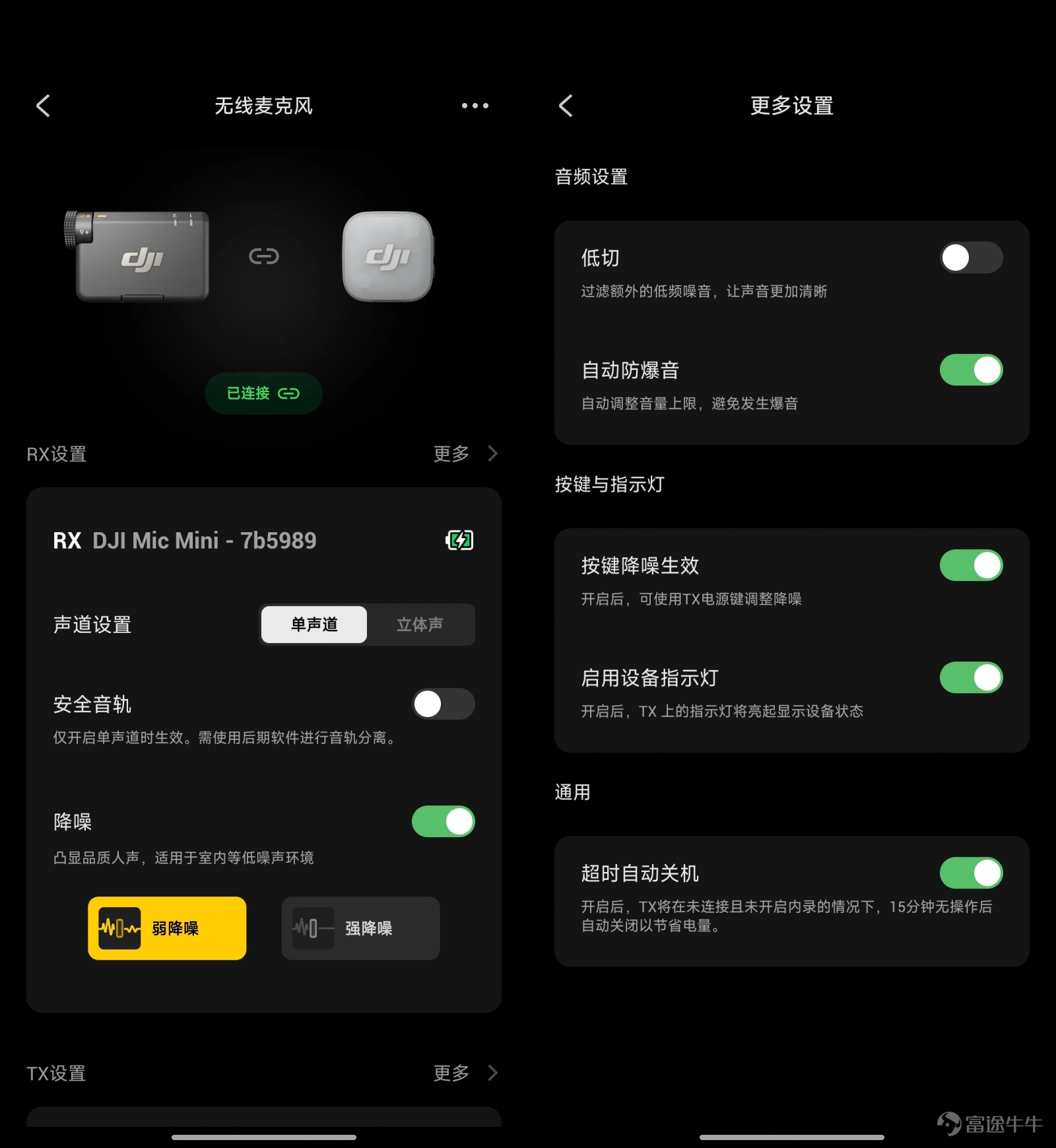
Secondly, it offers different functions tailored to various user scenarios. Let’s start with the issue that troubles many during outdoor shoots: background noise and environmental interference. Traditional microphones often apply noise reduction indiscriminately—once activated, ambient sounds disappear, but voices end up sounding as lifeless as emotionless AI. The Mic Mini 2, however, provides two levels of active noise cancellation.
When Tech Thunder tested it in our office, simply turning on the 'low setting' instantly smoothed out the hum from the overhead air conditioner and the buzz from the computer case, while still keeping colleagues’ conversations natural and clear. When we took it to the busy streets during rush hour, switching to 'strong mode (Strong)' managed to extract human voices from the cacophony of tire noise and honking horns in extreme environments.
Although under maximum noise reduction, there is a slight compromise in high-frequency details, it fully ensures absolute clarity and usability for voiceovers.
If noise reduction secures the baseline quality of a video, then the preset tonal options directly elevate its ceiling. Many people lack confidence in their own voices, often feeling that recordings sound 'muffled' or 'too sharp.' In the past, you'd need to learn how to adjust an equalizer, but now DJI has built-in three sound 'filters' directly into the Mimo app.
If you're casually recording a Vlog, the default 'normal mode' is enough to restore sound accurately. But if you happen to have a cold with heavy nasal tones or naturally muffled speech, switching to 'bright mode' adds an immediate sense of transparency and clarity to previously muddy audio, making enunciation crisper. On the other hand, if you want that late-night radio host charm, switching to 'full mode' enriches the low-end response, making your voice instantly deeper and richer.You don't need to understand what frequency bands are; if it sounds good, just go for it.
Finally, here's what we consider the most practical trick for everyday use: automatic level limiting to prevent audio clipping. This feature is simply a 'lifesaver for bad recordings.'Imagine this scenario: you're recording a talk show or screaming on a roller coaster at an amusement park, and when emotions run high, the volume suddenly spikes. Traditional microphones will clip the waveform, and even a miracle worker won't be able to fix that audio in post-production.
If it were only about being visually appealing and functional, the DJI Mic Mini 2 would at best be considered an excellent 'all-rounder,' but as an imaging giant, DJI has given it a moat that competitors at the same level simply cannot replicate — direct connection to the DJI OsmoAudio ecosystem.
(Image source: Lei Technology illustration)
In traditional action camera or pocket gimbal audio capture setups, you have to attach a receiver to the device body, which greatly compromises grip comfort and portability. However, the DJI Mic Mini 2 transmitter can connect directly to many core DJI devices like the Osmo 360, Osmo Nano, Osmo Action 6, Action 5 Pro, Action 4, and Pocket 3 without requiring any additional receiver.
Note that this isn't some stripped-down audio quality limited to 16kHz like when connecting ordinary Bluetooth earphones to a phone, but rather a true-to-life technology capable of transmitting high-quality 48kHz 24-bit audio.Once connected, you can control noise reduction settings and start/stop recording directly from the camera's screen menu, making the workflow as seamless as using a built-in microphone.
Even if you're not a DJI camera user, DJI's compatibility remains top-notch. For instance, for Sony DSLR/mirrorless users, DJI offers a dedicated hot shoe adapter. Simply plug the receiver into the Sony camera’s MI hot shoe, and you can eliminate the need for that annoying 3.5mm audio cable. Even better, the Sony camera can power the receiver while enabling synchronized power on/off between the microphone and the camera.
Additionally, for team collaborations involving 'mixed-device connections,' its receiver supports linking with both the previous-generation Mic Mini and the brand-new Mic Mini 2 transmitters. The mobile version of the receiver can even handle a mix of various transmitters including DJI Mic 2, Mic 3, Mic Mini, and Mic Mini 2.This level of extreme backward compatibility and ecosystem integration is unparalleled at this price point.
Summary: The ultimate choice for entry-level microphones under 100 yuan
Finally, according to Lei Technology's tradition, let's make a brief summary of the DJI Mic Mini 2:
Advantages:
1. Lightweight and versatile wearing options;
2. Colorful shell design is both attractive and enhances recognition;
3. Outstanding noise reduction during recording;
4. Excellent ecosystem connectivity performance.
Disadvantages:
1. The transmitter is smaller, so the charging case should theoretically be made smaller as well.
In terms of pricing, the DJI Mic Mini 2 is priced at only 599 yuan (including Mic Mini 2*2, charging case, receiver, magnetic front cover*14, windscreen, magnetic back clip, storage bag, adapter cable).
In the price range of 300-600 yuan, the market is flooded with numerous cheap alternatives. However, the DJI Mic Mini 2 enters the scene with Dajiang’s renowned quality control, an avant-garde magnetic shell design, and its unique Osmo ecosystem direct connection technology. For novice self-media creators and Vloggers who have budget constraints but basic requirements for video and audio quality, it is simply an irresistible 'ultimate weapon.'
At the end of the launch event, Dajiang also specially previewed the advanced version of the mini microphone, DJI Mic Mini 2S. Compared to the Mini 2, it features four transmitters and one receiver, along with independent internal recording capabilities. Considering Dajiang’s current microphone product positioning and price range, it is expected to target the wireless microphone market in the 1,000-yuan range. Everyone can look forward to it.
The 19th Beijing International Automotive Exhibition 2026 will be held from April 24 to May 3 at the China International Exhibition Center (Shunyi Pavilion) and the Capital International Convention and Exhibition Center (New China Exhibition Hall Phase II) in Beijing. This year's auto show, themed 'Leading the Era, Smart Future,' will showcase numerous cutting-edge technologies in the automotive industry.
Industry-leading brands such as BYD, Xiaomi, Harmony Intelligence Travel (Wenjie, etc.), XPeng, Nio, and Lantu are gathering together, unveiling several highly anticipated new models; suppliers like Horizon Robotics, Momenta, Zhuoyu, and others are flexing their muscles collectively, with deep integration of AI-driven large models empowering advanced autonomous driving, power batteries, ultra-fast charging technology, and other frontier technologies making appearances, creating a feast for the eyes!
The 'Electric Vehicle News' team under Lei Technology will dispatch a reporting crew to cover the event live, bringing exclusive front-line reports with the professional perspective of 'focusing on electric vehicles, mastering intelligence,' so stay tuned!

Risk Disclaimer: The above content only represents the author's view. It does not represent any position or investment advice of Futu. Futu makes no representation or warranty.Read more
Comments
to post a comment