Intel reports strong earnings—will its stock price regain upward momentum?

Earnings Options Strategy | Intel's stock has surged nearly 80%, can earnings add fuel to the fire?
$Intel (INTC.US)$ will release its Q1 2026 earnings after the US stock market closes on April 23rd/Thursday. The current market focus on this earnings report includeswhether data center and AI-related CPU demand can continue to materialize, whether gross margin can stabilize, and whether Foundry progress can continue to support valuation recovery.
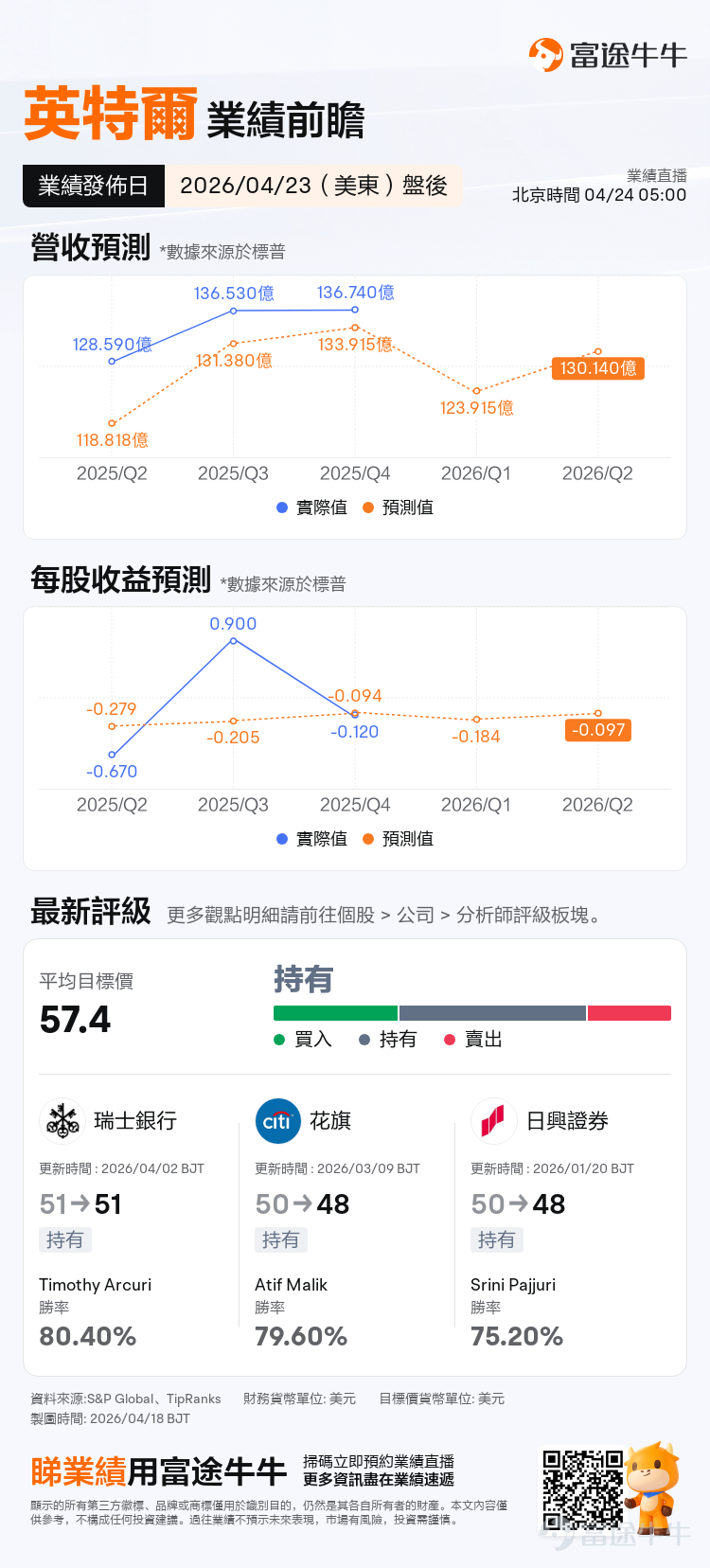
Based on the company's previous guidance, Intel's revenue forecast for Q1 2026 is $11.7 billion to $12.7 billion, with a non-GAAP gross margin of 34.5%. Current market consensus shows that Intel's expected revenue is $12.3915 billion, with EPS still negative, and profit remains weak compared to the same period last year. This means that the market currently has low profitability expectations for Intel’s Q1 performance itself,the real factors influencing post-earnings stock price movements will still be management disclosures regarding key business developments and guidance for subsequent quarters.。

Stock price surges nearly 80%, market cap hits $300 billion
As of the close on April 20th, Intel's share price was $65.7, showing a very strong recovery trend since April, with an impressive streak of rising in 11 out of 12 trading sessions, and monthly gains at extremely high levels in recent years. Year-to-date, Intel's stock price has skyrocketed by 78%, with its latest market capitalization nearing $330 billion.
The core drivers behind this sharp rise in stock price are threefold:
The first line,It's the revaluation of CPU value driven by AI inference and Agentic AI. As AI applications move from training to deployment, inference, and more complex system coordination, the market is reassessing the role of CPUs in AI infrastructure with higher weighting. Intel's Xeon product line and future volume expectations have thus returned to the trading mainline.
The second line,It's the announcement of several major collaborations, including the Terafab project led by Musk and Google, among others. The collaboration with Google strengthens the position of Xeon in AI infrastructure, as Xeon will continue to be deployed in Google Cloud infrastructure, and both parties will also advance customized IPU collaboration.
The third line,It's the renewed rise in expectations for 18A and Foundry. Recently, market discussions around 18A opening up to external customers have notably increased. Progress on 18A, potential external order intake, and the value of manufacturing assets are becoming key components in Intel's valuation recovery.

Key highlights of this earnings report
1) Data Center & AI: Can Xeon demand continue to materialize
This is the most critical focus of this earnings report. Intel already mentioned during the last conference call that demand for server CPUs driven by AI data centers was strong, with relatively tight supply in Q1 and expected improvement after Q2. In Q4 2025, Intel's Data Center and AI revenue reached $4.7 billion, a year-over-year increase of 9%. This earnings report will focus on two things: whether data center and AI-related revenues continue to improve, and whether management continues to emphasize the resilient demand for Xeon in AI inference and system coordination.
If this trend continues to strengthen, the market will be more inclined to view Intel as a beneficiary of the expansion phase of AI infrastructure.If management's tone is on the cautious side, the stock price is prone to high volatility or even a pullback after earnings.。
2) Gross margin: The hardest short-term key metric
The company provided Q1 non-GAAP gross margin guidance of 34.5%, lower than 37.9% in Q4 2025 and 39.2% in Q1 2025. This financial indicator is crucial as it directly reflects the current product mix, manufacturing efficiency, the pace of 18A implementation, and the impact of supply constraints on profitability.
For the current round of stock price recovery, if the gross margin significantly exceeds 34.5%, the market will interpret it as improved execution and easing manufacturing pressure; if the gross margin remains under pressure, the room for further valuation expansion will be compressed.
3) Foundry and 18A: Any more specific progress?
Intel Foundry remains the most contentious part of the market. In Q4 2025, Intel Foundry revenue was approximately $4.5 billion, but the quarterly operating loss still reached $2.509 billion; the full-year Foundry operating loss also remained substantial. Market focus on this business has become very clear: 18A yield, external customer interest, and the pace of subsequent node advancements.
If the earnings call provides more specific updates on 18A and external customer progress, the support for the stock price from the Foundry segment will strengthen.If discussions remain at the medium- to long-term vision level, the market is more likely to continue viewing it as a long-term narrative.

4) Q2 Guidance: The key variable determining post-earnings direction
What truly impacts the stock price in this earnings report is still the guidance tone for Q2 and the second half of the year. The company previously clarified that Q1 was a quarter with relatively tighter supply, and improvement is expected starting from Q2. If management confirms marginal supply improvements, steady demand for data center CPUs, and a beginning recovery in gross margin this time, the market's expectation of Intel having passed its 'temporary low point' will further strengthen.
Options Strategy: Will Last Quarter's Big Volatility Repeat?
First, let's look at the options pricing before earnings. Currently, Intel options havean implied volatility of about 74%, with an IV Rank of approximately 84%.The market is implying a post-earnings stock price movement of ±11.6%, indicating relatively high volatility expectations, but still below last quarter’s single-day drop after the results were released. This also suggests that pre-earnings options prices are already not cheap.

1) Bullish but unwilling to pay too much for high IV: Bull Call Spread
If you're optimistic about Intel strengthening further after earnings, a bull call spread would be more suitable. With current IV already at a high level, directly buying single-leg Calls could result in reduced profits due to a potential post-earnings volatility contraction; using a spread can lower costs and is better suited for betting on 'a continued rise in share price, but within the range of market expectations.'
2) Already holding underlying shares and worried about high volatility: Covered Call / Collar
If you already hold Intel shares, it would be more appropriate to view this event as an opportunity to collect high premiums ahead of earnings.
For a slightly more aggressive approach, you can use a Covered Call; for a more defensive strategy, you can implement a Collar, which involves selling a Call while adding a Put for protection.
Such strategies are well-suited for the current high IV environment, where the stock price has already risen, and market expectations have increased. Even if the earnings report isn't bad, there may still be volatility following profit realization.
3) Bearish but want to control strategy costs: Bear Put Spread
If there are concerns that the risk points after Intel's earnings report stem from a conservative Q2 guidance, continued gross margin pressure, or 18A progress falling short of market expectations, a bear put spread would be more suitable. This type of structure is better for betting on moderate pullbacks, and its cost is more controllable than buying a single Put option.

4) Expecting big volatility but not committing to a direction: Straddle / Strangle requires more caution
From a pricing perspective, the market has already priced in nearly an 11% earnings-related volatility expectation, with implied volatility (IV) also at a high level. In this environment, a dual-buying strategy can be executed, but it demands that actual volatility significantly exceed expectations. If the share price does not fluctuate enough post-earnings, the decline in IV will noticeably erode profits.
For Intel’s Q1 earnings report, the market focus is relatively clear:Whether demand for AI server CPUs can continue, whether gross margins can stabilize, whether there is solid progress in 18A and Foundry,and whether Q2 guidance continues to improve. The earnings figures themselves are important, but what truly determines the post-earnings stock price direction is whether management can further clarify and strengthen the fundamental logic behind this current recovery phase.
Risk Disclaimer: The above content only represents the author's view. It does not represent any position or investment advice of Futu. Futu makes no representation or warranty.Read more


Comments (6)
to post a comment
17
40