
The Q1 earnings season for US stocks kicks off! Major Wall Street banks take the lead

Earnings Options Strategy | With Amazon's earnings report approaching and the upgrade of the Anthropic partnership, can AWS continue to meet high expectations?
After the market closes on April 29 EST, Amazon will announce its Q1 2026 earnings.From a trading perspective, Amazon's upcoming earnings report faces a relatively high expectation baseline, and the market has also started to assign higher valuation prospects to AWS's AI business. On April 20...$Amazon (AMZN.US)$ Amazon announced a significant upgrade in its partnership with Anthropic, exchanging substantial computing power investment for deeper commercial integration. This collaboration comes just before the earnings announcement.
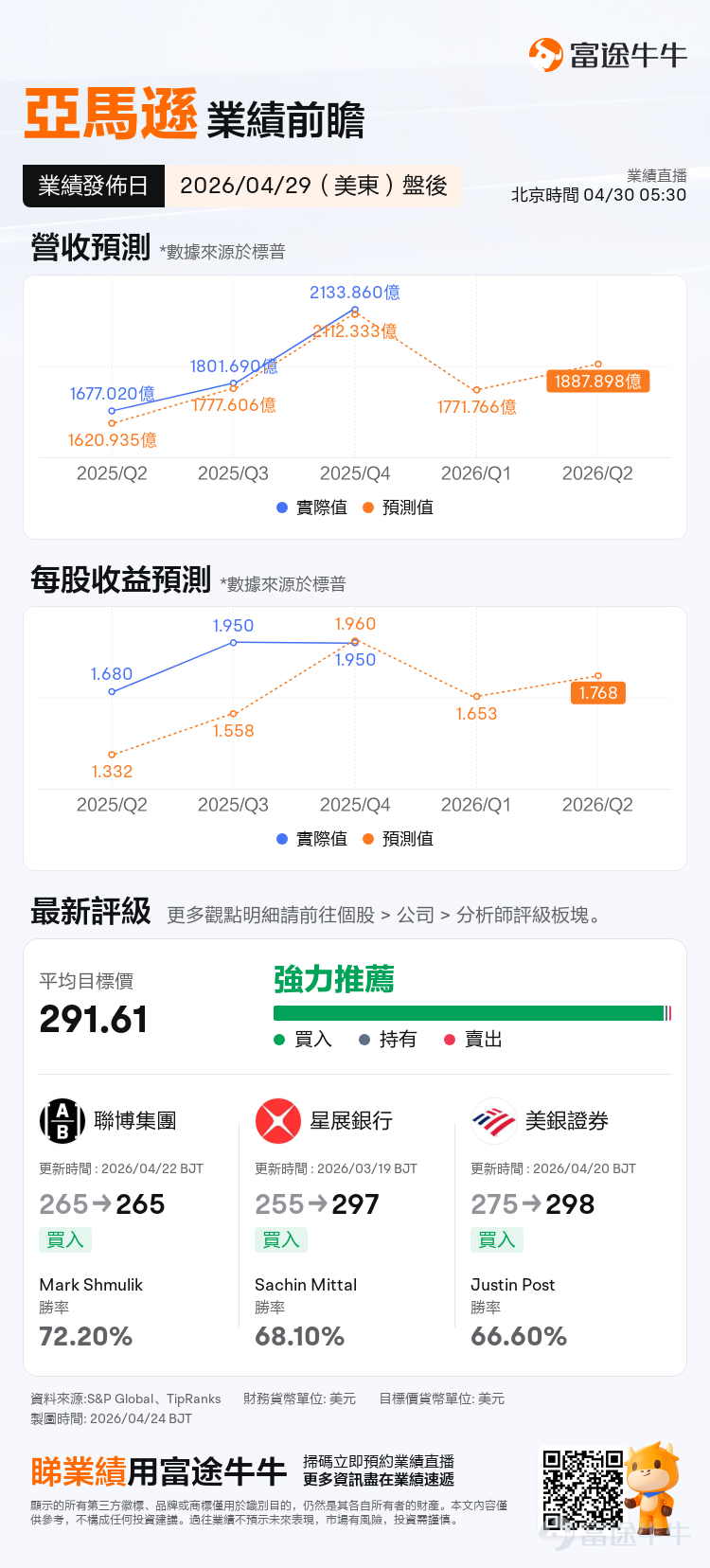
Current institutional expectations indicate that Amazon is projected to achieve revenue of $177.177 billion in Q1 2026, marking a 13.82% year-over-year increase; expected earnings per share are $1.653, reflecting a 3.97% year-over-year rise.The company previously provided Q1 guidance of $173.5 billion to $178.5 billion in revenue and $16.5 billion to $21.5 billion in operating profit, which overall sits at the higher end of the earlier guidance range. With this earnings release, the market aims to confirm whether Amazon's significantly increased AI investments have begun translating more clearly into AWS growth, order visibility, and mid-term profit elasticity.

What to focus on in this earnings report
(1) First and most importantly, look at AWS’s growth rate.
Over the past few quarters, the market’s recovery in Amazon's valuation has largely been driven by AWS regaining momentum. In the previous quarter, AWS reported a single-quarter revenue increase of 24% year-over-year to $35.58 billion, marking one of the steeper growth trajectories across several quarters.
AWS's growth last quarter also led the market to regain confidence that Amazon's investments in large model training, inference, and enterprise AI applications are transitioning from 'infrastructure first' to 'revenue realization catching up.'According to Morgan Stanley estimates, AWS's backlog remains strong, recently bolstered by OpenAI business integration. It is expected to reach approximately 350 billion US dollars by the end of the first quarter, driven by data center capacity expansion. Growth forecasts for AWS in the first and second quarters have been raised to 29% and 31%, respectively, with acknowledgment that faster growth could occur if more capacity comes online.
The current market consensus for AWS's Q1 growth rate is around 25%, with some sell-side estimates at about 28%. If AWS growth exceeds expectations this time, the market will interpret it as a sign that demand has not slowed but continues to expand. However, if growth falls back to the low 20% range, after-hours trading tolerance will significantly decline.
(2) Focus on profit margins, not just revenue
Amazon's strength lies in its increasingly high-quality revenue structure across retail, advertising, third-party services, and AWS. Continued growth in the advertising business remains a key pillar of the profit structure.
Last quarter, Amazon's massive Capex of $200 billion raised market concerns. Such a scale of Capex implies that next year's depreciation as a percentage of revenue is likely to increase further, putting more obvious pressure on profit margins.In this quarter's guidance, operating profit is expected to be between $16.5 billion and $21.5 billion. Even at the upper limit, this is below market expectations of approximately $22 billion. The midpoint of the guidance corresponds to an operating profit margin (OPM) of 10.8%, down a full percentage point year-over-year, also suggesting that the massive Capex will weigh on profitability.
Against the backdrop of surging artificial intelligence (AI) demand (currently at an annualized scale of $15 billion, accounting for about 10% of the business) and relatively low profit margins,Ensuring AWS maintains healthy profitability is crucial.According to Morgan Stanley's forecasts, AWS's profit margin is still expected to remain above 30% for four reasons: strong growth momentum in CPU and Graviton-related businesses, which have relatively high profit margins; second, ongoing restructuring efforts (with 30,000 white-collar employees laid off company-wide over the past six months, and social media indicating there may be more); third, AWS's recent price hike for its EC2 services, which helps boost both its revenue and profit margins; fourth, AWS's depreciation and amortization expenses as well as non-depreciation operational costs remain within controllable limits.
In other words, if this earnings report shows stable profit margins, the market will interpret it as a sign of stronger-than-expected core business resilience. However, if profits merely meet the lower end of guidance or worse, concerns about 'AI investment dragging on short-term returns' will resurface.
(3) Focus on Q2 guidance and management commentary
Especially for a company like Amazon, which has already been placed by the market in the 'core AI beneficiary' framework, investors care most about whether demand continues to outpace supply, whether customer sign-ups are deepening, whether capital expenditures will continue to increase, and when these investments will more clearly reflect in free cash flow and profit performance.If management continues to emphasize on the earnings call that 'demand is strong, but we are still expanding production,' the market generally accepts it, provided the growth trajectory hasn't slowed down.
In Andy Jassy's shareholder letter on April 9, he disclosed for the first time that AWS's AI business has an annualized run rate exceeding $15 billion. He emphasized that the company’s $200 billion capital expenditure plan for 2026 is not based on vague expectations, but rather backed by substantial customer commitments. In other words, Amazon is no longer debating 'whether to tell the AI story,' but is focused on embedding that narrative into its financial statements.
How should we interpret the deepening partnership between Anthropic and Amazon
Before this earnings report, Amazon’s new partnership with Anthropic is one of the most noteworthy items worthy of separate discussion.The significance of this deal for Amazon lies first in the transformation from a cooperation framework to a long-term procurement contract, which means significantly improved visibility of future AI infrastructure revenue.
According to Amazon's latest disclosed cooperation details on April 20, Anthropic will commit to spending over $100 billion on AWS technology over the next decade, securing up to 5GW of Trainium computing capacity. The partnership also covers existing and future generations of Trainium chips, as well as large-scale Graviton CPU resources. Meanwhile, Amazon will initially invest an additional $5 billion, with the potential to add up to $20 billion more in the future. The company also disclosed that more than 100,000 customers are already running Claude models on AWS, and Anthropic will continue expanding its inference deployment in Asia and Europe.
Although the market previously recognized AWS as a key platform for AI training and inference, many investors were concerned about whether Amazon's spending would yield returns too slowly.Anthropic has now provided a decade-long, multi-billion-dollar technical procurement commitment, which essentially serves as stronger demand validation for Amazon’s high capital expenditures. For the stock price, this does not necessarily mean immediate short-term profit release, but it enhances the market's assessment of AWS’s medium-term revenue visibility.
The reason Anthropic's previous collaboration did not significantly boost AWS growth, as reported by Semi Analysis, was that Anthropic had been using Google Cloud (GCP) more heavily and only transitioned to extensive use of AWS between Q3 2025 and Q4 2025. Thus, the impact on AWS growth will become more evident going forward.
The second layer of significance is that the commercial validation of Trainium is becoming more robust.
Previously, when the market discussed Amazon’s in-house chips, they were mostly viewed as a technical route to hedge against NVIDIA supply constraints and reduce training costs. Now, the situation is changing.Anthropic is not just a client of AWS but is also deeply involved in the collaborative optimization of subsequent generations of Trainium products. This relationship goes beyond that of a typical client and cloud provider, carrying a clear implication of jointly defining the product.This signal indicates that Amazon is attempting to build an integrated system of 'cloud platform + foundational models + proprietary chips,' rather than merely selling computing power. For AWS, the deeper this integration, the higher the client migration costs, and the stronger its long-term bargaining power will be.
The market will welcome these large orders as they improve future revenue visibility; at the same time, it will continue to closely monitor capital expenditures.。The company's capital expenditure plan of approximately 200 billion US dollars this year is largely focused on AI infrastructure. In other words, the partnership with Anthropic seems to signal to the market that this money is not being spent blindly, but it does not automatically alleviate investor concerns about short-term free cash flow pressures.
If management clarifies 'demand certainty' on earnings night, the collaboration will be interpreted as positive; however, if only increased investments are visible without corresponding evidence of stronger performance, the market may interpret this move as 'beneficial for the long term, but pressuring the short term.'
Earnings options strategy
Based on available information, Amazon's Q1 revenue will likely be near the upper end of guidance, with AWS growth expected to remain high while advertising and third-party services continue to provide profit support. What really needs observation is whether operating profit can maintain resilience after absorbing investments and whether the company will provide relatively stable growth guidance for Q2.
If all these points hold true, this earnings report will likely be interpreted by the market as 'AI investments gradually paying off.' Conversely, if AWS growth falls below market-implied expectations or management appears more conservative about future margins, the stock price might enter a round of valuation digestion even if fundamentals remain solid.
From a technical perspective, Amazon (AMZN.US) shows a robust upward trend, with the moving average system displaying a bullish alignment, indicating an upward mid-term trend. However, signs of weakening upward momentum have emerged as of April 20, 2026.Trading volume has significantly contracted after peaking, showing an adjustment pattern of 'price decline with shrinking volume.' Multiple short-term overbought indicators are resonating to issue warnings, suggesting significant technical correction pressure.
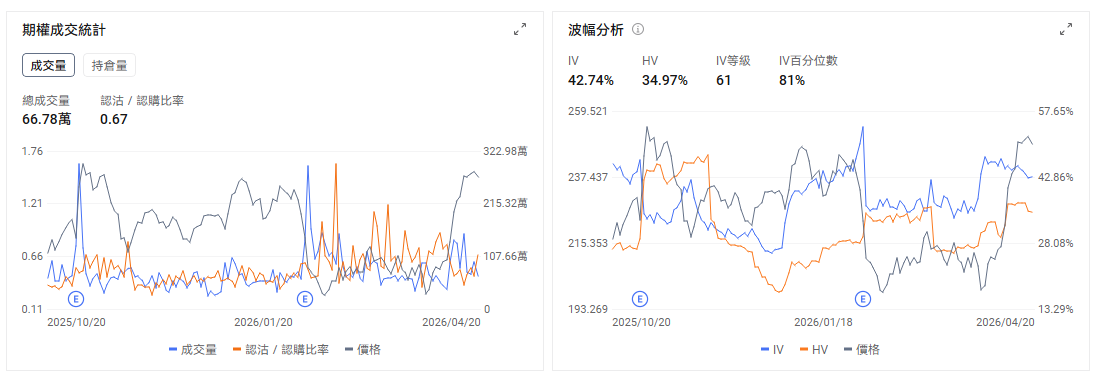
Moreover, high volatility pricing in the options market and the emergence of long-term put protection have further heightened market vigilance towards potential risks.As of April 20, the implied volatility (IV) of Amazon options was 42.73%, with its IV percentile reaching as high as 81%; the put/call ratio stood at 0.67, rebounding from extremely low levels in previous trading sessions (such as 0.36). Although the absolute value is still below 1 (indicating more active bullish trading), the rise in the ratio may reflect that some funds are beginning to shift or increase hedging.The earnings-day volatility implied by the options market is ±7.26%.
(1) If you already hold AMZN shares and are concerned about a pullback due to earnings uncertainty
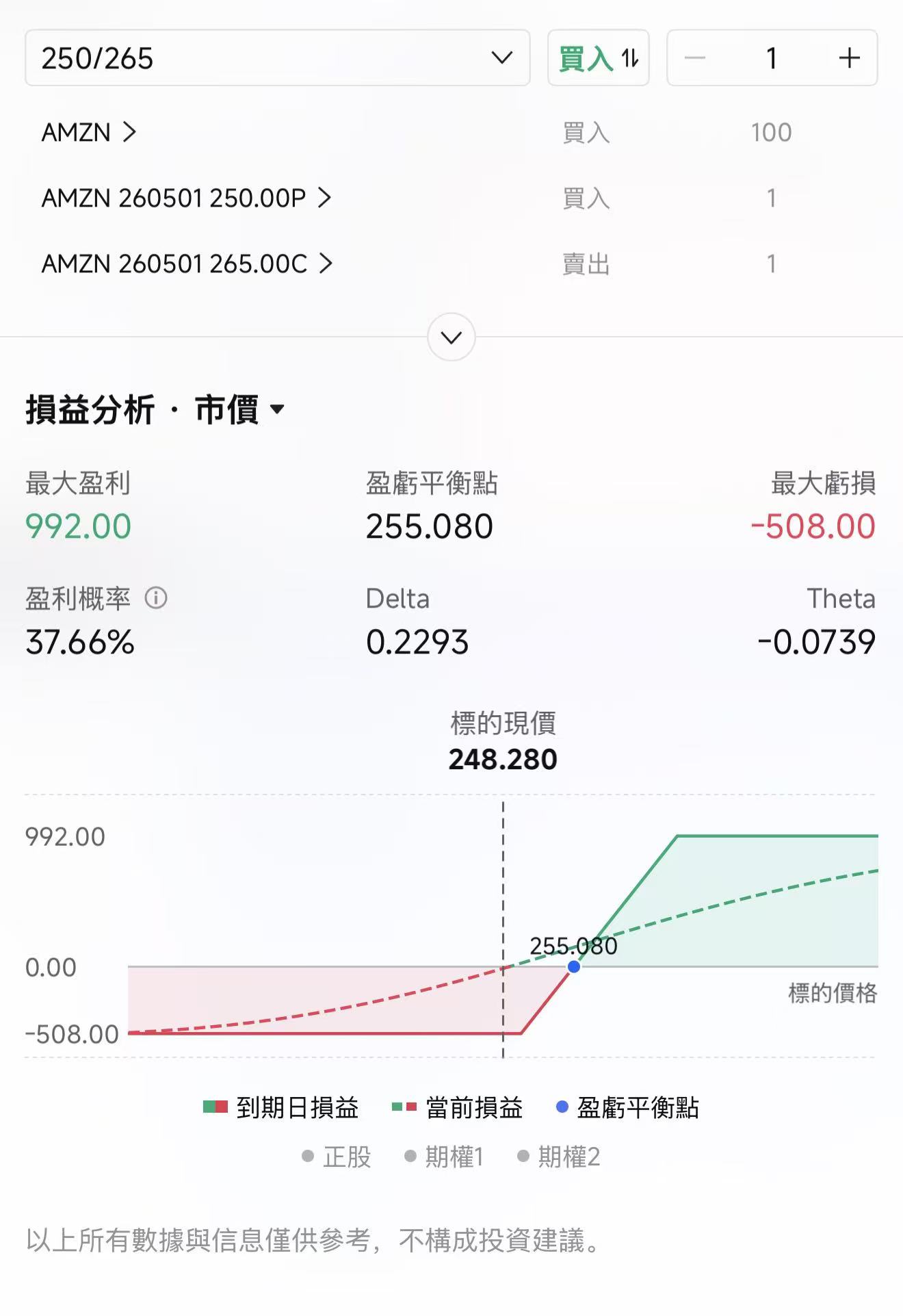
you might considerLong Collar. The core of this strategy is not to bet on a sharp rise but to lock in potential pullbacks during earnings week. Since the market has already priced in a significant amount of optimism, and AMZN is close to its previous high, any earnings report that merely 'meets expectations' rather than 'significantly beats expectations and raises guidance' could easily lead to profit-taking. The advantage of a collar is that it preserves some upside potential post-earnings while hedging downside risk.
(The figure below illustrates the simulated profit and loss scenario of this strategy on the expiration date. The design image displayed on the screen is for demonstration purposes only and does not constitute any investment advice or guarantee; market conditions fluctuate frequently, and the prices shown do not represent actual values.)
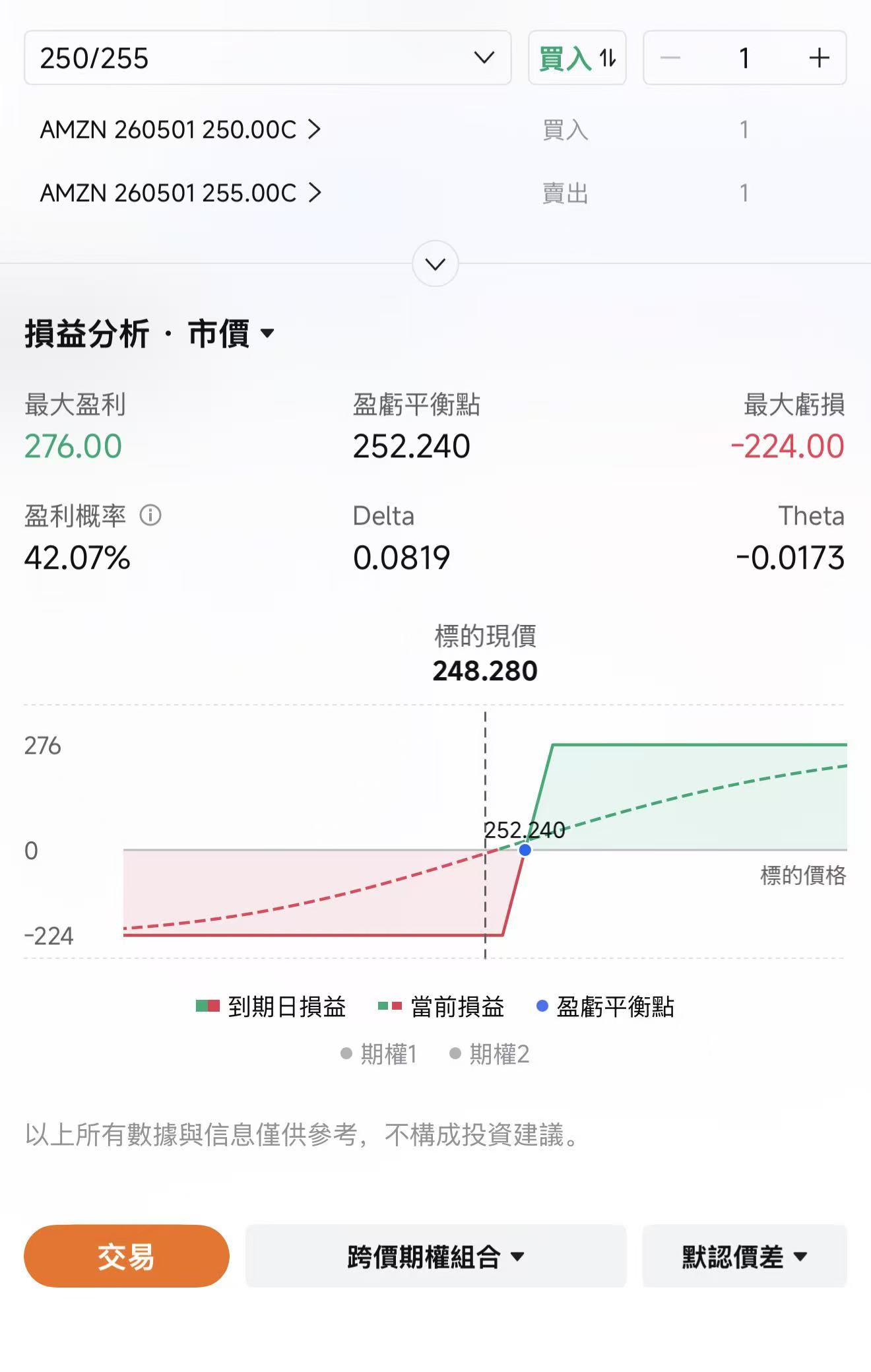
(2) If you are currently out of the market or lightly positioned and believe that earnings will likely be positive the most suitable approach would be Bull Call Spread,. Stronger-than-expected results in AWS growth, advertising, profit margins, or Anthropic-related AI developments could provide conditions for further stock price appreciation; however, given that IV is already relatively high before earnings, directly buying naked calls may not yield comfortable profits even if the direction is correct. A spread structure can reduce upfront costs and sell off part of the expensive time value.
(The figure below illustrates the simulated profit and loss scenario of this strategy on the expiration date. The design image displayed on the screen is for demonstration purposes only and does not constitute any investment advice or guarantee; market conditions fluctuate frequently, and the prices shown do not represent actual values.)
(3) If you are a pure event trader looking to take a small position to capitalize on earnings volatility itself
due to IV having risen to elevated levels, the breakeven requirements for long straddles/strangles ahead of earnings are quite high, and the cost of directly purchasing a straddle/strangle may be substantial unless you firmly expect realized volatility to significantly exceed the market's current pricing of around ±7.3%. A more prudent approach is to wait until after earnings are released and then make directional bets based on the situation, keeping in mind that single-leg trades carry higher drawdown risks, so position sizing must be carefully controlled.
Finally, Option Sir brings a small perk for fellow investors, welcome to claim it.Options Beginner Pack
*This event is exclusive to invited HK users. Click to learn more.Detailed event rules>>
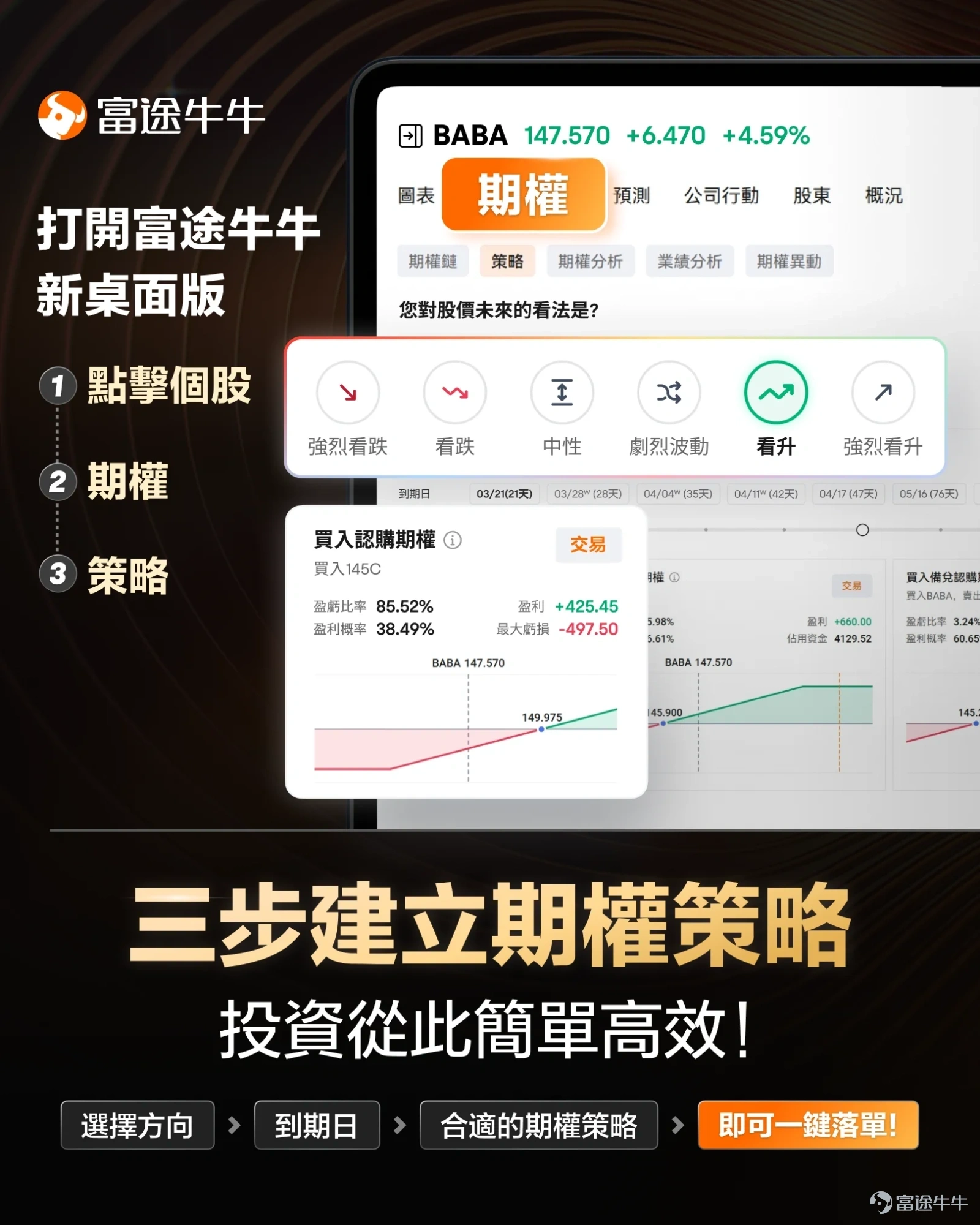
Market conditions are complex and volatile,Options strategyOverwhelmed by choices? Futubull helps you build a portfolio in three steps.Options strategymaking investing simple and efficient from now on!
Option Risk Warning:An option is a contract that grants the holder the right, but not the obligation, to buy or sell an asset at a fixed price on a specific date or at any time before that date. The price of an option is influenced by various factors, including the current price of the underlying asset, the strike price, time to expiration, and implied volatility. Implied volatility reflects the market’s expectations for the level of volatility in the option over a future period. It is a data point derived inversely from the Black-Scholes option pricing model and is generally regarded as an indicator of market sentiment. When investors anticipate greater volatility, they may be more willing to pay a higher price for options to hedge risks, resulting in higher implied volatility. Traders and investors use implied volatility to assess the attractiveness of option prices, identify potential mispricings, and manage risk exposure.
Disclaimer:This content does not constitute any offer, solicitation, recommendation, opinion, or guarantee of any securities, financial products, or tools. The risk of loss in trading options can be substantial. In some cases, losses may exceed the initial margin deposited. Even if you set contingent orders such as 'stop-loss' or 'limit' orders, these may not prevent losses. Market conditions may make such orders unexecutable. You may be required to deposit additional margin within a short period. If you fail to provide the required amount within the specified time, your open positions may be liquidated. However, you will still be responsible for any shortfall in your account. Therefore, before trading, you should study and understand options and carefully consider whether such trading is suitable for you based on your financial situation and investment objectives. If you trade options, you should be familiar with the procedures for exercising options and the rights and obligations upon exercise and expiration. Options trading carries extremely high risks and is not suitable for all investors. Investors should carefully readCharacteristics and Risks of Standardized Options。
Risk Disclaimer: The above content only represents the author's view. It does not represent any position or investment advice of Futu. Futu makes no representation or warranty.Read more


Comments
to post a comment
15
39