Following the failed launch of the ASTS satellite, where do space-related stocks go from here?

Daily Options Seller Strategy | A Tale of Two Extremes! Holding ASTS and feeling trapped? Thinking of chasing RKLB at a higher price? Practical Guide to Options Strategies Amid Diverging Space Stocks
1. Market Barometer: Temporary Pause in US Stock Rally, Divergent Trends Among Space Concept Stocks
In the previous trading session, the three major US stock indices closed slightly lower, with internal divergence within the space sector, where $AST SpaceMobile (ASTS.US)$ plummeted over 13% pre-market, with surging trading volumes, and ultimately closed down 5.30%, while $Rocket Lab (RKLB.US)$ rose more than 5%, showing mixed sentiment towards satellite communication stocks. How should one utilize options strategies to position themselves amid the diverging trends in space concept stocks?
II. Focus on Hot Targets
$AST SpaceMobile (ASTS.US)$ : Launch failure triggers valuation correction, insurance coverage mitigates short-term impact
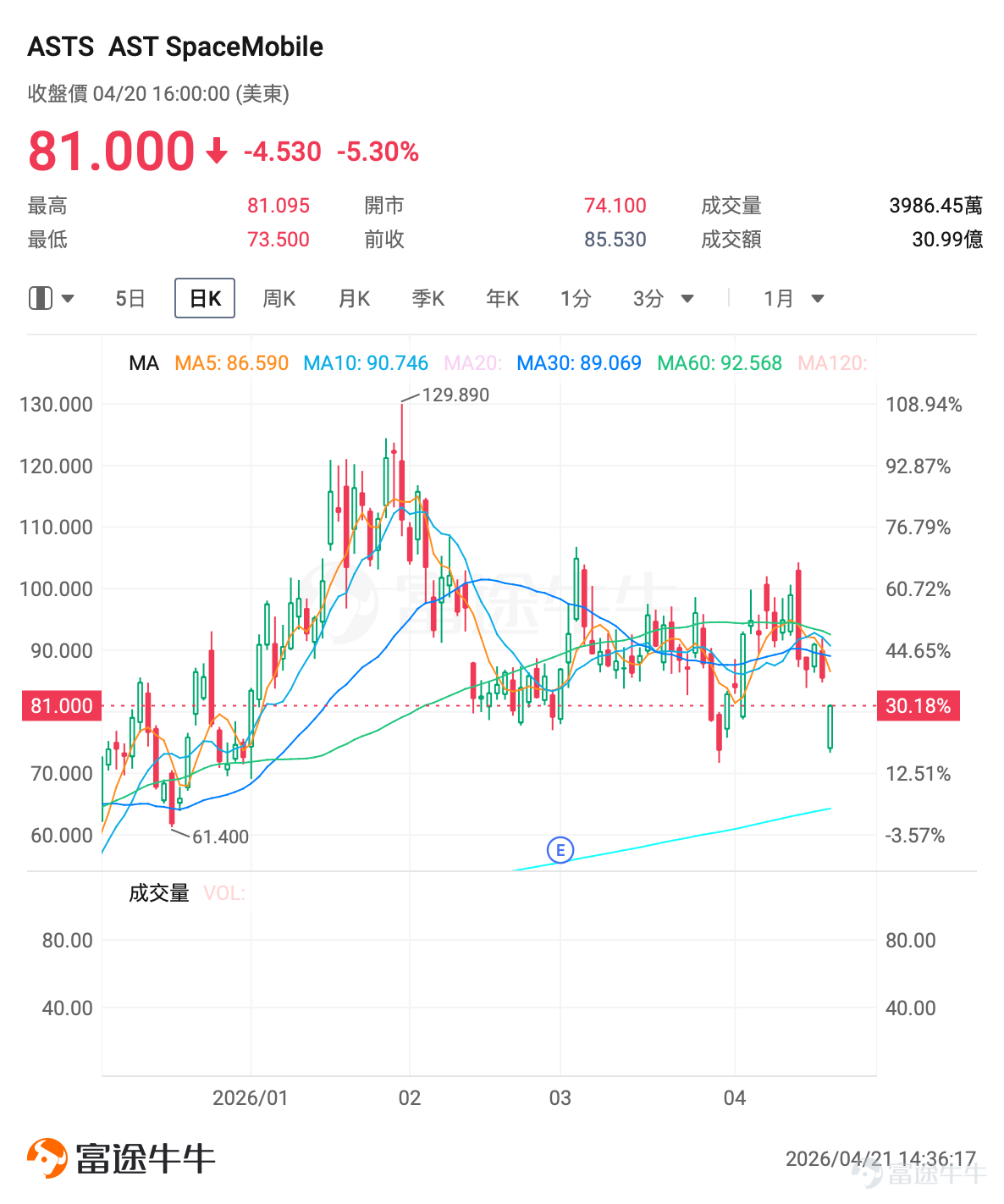
$AST SpaceMobile (ASTS.US)$ closed down 5.30% in the prior trading session, with intraday volatility exceeding 10%, and a turnover reaching 3.099 billion US dollars.
Over the weekend, the company disclosed significant negative news,its BlueBird 7 satellite, launched by Blue Origin's New Glenn rocket, was placed into an orbit lower than planned due to subpar performance of the rocket’s upper stage. Although the satellite successfully separated and powered on, its onboard propulsion system lacks the capability to raise it to operational altitude, forcing the company to decide on deorbiting the satellite.
This marks the first time ASTS has encountered a launch failure during a critical satellite deployment, exposing the risks associated with reliance on a single rocket supplier. The progress of subsequent launches using other types of rockets will become a focal point for the market.However, the company stated that the satellite's cost is expected to be recoverable through insurance, and it still maintains its target of having approximately 45 satellites in orbit by the end of 2026. The closing decline narrowed.
Technically, the stock price has fallen below multiple short-term moving averages, with increased trading volume accompanying the price drop. The short-term trend is bearish, with support levels around the previous dense trading range of $65-$79.

$Rocket Lab (RKLB.US)$: Fundamental performance continues to materialize, analysts raise target prices
$Rocket Lab (RKLB.US)$ The previous trading day saw a rise of over 5%,Cumulative gains from April to date are approximately 39%, with a staggering 374% increase over the past year.
The company's recent fundamental performance continues to materialize.Full-year 2025 revenue reached $602 million, a year-over-year increase of 38%. As of the end of Q4, the company had an order backlog of $1.85 billion, a significant year-over-year increase of 73%, primarily driven by an $816 million government contract for SDA Tranche 3. The company recently renewed a three-launch contract with Japan’s iQPS, bringing the total number of cooperative launches to 15, further demonstrating the stickiness of commercial clients.
Analysts on Wall Street have recently raised the company’s target price. Stifel increased the target price to $105,Roth MKM raised the target price to $100, with the average analyst target price at approximately $91. The current stock price is close to the average analyst target price. Going forward, close attention should be paid to business developments and new catalysts brought by Space X's IPO.

III. Seller Options Strategy

Opportunity filtering logic:
$AST SpaceMobile (ASTS.US)$ In the short term, under bearish news, the stock price may retreat. At this point, by selling call options, if the stock price continues to fluctuate and fall back, the cost of holding shares can be reduced through collecting option premiums, hedging against the risk of a stock price pullback. If the stock price rises above the strike price, the shares can also be sold at the target price, locking in exit profits.
2. Sell 1 contract $Rocket Lab (RKLB.US)$ 20260515 70P, estimated required margin (for reference only): $7000 ($70 × 100)

Opportunity filtering logic:
Expectations of SpaceX going public may continue to catalyze space stocks, but in the short term, RKLB's strong fundamentals and institutions raising their target prices have led to a rapid rise in its share price.Some investors may not have entered the market to establish positions yet.
If one chases the stock price higher by buying the underlying stock at this moment, they face the risk of a pullback. By selling put options, if the stock price continues to rise or remains volatile at high levels, option premiums can be collected, improving the annualized return on idle funds. If the stock price pulls back to near the strike price, one can also enter at the pullback price to position themselves in the space concept stock RKLB.
IV. Risk Control Reminder
Although the seller strategy has a high probability of success, investors must still manage risks effectively:
– Position management is key:The biggest risk for sellers lies in black swan events. It is recommended thatthe margin requirement for any single underlying should not exceed 20% of total capital. Never sell options beyond your capacity to handle them just for the sake of greedy premium collection.
– Covered call options should be rolled over in a timely manner.(Rolling): When a covered call option becomes deeply in-the-money (stock price far exceeds the strike price),if you remain bullish on the underlying stock, you should decisively 'roll' the position— that is, buy to close the current option while simultaneously selling an option with a further expiration date and a higher strike price, avoiding the forced liquidation of the underlying stock at a low price.
– Cash-secured put options should beware of 'left-tail risk':For cash-secured puts,if the stock price collapses due to deteriorating fundamentals (rather than normal pullbacks), don’t hold on stubbornly.At this point, it's advisable to cut losses or 'roll down' to gain time, waiting for volatility to normalize.
Case Selection Criteria
Open Futubull >> Market >> Options >> Seller Zone >> Filter; Common screening criteria for Cash Secured Put and Covered Call strategies: IV Percentile > 40%; Total option volume > 60,000 contracts; Days to expiration 0-45 days; Daily option volume/open interest > 500 contracts; ROI > 2%; Annualized ROI > 30%. Cash Secured Put: OTM Probability > 60%; Covered Call: OTM Probability > 70%;
Underlying selection rule: For each underlying asset, choose the one with the highest probability of profit. Probability refers to the likelihood that the option contract will not be exercised, i.e., the out-of-the-money probability. The higher the probability, the lower the chance of being exercised, and the greater the likelihood of securing stable option premiums. Data source: Futubull. The information is based on closing prices as of the previous trading day; all data and information in the options seller zone are for reference only and do not constitute any investment advice.
 Finally, here's a small perk for fellow investors. Welcome, fellow investors, to claim your benefit.Options Beginner Pack
*This event is exclusive to invited HK users. Click to learn more.Detailed event rules>>
Market conditions are complex and volatile,Options strategyOverwhelmed by choices? Futubull helps you build a portfolio in three steps.Options strategymaking investing simple and efficient from now on!
Options Risk Warning
An option is a contract that grants the holder the right, but not the obligation, to buy or sell an asset at a fixed price on a specific date or at any time before that date. The price of an option is influenced by various factors, including the current price of the underlying asset, the strike price, time to expiration, and implied volatility. Implied volatility reflects the market’s expectations for the level of volatility in the option over a future period. It is a data point derived inversely from the Black-Scholes option pricing model and is generally regarded as an indicator of market sentiment. When investors anticipate greater volatility, they may be more willing to pay a higher price for options to hedge risks, resulting in higher implied volatility. Traders and investors use implied volatility to assess the attractiveness of option prices, identify potential mispricings, and manage risk exposure.
Disclaimer
This content does not constitute any offer, solicitation, recommendation, opinion, or guarantee of any securities, financial products, or tools. The risk of loss in trading options can be substantial. In some cases, losses may exceed the initial margin deposited. Even if you set contingent orders such as 'stop-loss' or 'limit' orders, these may not prevent losses. Market conditions may make such orders unexecutable. You may be required to deposit additional margin within a short period. If you fail to provide the required amount within the specified time, your open positions may be liquidated. However, you will still be responsible for any shortfall in your account. Therefore, before trading, you should study and understand options and carefully consider whether such trading is suitable for you based on your financial situation and investment objectives. If you trade options, you should be familiar with the procedures for exercising options and the rights and obligations upon exercise and expiration. Options trading carries extremely high risks and is not suitable for all investors. Investors should carefully readCharacteristics and Risks of Standardized Options。
Risk Disclaimer: The above content only represents the author's view. It does not represent any position or investment advice of Futu. Futu makes no representation or warranty.Read more

Comments (2)
to post a comment
17
21