
Tesla's Q1 performance was strong, is it time to take a position?

AI5 chip tape-out has been completed, reshaping Tesla's valuation logic—will the rebound cycle begin? | In-depth Analysis | Research Report | U.S. Stocks | AI Industry | Electric Vehicles
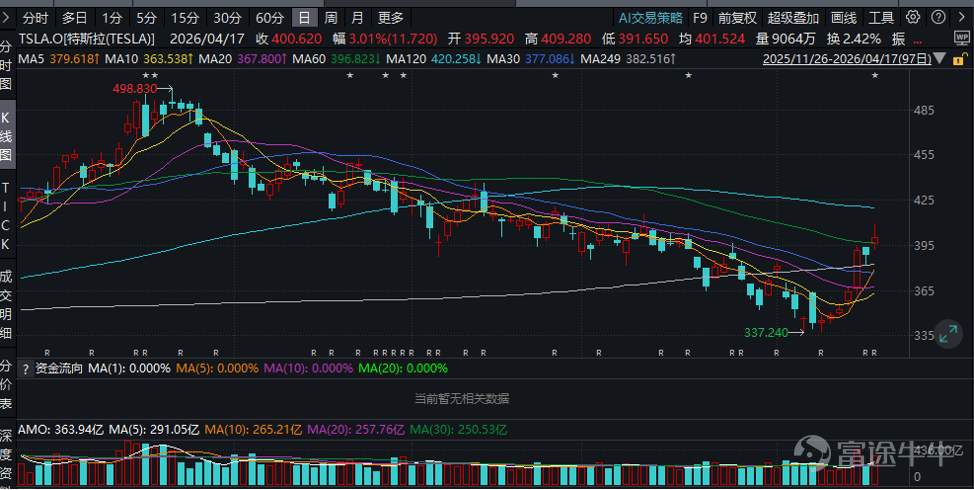
Elon Musk officially announced last week.$Tesla (TSLA.US)$The AI chip design team has completed tape-out of the AI5 chip, marking a critical milestone in moving the chip from design to mass production. At the same time, several other chips, including the AI6 and Dojo3, are being developed in parallel. He also stated that the AI5 is expected to become one of the highest-volume AI chips globally in the future. This chip's single-chip performance can rival NVIDIA's Hopper architecture while offering lower costs and power consumption, and it will be deployed in$Tesla (TSLA.US)$The entire vehicle lineup and the Optimus humanoid robot are the core of its ground-based computing power strategy; spurred by this positive development,$Tesla (TSLA.US)$Last week, the stock posted a cumulative gain of 14.8%, reversing its previous slump. Earlier, the company also announced that it would team up with its subsidiaries SpaceX and xAI to launch a superchip manufacturing project codenamed "Terafab," and as recent…$Tesla (TSLA.US)$The release of the Q1 2026 earnings report is approaching,$Tesla (TSLA.US)$Can we capitalize on the momentum to kick off a rebound?
$Tesla (TSLA.US)$CEO Elon Musk recently officially announced that the company's self-developed AI5 chip has successfully completed tape-out.,and stated that it "will become one of the world's highest-volume AI chips in the future.". According to official disclosures, the AI5 chip's performance directly rivals NVIDIA's Hopper (H100) / Blackwell (B100) flagship AI chips, while also offering significant cost advantages, with application scenarios covering$Tesla (TSLA.US)$The entire vehicle lineup, the Cybercab autonomous taxi, and the Optimus humanoid robot are slated for large-scale mass production by 2027.
Prior to this,$Tesla (TSLA.US)$It has been officially announced that the company will join forces with its subsidiaries SpaceX and xAI to launch a superchip manufacturing project codenamed "Terafab," aiming to integrate the entire AI chip value chain—from design and manufacturing to application—and provide production capacity to support the large-scale mass production of AI5 chips.Fueled by the major breakthrough of AI5's successful tape-out,$Tesla (TSLA.US)$U.S. stocks rose more than 14.8% last week, signaling a significant rebound in market sentiment.
In addition,$Tesla (TSLA.US)$The company is scheduled to release its first-quarter 2026 earnings report after the U.S. market closes on April 22, 2026. Market attention will be focused on revenue figures, gross-margin performance, and management's latest guidance for full-year results, FSD deployment, and the AI-chip and robotics businesses. This earnings report will serve as a critical inflection point in determining whether the stock's rebound can sustain.

Figure 1: Tesla (TSLA.US) stock performance; Source: Wind
The AI5 chip delivers performance on par with industry flagships, while its cost advantage establishes a core competitive barrier.
The AI5 chip is$Tesla (TSLA.US)$This is an iteratively upgraded self-developed AI chip that, with a single-chip configuration, delivers performance comparable to NVIDIA's Hopper architecture, and with a dual-chip configuration, approaches the Blackwell architecture. It fills the previous gap in high-end computing power of self-developed chips and can simultaneously meet the demanding computational needs of large model training, real-time inference for autonomous driving, and edge-side control for robots.
More importantly, the AI5 chip boasts a game-changing cost advantage. $Tesla (TSLA.US)$By developing a full-stack, vertically integrated solution in-house, the company eliminates brand markups and channel costs typically borne by chip manufacturers. At the same time, through strategic partnerships with SpaceX and xAI, it has secured massive internal demand, enabling further cost reductions via large-scale production. This low-cost advantage will deliver two key benefits: first, it will substantially lower the hardware entry barrier for in-vehicle FSD and the Optimus humanoid robot, accelerating the commercial rollout of these two businesses; second, it will significantly improve the gross margin of the company's related operations, helping it break free from the price-war-driven overcompetition in the full-vehicle manufacturing segment.

Figure 2: Tesla (TSLA.US) AI5 chip shows significant performance optimization compared with AI4; Source: Tesla (TSLA.US) 2025 Annual General Meeting PPT
Full-scenario coverage, enabling a closed-loop ecosystem for AI.
The AI5 chip was not originally designed to be compatible with a single product, but ratherAchieve$Tesla (TSLA.US)$Unified, full-ecosystem computing power, with core coverage across three major scenarios, fully launching the company's second growth trajectory.:
First is the in-vehicle intelligent driving scenario.: Integrated across the entire vehicle lineup, it provides ample computational redundancy for FSD full self-driving, enabling the deployment of L4+ autonomous driving in all scenarios while also laying the hardware foundation for the large-scale operation of Cybercab robo-taxis, ensuring that every vehicle$Tesla (TSLA.US)$All vehicle models will serve as edge computing nodes, forming a distributed autonomous-driving computing network.
Second, humanoid robot scenarios.As the "core brain" of the Optimus humanoid robot, it meets the low-latency, high-computing-power requirements for motion control, environmental perception, and human–robot interaction. Its cost-effectiveness will directly propel Optimus from the prototype stage to large-scale mass production, unlocking a trillion-dollar consumer and industrial market for humanoid robots.
Third, cloud-based AI training scenarios.: Providing computing power support for xAI's large model training, SpaceX's Starlink operations and aerospace control, replacing NVIDIA chips to achieve independent and controllable cloud computing power, while relying on the Terafab project to achieve self-sufficiency in computing power capacity and break free from dependence on third-party computing power supply.
The Terafab super-chip manufacturing project, which is aligned with the tape-out of the AI5 chip, is$Tesla (TSLA.US)$The core guarantee for achieving long-term computing power self-sufficiency. By collaborating with SpaceX and xAI—three major players—$Tesla (TSLA.US)$This has secured long-term, stable, and massive chip demand, providing ample order support for the capacity ramp-up of chip manufacturing facilities—precisely the core confidence that enables Musk to boldly claim, "We will become one of the world's highest-volume AI chip producers." At the same time, the Terafab project will help$Tesla (TSLA.US)$Breaking the monopoly of TSMC and Samsung in advanced-node chip manufacturing, achieving end-to-end controllability across the entire chip value chain—from design and fabrication to application—will significantly mitigate supply-chain risks stemming from geopolitical tensions and global chip capacity shortages, thereby providing robust production capacity support for the mass production and deployment of AI5 chips by 2027, as well as for the large-scale rollout of FSD and Optimus.
FSD Autonomous Driving: Dual Breakthroughs in Version Iteration and Global Regulation, Fully Establishing the Commercialization Closed Loop
Since 2026,Tesla ($Tesla (TSLA.US)$) FSD has achieved end-to-end breakthroughs spanning technological iteration, breaking through global regulatory barriers, and establishing a closed-loop commercialization model, thereby laying a solid market foundation for the automotive deployment of the AI5 chip.In terms of core technology iteration, in early April 2026, Elon Musk officially announced the full global rollout of FSD version 14.3 to all paid users, marking the most substantial update since the beginning of 2026. This release features a complete overhaul of the underlying neural network, delivering breakthroughs across the three core pillars of perception, decision-making, and control. Not only does it improve the accuracy of pedestrian, non-motorized vehicle, and obstacle detection by 40%, significantly enhancing recognition stability in challenging conditions such as backlight, nighttime driving, and rain or fog, but it also incorporates hundreds of algorithmic optimizations to address key pain points on urban roads—such as stop-and-go traffic, lane-cutting and yielding, and unprotected left turns—resulting in a driving style that more closely aligns with human habits. In addition, several new intelligent interaction features have been introduced. As of mid-April, the update has already been rolled out to testers and is expected to rapidly reach all global subscribers, further elevating the vehicle's autonomous driving capabilities to the next level.
At the global regulatory level,$Tesla (TSLA.US)$In April 2026, FSD achieved a series of critical breakthroughs, opening up vast growth opportunities in overseas markets.In the U.S. market, on April 6, the National Highway Traffic Safety Administration officially announced the conclusion of its investigation into$Tesla (TSLA.US)$An investigation into the "Smart Summon" feature has concluded that the system does not pose a significant safety risk to the public and therefore no further regulatory measures are required. This initiative covers nearly 2.6 million vehicles.$Tesla (TSLA.US)$The completion of the vehicle investigation has completely eliminated the core regulatory uncertainty surrounding FSD in the U.S. market. In the European market, on April 10, the Dutch Vehicle Authority issued$Tesla (TSLA.US)$The FSD Supervision Edition has issued Europe's first type-approval certificate for a vehicle model, making the Netherlands the first country on the European continent to authorize the commercial deployment of this system on public roads for end-users.$Tesla (TSLA.US)$It is also planned to extend this authorization to other EU member states, including Germany and France, via the EU mutual recognition mechanism in the summer of 2026, thereby removing the key barrier to FSD's large-scale rollout in the European market.
Meanwhile,$Tesla (TSLA.US)$The commercial closed-loop for FSD is continuously being refined, opening up entirely new revenue opportunities.Currently$Tesla (TSLA.US)$The company has fully transitioned to an FSD subscription-based business model, which boasts a gross margin exceeding 70%—significantly higher than that of the vehicle manufacturing business—thereby establishing itself as a stable source of high-margin revenue. This subscription model has also created a positive data flywheel: "subscription revenue funds AI R&D; user driving data feeds back to refine and optimize algorithms; algorithm upgrades, in turn, attract more subscribers." As of now,$Tesla (TSLA.US)$Globally, more than 6 million vehicles are now equipped with FSD hardware, providing a massive user base for the subscription service. In addition, FSD's commercial applications have expanded from consumer-facing subscriptions to B2B Robotaxi operations. In February 2026, the production-validation vehicle for the Cybercab autonomous taxi rolled off the assembly line, with mass production scheduled to commence at the Texas Gigafactory in April. This model completely eliminates the human-driver interface and relies entirely on the FSD system for autonomous driving; its accompanying operational app has also been updated to close the payment loop for commercial operations.
Optimus Humanoid Robot: Full Clarity on the Mass-Production Roadmap, Accelerating Industrial Deployment
The Optimus humanoid robot is$Tesla (TSLA.US)$Over the next decade, AI5 chips will serve as the "core brain" and the primary engine of growth, providing the essential computational power needed for robotic motion control, environmental perception, and human–robot interaction. Since 2026, the Optimus project has successfully completed end-to-end implementation across the entire value chain—product iteration, production-line deployment, and mass-production planning—marking the countdown to full-scale industrialization. Notably, the third-generation Optimus (Gen 3) features a comprehensive upgrade of its core technologies: on the intelligence front, it integrates the same BEV perception algorithm and Dojo supercomputing training model used in FSD, enabling autonomous navigation, complex task planning, and operation across diverse scenarios; on the hardware front, it employs lightweight carbon-fiber composites, reducing the overall weight to 45 kg while significantly enhancing flexibility and durability, with particular emphasis on optimizing fine manipulation capabilities in the hands to address key pain points such as grasping and assembly.
$Tesla (TSLA.US)$A mass-production roadmap for Optimus has been finalized: In the summer of 2026, small-batch pilot production of Optimus Gen 3 will commence at the Fremont plant in California, with an initial annual capacity of 50,000 to 100,000 units; by the end of 2026, preparations for capacity ramp-up will be completed, with priority given to its application in$Tesla (TSLA.US)$Technical validation and iterative refinement of the factory's internal operations have been completed; mass production is scheduled for 2027, with the product set to launch to the public, creating synergy with the in-vehicle deployment of the AI5 chip. Musk has repeatedly made it clear thatOptimus will become$Tesla (TSLA.US)$The future core business is projected to have a market size far exceeding that of the automotive industry.The long-term goal of the project is to achieve an annual production capacity of 10 million units and reduce the cost of a complete system to below US$20,000.$Tesla (TSLA.US)$In March 2026, we also launched a global recruitment campaign targeting core talent in AI, engineering, and manufacturing, fully accelerating our efforts toward large-scale mass production.
To support Optimus’s mass-production objectives,$Tesla (TSLA.US)$A strategic realignment of the global production base has been initiated. In April 2026,$Tesla (TSLA.US)$It was officially announced that production of the Model S and Model X will be completely halted in the second quarter, with the Fremont factory in California undergoing a full-scale transformation to focus exclusively on manufacturing Optimus Gen 3, thereby establishing the world’s first large-scale production line for humanoid robots. Meanwhile, the Shanghai Gigafactory in China has already started pilot production of Optimus-related components on select lines, with full-scale mass production expected to begin in the second half of 2026. Leveraging its core strengths in supply-chain management, precision assembly, and large-scale manufacturing, the facility will provide critical support for the global expansion of Optimus production.

Figure 3: Parameters of Tesla's (TSLA.US) latest-generation robot; Source: EIO, Tesla Optimus
What's the outlook for the future?
Since 2026,$Tesla (TSLA.US)$The stock price has remained under pressure, with cumulative declines exceeding 12%.The key headwinds include: intensifying price competition across the vehicle market, which has fueled concerns about declining gross margins; quarterly delivery volumes falling short of expectations; slower-than-expected global rollout of FSD; and insufficient execution in the AI and robotics businesses.As of the time this AI5 report was released, the market had already fully priced in pessimistic expectations for Q1 earnings, leaving room for a stock-price rebound.Meanwhile, the successful tape-out of the AI5 chip has directly shattered market expectations regarding$Tesla (TSLA.US)$Questions about "AI technology falling behind", driving a shift in the company's valuation logic from the traditional PE valuation of whole-vehicle manufacturing to the growth-oriented valuation of AI technology companies. Referencing the valuation levels of AI companies such as NVIDIA and Microsoft,$Tesla (TSLA.US)$The company's AI computing power, autonomous driving, and robotics businesses will deliver a substantial valuation premium, which constitutes the core underlying rationale behind the stock's sustained rebound.
Looking ahead, the market is paying close attention to April 22.$Tesla (TSLA.US)$The company will unveil its Q1 earnings results, provide updates on the progress of its various business segments, and offer forward guidance. Currently, market expectations project total Q1 revenue in the range of $22.5 billion to $23.4 billion, representing a significant quarter-over-quarter decline.The core drag stems from two factors: first, sluggish growth in delivery volumes, compounded by an intensifying global price war in the electric-vehicle sector, leading to widespread market expectations of year-on-year and quarter-on-quarter declines in average vehicle selling prices; second, deployment of the energy-storage business may fall short of expectations, thereby weakening the contribution of high-margin non-automotive revenue.However, the market's sensitivity to already-announced earnings data has declined significantly, with the primary focus now shifting to management's forward guidance—particularly on the implementation plans for the previously announced AI5 chip, FSD, and Optimus. Specifically, this includes: the mass-production timeline and capacity-planning for the AI5 chip, as well as the construction progress of the Terafab project; the global rollout plan for FSD version 14.3, the pace of its deployment in the European market, and the subscriber-growth targets; the launch details and mass-production roadmap for Optimus Gen 3; and the operational timeline for the Cybercab autonomous taxi. Overall,$Tesla (TSLA.US)$The successful tape-out of the AI5 chip has partially offset the pessimistic expectations for weak Q1 results.If management can further clarify the commercialization roadmap for the AI business in the earnings report, shifting the market's valuation rationale from that of a "full-vehicle manufacturer" to a "full-stack AI technology company," the stock price could still embark on a rebound even if Q1 results fall slightly short of expectations. Conversely, if the guidance for the AI business is overly conservative and earnings significantly miss expectations, the stock will face additional downward pressure.
Disclaimer: Any investments or potential transactions described in or related to the information provided in this publication are subject to the laws and regulatory requirements applicable in your jurisdiction, and you are solely responsible for ensuring compliance with such laws and regulations. The content of this publication is for informational purposes only and does not constitute investment advice. While we have made every effort to ensure the accuracy of the financial information provided, we disclaim any liability and provide no warranties, express or implied, as to the accuracy, completeness, or validity of all or any part of such information. We shall not be liable for any errors or omissions. In addition, please note that the prices of securities and virtual assets are subject to volatility, with virtual assets in particular carrying exceptionally high risks; investors should exercise due diligence and assume full responsibility for the risks associated with such products.
———————————————————————
About the Author:
Victory Securities – Hong Kong's Leading Virtual Asset Broker
Victory Securities (08540.HK), which has been rooted in Hong Kong for over 50 years, is a comprehensive, fully licensed securities firm offering end-to-end financial services. It provides four core business services to individual investors, institutional investors, high-net-worth clients, and corporations: wealth management, asset management, virtual assets, and capital markets. The company has received numerous awards and holds essential business qualifications across the Asia-Pacific region. In 2023, Victory Securities became the first licensed securities firm in Hong Kong to obtain licenses from the Securities and Futures Commission for virtual asset trading, advisory, and asset management services. It was also approved by the SFC to offer virtual asset trading and advisory services to retail investors, providing a one-stop, compliant, and legal platform for Bitcoin and Ethereum trading, exchange, and fund deposit/withdrawal services.
Risk Disclaimer: The above content only represents the author's view. It does not represent any position or investment advice of Futu. Futu makes no representation or warranty.Read more
Comments
to post a comment
1