
Daily Options Outlook | Nasdaq rallies for 13 consecutive sessions; US-Iran ceasefire agreement expiration approaching; Strategy rises 11.80%, adds $1 billion Bitcoin purchase
I. Today's Options Opportunities Outlook
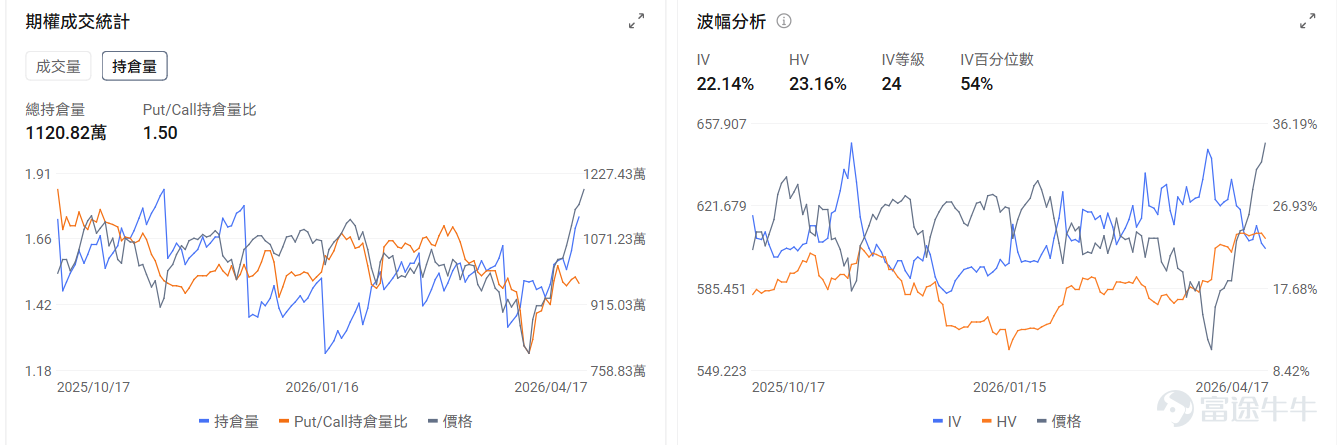
Macroeconomic level, Nasdaq hits new high with a 13-day winning streak, but the US-Iran ceasefire agreement (April 22) is nearing expiration, with tensions escalating again over the weekend; Trump stated that the concept of the agreement has been completed and a delegation is heading to Islamabad, while Iranian officials denied any negotiation plans, citing 'unreasonable demands and frequent changes in US stance' as making talks unpromising. Current options market shows $Invesco QQQ Trust (QQQ.US)$ Options Put/Call volume ratio at 1.1, open interest ratio at 1.5, implied volatility (IV) at 22.14%, with IV percentile reaching 54%, indicating that market investors are using large amounts of Puts to hedge risks
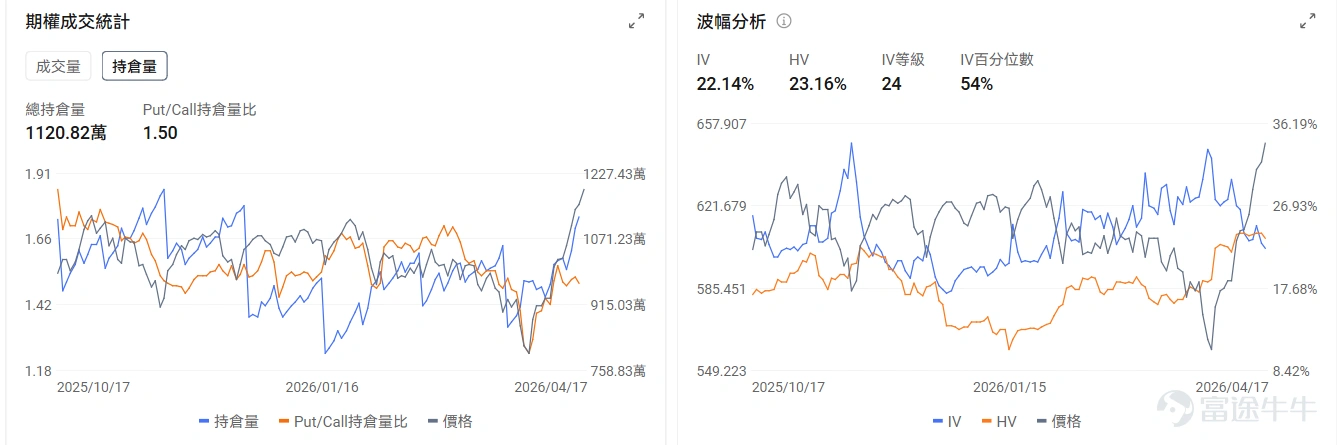
On the individual stock level, Oil stocks collectively rise pre-market, $Petroleo Brasileiro SA Petrobras (PBR.A.US)$ up 2.83%, $ConocoPhillips (COP.US)$ up 2.11%, $Exxon Mobil (XOM.US)$ up 1.43%. Among them, PBR.A's Put/Call volume ratio is 0.11, reflecting a strong bullish inclination.
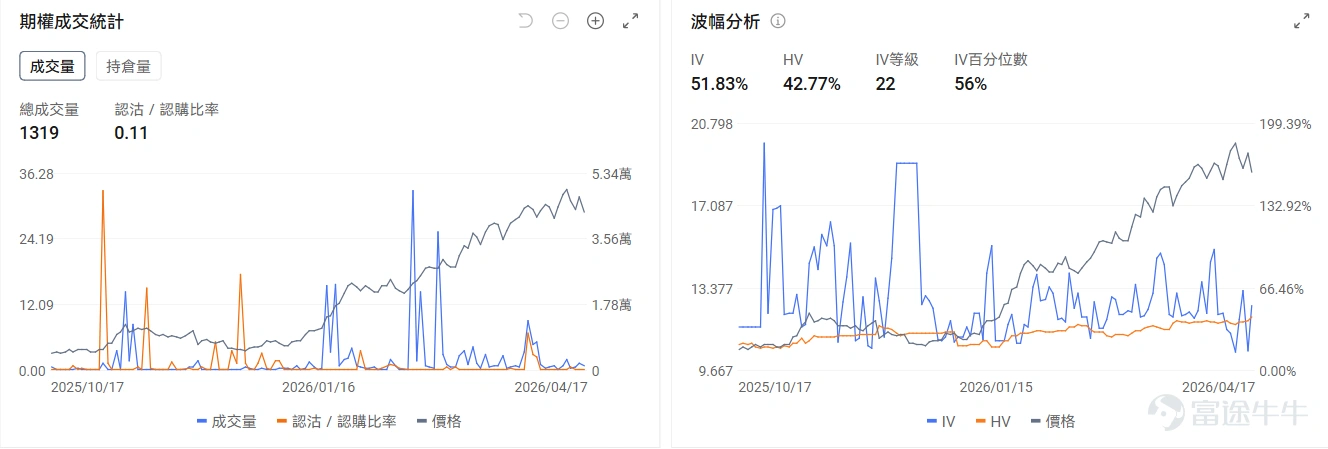
$SanDisk (SNDK.US)$ down 1.41% pre-market, $ASML Holding (ASML.US)$ down -1.35%. SNDK's Put/Call volume ratio is 0.79, with its IV percentile rising to 90%, reflecting market expectations for further stock volatility.
II. Review of yesterday's options market
Index Options
On April 17 Eastern Time, trading volume in the US index options market increased, totaling 8.05 million contracts traded. The put/call trading ratio rose to 0.85.
As the upcoming expiration date approaches,$S&P 500 Index (.SPX.US)$ The distribution of options trading volume showed the following characteristics: peak trading volume for put options occurred at 7,000 points, while for call options it peaked at 7,125 points.
Single Stock Options
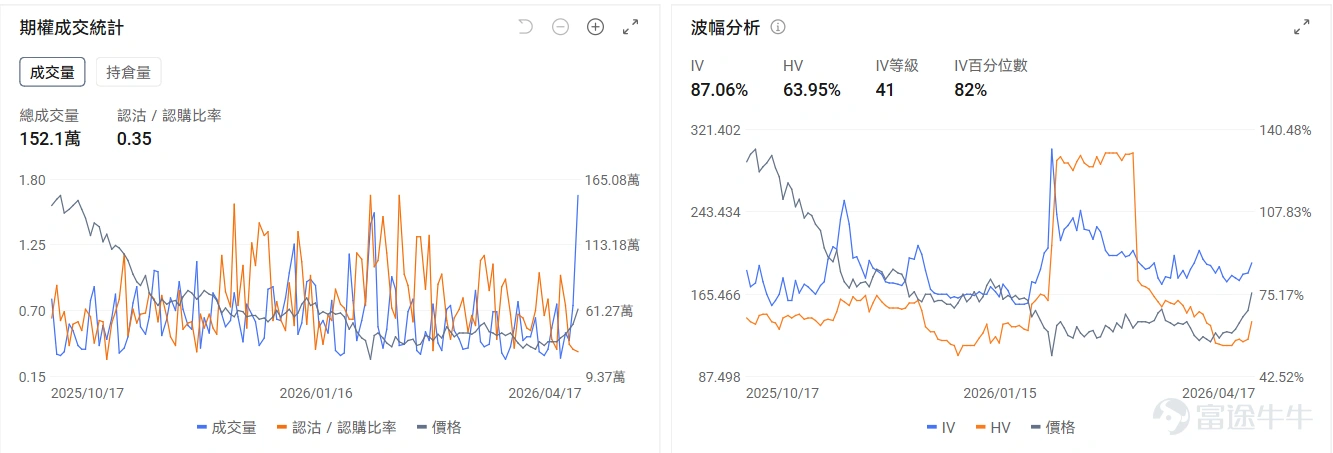
$Strategy (MSTR.US)$Closed up 11.80%, with 1.521 million options contracts traded, and the put/call volume ratio dropped to 0.35. Strategy's share price rose 11.8% as the company announced an additional purchase of $1 billion worth of Bitcoin.
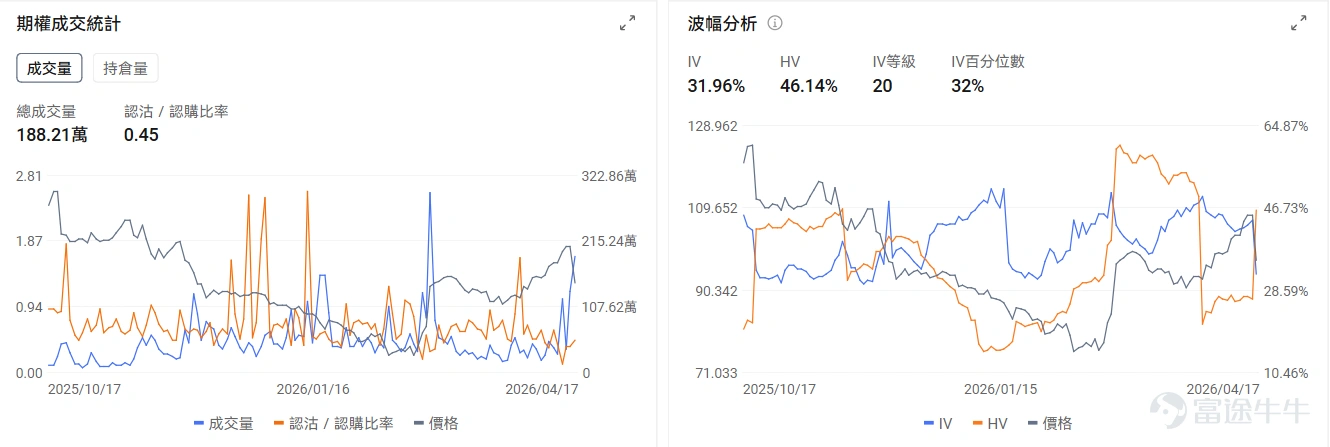
$Netflix (NFLX.US)$Closed down 9.72%, with 1.8821 million options contracts traded, and the put/call volume ratio rose to 0.45. Netflix reported better-than-expected Q1 results but gave weak guidance for Q2, while co-founder Reed Hastings announced his departure from the board.
Top list of options trading volume
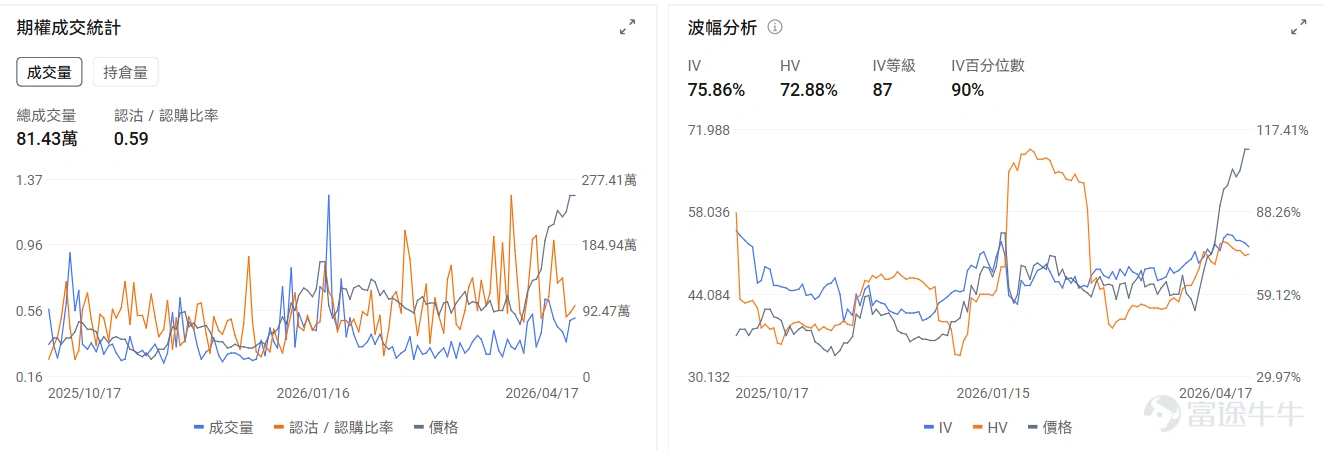
Among the top 10 stocks by options trading volume,$Intel (INTC.US)$The put/call volume ratio reached a high of 0.59. Intel signed a multi-year cooperation agreement with Google and received a target price increase from Bank of America to $48.
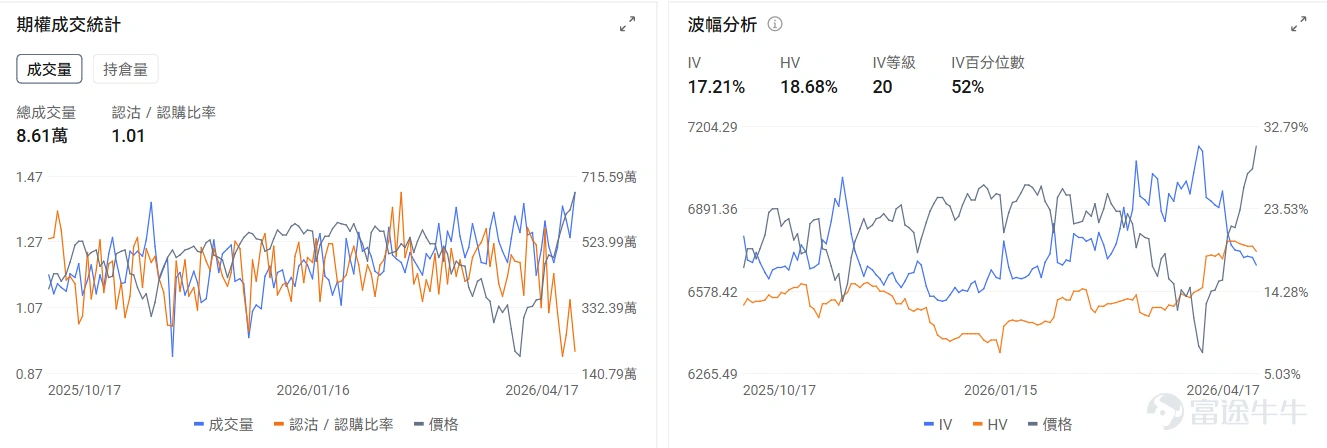
The highest put/call open interest ratio is$Palantir (PLTR.US)$Reaching 1.01. Palantir was selected by the Federal Aviation Administration to bid on a new artificial intelligence air traffic management tool project.
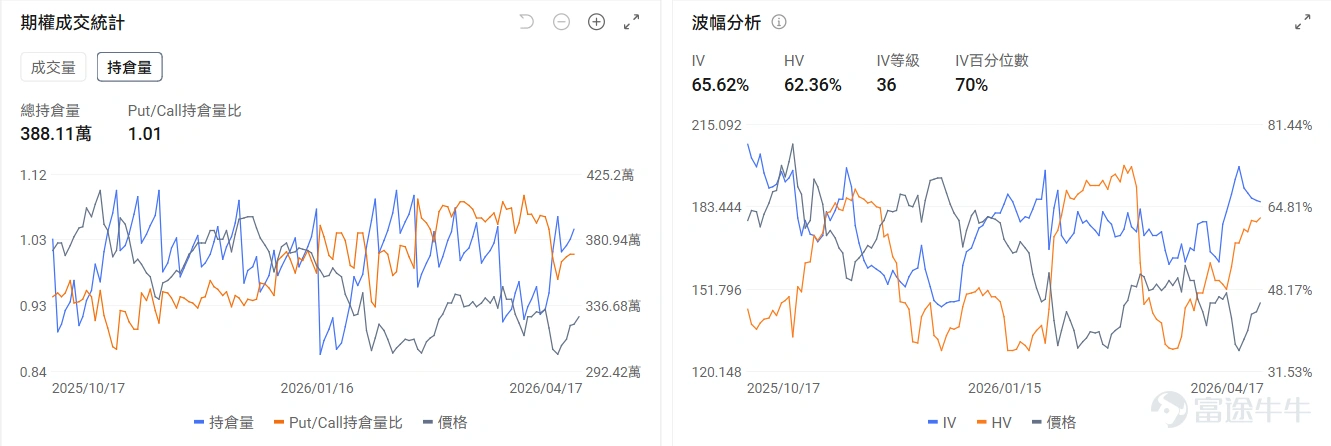
Implied volatility rankings (underlying market cap > $10 billion and options trading volume > 100,000)
$Infleqtion (INFQ.US)$Implied VolatilityThe highest increase, reaching 163.98%, representing a rise of 21.01% from the previous trading day. Infleqtion’s share price surged 26.65% after NVIDIA mentioned the company as a quantum AI model partner during a virtual conference.

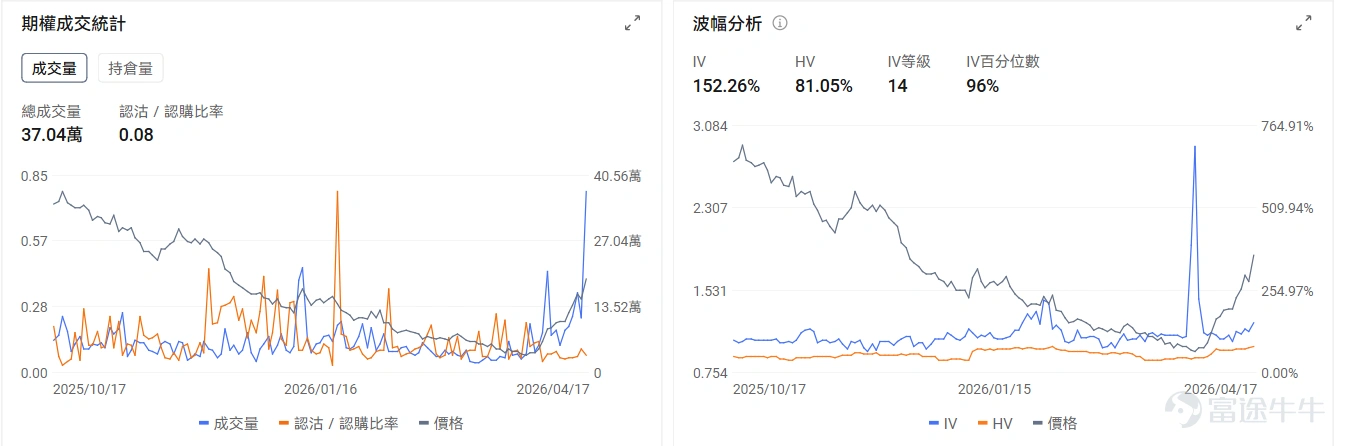
$AMC Entertainment (AMC.US)$Implied volatility increased the most, reaching 152.26%, up 22.46% from the previous trading day. AMC's subsidiary Odeon completed a $425 million term loan, and B. Riley raised its target price from $1.5 to $2.
Risk Warning
An option is a contract that gives the holder the right, but not the obligation, to buy or sell an asset at a fixed price on a specific date or before that date. The price of an option is influenced by various factors, including the current price of the underlying asset, the strike price, time to expiration, and implied volatility.
Implied volatility reflects the market's expectation of the option's volatility over a certain period in the future. It is derived inversely from the BS pricing model of options and is generally considered an indicator of market sentiment. When investors anticipate greater volatility, they may be more willing to pay higher prices for options to hedge risks, resulting in higher implied volatility.
Traders and investors use implied volatility to assessOption priceattractiveness, identify potential mispricings, and manage risk exposure.Disclaimer
This content does not constitute any offer, solicitation, recommendation, opinion, or guarantee of any securities, financial products, or tools. The risk of loss in trading options can be substantial. In some cases, losses may exceed the initial margin deposited. Even if you set contingent orders such as 'stop-loss' or 'limit' orders, these may not prevent losses. Market conditions may make such orders unexecutable. You may be required to deposit additional margin within a short period. If you fail to provide the required amount within the specified time, your open positions may be liquidated. However, you will still be responsible for any shortfall in your account. Therefore, before trading, you should study and understand options and carefully consider whether such trading is suitable for you based on your financial situation and investment objectives. If you trade options, you should be familiar with the procedures for exercising options and the rights and obligations upon exercise and expiration. Options trading carries extremely high risks and is not suitable for all investors. Investors should carefully readCharacteristics and Risks of Standardized Options。
This content does not constitute any offer, solicitation, recommendation, opinion, or guarantee of any securities, financial products, or tools. The risk of loss in trading options can be substantial. In some cases, losses may exceed the initial margin deposited. Even if you set contingent orders such as 'stop-loss' or 'limit' orders, these may not prevent losses. Market conditions may make such orders unexecutable. You may be required to deposit additional margin within a short period. If you fail to provide the required amount within the specified time, your open positions may be liquidated. However, you will still be responsible for any shortfall in your account. Therefore, before trading, you should study and understand options and carefully consider whether such trading is suitable for you based on your financial situation and investment objectives. If you trade options, you should be familiar with the procedures for exercising options and the rights and obligations upon exercise and expiration. Options trading carries extremely high risks and is not suitable for all investors. Investors should carefully readCharacteristics and Risks of Standardized Options。
Risk Disclaimer: The above content only represents the author's view. It does not represent any position or investment advice of Futu. Futu makes no representation or warranty.Read more

Comments
to post a comment
29
5