AI Boom vs. Tight Liquidity: Will the US Stock Rally Continue?

The $100 Options Opportunity Pool | Lesson One on Capitol Hill, Musk's Midterm Exam
Hello fellow investors, welcome to this week's 'Hundred-Dollar Options Play' opportunity pool!
Each week we focus on clear market themes and highlight low-barrier options opportunities worth watching. We don't talk about overnight thousand-fold gains; instead, we analyze the logic, whether it's worth your attention, and where the risks lie.
Market Focus This Week: A Policy Debut and a Tech Scorecard
This week, the focus will shift decisively: from external shocks to internal policies, from event-driven moves to fundamental validation. The core lies in two 'judgments'—
The first trial relates to the source of global liquidity. Kevin Warsh, the Federal Reserve chairman candidate nominated by President Trump, is about to face a congressional hearing. This is not an ordinary personnel process but a crucial "litmus test" for the market regarding the interest rate path in the coming years. Traders have been heavily buying positions betting on a dovish shift by the Fed, with even aggressive bets appearing in the interest rate options market, wagering that rate cuts could happen faster than current expectations. Every word from Warsh during the hearing could reshape the market's judgment on whether rates will remain "higher for longer" or if there will be a "turnaround," directly impacting major indices.
The second trial pertains to the core narrative within the wave of technological advancement. $Tesla (TSLA.US)$ Tesla will release its earnings report after the market closes on April 22. Tesla needs to answer whether the AI-driven future represented by FSD, Robotaxi, and Optimus robots can sustain a trillion-dollar market valuation amid the deliberate contraction of traditional automotive businesses.
This week, we will simultaneously witness a potential inflection point in macroeconomic policy and a landmark tech company validating its role in the broader narrative of the times. Let’s break them down one by one.
SPY & QQQ: The debut of the new Fed leader — a high-stakes poker game
At 22:00 Beijing time on Tuesday evening, Kevin Warsh, the Federal Reserve chairman nominee, will attend a hearing before the Senate Banking Committee.The market is no longer simply trading economic data but has begun preemptively trading the significant event of a "change in Fed leadership." Warsh is widely regarded as a candidate who may be more inclined than current Chairman Powell to respond to White House requests and push for rate cuts.
This hearing will mark Warsh’s first opportunity to systematically present his monetary policy stance before Congress.His statements will directly address the market’s most pressing concern: Will the new Fed leader risk a pivot to stimulate the economy despite persistent inflation?
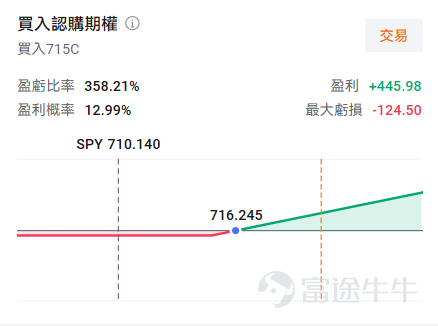
Before the opening, the market had already placed significant bets. Regardless of whether the outcome leans dovish or hawkish, volatility will be substantially released. $SPDR S&P 500 ETF (SPY.US)$ and $Invesco QQQ Trust (QQQ.US)$As a large-cap ETF with excellent liquidity, its daily expiration feature provides investors with flexibility for strategic deployment. Consider options expiring on April 21st for positioning.
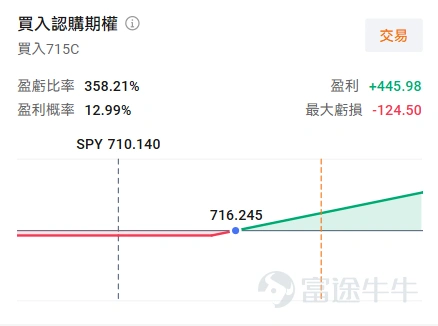
(The design images displayed on the screen are for demonstration purposes only and do not constitute any investment advice or guarantee; market conditions fluctuate frequently, and the option prices shown in the illustration do not represent actual situations. The filtering criterion is options with a unit price around 1 dollar.)
Three possible scenarios -
Scenario A: Clear dovish signal. Wash suggests prioritizing economic growth and financial stability, leaving open the possibility of initiating a rate-cutting cycle sooner. US Treasury yields fall accordingly, while the most interest-rate-sensitive tech stocks (QQQ) and the broader market (SPY) gain upward momentum. Funds that previously flowed out due to expectations of higher rates rapidly return.Corresponding strategy: Buy Calls.
Scenario B: Unexpectedly hawkish. Wash emphasizes that combating inflation remains the top priority, even showing openness to maintaining higher interest rates. The market is forced to reprice for a 'higher for longer' rate environment, pressuring growth stock valuations and causing indices to face downward adjustments.Corresponding strategy: Buy Puts.
Scenario C: Ambiguous. The market oscillates back and forth as it is repeatedly interpreted, with no clear direction, while volatility quickly recedes after events conclude. Whether you bought Calls or Puts, you might end up getting hit from both sides.
Note that this is a typical example of event-driven trading. Before major events, option prices will include a 'volatility premium' – think of it as the 'ticket price' the market charges for upcoming uncertainty. Once the event concludes and uncertainty dissipates, this premium evaporates quickly, potentially causing a sudden drop in option prices. So even if you guessed the direction correctly, if the index doesn't move significantly enough, your options may not be profitable or could even lead to losses. Be sure to think this through in advance.
Tesla: Does the market endorse the shift in narrative from an automaker to an AI company?
Tesla will release its Q1 2026 earnings report shortly after the market closes on April 22. The context of this earnings report is particularly unique: two starkly contrasting narratives are clashing within the same report.
Evidence supporting Tesla as a 'slowing automaker' is accumulating – The recently announced quarterly delivery figures show only a 6% year-over-year increase, and the Model S and Model X are officially entering the countdown to production cessation. If you're solely focused on the 'how many cars were sold' metric, this earnings report is unlikely to impress.
However, the narrative around Tesla being an 'AI company' is accelerating – A new version of autonomous driving software has been pushed to testers, Robotaxi now supports Apple Pay and Google Pay (building commercial infrastructure), and although the Optimus robot has seen slight delays, it can now operate independently. The company continues to push automation and workforce optimization, which could result in unexpectedly strong profitability.
The real catalyst isn’t in the earnings numbers but rather in the earnings call.What Elon Musk needs to deliver isn't a report on car sales figures but rather a clear monetization path and timeline for the AI business.
If the earnings call reveals strong FSD subscription data, clear breakthroughs in Robotaxi deployment, or Optimus securing its first commercial intent — the valuation logic of a 'technology company' will be reinforced, and the stock price could open up new upside potential.
Conversely, if the AI narrative offers no new developments and merely repeats information already known to the market, investors will be disappointed and may revert to measuring Tesla using the yardstick of a 'car company' — making the current valuation appear very expensive. Coupled with weak data from traditional businesses, the stock price could face significant pressure.
Tesla's stock price fluctuations after earnings reports have always been intense, with recent range volatility nearing 20%. However, one thing requires special attention: before the earnings report, Tesla's option prices have already been pushed significantly higher.
Why? Because everyone knows that the earnings report will bring large fluctuations, and this consensus of 'everyone expecting volatility' itself gets priced into the options in advance. Once the earnings report is released and uncertainty dissipates, this premium evaporates rapidly. In simple terms, you bought a ticket for 'expected high volatility,' but the ticket itself has become very expensive — the actual stock price movement must be large enough to cover the cost of your ticket before you can truly profit.The worst-case scenario isn't a sharp rise or fall, but rather an uneventful earnings report leaving the stock price stagnant — in which case, the options you purchased will depreciate quickly.
The price of Tesla's common stock is relatively high, resulting in a higher premium threshold for single options contracts. For traders seeking to participate in its volatility at a lower cost, they can considerthe daily leveraged two-times bull ETF $Direxion Daily TSLA Bull 2X Shares (TSLL.US)$ . This ETF is low-priced, and the cost of its options contracts is also much cheaper than Tesla's common stock (as shown in the figure below, buying one contract only costs a few dozen dollars).However, its specific risks must be carefully considered.:Leveraged ETFs aim to provide twice the daily return, but holding them long-term will result in decay due to daily compounding adjustments, making them unsuitable for long-term investment. Additionally, these products are more volatile on their own.
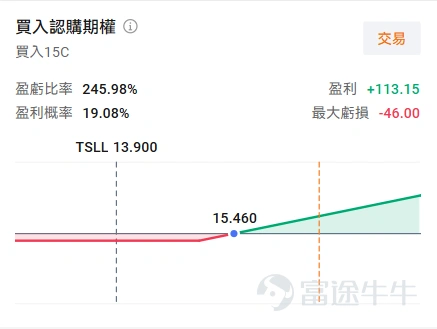
(The design images displayed on the screen are for demonstration purposes only and do not constitute any investment advice or guarantee; market conditions fluctuate frequently, and the option prices shown in the illustration do not represent actual situations. The filtering criterion is options with a unit price around 1 dollar.)
The final key reminder
Options trading is a game of volatility, time, and uncertainty. This week, the uncertainties surrounding two opportunities stem from different dimensions: SPY/QQQ bets on the direction of policy influence, while Tesla's wager is on whether its business model can successfully pivot. However, they share one thing in common — If the market reaction is muted or moves in the opposite direction upon expiration, the options you purchased may expire worthless.
These two themes are not entirely independent either: If Wash’s hearing sends a dovish signal and interest rate expectations decline, it would also benefit high-valuation growth stocks like Tesla. Conversely, if the hearing unexpectedly leans hawkish, even if Tesla delivers decent earnings, its stock price could still be dragged down by the broader market. Fellow investors trading Tesla options should keep an eye on the progress of the hearing.
Always remember:Maximum loss = the full premium you have paid. Think carefully about whether you can afford to lose this money before deciding to take a position.
This week, the new Fed chair will make their debut, and Tesla is set to report earnings. Continuously refine your methodology with results as feedback. See you at the recap!
Finally, here's a small perk for fellow Futubull investors, welcome to claim it.Options Beginner Pack
*This event is exclusive to invited HK users. Click to learn more.Detailed event rules>>
Futu's simulated trading challenge is now open for registration! Zero cost, zero risk, and you could win stock cash vouchers!For more details, click here
Risk WarningAn option is a contract that gives the holder the right, but not the obligation, to buy or sell an asset at a fixed price at any time on or before a specific date. The price of an option is influenced by various factors, including the current price of the underlying asset, the strike price, the time to expiration, and implied volatility. Implied volatility reflects the market's expectation of the option’s volatility over a certain period in the future. It is derived inversely from the Black-Scholes (BS) pricing model and is generally considered an indicator of market sentiment. When investors expect greater volatility, they may be more willing to pay higher prices for options to help hedge risks, leading to higher implied volatility. Traders and investors use implied volatility to evaluate.Option priceattractiveness, identify potential mispricings, and manage risk exposure.
Risk WarningAn option is a contract that gives the holder the right, but not the obligation, to buy or sell an asset at a fixed price at any time on or before a specific date. The price of an option is influenced by various factors, including the current price of the underlying asset, the strike price, the time to expiration, and implied volatility. Implied volatility reflects the market's expectation of the option’s volatility over a certain period in the future. It is derived inversely from the Black-Scholes (BS) pricing model and is generally considered an indicator of market sentiment. When investors expect greater volatility, they may be more willing to pay higher prices for options to help hedge risks, leading to higher implied volatility. Traders and investors use implied volatility to evaluate.Option priceattractiveness, identify potential mispricings, and manage risk exposure.
DisclaimerThis content does not constitute any offer, solicitation, recommendation, opinion, or guarantee of any securities, financial products, or tools. The risk of loss in trading options can be substantial. In some cases, losses may exceed the initial margin deposited. Even if you set contingent orders such as 'stop-loss' or 'limit' orders, these may not prevent losses. Market conditions may make such orders unexecutable. You may be required to deposit additional margin within a short period. If you fail to provide the required amount within the specified time, your open positions may be liquidated. However, you will still be responsible for any shortfall in your account. Therefore, before trading, you should study and understand options and carefully consider whether such trading is suitable for you based on your financial situation and investment objectives. If you trade options, you should be familiar with the procedures for exercising options and the rights and obligations upon exercise and expiration. Options trading carries extremely high risks and is not suitable for all investors. Investors should carefully readCharacteristics and Risks of Standardized Options。
Risk Disclaimer: The above content only represents the author's view. It does not represent any position or investment advice of Futu. Futu makes no representation or warranty.Read more


Comment (1)
to post a comment
8
3