
Tesla's Q1 performance was strong, is it time to take a position?

Earnings Options Strategy | Tesla's Q1 earnings report is here! The major test of transformation from an automaker to an AI giant begins, will it trigger a battle at the $400 mark?
$Tesla (TSLA.US)$ is set to release its Q1 2026 earnings report after the market close on April 22. This is not only a quarterly report card but also a critical validation window for its transformation from a traditional automaker to an AI and robotics technology company.
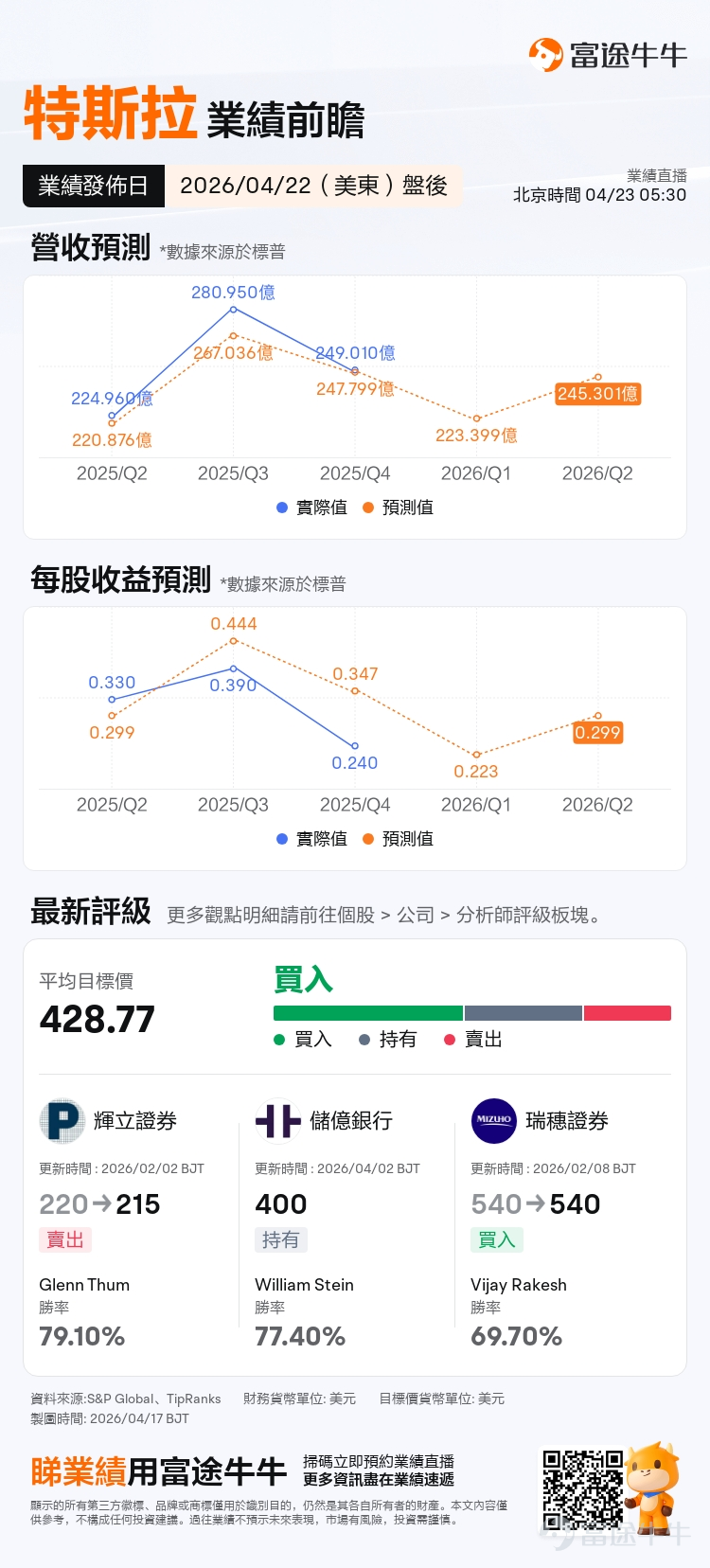
Institutional forecasts expect Tesla's Q1 2026 revenue to reach $22.34 billion,a year-over-year increase of 15.54%,with expected earnings per share of $0.223,an increase of 85.75% year-over-year.(The above data follows the US-GAAP accounting standard.)

I. Pressure on Traditional Business: Both Vehicle Deliveries and Energy Storage Fall Short of Expectations, with Inventory and Gross Margin Becoming Key Focus Points
Automotive Business: The Red Light Is Flashing
Although Tesla’s financial report has not been officially released, preliminary delivery data has already dampened market expectations.Data shows that Tesla's Q1 deliveries were only 358,000 units, marking not only a 14% decline quarter-over-quarter but also falling short of Wall Street's consensus estimate of approximately 370,000 units. Although the Shanghai Gigafactory delivered 213,000 units in Q1, representing a counter-trend year-over-year growth of 23.5%, it was still insufficient to offset the weakness in overall global deliveries.
The decline in delivery figures is mainly attributed to the expiration of U.S. federal tax credits at the end of September 2025, which impacted demand for electric vehicles in the U.S. Additionally, intensified competition in Europe, along with continued market share pressure from traditional automakers and Chinese EV brands, has squeezed Tesla's market space.
More concerning is the issue of inventory buildup. Tesla's production for the quarter reached 408,400 vehicles, creating a 50,000-unit inventory gap compared to deliveries, the highest in four years.Investors will focus on how management plans to reduce inventory through price cuts, promotions, or production adjustments, and whether the gross margin of the automotive business will fall below expectations.Deutsche Bank analysis indicates that after excluding carbon credit revenue, the automotive business gross margin for Q1 is expected to drop from 17.9% in the previous quarter to around 14.7%.
Energy storage deployment fell far short of expectations—was this a short-term fluctuation or a sign of a trend reversal?
The energy storage business has always been a bright spot in Tesla's earnings reports, but energy storage deployment in the first quarter was only 8.8 GWh, significantly lower than the market expectation of 14.4 GWh.Although some Wall Street analysts (such as Deutsche Bank) believe this shortfall is likely due to timing fluctuations in order deliveries and expect sequential improvement in subsequent quarters.
However, the market remains concerned about whether this could signal a reversal of growth trends. During the earnings call, any adjustments to full-year energy storage deployment guidance by management will directly impact valuation expectations for this business.
Secondly, AI and Robotics: Successful tape-out of the AI5 chip, with attention on the mass production progress of Robotaxi and Optimus.
The market's valuation of Tesla is essentially divided into two major parts: the automotive and energy storage businesses form the foundation, while the realization pace of FSD software subscriptions, the Robotaxi network, and the Optimus humanoid robot determines Tesla's valuation elasticity.
On the eve of the earnings report, on April 15, Musk personally announced that the AI5 chip had completed its tape-out, marking a milestone event for Tesla's self-developed AI chips.The chip delivers a single-precision computing power of 2500 TOPS, with performance 40 times higher than the previous generation AI4. It will provide core computing power support for FSD, Robotaxi (Cybercab), and the Optimus humanoid robot.
According to industry norms, after tape-out, a testing and validation period of 12 to 18 months is required. Small-scale trial production is expected by the end of 2026, with mass production slated for mid-2027, directly aligning with the commercialization timelines for Cybercab and Optimus.
In this earnings report, the market will focus on three key AI advancements:
First, the global mileage driven by FSD and the progress of regulatory approvals, which are prerequisites for the deployment of Robotaxi.A recent regulatory breakthrough for FSD in Europe has provided a strong boost. On April 11, the Netherlands announced it was the first to approve the supervised version of FSD for road use, clearing a key obstacle for Tesla’s entry into the EU market.
Second, the progress of Cybercab.Tesla’s new fleet of unmanned taxis is currently operational in Austin, Texas, and San Francisco, but it is difficult to determine how many are fully autonomous and how many are remotely operated. Despite Tesla’s commitment to expanding unmanned taxis to seven new cities, one-third of 2026 has already passed without achieving this goal.

Third, the small-scale mass production timeline and cost targets for Optimus V3.Musk stated that Gen 3 represents the first design iteration aimed at mass production, with the first production line scheduled to launch by the end of 2026. Long-term plans include an annual production capacity of one million units. UBS Group analysts predict that Tesla will produce only 5,000 units by 2027 and 30,000 units by 2030. This earnings report may update the number of internal factory deployments and provide a detailed timeline for mass production of Optimus.
Moreover, the market is also looking forward to Musk revealing some information about SpaceX's IPO. For Tesla investors, the capital diversion pressure from a SpaceX IPO is a real concern.
Third, the 'hidden mine' of earnings season: capital expenditure
During the earnings call in January 2026,Tesla's management indicated that the company's capital expenditure for 2026 is expected to exceed $200 billion.Compared with Tesla's capital expenditure of approximately $85 billion in 2025 and a peak of only $113 billion in 2024, the 2026 spending will be nearly double the historical peak. The $200 billion will primarily be allocated to six new factories, AI computing power, and the Robotaxi/Optimus fleet.
Tesla's balance sheet remains robust. By the end of 2025, the company holds over $440 billion in cash and investments, sufficient to support large-scale capital expenditures.However, Barclays warned that Tesla’s Tetafab and 100GW solar projects were not included in the original capital expenditure guidance. If Q1 capital expenditure rises significantly or the full-year guidance exceeds $200 billion, this could lead to negative free cash flow.
On March 30, TeslaAI's official Weibo account announced the official launch of the Terafab superchip factory project. It was disclosed that the Terafab project plans an annual production capacity of up to 100 to 200 billion advanced AI and memory chips, with a total investment estimated at $200 billion. Bloomberg analysis pointed out that Terafab will undergo a long cycle from construction to full production, raising questions about whether the $200 billion budget will be sufficient.
On the April 22 earnings call, investors will focus on whether the $200 billion capital expenditure guidance remains unchanged, whether Musk will disclose more details about Terafab's capital expenditure and production capacity plans, and how Q1 free cash flow performs.
In addition, as the commercialization of Robotaxi and Optimus is still years away, high capital expenditure will put pressure on short-term free cash flow. If Musk cannot clearly articulate 'when Tesla will start making money through Robotaxi' during this earnings call, the market's tolerance for such massive cash burn may be tested.
4. Analyst Divergence and Technical Analysis
Currently, there is significant divergence among financial institution analysts regarding Tesla's target price.(The target price ranges from $125 to $600, with an average of $428). The core debate remains whether Tesla is a 'pure EV company' or an 'AI revaluation platform.' Currently, approximately 48% of institutional ratings are Buy, 30% are Hold, and 22% are Sell.
After Tesla released its delivery data in early April,JPMorgan reiterated its 'Underweight' rating in a follow-up report, with a target price of just $145.Additionally, several institutions have recently lowered Tesla's target price. Deutsche Bank reduced Tesla's target price from $500 to $465, while TD Securities cut it from $519 to $490.
Barclays raised its target price for the company from $275 to $360.On the other hand, Wedbush remains firmly bullish, steadfastly maintaining a $600 target price.Analyst Dan Ives emphasized that the AI era represents the most important chapter in Tesla's growth story.

From a technical perspective, Tesla's stock price has pulled back from near the $500 high to around $350 before the previous rally began, and has since rebounded above the 60-day moving average.The current stock price is facing a key battle at the $400 level.
From an annual perspective, Tesla's stock price remains down year-to-date, indicating that the medium-term trend has not yet fully reversed.If the stock price can stabilize above $400 and break through $420 with increased volume, it will confirm a medium-term upward trend.Conversely, if the stock falls below $390 after the earnings report, it may retest the previous lows.

V. Options Strategy: How to position for Tesla’s earnings event in a low implied volatility environment?
As of April 17,Tesla's options implied volatility (IV) stands at 50.56%, with the IV percentile at only 24%, which is historically low.Low IV means option prices are relatively cheap, creating a golden window for implementing an “event-driven + volatility” strategy.

1. Single-leg Call
If investors believe that Tesla's earnings report may boost investor confidence and the stock price will continue to rebound, they can buy Call options in advance.However, it is important to control position size and focus on in-the-money options.

(The design images displayed on screen are for illustrative purposes only and do not constitute any investment advice or guarantees; market conditions fluctuate frequently, and the option prices shown do not represent real-world values.)
2. Protective Put
If investors hold Tesla shares and are concerned that the earnings report data might fall short of expectations or fail to provide clear guidance on AI business, leading to a drop in stock price, they can buy corresponding put options to hedge the risk.

(The design images displayed on screen are for illustrative purposes only and do not constitute any investment advice or guarantees; market conditions fluctuate frequently, and the option prices shown do not represent real-world values.)
3、Straddle purchase before earnings + directional position increase after earnings
If investors think that Tesla’s earnings report will trigger fierce bullish-bearish battles, making it hard to predict the direction of the stock price, they can adopt a combination of 'straddle purchase before earnings + directional position increase after earnings.'The straddle strategy before earnings captures significant stock price fluctuations and implied volatility (IV) spikes; after earnings, depending on performance and guidance, switch to a directional strategy (call/put options).

(The design images displayed on screen are for illustrative purposes only and do not constitute any investment advice or guarantees; market conditions fluctuate frequently, and the option prices shown do not represent real-world values.)
For example: using the current stock price of $400 as a benchmark, buy call and put options expiring on April 24 with a strike price of $400. After earnings, if results exceed expectations, increase positions in call options; if traditional business continues to deteriorate and AI guidance falls short of expectations, add positions in put options.
Summary
Tesla’s Q1 earnings report represents a direct clash between its traditional automotive business and AI-driven narratives. In the short term, weak deliveries and energy storage will continue to weigh on valuation; in the long term, progress on the AI5 chip tape-out, Robotaxi, and Optimus mass production will determine whether it can transform from an automaker into an AI technology giant.
 Finally, here's a small perk for fellow investors. Welcome, fellow investors, to claim your benefit.Options Beginner Pack
*This event is exclusive to invited HK users. Click to learn more.Detailed event rules>>
Market conditions are complex and volatile,Options strategyOverwhelmed by choices? Futubull helps you build a portfolio in three steps.Options strategymaking investing simple and efficient from now on!
Options Risk Warning
An option is a contract that grants the holder the right, but not the obligation, to buy or sell an asset at a fixed price on a specific date or at any time before that date. The price of an option is influenced by various factors, including the current price of the underlying asset, the strike price, time to expiration, and implied volatility. Implied volatility reflects the market’s expectations for the level of volatility in the option over a future period. It is a data point derived inversely from the Black-Scholes option pricing model and is generally regarded as an indicator of market sentiment. When investors anticipate greater volatility, they may be more willing to pay a higher price for options to hedge risks, resulting in higher implied volatility. Traders and investors use implied volatility to assess the attractiveness of option prices, identify potential mispricings, and manage risk exposure.
Disclaimer
This content does not constitute any offer, solicitation, recommendation, opinion, or guarantee of any securities, financial products, or tools. The risk of loss in trading options can be substantial. In some cases, losses may exceed the initial margin deposited. Even if you set contingent orders such as 'stop-loss' or 'limit' orders, these may not prevent losses. Market conditions may make such orders unexecutable. You may be required to deposit additional margin within a short period. If you fail to provide the required amount within the specified time, your open positions may be liquidated. However, you will still be responsible for any shortfall in your account. Therefore, before trading, you should study and understand options and carefully consider whether such trading is suitable for you based on your financial situation and investment objectives. If you trade options, you should be familiar with the procedures for exercising options and the rights and obligations upon exercise and expiration. Options trading carries extremely high risks and is not suitable for all investors. Investors should carefully readCharacteristics and Risks of Standardized Options。
Editor/Doris
Risk Disclaimer: The above content only represents the author's view. It does not represent any position or investment advice of Futu. Futu makes no representation or warranty.Read more


Comments (12)
to post a comment
36
86