
Good news from the Middle East! Trump says a U.S.-Iran deal is largely finalized

Grand View · Weekly Interest Rate Analysis | Firing at Sea! The Real Reason Behind the US Stock Market Surge...?
The202606phase
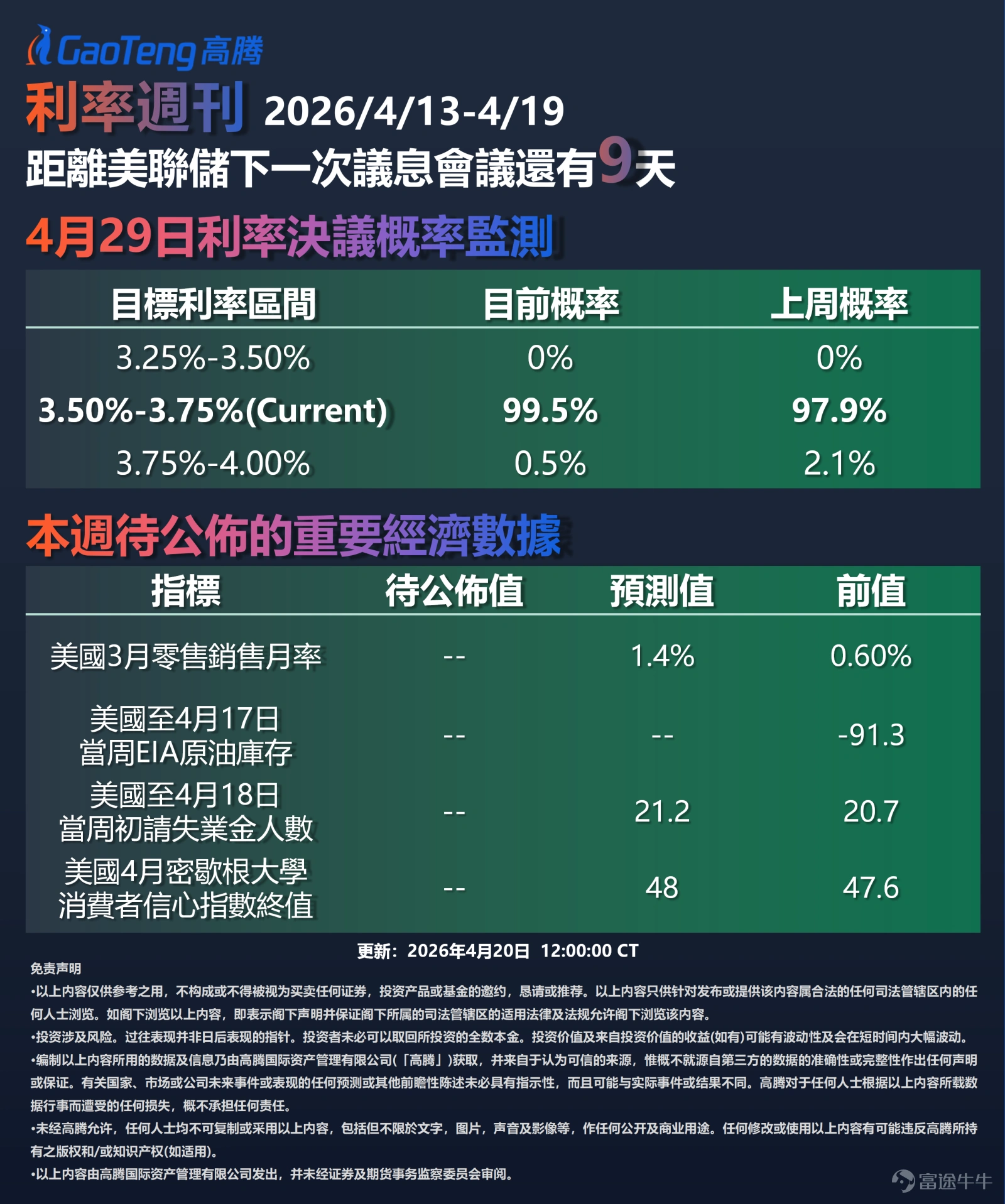
According to CME FedWatch data, there are still9 daysCurrently, the market expects that the probability of maintaining interest rates3.50%-3.75%(Current) Probability of no change is99.5%, raising interest rates to3.75%-4.00%with only a probability of0.5%. Compared to one day ago, the probability of remaining unchanged was99.0%, market expectations remain largely stable; compared to a week ago when the probability of remaining unchanged was97.9%, expectations for the Federal Reserve to maintain the current interest rate range have further strengthened.
The analysis driving the surge in the US stock market is at the end of the article, please read it patiently.
US-Iran Situation: Firing at Sea, Casting Shadow over Negotiations
Last week (April 13–April 19), the US-Iran situation escalated sharply.April 20, the US militaryin the Gulf of Omanseized the Iranian cargo ship "TOUSKA", blowing a hole in the engine room to force it to stop.US President TrumpA social media post stated, "We have completely seized their ship and are checking what’s on board!" The US Marine Corps has taken control of the vessel.
Iran quickly retaliated. A spokesperson for Iran's Armed Forces' Khatam al-Anbiya Central Headquarters said that the US violatedCeasefire agreement, inin the Gulf of Omanfired at an Iranian merchant ship and sent several soldiers onto the deck, paralyzing the ship's navigation system, committing an act of 'maritime plunder.' The Iranian Supreme Joint Military Command later announced that after the US attacked Iranian vessels, the Iranian military also responded withDroneattacks on some US warships.
Regarding the prospects for negotiations, Iran's official news agency IRNA posted on its social media account that‘Iran rejects a second round of talks with the US.’Iranian public opinion believes that under the ongoing USnaval blockade,Trump’s announcement to resume talks is a ‘public opinion war’ aimed at pressuring Iran. The two-week temporary ceasefire between the US, Israel, and Iran will expire on Wednesday morning Beijing time.April 22(Wednesday) morning. Trump stated that his envoy will arrive in Islamabad the day before the end of the two-week ceasefire.Islamabad, but Iran has yet to confirm the dispatch of a negotiating representative.
Chairman of Iran's Parliamentary National Security and Foreign Policy CommitteeEbrahim Azizistated that Iran will never relinquish control overStrait of Hormuzthe crucial waterway, which is an inseparable part of Iran’s national sovereignty and will remain under Tehran's full jurisdiction. The ability to regulate maritime traffic through this waterway is now considered vital for restoring deterrence and maintaining long-term strategic leverage.
Fed Dynamics: Officials Maintain Cautious and Wait-and-See Stance
Last week, Fed officials expressed overall caution, emphasizing that it would be premature to provide interest rate guidance amid current geopolitical uncertainties.Williamsindicated that now is not the time to provide rate guidance. If inflation reaches target levels, rate cuts are still expected. He also mentioned that the Fed is closely monitoring banks’ exposure to private equity risks.
GoolsbeeHe stated that if the US inflation rate is at 4%, no one should think that interest rates should drop back to 2%. He also warned that if US inflation remains high, interest rate cuts might be postponed until after 2026. Although most people expect the Federal Reserve to cut interest rates at least once this year, Chicago Fed President Goolsbee indicated that the longer the conflict in the Middle East persists, the more the Fed’s rate cuts will be delayed.
Federal Reserve Governor Milanhas also shown a subtle shift in stance. SinceTrumphis appointment in September last year to fill the vacancy on the Federal Reserve Board, Milan has been an outlier among his Fed colleagues, consistently advocating for larger and more frequent interest rate cuts. However, recently his position appears to have shifted slightly,moving from 'four rate cuts' to 'three rate cuts'.by 2026 has been fully priced in.
The minutes from the Federal Reserve's March monetary policy meeting revealed that some central bank officials believe the conflict in Iran has brought"two-way risks"—it could either push up inflation or suppress economic growth. At the March 17-18 monetary policy meeting, the Fed announced it would keep the federal funds rate target range steady at 3.5% to 3.75%, marking the second consecutive time rates were left unchanged.
Internal divisions: Persistent hawk-dove tug-of-war leads to divergent policy paths.
Doves:GoolsbeeAlthough warning of inflation risks, still expects the Federal Reserve to cut interest rates at least once this year; the interest rate swap market signals a dovish shift, now pricing in a15-basis-pointTraders currently believe that the probability of the Federal Reserve cutting interest rates before December is approximately60%。
Hawkish:MilanA shift to a more hawkish stance, moving from supporting four rate cuts to three;US President TrumpHas repeatedly expressed that interest rates should be lowered, but the Federal Reserve remains independent.
Key data: US March CPI surged, inflation returns to the '3 era'
Data recently released by the US Bureau of Labor Statistics shows that, driven by soaring oil prices, the US Consumer Price Index (CPI) in March increased by 3.3% year-over-year and 0.9% month-over-month. Market analysts believe that, combined with statements from Federal Reserve officials, anchoring inflation is the Fed’s primary goal, and future policy expectations will heavily depend onUS-Iran talksdevelopments, the sustainability of subsequent energy price increases, changes in inflation expectations, etc.
CITIC SecuritiesThe research report noted that overall inflation in the US in March was significantly pushed higher due to surging oil prices, while core inflation showed moderate growth. It is expected that the risk of secondary inflation in the US is small. April’s CPI may continue to record relatively high growth affected by compensatory increases in rental inflation. If oil prices fall slowly, the year-over-year CPI for the remainder of the year might remain above 3%. This will pose a significant challenge to the Federal Reserve's monetary policy.
Goldman Sachsholds a relatively optimistic view, stating that the inflation shock of 2022 will not be repeated and the Federal Reserve will cut interest rates twice in the second half of the year.Goldman Sachspointed out that although inflation is expected to rise, economic growth will slow, and the unemployment rate will increase slightly, this shock is not enough to trigger a full-blown supply chain crisis, nor will it force the Federal Reserve into a panic rate hike. The rise in unemployment, combined with further improvement in core inflation, should be sufficient to offset the upward pressure brought by energy price transmission, providing strong support for interest rate cuts in September and December.25 basis pointsprovide strong support.
Historical reference: The tug-of-war between geopolitical conflict and Fed policy
Historically, the impact of geopolitical conflicts on Fed policy has usually been short-lived unless it has a lasting effect on inflation and economic growth. After the outbreak of the Russia-Ukraine conflict in 2022, the Fed faced a difficult choice between surging inflation and slowing economic growth, ultimately opting for an aggressive rate hike path. The uniqueness of the current US-Iran conflict lies in its direct impact on the chokepoint of global energy supply –Strait of Hormuz, making the inflation risk more prominent.
When U.S.-Iran tensions escalated in 2020, the Federal Reserve was in a rate-cutting cycle, and geopolitical risks instead reinforced the necessity for easing policies. However, the Fed is currently in a"higher for longer"interest rate environment, and rising energy prices due to geopolitical conflicts could further delay the timing of rate cuts. Investors should pay attention toApril 30the upcoming Fed interest rate meeting, where the Fed will update its economic forecasts and hold a press conference.
progress on the nomination of the Federal Reserve Chair: Kevin Warsh's confirmation hearing is coming up.
The nominee for Federal Reserve Chair, Kevin Warsh,is set to hold his confirmation hearing onOn April 21. According to reports, Warsh has cleared the obstacles hindering his confirmation, and Senator SCOTT stated that he expects Warsh’s nomination to pass. WarshApril 14Submitted detailed financial disclosure documents, with personal assets valued at hundreds of millions of dollars, including investments in several well-known unicorns that are not yet listed. If Wash is elected, he is expected to become the wealthiest leader in the history of the Federal Reserve.
US President TrumpExpressed hope that Wash will be confirmed as the Federal Reserve chairman next week, and stated that he does not intend to abandon the investigation of the current Fed Chairman Powell; if Powell does not resign on time, he will be fired. Democrats on the U.S. Banking Committee said that Wash’s hearing should be postponed.
Market Sentiment Snapshot
Investors are currently in a state of“Restored risk appetite” and “Geopolitical risk concerns”The intertwined state of the market is evident. On one hand, global equities rebounded sharply last week, with the Nasdaq surging 6.84% in a single week, indicating a recovery from previous lows. On the other hand, the unclear prospects of negotiations and the outbreak of hostilities between the US and Iran at sea have heightened geopolitical risks, causing crude oil to gap up 5% last Monday, while gold maintained its strength. Caught between inflation and geopolitical risk, the market is expected to remain highly volatile.
Market Reaction: Restored Risk Appetite, Stock Market Rebounds Sharply
Last week, the global market showed a typical pattern of“Restored risk appetite”—a sharp rebound in the stock market, volatile crude oil ending lower, strong gold performance, and a weaker dollar, showing that after the turbulence earlier, risk aversion sentiment has eased somewhat, but structural differentiation remains clear.
In terms of commodities, on April 20, the U.S. military seized the Iranian cargo ship “TOUSKA” in the Gulf of Oman, and Iran quickly retaliated by announcing drone attacks on U.S. warships. However, behind the tough statement from Iran’s official news agency IRNA that “Iran rejects a second round of talks with the U.S.,” the market has picked up signs of easing—Iran’s president said there was “a necessary willingness to end this war,” and Iran’s foreign minister informed France of progress in negotiations on multiple issues. Meanwhile, shipping through the Strait of Hormuz resumed. Ebrahim Azizi, head of the National Security and Foreign Policy Committee of Iran’s Parliament, stated that Iran would never give up control over the Strait of Hormuz, but the market expects the waterway to remain open, alleviating concerns about global energy supply disruptions, causing significant volatility in the crude oil market. $Crude Oil Futures (JUL6) (CLmain.US)$ Weekly closeUSD 84.00, sharply down5.73%, with a weekly range as high as 22.7%, hitting a low of 78.97 and a high of 96.93. Although it surged toUSD 96.93early in the week, it retreated significantly in the second half. Gold showed strength against the trend, $Gold Futures (JUN6) (GCmain.US)$ closeUSD 4849.4, up1.64%, reaching a weekly high of 4917.7. The fact that gold remained supported despite the rebound in risk assets indicatesThe market has not completely abandoned safe-haven assets。
In the foreign exchange market, $USD (USDindex.FX)$ close98.229, down0.47%, hitting a mid-week low of 97.629. The weakening of the US dollar and the rebound in risk assets showed a typical negative correlation, indicatinga flow of funds from safe-haven assets to risk assets。
In the Asia-Pacific stock markets, South Korea and Taiwan markets showed the strongest resilience. $Korea Composite Index (.KOSPI.KR)$ Surge+5.68%, close6,191.92 points。 $Nikkei 225 (.N225.JP)$Increase+2.73%, close58,475.90 points. The Hong Kong stock market diverged, $Hang Seng Index (800000.HK)$Increase+1.03%, close26,160.33 points; $Hang Seng TECH Index (800700.HK)$ Surge+3.75%, close5,042.68 points, with technology stocks showing significantly better elasticity compared to the broader market.
In the U.S. stock market, previous market panic over AI disrupting traditional software business models was overly exaggerated, causing the sector to experience“extreme emotional suppression”As extreme pessimism receded, investors reassessed the long-term impact of AI on the industry. Meanwhile, CoreWeave announced an $8.5 billion loan facility for building AI infrastructure and received a Moody's A3 investment-grade rating, which is consideredAI 'New Cloud'(Neocloud) a milestone in the field, driving strong gains in growth-oriented technology stocks. $Nasdaq Composite Index (.IXIC.US)$ Surge+6.84%, close24,468.48 points, closing near the week’s highest point. $S&P 500 Index (.SPX.US)$ Surge+4.54%, close7,126.06 points。 $Dow Jones Industrial Average (.DJI.US)$Increase+3.19%, close49,447.43 points。
Other major central bank activities
PBOC: This week, the People's Bank of China conducted a 7-day reverse repo operation worth 5 billion yuan, keeping the interest rate unchanged. Recently, Pan Gongsheng, Party Secretary and Governor of the People’s Bank of China, visited Tsinghua University, where both parties signed a cooperation agreement. They aim to deepen collaboration in cultivating high-level financial talent, conducting major theoretical and policy research on finance, and building platforms for fintech innovation.1.40%Remains unchanged.April 15, the People's Bank of China conducted a 500 billion yuan outright reverse repo operation through fixed-quantity and interest rate tenders with multiple price bids, for a term of six months (183 days).Pan Gongsheng, Governor of the People's Bank of Chinaattended the 53rd International Monetary and Financial Committee meeting and stated that the People’s Bank of China will implement an appropriately loose monetary policy.
European Central Bank: The money market has lowered the probability of a European Central Bank rate hike in April from 15% previously to8%, with markets expecting the ECB deposit rate in December to be at2.43%。Olaf Sleijpen, member of the European Central Bank's Governing Councilbelieves it is reasonable for investors to bet on a rate hike this year. The minutes from the European Central Bank's policy meeting on March 18-19 showed that ECB officials see a weaker euro posing upside risks to inflation.JPMorganThe European Central Bank is expected to raise interest rates in June and September 2026.25 basis points, whereas the previous forecast was for interest rate hikes in April and July.ECB President Christine Lagardeindicated that the European Central Bank shows no inclination to tighten policy.
Bank of Japan:Bank of Japan Governor Kazuo Uedanoted that conflicts in the Middle East bring dual risks of upward inflationary pressure and economic downturn. Rising oil prices will exert upward pressure on core inflation, and appropriate policies will be chosen to achieve the inflation target.Japanese Finance Minister Satsuki Katayamaindicated that in view of the evolution of the Middle East conflict and the potential impact of any interest rate hike on the economy, several central bank governors are inclined to adopt a wait-and-see approach towards monetary policy.Japanese Cabinet Secretary Minoru Kiuchistated that the Bank of Japan is expected to implement appropriate monetary policies to sustainably and steadily achieve its price stability target.
Bank of England:Bank of England Governor Baileyindicated there will be no rush to decide on an interest rate hike. Traders have lowered their expectations for the European Central Bank’s interest rate policy in 2026 and are now pricing in a rate increaseof 56 basis points.。
Risk Disclaimer: The above content only represents the author's view. It does not represent any position or investment advice of Futu. Futu makes no representation or warranty.Read more

Comment (1)
to post a comment
3
1