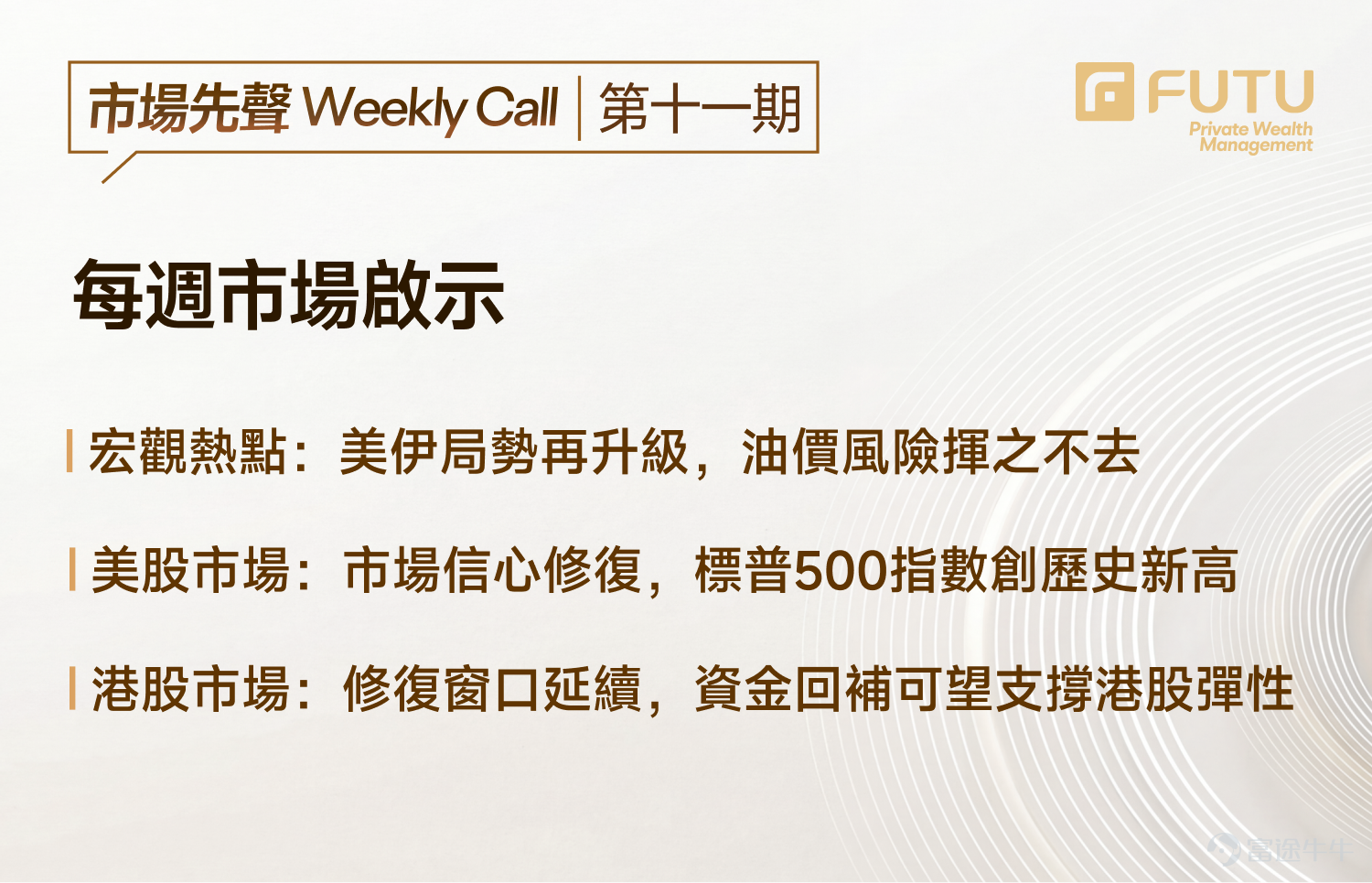

The S&P 500 has risen for seven consecutive weeks—should you chase the rally or take profits?

[Weekly Market Insights] Renewed US-Iran tensions, S&P 500 breaches 7,100 points for the first time, setting a new historical high
![Guide to this week's strategies for the US and Hong Kong markets: Geopolitical situation escalates again; can the US stock market sustain its new highs? The Hang Seng Index continues to rebound, where are the investment opportunities in Hong Kong stocks? Live broadcast scheduled for today at 16:30. Futu Private Wealth Research experts will join you to review this week's market outlook and explore investment opportunities in commercial spaceflight! [Share Link: The trillion-dollar SpaceX IPO is set to explode. How should one position themselves in the commercial aerospace industry chain?] [I. Macroeconomic Observations] 1.1 International Macroeconomic: The situation between the US and Iran escalates again; has the oil price risk not yet passed? On the evening of April 17, Iran's foreign minister stated on social media that given the ceasefire agreement between Lebanon and Israel, the Strait of Hormuz would be fully open to all merchant ships during the ceasefire. However, due to negotiations stalling again on Saturday, Iran attacked tankers once more, leading to the closure of the Strait of Hormuz again. On Friday, based on negotiation news, the US stock market broadly rose, with reduced capital concentration; butAs the situation escalates again, oil prices are expected to jump once more, though the increase is expected to be limited. March PPI increased by 0.5% month-over-month (4.0% year-over-year), with the market median expectation at +1.1%; core PPI (excluding food and energy) increased by 0.1% month-over-month (3.8% year-over-year), with the market median expectation at +0.4% ——All below market expectations。 In March, input costs for US manufacturers continued to rise but at a slower paceReflecting global shortages in some metals and memory chipsExcluding food and energy, domestic consumer goods inflation has moderately slowed, indicating that rising costs are being passed on to end consumer prices...](https://nnqimage.futunn.com/sns_client_feed/988889/20260420/fb777a5a8f0e3954f7a775e6139506f1.png/big?area=1&is_public=true&imageMogr2/ignore-error/1/format/webp)
Guide to this week's strategies for the US and Hong Kong markets:
Geopolitical situation escalates again; can the US stock market sustain its new highs?
The Hang Seng Index continues to rebound, where are the investment opportunities in Hong Kong stocks?
Live broadcast scheduled for today at 16:30. Futu Private Wealth Research experts will join you to review this week's market outlook and explore investment opportunities in commercial spaceflight!
![Guide to this week's strategies for the US and Hong Kong markets: Geopolitical situation escalates again; can the US stock market sustain its new highs? The Hang Seng Index continues to rebound, where are the investment opportunities in Hong Kong stocks? Live broadcast scheduled for today at 16:30. Futu Private Wealth Research experts will join you to review this week's market outlook and explore investment opportunities in commercial spaceflight! [Share Link: The trillion-dollar SpaceX IPO is set to explode. How should one position themselves in the commercial aerospace industry chain?] [I. Macroeconomic Observations] 1.1 International Macroeconomic: The situation between the US and Iran escalates again; has the oil price risk not yet passed? On the evening of April 17, Iran's foreign minister stated on social media that given the ceasefire agreement between Lebanon and Israel, the Strait of Hormuz would be fully open to all merchant ships during the ceasefire. However, due to negotiations stalling again on Saturday, Iran attacked tankers once more, leading to the closure of the Strait of Hormuz again. On Friday, based on negotiation news, the US stock market broadly rose, with reduced capital concentration; butAs the situation escalates again, oil prices are expected to jump once more, though the increase is expected to be limited. March PPI increased by 0.5% month-over-month (4.0% year-over-year), with the market median expectation at +1.1%; core PPI (excluding food and energy) increased by 0.1% month-over-month (3.8% year-over-year), with the market median expectation at +0.4% ——All below market expectations。 In March, input costs for US manufacturers continued to rise but at a slower paceReflecting global shortages in some metals and memory chipsExcluding food and energy, domestic consumer goods inflation has moderately slowed, indicating that rising costs are being passed on to end consumer prices...](https://nnqimage.futunn.com/sns_client_feed/988889/20260420/933c82cd026e73bef1bf73c9e04524fa.png/big?area=1&is_public=true&imageMogr2/ignore-error/1/format/webp)
[I. Macroeconomic Observations]
1.1 International Macroeconomic:
The situation between the US and Iran escalates again; has the oil price risk not yet passed?
On the evening of April 17, Iran's foreign minister stated on social media that given the ceasefire agreement between Lebanon and Israel, the Strait of Hormuz would be fully open to all merchant ships during the ceasefire. However, due to negotiations stalling again on Saturday, Iran attacked tankers once more, leading to the closure of the Strait of Hormuz again. On Friday, based on negotiation news, the US stock market broadly rose, with reduced capital concentration; butAs the situation escalates again, oil prices are expected to jump once more, though the increase is expected to be limited.

Figure 1 Brent Crude Oil Price
March PPI increased by 0.5% month-over-month (4.0% year-over-year), with the market median expectation at +1.1%; core PPI (excluding food and energy) increased by 0.1% month-over-month (3.8% year-over-year), with the market median expectation at +0.4% ——All below market expectations。
In March, input costs for US manufacturers continued to rise but at a slower paceReflecting global shortages in some metals and memory chipsThe core inflation of domestically produced consumer goods, excluding food and energy, showed a mild slowdown, indicating limited pass-through of rising costs to end consumer prices

Figure 2: U.S. March PPI Month-on-Month Data
1.2 Domestic Macroeconomics:
China’s Q1 GDP grew 5.0% year-over-year, are housing prices in first-tier cities showing signs of recovery?
Preliminary calculations show that Q1 GDP grew by 5.0% year-over-year, with nominal GDP growth rebounding significantly more than real GDP. The GDP deflator, which had been negative for 11 consecutive quarters, is expected to turn positive.It can positively incentivize both corporate profits and household consumption.。Exports exceeded expectations.In the first quarter, exports amounted to 6.85 trillion yuan, a year-on-year increase of 11.9%; retail sales were slightly below expectations due to last year's high base, with a year-on-year increase of 2.4% in the first quarter, as car and petroleum product sales contracted simultaneously.
Real estate data was weak in absolute terms, buthome prices in first-tier cities showed marginal recovery,with both new and existing home prices in Beijing and Shanghai rising month-over-month. Early signs suggest the bottoming-out phase for real estate is nearing an end. In March, corporate bonds were the primary driver of aggregate financing, reflecting that current bond issuance rates are more advantageous compared to credit funding costs, leading to a noticeable trend of companies opting for 'bond-for-loan' strategies; M2 increased by 8.5% year-on-year, M1 by 5.1%, while household deposits saw a reduction of 650 billion yuan, indicating a significant weakening of the Spring Festival displacement effect on deposit activation.The probability of further policy easing is increasing.。

Figure 3: National Sales Data for Commodity Housing

Figure 4: Retail Sales Growth by Consumption Type
[Section Two: Market Views]
2.1 US Stock Market
The S&P 500 index hit a record high. Is it a recovery-driven rally or has the positive news run its course?
$S&P 500 Index (.SPX.US)$Up 4.54% for the week,$NASDAQ 100 Index (.NDX.US)$Up 1.52%, marking 13 consecutive trading days of gains, creating one of the longest winning streaks since 1992, and hitting a new all-time high above 7,100 points for the first time.Better-than-expected Q1 earnings from AI and semiconductor sectors, along with the Philadelphia Semiconductor Index hitting a new all-time high, became the core driver behind the Nasdaq’s sustained strength.
The market has swung back from pessimistic scenarios toa baseline scenario where conflicts remain manageable, oil prices rise but not out of control.The key point is that the worst-case war scenario hasn't materialized, but the rapid rebound in indices has already priced in much of the good news. Going forward, the market will focus more on corporate earnings and economic momentum. Despite valuation compression, tech stocks still show upward revisions in profits, making them the main recovery theme. Defense and energy infrastructure will benefit in the medium to long term from geopolitical disturbances and increased capital expenditures on energy security. US interest rates remain relatively high, meaning US stocks are likely to see sector-specific strength rather than broad-based gains going forward; maintaining a cautiously optimistic stance.
Initial jobless claims in early April stood at 207,000 people, lower than the expected range of 213,000-215,000, indicating resilience in the labor market and core inflation that hasn't spread, suppressing fears of further rate hikes. The forward 12-month P/E ratio for the S&P 500 was 21.35 (as of April 16), corresponding toprojected earnings growth of +15% for the S&P 500 and +28% for the Nasdaq by 2026.

Figure 5: S&P 500 Forward 12-Month P/E Ratio
Focus Stocks—$Grab Holdings (GRAB.US)$:The core competitiveness lies in the ability to monetize synergies across transportation, delivery, payments, credit, and merchant tools in the Southeast Asian market.Currently, about two-thirds of users utilize two or more services, significantly enhancing user lifetime value while reducing standalone customer acquisition costs. Over 90% of order dispatching and ride-hailing operations are completed by AI, which is now extending into merchant-facing and risk-control domains, including Merchant Assistant, store operation analysis, and credit underwriting optimization. This continues to drive down fulfillment costs and improve dispatch efficiency.
Management provided clear guidance with revenue CAGR projected at 20% from 2025 to 2028, targeting EBITDA of $1.5 billion by 2028 and a free cash flow conversion rate of 80%. The company announced a new $500 million stock repurchase plan, bringing the total authorized repurchases to $1 billion upon completion.This signals that management has greater confidence in future cash flows and views the current share price as attractive.

Figure 6: GRAB Valuation Reference
2.2 Hong Kong Stock Market
The Hang Seng Index rose by 3.09%, extending the recovery window for Hong Kong stocks. Where are the investment opportunities?
The Hang Seng Index gained 3.09% for the week, with an average daily turnover of HKD 237 billion. Southbound trading via Stock Connect recorded cumulative net inflows of HKD 25.7 billion. On April 14, sectors such as durable consumer goods, semiconductors, non-ferrous metals, and real estate led gains. On April 15, innovative pharmaceuticals outperformed, while large-cap tech stocks broadly advanced, reflecting both growth and oversold rebounds.Micro liquidity showed marginal improvement. From April 9 to April 15, 2026, active foreign capital recorded net outflows of $10.1 million, while passive foreign capital saw net inflows of $806.5 million.
Hong Kong stocks are expected to remain volatile in the short term, with a bias towards bullishness. April to May remains within a recovery window. Improved risk appetite supports the upside potential for Hong Kong equities, but overseas liquidity remains tight and oil prices sticky, limiting upward movement due to pressure on the denominator side.In terms of allocation, prioritize technology internet (AI computing power/export-driven repricing), innovative drugs, semiconductors, and airlines benefiting from falling oil prices and increased travel during the May Day holiday, while using high dividend yields as a hedge against volatility.
The Hang Seng Index's forward 12-month P/E ratio is 11.52 (as of April 17), which remains attractive in valuation terms.

Figure 7: Hang Seng Index Forward 12-Month P/E Ratio
Focus Stocks —$COSCO SHIP ENGY (01138.HK)$:The main focus is whether the VLCC freight rate can stay at a high level. On April 10, 2026, the VLCC TD3C-TCE reached $450,000/day, and the average TCE for Q1 2026 was approximately $151,000/day, a year-on-year increase of 332%.Several institutions have raised their forecasts for the company’s net profit attributable to shareholders in 2026 to between RMB 11 billion and RMB 15.8 billion.
Effective new additions on the supply side are extremely low — only about 6, 23, and -2 new VLCCs will be added in 2026-2028, corresponding to growth rates of 0.7%, 2.5%, and -0.2%. Effective supply is far from as relaxed as static delivery figures suggest. Domestic crude shipping revenue in 2025 is RMB 5.457 billion, with COA coverage of approximately 90%; LNG segment revenue is RMB 2.547 billion, with domestic and LNG operations providing a stable safety net for the company, avoiding the sharp earnings drop seen in pure spot crude shipping companies.
Export trade determines elasticity; domestic trade and LNG determine the safety net; supply-side dynamics determine cycle sustainability; geopolitical and structural changes determine the upward trajectory.

Figure 8: COSCO Shipping Energy Valuation
[III. Focus for This Week]
![Guide to this week's strategies for the US and Hong Kong markets: Geopolitical situation escalates again; can the US stock market sustain its new highs? The Hang Seng Index continues to rebound, where are the investment opportunities in Hong Kong stocks? Live broadcast scheduled for today at 16:30. Futu Private Wealth Research experts will join you to review this week's market outlook and explore investment opportunities in commercial spaceflight! [Share Link: The trillion-dollar SpaceX IPO is set to explode. How should one position themselves in the commercial aerospace industry chain?] [I. Macroeconomic Observations] 1.1 International Macroeconomic: The situation between the US and Iran escalates again; has the oil price risk not yet passed? On the evening of April 17, Iran's foreign minister stated on social media that given the ceasefire agreement between Lebanon and Israel, the Strait of Hormuz would be fully open to all merchant ships during the ceasefire. However, due to negotiations stalling again on Saturday, Iran attacked tankers once more, leading to the closure of the Strait of Hormuz again. On Friday, based on negotiation news, the US stock market broadly rose, with reduced capital concentration; butAs the situation escalates again, oil prices are expected to jump once more, though the increase is expected to be limited. March PPI increased by 0.5% month-over-month (4.0% year-over-year), with the market median expectation at +1.1%; core PPI (excluding food and energy) increased by 0.1% month-over-month (3.8% year-over-year), with the market median expectation at +0.4% ——All below market expectations。 In March, input costs for US manufacturers continued to rise but at a slower paceReflecting global shortages in some metals and memory chipsExcluding food and energy, domestic consumer goods inflation has moderately slowed, indicating that rising costs are being passed on to end consumer prices...](https://nnqimage.futunn.com/sns_client_feed/988889/20260420/cabb0701fb4a1c0da39b9dde040f2c28.png/big?area=1&is_public=true&imageMogr2/ignore-error/1/format/webp)
[4. Major bank views]
US Stock Summary:The market has swung back from a pessimistic scenario to one where the conflict is deemed manageable, with subsequent focus shifting more towards earnings and sector momentum. After experiencing valuation compression, tech stocks continue to see upward revisions in profits, remaining the key recovery driver; this trend is unlikely to end in the short term. Following the easing of geopolitical tensions, the loss of safe-haven buying support for the US dollar, and the potential policy shift by the new Fed leadership in the second half of the year, global markets are expected to outperform the US market. The S&P 500’s earnings growth for 2026 is projected at approximately 15%, with the technology sector at about 28%.The earnings floor continues to support large-cap tech, sustaining a structurally strong pattern.
Hong Kong Stock Summary:Hong Kong stocks are expected to remain range-bound with a slight upward bias in the near term. April to May still represents a recovery window. Priority in allocation should be given to technology and internet, innovative pharmaceuticals, semiconductors, and sectors benefiting from falling oil prices/stronger RMB and increased travel during the May Day holiday, such as airlines. High-dividend stocks can serve as a hedge against volatility. Overall, China's economic activity remains orderly, with Qingming consumption data showing resilience to external shocks.Recommended barbell strategy: on one side, high-quality growth targets like AI computing power and overseas expansion; on the other, high-dividend defensive assets, balancing both flexibility and stability.
![Guide to this week's strategies for the US and Hong Kong markets: Geopolitical situation escalates again; can the US stock market sustain its new highs? The Hang Seng Index continues to rebound, where are the investment opportunities in Hong Kong stocks? Live broadcast scheduled for today at 16:30. Futu Private Wealth Research experts will join you to review this week's market outlook and explore investment opportunities in commercial spaceflight! [Share Link: The trillion-dollar SpaceX IPO is set to explode. How should one position themselves in the commercial aerospace industry chain?] [I. Macroeconomic Observations] 1.1 International Macroeconomic: The situation between the US and Iran escalates again; has the oil price risk not yet passed? On the evening of April 17, Iran's foreign minister stated on social media that given the ceasefire agreement between Lebanon and Israel, the Strait of Hormuz would be fully open to all merchant ships during the ceasefire. However, due to negotiations stalling again on Saturday, Iran attacked tankers once more, leading to the closure of the Strait of Hormuz again. On Friday, based on negotiation news, the US stock market broadly rose, with reduced capital concentration; butAs the situation escalates again, oil prices are expected to jump once more, though the increase is expected to be limited. March PPI increased by 0.5% month-over-month (4.0% year-over-year), with the market median expectation at +1.1%; core PPI (excluding food and energy) increased by 0.1% month-over-month (3.8% year-over-year), with the market median expectation at +0.4% ——All below market expectations。 In March, input costs for US manufacturers continued to rise but at a slower paceReflecting global shortages in some metals and memory chipsExcluding food and energy, domestic consumer goods inflation has moderately slowed, indicating that rising costs are being passed on to end consumer prices...](https://nnqimage.futunn.com/sns_client_feed/988889/20260420/05bbadaba6c3100eab08c1c6209bfe2a.jpg/big?area=1&is_public=true&imageMogr2/ignore-error/1/format/webp)
Risk Disclaimer: The above content only represents the author's view. It does not represent any position or investment advice of Futu. Futu makes no representation or warranty.Read more

Comments
to post a comment
1
3