
Hallways remain uncleaned as some residential property management companies have withdrawn for over six years: Profitless enterprises retreat, bidding farewell to 'toxic' scale
Source of this article: Era Finance, Author: Liang Zhengyu
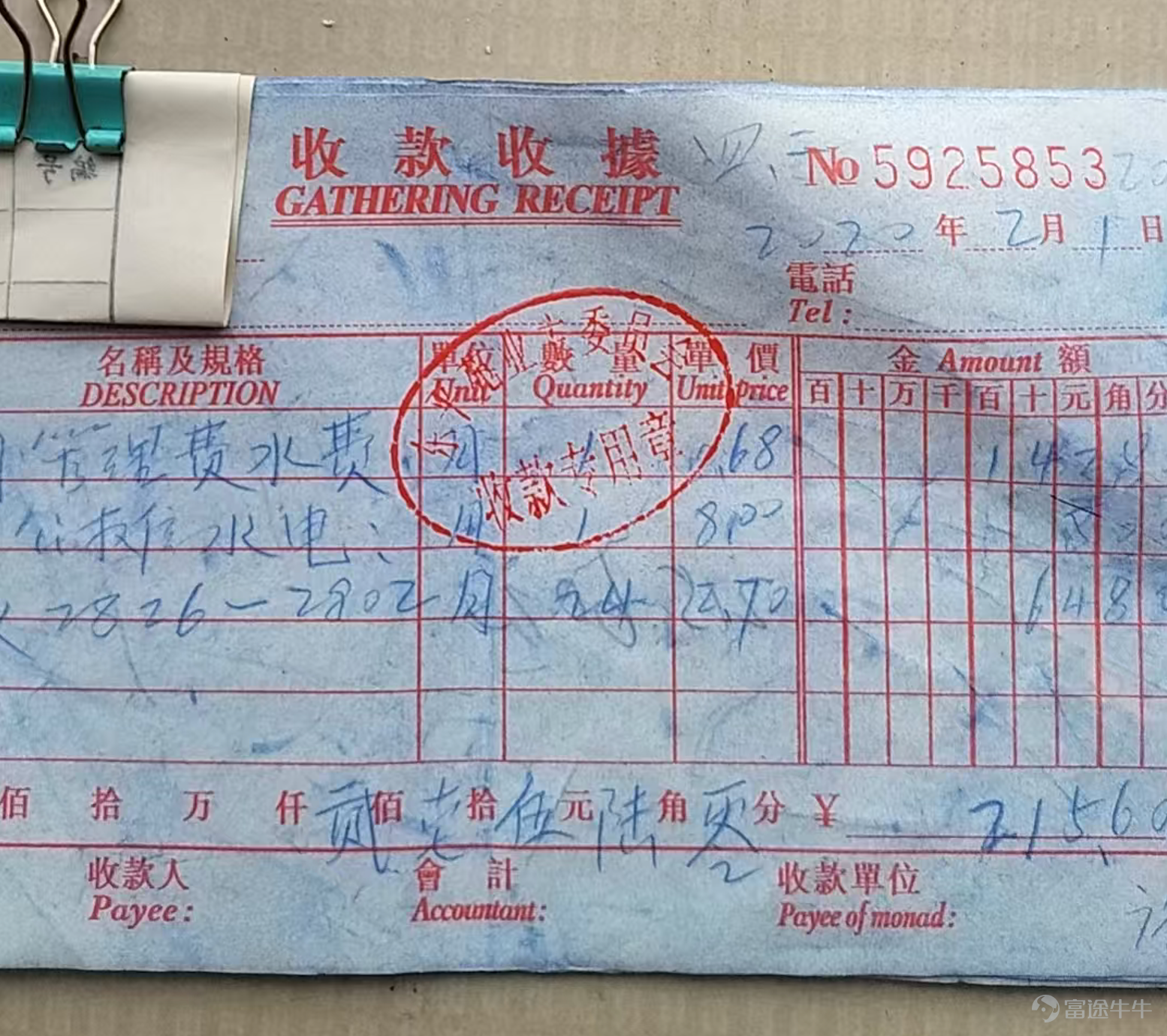
2,269 days have passed, and Ms. Yang still keeps the receipt for her last property management fee payment, dated February 1, 2020.
The light blue handwriting on the receipt is fading. Along with the ink, the community of Dongping Garden that the receipt represents is also 'fading' away.
Due to the difficulty of having community oversight replace professional services, over the six years without property management, Dongping Garden gradually descended into a state of disorder—garbage piled up at the entrance awaiting removal, hallways were left uncleaned, and fallen leaves accumulated. The lack of access control allowed outside vehicles to occupy parking spaces freely.
Dongping Garden, located in Panyu, Guangzhou, is a self-built residential compound originally constructed for employees, comprising over 300 households, with residents moving in by 2003. As the original unit employees sold their homes and moved out, the managing entity withdrew, and some homeowners consistently failed to pay property fees, leading the original property management company to eventually exit due to unsustainable operations.
Ms. Yang told Times Finance that the property management fee at Dongping Garden was 0.68 yuan per square meter per month at the time.

The receipt Ms. Yang has kept to this day, photo provided by the interviewee.
The situation at Dongping Garden is not an isolated case. According to CRIC data, by 2025, there will be 173 property management withdrawal projects nationwide, with 64.7% being voluntary exits. A report from the China Index Academy also shows that between 2024 and 2025, the voluntary withdrawal rate of managed projects by the top 50 property management companies increased by 37% year-on-year, with residential projects accounting for over 80%.
Property management companies are beginning to voluntarily exit projects, even breaking the old logic of not withdrawing from projects associated with real estate developers.
“A decade ago, Vanke Property took over a project developed by a leading real estate company in Shenzhen. At the time, I was shocked that its subsidiary property management could abandon a project developed by an affiliated real estate company,” recalled Zhu Baolian, chairman of Spacecom, in his 2025 Letter to Shareholders.
But last year, Vanke Property made its first exit from a project developed by an affiliate in Tianjin. 'This marks a breakthrough of the historical internal red line,' Zhu Baolian said.
After the property management withdraws, who will take over these communities? Property companies that once relied on scale expansion will need to figure out how to maintain growth amid liquidation and contraction.
Homeowners are dissatisfied with the services, making it difficult for property management to collect fees
The property management has already dismissed the security guards. Now food delivery riders can enter and exit the community freely, and no one has cleaned the area near our doorsteps for a long time,” said Wu Yue (pseudonym), an owner at One Place Harmony Mansion.
In 11 days, this community will also enter a state without property management. Wu Yue told Times Finance that the property manager announced in the homeowner’s group that since operating income can no longer cover the necessary costs for basic services, and the project has been in serious losses for a long time, Vanke Property decided to officially withdraw on April 30.

The lobby at the base of Wu Yue's building, photo provided by the interviewee.
One Place Harmony Mansion is located in Jinhua, Zhejiang. It was handed over in 2023, with a property management fee of 3 yuan per square meter per month. “For our small county, this property fee is relatively expensive,” Wu Yue said.
The property management company also has its own difficulties. Vanke Property, which is responsible for the community’s property services, stated that 'since moving in, the project’s income and expenditures have been severely unbalanced, and despite taking various measures, operations remain unsustainable.'
Times Finance learned that due to unresolved decoration issues causing dissatisfaction among homeowners, it ultimately resulted in refusal to pay property fees. According to information Wu Yue received from the property manager, the collection rate for property fees at One Place Harmony Mansion last year was less than 50%.
Difficulty in collecting fees is a common problem faced by the property management industry and is also one of the reasons why property companies proactively withdraw from sites.
In the past two years, many regions have introduced guideline prices for property fees, imposing restrictions on initial pricing and increases. Meanwhile, some homeowners, expecting prices to drop or services to improve, choose to delay or even refuse payment.
A homeowner in Wuxi posted on social media frankly stating: 'A property management fee of 2.5 yuan per square meter per month has resulted in a mess of services — clogged public pipes left unattended, non-transparent public energy consumption data, and improperly issued invoices. I’m not refusing to pay the property management fee; I’m refusing to pay for services that don’t match the cost.'
On the other hand, as sales slow down, the number of unsold properties held by developers increases, and the accumulated unpaid property fees from a large number of vacant homes gradually build up into substantial accounts receivable, with some projects reaching millions of dollars. This portion of accounts receivable often eventually turns into bad debt.
Zhu Baowei remarked directly, 'Should we take on a project if over 30% of the units in a newly delivered community remain unsold?'
Data shows that the average collection rate of property service companies nationwide has declined for four consecutive years, dropping to 71% in 2025. Among them, listed property companies are at approximately 78%, while small and medium-sized property companies generally fall below 65%, with some projects even falling below 50%.
'Decisively exit,' the trend of withdrawing from property projects is spreading.
While revenue is under pressure, costs remain highly rigid.
Data disclosed by Yuexiu Services indicates that its basic property management gross margin fell by 3.7 percentage points year-on-year to 11.3%, mainly dragged down by rising labor costs.
Declining profits combined with bad debt risks have led listed property service companies to start exiting unprofitable projects.
At the earnings conference in March this year, He Shuhua, Chief Operating Officer of Vanke Property, clearly stated that the company had established a special task force to manage loss-making existing projects, improving operations through flexible pricing, and would decisively exit any projects that could not be turned around.
Similar logic has already formed a consensus within more property management firms.
The management of Country Garden Services stated that they would not easily give up any loss-making project, but those that are difficult to turn around will be actively phased out. Last year, about 1% of projects were exited.
In 2025, the area of projects reaching contract expiration or being withdrawn by China Overseas Property will reach 55.6 million square meters, a year-on-year increase of 25%. China Resources Mixc Life has withdrawn some projects from entities such as Nantong Changle Property, Runyue Nantong, and Runyue Xiamen. Yongsheng Services exited more than 200 projects. 'These projects are assessed as being of poor quality, with weak foundational conditions and high operational difficulty, not aligning with the company’s current strategic layout,' said Lin Zhubo, President of Yongsheng Services.
Overall, in 2025, the total managed area of 50 listed property management companies disclosing their managed areas is approximately 7.51 billion square meters, representing a year-on-year growth of 5.3%, with the growth rate declining by 1.4 percentage points compared to the previous year. By comparison, this indicator was once as high as 49.2% in 2021.

Image source: Pexels
'The current withdrawal of property management projects is essentially the result of corporate strategic adjustments,' said Yang Xi, founder of Zhongwu Think Tank. Whether state-owned enterprises or market-oriented companies like Greentown, Longfor, and Vanke, they have shifted from scale orientation to profitability orientation. The key criterion for judgment now is whether the project possesses sustainable profitability.
A deeper contradiction lies in the long-term undervaluation of the hidden value of property services.
'Owners often focus on visible experiences like the attitude of security guards and cleaning frequency, but the more essential function of property management is the long-term maintenance of the building structure and facilities.' Yang Xi pointed out that the upkeep of critical facilities such as elevators and fire systems directly affects asset longevity and safety, but these values are difficult to perceive immediately.
This also means that while the exit of property management may bring short-term cost reductions, in the long run, the absence of maintenance could lead to higher overall costs.
'This is fundamentally a process of market education,' said Yang Xi. As some communities fall into governance difficulties after property withdrawals, homeowners may gradually come to recognize the true value of property services.
Who will take over?
After the withdrawal of property services, the real problems are just beginning.
Zeng Yi (pseudonym) has worked for many years at a branded property management company in East China. Recently, his company took over a 'withdrawn' project.
This residential community is located in Hangzhou, with a total construction area of approximately 120,000 square meters and fewer than a thousand households. Due to disagreements between the homeowners and the former property management company over fee standards, the latter exited midway through last year. Under the coordination of the local subdistrict office, the community was temporarily managed by a small local property management company. After months of negotiations, Zeng Yi's company finally took over.
In fact, for leading property management companies, a community with fewer than a thousand households does not qualify as a high-quality asset. This also means that similar communities may take longer to find a new management company, during which time homeowners might have to endure a disordered environment.
Zeng Yi stated that when evaluating whether to take over a property, the core consideration is whether the financials make sense. The evaluation focuses on basic conditions such as managed area, number of households, current collection rate, and equipment status, while also assessing the revenue potential of public spaces like advertising spots. If the project size is moderate, the collection rate relatively stable, and the hardware condition acceptable with controllable maintenance costs, then there will be more room for improvement and companies will be more willing to enter.
But even after screening, the collection rate remains an unavoidable challenge. 'We have an internal saying: relying on “moving the homeowners” to pay property fees,' Zeng Yi admitted frankly.
To improve the collection rate, property management companies are trying new methods.
Vanke Property launched a 'flexible pricing' initiative at the end of 2024, attempting to break down property services into quantifiable service lists accompanied by cost breakdowns, allowing homeowners to understand where their money is being spent.
Take the Four Seasons Flower City in Laishan District, Yantai, Shandong, as an example. Promoted by the local subdistrict and community, Four Seasons Flower City introduced Vanke Property at the beginning of this year, adopting a homeowner-driven 'customizable menu' service model, dividing services into baseline services and optional services. Homeowners select the content and adjust the frequency based on actual needs, ultimately forming a customized plan covering six major categories and over 300 items.
Yang Xi believes that the core of this model lies in transparency and joint participation. In the past, service standards were unilaterally set by property management companies, but now they are negotiated between both parties, improving homeowners’ understanding of the service content and providing a basis for subsequent supervision and evaluation.
Beyond mid-to-high-end projects, property management companies have also started exploring viable paths for low-fee scenarios.
By the end of 2025, Country Garden Services launched its proprietary brand 'Joyful Hundred Families,' targeting older communities, with projects implemented in cities like Shanghai, Beijing, Shenzhen, and Wuhan.
"Yuebaijia is an exclusive operation model targeting products with low property management fees." Zhao Jiajie, General Manager of the Operations Management Center at Country Garden Services, introduced that this model adheres to low prices and universal benefits, focusing on ensuring basic services such as security, fire protection, and elevator maintenance.

Image source: Pexels
Zeng Yi's company is exploring regionalized management - by integrating multiple surrounding old or low-fee communities under the unified operation of a single property management company, rigid costs like labor can be distributed through economies of scale. "When a single community is small in scale, companies often struggle to cover costs. However, if regionalized operations are formed, the overall financials can work out."
Rejecting 'toxic' scale
The deeper significance of the wave of property management withdrawals lies in changes to industry rules.
Over the past decade, the core logic of the property management industry has been scale expansion, competing on managed area, contracted area, and growth rates. Now, this logic is becoming obsolete.
"The scale competition is coming to an end; the next phase will focus on output per project and project quality." A report from CRI Intelligence pointed out that both managed area and contracted area growth rates have slowed to single digits, indicating that the industry has completely moved away from the previous era of rapid scale expansion dependent on parent company support, officially entering an era of deep cultivation of existing stock.
Against this backdrop, companies' expansion strategies have rapidly tightened.
Cric pointed out that property companies are not refraining from taking on projects but are rejecting 'toxic' scale. Within their core markets after contraction, companies’ growth strategies emphasize quality above all else.
Property enterprises generally impose stricter financial and risk control constraints, such as setting clear gross margin bottom lines and upper limits for collection cycles, only acquiring projects under the premise of ensuring no losses and maintaining cash flow.
This shift is also reflected in regional layouts.
In 2025, the average managed area per city for 23 listed property management companies that disclosed data reached 1.687 million square meters, a year-on-year increase of 6.5%. While continuing to exit inefficient projects, companies are concentrating resources in high-tier cities, reducing costs and amplifying scale effects by increasing single-city management density.
The anxiety over growth has not disappeared. Yang Xi pointed out that due to the contraction in the new housing market, the overall revenue growth rate of the property management industry has dropped to about 4%, with external momentum significantly weakening. However, structural opportunities remain: on one hand, by taking over quality projects after market consolidation to increase market share; on the other hand, accelerating expansion into high value-added areas such as facilities management and asset operations, while leveraging technology to cut costs and improve efficiency.
Property enterprises are extending their business reach into non-residential fields.
In 2025, China Overseas Property signed new contracts worth 5.24 billion yuan, of which non-residential projects accounted for 3.13 billion yuan, representing 68.4% of the managed area. Newly added projects include commercial formats such as the Nanjing ZTE Yuhua Park, public construction formats like Central South University and Beijing Language University, as well as urban service formats such as the integrated sanitation project in the western area of Dongli District, Tianjin. Over the past year, Country Garden Services achieved nearly 2.5 billion yuan in revenue from six major market-oriented strategic businesses including integrated marketing, home retailing, and liquor, contributing the majority of its value-added income, with an annualized growth rate reaching 40% or even 100%.
When property management companies start selecting residential communities, those communities also passively enter a more brutal screening process. But it's not just the communities being screened. Zhu Baowei believes that the current property management market competition is in a 'Warring States Era,' and the number of companies will decrease from hundreds of thousands to tens of thousands in the future.
Not all communities can remain on the receiving end of services, and not all property management companies can stay in business to provide those services. Property management will eventually evolve from a scale-driven business to one centered around value and trust.
Risk Disclaimer: The above content only represents the author's view. It does not represent any position or investment advice of Futu. Futu makes no representation or warranty.Read more

Comments
to post a comment
6
1