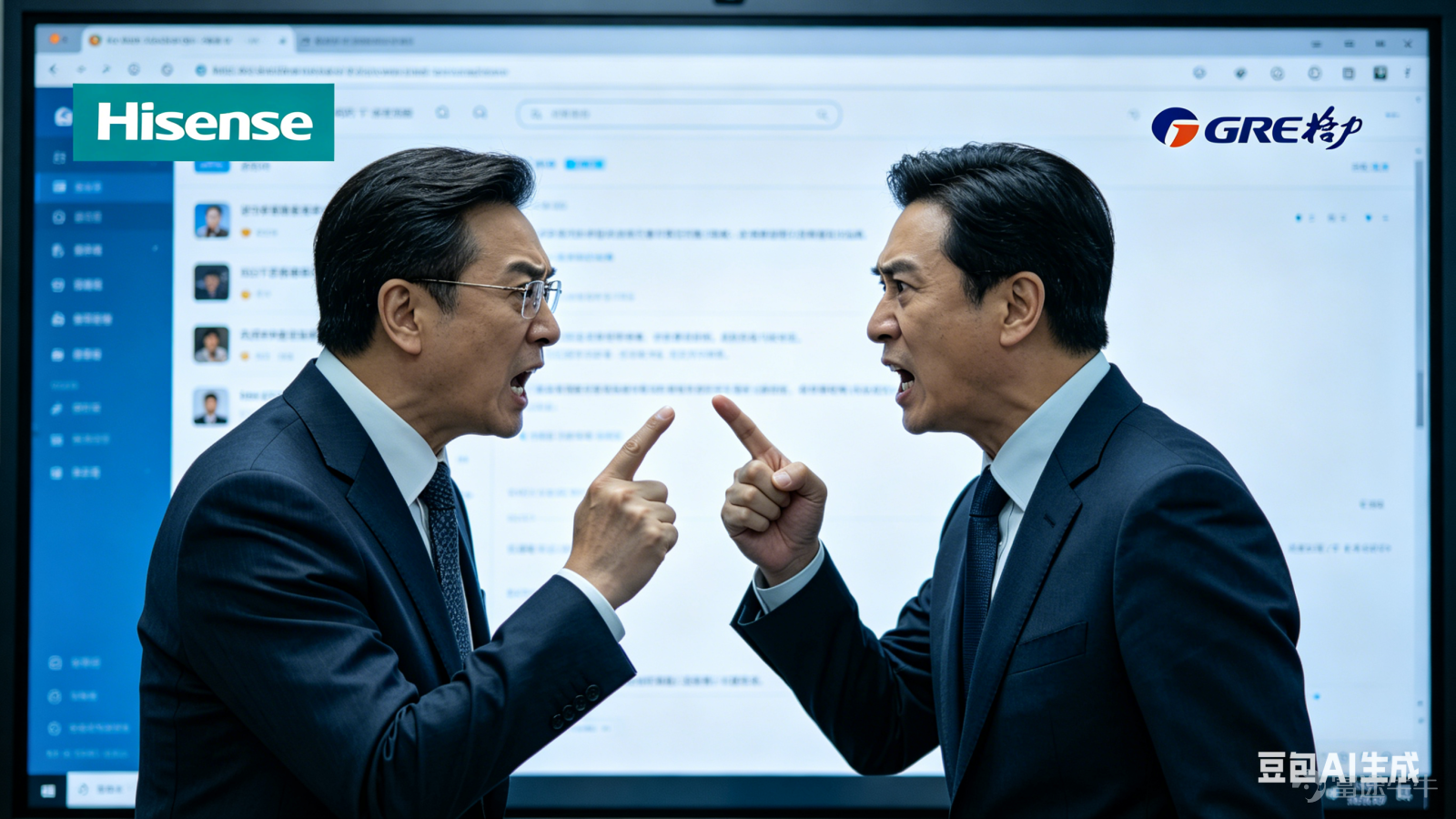

Behind the online feud between Hisense and Gree, the 'golden age' of air conditioners is gone for good

The air conditioner market, which has already fallen into stagnation, has re-entered the public eye due to an online feud.
On April 14, Zhu Lei, marketing director of Gree Electric Appliances, angrily accused on Weibo that during the Shanghai Home Appliance Expo, Hisense Air Conditioner blatantly plagiarized Gree's original phrase 'Real Copper, Real Quality' for promotional purposes. Zhu Lei believed that 'Real Copper, Real Quality by Gree' had been widely disseminated across the country through CCTV reports, making it a household name. More importantly, this is not just an advertising slogan or a concept but a complete standard.
Subsequently, Yang Xiangxi, the brand director of Hisense Air Conditioning's Air Division, retorted that 'genuine copper materials' do not belong to any single company. He also posted Gree's application form to join the 'Air Conditioning Aluminum Strengthening Application Research Working Group,' accusing Gree of being hypocritical.

After both sides exchanged verbal blows, the latest development was on April 15th when Zhu Lei posted five Weibo messages in the middle of the night questioning Yang Xiangxi: 'Can you guarantee that all your home air conditioning products use copper tube heat exchangers and copper coil motors? If so, then genuine copper materials welcomes you.' At the same time, Zhu Lei stated that he would leave this question for the other party and temporarily refrain from responding further.
However, Yang Xiangxi did not continue to respond on Weibo but instead moved to WeChat video posts, releasing three videos in response.
In Hisense's air conditioning production workshop, Yang Xiangxi used on-site footage to prove that Hisense Air Conditioner's claim of 'genuine copper materials' is true. On the evening of April 16th, Yang Xiangxi also presented new evidence — 'A teardown of Gree's (certain model) 5-horsepower air conditioner revealed the use of aluminum coil motors.'
As of now, Gree has not responded further, and the verbal spat between the two sides has temporarily come to an end. However, following the controversy, the cost challenges and market competition looming over the air conditioning industry are intensifying.
Reviewing this 'online exchange' between Hisense and Gree, the focus of the dispute was whether 'genuine copper materials' originated with Gree.
Regarding the issue of originality of 'genuine copper materials,' Gree's executive Zhu Lei stated that if 'genuine copper materials' were promoted by Hisense first, Gree would never have used this phrase as a slogan for promotion. However, before Gree applied the phrase 'genuine copper materials made by Gree' across all media platforms, no other home appliance company was seen using this phrase for promotion.
At the same time, Zhu Lei noted that 'brand communication is a creative process; it’s not about how simple or complex the words are, but who effectively conveys them and creates a meaningful impression.' Therefore, Zhu Lei believes that Hisense Air Conditioning's promotion of 'genuine copper materials' plagiarized Gree's idea.
In response to Gree executive Zhu Lei's accusations, Hisense executive Yang Xiangxi publicly stated that as early as 2016, media reports showed home appliance companies promoting the concept of 'genuine copper materials,' including Hisense, Changhong, and Skyworth, but not Gree. It remains inconclusive who plagiarized the concept of 'genuine copper materials.'
"The four characters 'genuine copper and real material' do not belong to Ge or Zhu, but to all Chinese people," emphasized Yang Xiangxi.
Some legal professionals also indicated to the author that 'genuine copper and real material' is merely a four-character phrase, which is overly brief. In judicial practice, such extremely short advertising slogans usually lack the necessary expressiveness and originality, making it difficult to be recognized as a 'work' under copyright law, and thus are not protected by copyright law.
At the same time, 'genuine copper and real material' directly describes the feature of air conditioning products 'using real copper materials.' This phrase belongs to a direct descriptive term for the main raw materials and quality of the product, with very weak inherent distinctiveness. According to the Trademark Law, marks that only directly indicate characteristics such as the main raw materials of the goods cannot, in principle, be registered as trademarks.
In addition to the controversy over the originality of the 'genuine copper and real material' promotion, another focus of Hisense and Gree's ongoing mutual accusations is whose air conditioners are genuinely 'genuine copper and real material,' and whose are 'copper instead of aluminum,' deceiving users.
In the certificates released by Hisense, it clearly states that only the two components use copper tubing, the connecting tube uses copper tubing, but there is no mention of the compressor motor and fan motor. So, does the winding of the two motors in Hisense air conditioners use copper? Aluminum? Or partly copper and partly aluminum? And if so, which parts use copper and which parts use aluminum?
Zhu Lei stated that 'genuine copper and real material' means copper tubing for the evaporator and condenser, copper windings for the fan motor, and copper windings for the compressor motor. Gree's adherence to 'genuine copper and real material' is to uphold the bottom line for consumers. If Gree didn't do this, aluminum products could flood the market at any moment.
Subsequently, in Yang Xiangxi's response video, the production workshop of Hisense air conditioners showed that both the evaporator and condenser used internally threaded copper tubing. However, Yang Xiangxi did not show in the video the actual materials used in the fan motor and compressor motor windings of Hisense air conditioners.

Meanwhile, Yang Xiangxi also released a new video stating that Gree had promised consumers: Gree has no aluminum-wound motor air conditioning products on the Chinese market. However, a blogger previously found an aluminum-wound motor in a disassembled 5-horsepower Gree air conditioner (a certain model).
As of now, Gree has not responded to this matter.
In fact, the so-called "aluminum for copper" in the air conditioning industry actually refers to a technical route promoted by the industry to address the high price of copper. This involves attempts to partially replace copper with aluminum through structural design, material modification, and process upgrades.
Copper is a core raw material for air conditioners, accounting for about 20% of the cost. Throughout 2025, the price of copper increased by more than 34%, rising from about 73,830 yuan per ton at the beginning of the year to approximately 99,180 yuan per ton by the end of the year. The main copper contract on the Shanghai Futures Exchange even surged by over 40%. This directly exacerbated cost pressures in the air conditioning industry, causing widespread pressure on the industry's gross profit margins.
In comparison, the annual increase of the main aluminum contract on the Shanghai Futures Exchange was approximately 15%. The absolute price difference between spot copper and aluminum reached 77,000 yuan per ton, with the price of copper being about 4.06 times that of aluminum. The significant price gap between copper and aluminum, as well as their disparate increases, has also been an important driver of changes in the technical route of the air conditioning industry.
To control costs, since 2025, 19 companies including Midea, Haier, Hisense, and Xiaomi have jointly advocated for the promotion of "aluminum for copper" technology applications. Gree, however, became the only leading air conditioner brand to refuse participation. However, an "Application Form for Membership in the Air Conditioner Aluminum Reinforcement Application Research Working Group" shows that on March 27, 2025, Gree proactively applied to join the "aluminum for copper" working group.
"Gree’s participation in research and not in the joint 'aluminum for copper' initiative by 19 companies are two completely different matters."
Zhu Lei stated that as an industry player, participating in new material research is part of the job. Based on long-term research conclusions, President Dong (Dong Mingzhu) clearly stated: 'Aluminum replacing copper isn’t impossible, but we cannot guarantee that after substitution, our quality requirements will still be met, so we won’t use it.'
The public spat between Hisense and Gree briefly spiked the real-world attention on the air conditioning industry, but its future remains uncertain.
In 2025, the air conditioning industry exhibited the typical characteristic of "volume increase but revenue decrease": sales grew under policy stimulus (76.043 million units, a year-on-year increase of 4.7%), but fierce price wars resulted in retail revenue failing to rise correspondingly (235.66 billion yuan, a year-on-year decrease of 0.4%). This led to clear divergence in corporate revenue and profit performance.
Among them, Hisense’s HVAC revenue in 2025 was 38.829 billion yuan, a year-on-year decrease of 3.61%, with a gross margin of 27.43%, down 1.12 percentage points year-on-year; Gree’s consumer appliance business (primarily air conditioners) generated revenue of 76.279 billion yuan in the first half of 2025, representing a year-on-year decrease of 5.09%.
During the overall market downturn, Xiaomi has become the biggest variable.
In 2025, Xiaomi's air conditioner sales exceeded 8.5 million units, a year-on-year increase of 24%, setting a new historical record and becoming the fastest-growing category in Xiaomi's home appliance lineup. The IoT segment, where Xiaomi's air conditioners belong, achieved an annual revenue of 123.2 billion yuan, representing an 18.3% year-on-year growth; its gross margin was 23.1%, improving by 2.8 percentage points year-on-year, reaching another all-time high.
In terms of market share, full-channel data for 2025 shows that Midea (approximately 29%), Gree (approximately 17%), and Haier (approximately 15%) remain in the top three, but Xiaomi (approximately 10%) is closely following behind, emerging as the largest growth variable. Xiaomi's launch of the 'entry-level' air conditioner directly lowered the industry average price, forcing traditional brands to follow suit with price cuts, plunging the industry into fierce competition characterized by 'trading price for volume'.
Xiaomi Group President Lu Weibing has publicly stated his goal: by 2030, Xiaomi's air conditioning business aims to rank among the top two in the Chinese market. This signals that over the next five years, competition at the forefront of the industry will intensify even further.
AVC also noted that while government subsidies have driven retail volume growth in the air conditioning industry, the overall scale remained flat due to price wars, with the industry average price hitting its lowest point in the past five years. The combination of slowing growth and falling prices reflects the industry’s entry into the deep waters of a saturated market, where price competition has become white-hot and market polarization is worsening.
How long will the price war in the air conditioning industry continue, and whether there will be a turning point after industry growth stalls remains uncertain. In the intense battle of存量competition, these questions will prove far more brutal and specific than any 'heated debate' over materials.(By Tech Observer, Author Rao Xiangyu, Editor Yang Lin)
Risk Disclaimer: The above content only represents the author's view. It does not represent any position or investment advice of Futu. Futu makes no representation or warranty.Read more

Comments
to post a comment
2