
Kimi's problem is not with its competitors, but with its starting point
(The author of this article is Lueda Reference, published by Titanium Media with authorization)
By Luede Reference, Author: Ermao
A typical entrepreneur's halo is forming around Yang Zhilin.
The industry looks up to technology, and he stands on stage talking about reasoning, agents, and AI-led R&D in the coming years; the market looks down at products, and Kimi has quickly rolled out a series of new features over the past few months: KimiCode, capable of writing documents, creating PPTs, processing spreadsheets, and coding; Kimi Claw, able to automatically scrape web information; Deep Research, for in-depth data retrieval; and Agent Swarm, enabling multiple AIs to collaborate on complex tasks.
It’s easy for outsiders to draw a smooth conclusion: MoonSide (hereinafter referred to as MoonDark) is transitioning from a star model company into a next-generation productivity platform company.
This judgment isn’t wrong, just incomplete.
Because when Kimi no longer settles for being just a 'question-answering' model but instead aims to become an 'execution platform for knowledge work,' it truly enters a track where technical breakthroughs alone won’t guarantee an easy win. There aren't just a few large model companies standing in the way, but a whole lineup of giants who already control developer portals, office entry points, and enterprise workflows.
And Kimi’s challenge lies not only in strong competitors but also in the fact that it is almost simultaneously handling two extremely resource-intensive tasks: strengthening its foundational capabilities to handle complex work while competing for the front-end entrance to knowledge work.
Others either already have the entrance or start by climbing up from the capability layer, whereas Kimi seems to have pushed itself to the forefront battlefield before fully establishing its foundation. This path requires immense capital intensity, and the speed at which competitive moats form might not match the rate of cash burn.
Yang Zhilin excels at steering direction, but the success or failure of a company depends not only on direction but also on whether one can synchronize technology, product, growth, and commercialization with the same rhythm.
The former resembles the intuition of a genius, while the latter falls within the homework of an entrepreneur. Rather than saying Yang Zhilin has already provided a complete answer, it’s more accurate to sayhe is now approaching the hardest part of this problem.
In March 2026, on the main stage of NVIDIA's GTC conference in Las Vegas, Yang Zhilin sat alongside the heads of OpenAI and DeepMind. This is the standard group photo of top AI professionals globally, but Yang Zhilin's identity tag is slightly different from others—He is the only representative from an independent large model venture, while the rest are project leaders under tech giants.
When this photo was circulated domestically, the valuation of MoonShot had just broken through 18 billion USD, quadrupling in three months, setting one of the fastest records for a Chinese company to become a 'decacorn' (referring to unlisted startups valued at over 10 billion USD).
However, its status may soon change again: not long ago, Bloomberg reported that MoonShot had begun preliminary discussions with CICC and Goldman Sachs regarding a potential IPO in Hong Kong. With Zhipu and MiniMax in the spotlight earlier, it’s easy for outsiders to cast this kind of light onto MoonShot when it comes to its IPO journey.
This is almost a natural extension of the entrepreneurial halo surrounding Yang Zhilin.
Among this generation of AI entrepreneurs in China, Yang Zhilin is one of the few who cannot be discussed solely within a domestic context. Moreover, on key issues determining the upper limits of large model companies, MoonShot can no longer be compared merely within the local landscape.
ZhenFund, as one of MoonShot’s early investment institutions, has its managing partner Dai Yusen openly expressing his recognition of Yang Zhilin. In an article, he revealed that Yang Zhilin was publicly regarded as the 'god among gods' during his time at Tsinghua University. Such sentiment isn’t entirely superfluous in understanding Yang Zhilin.
Yang Zhilin's academic foundation seems almost pre-laid for the era of large models:
In 2015, he graduated from the Computer Science Department of Tsinghua University and later entered Carnegie Mellon University’s Language Technologies Institute with the highest grades in his year. Over the next four years, he consistently appeared in the author lists of top AI conferences such as ICML, NeurIPS, and ICLR, entering the global core academic evaluation system at a very early stage.
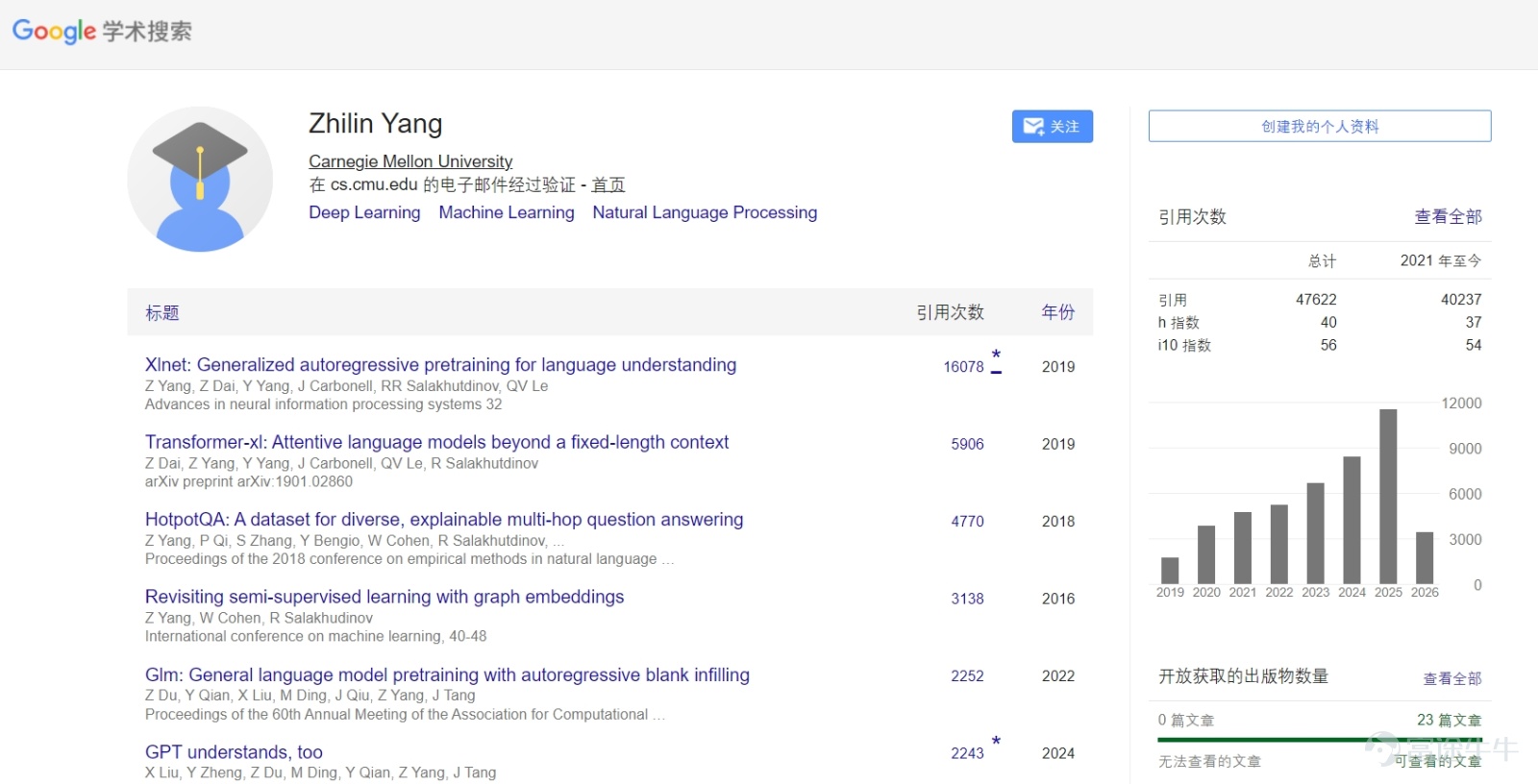
More importantly, it's not just about 'having published a few good papers.' As the first author or co-first author, he proposed Transformer-XL and XLNet, which remain indispensable names in the history of pre-trained model development. The former advanced long-text modeling capabilities significantly, while the latter is an unavoidable milestone in the field of pre-trained models, directly influencing the subsequent technical roadmap of the GPT series.

In 2019, he became one of the youngest area chairs in ACL (Association for Computational Linguistics, a top international academic organization) history. Before founding MoonShot, he worked at Google Brain and FAIR (Meta’s Fundamental AI Research Institute), showcasing both the sharpness of a theoretical researcher and the engineering acumen honed in top industrial labs — such experience is uncommon domestically.
Because of this, when outsiders evaluate MoonShot, they often talk not only about capability but also a harder-to-quantify quality. Perhaps the evaluation by Ji Yichao, chief scientist of Manus, on Kimi, can summarize it:
“Kimi, as a company, has relatively good taste.”
Taste, or “taste,” has been frequently mentioned in the venture capital circle in recent years and is often considered the only moat for AI companies. In March 2026, The New Yorker even wrote directly: “taste” has become Silicon Valley's new buzzword, with a popularity akin to “disruption” in the 2010s.
In Ji Yichao’s view, the embodiment of taste lies in a company’s evaluation metrics or internal benchmarks. “Because your internal measurement criteria, whether for model benchmarking or for people, essentially determine the direction that the company and its products should take.”
One prominent characteristic of Yang Zhilin is thathe seems not to be satisfied with simply ‘scoring high on others’ questions’ but always wants to confirm first: Is the question itself properly formulated?
The vast majority of public benchmarks in the industry are fundamentally defined by humans, and there are often issues with insufficient or ineffective benchmarks.
“Currently, there aren’t many benchmarks available for agents, and when you see a score on a benchmark, more often than not, it does not reflect the agent's actual capability, and can even be quite one-sided. I think this is a problem everyone needs to address.” In an episode of Zhang Xiaojun’s Business Talk podcast, Yang Zhilin revealed this current state of the industry.
However, many companies, in order to boost their scores, only focus on specific scenarios to facilitate press releases for various purposes. But that doesn't reflect the model's true performance capabilities. In more OOD (Out-of-Distribution, simply understood as 'out-of-scope') scenarios, the user experience can become significantly worse.
In light of this, the Yuean team internally developed a benchmark that is closer to real-world tasks.
For example, in the code direction of K2.5, rather than just looking at public leaderboards, they designed the Kimi Code Bench to measure tasks like build, debug, refactor, and test, which are closer to actual software engineering. In office scenarios, they specifically created the AI Office Benchmark and General Agent Benchmark to assess the quality of Office outputs and how well multi-step workflows are completed.

At a deeper level, during the training of K2.5 Agent Swarm, its reward mechanism isn't just about the appearance of involving more agents. It deliberately avoids two situations: many agents still working in sequence, or forcing parallelism by creating a bunch of ineffective steps that actually slow down overall progress.
This is almost the concrete version of Ji Yichao’s statement: the benchmark you use will shape the product you train. Yuean didn’t create a set of functions first and then retroactively find explanations for them. On the contrary,it first decides what capabilities are worth measuring, and the product grows outward along these metrics.
However, such an approach also implies higher R&D costs, slower product iteration, and higher demands on the consistent delivery of underlying model capabilities.
In fact, this continues Yang Zhilin's past style.
Whether it was Transformer-XL or the later XLNet, he didn’t just push a little further along existing paths. The former aimed to address why models tend to forget or fail to connect when dealing with longer information, while the latter bypassed some inherent flaws in the mainstream pre-training approach at the time, essentially rewriting the problem itself.
The commonality between these two works is that neither stayed within the established framework to make incremental improvements; instead, they directly challenged the premises that the industry had tacitly accepted at the time.
This is Yang Zhilin. He seems to never be content with merely accelerating on an existing track, butalways questions first: Should the starting point, rules, and boundaries of this track be redrawn from the beginning?
During his entrepreneurial phase, this habit of 'defining the problem first, then applying technology' became even more concrete.
As early as 2023, when Kimi entered the public eye with its ultra-long text capabilities, Yang Zhilin valued not just 'the ability to contain more content,' but something more fundamental: As information grows and tasks become longer, can the model still maintain coherence and continue progressing?
Looking back today, what Kimi displays on its homepage is no longer just a dialogue box, but a series of capability modules like Docs, Slides, Sheets, Deep Research, Kimi Code, Kimi Claw, Agent Swarm. On the surface, it appears that the product range is expanding; looking deeper, they are all addressing the same question:
The true value of a model isn’t about delivering a single impressive response at a given moment, but whether it can handle extended and increasingly complex tasks without faltering throughout the entire process.

A product aiming for this level of performance would find it hard to remain in the position of a mere 'chat assistant.' Instead, it will gradually be pushed into heavier roles: an entry point, control center, or even execution platform for knowledge work.
However, as Kimi shifts from 'answering questions' to 'managing knowledge work,' it becomes difficult to focus on just one end: It needs to strengthen its models below and compete for user access above. Without strong user relationships, it remains merely a capability provider for others; without solid foundational capabilities, it cannot fulfill the promise of 'getting things done.'This means that Dark Side of the Moon has entered a more resource-intensive battle from the start — higher capital density and a longer realization cycle.
When a company fights two battles simultaneously, money ceases to be just a financial issue and becomes strategy itself. Dark Side of the Moon may not worry about survival, but how could it possibly not need more funding?
On the last day of 2025, Yang Zhilin released an internal letter revealing that the company's cash holdings exceeded 10 billion yuan. For comparison, using pre-IPO financial data as a benchmark: MiniMax had approximately 2.49 billion yuan in cash and cash equivalents when it went public in Hong Kong; Zhipu had around 2.55 billion yuan at the same time. When considering a broader measure of available funds, MiniMax had about 7.21 billion yuan, while Zhipu had approximately 3.21 billion yuan.
As a result, Yang Zhilin said: 'We are not in a rush to go public in the short term.' However, three months later, rumors of Moonlight’s IPO spread widely. It seems to contradict Yang Zhilin's earlier statement of 'not being in a hurry.'
However, when these two statements are placed on the same timeline, they may not actually conflict with each other. The former suggests that Moonlight does not need to rush to go public for survival or to extend its lifespan, while the latter implies that during a period when AI concepts are once again favored by capital, the company has no reason to keep a potentially wider financing channel closed for long.
After all, not going public out of immediate survival anxiety is one thing, and preparing resources for the next, more expensive battle is another.
Moreover, how could Moonlight not be short on money?
The change currently occurring in the industry is:Model companies are scrambling for entry points, office giants are acquiring models, and collaboration platforms are integrating AI horizontally.These three forces appear to be moving in different directions on the surface, but at their core, they are competing for the same thing: control points of knowledge work — which is the battlefield where Yang Zhilin currently stands.
To put it more directly, everyone wants to move from 'helping users do a little something' to 'defining how users get things done.'
The reason is not complicated: large models are becoming increasingly intelligent, but 'intelligence' alone does not directly create value. What truly determines whether value can be realized is who can first connect this brain to the hands and feet of the real world.
Like a great plan, if it cannot be executed and implemented, it is no different from armchair strategizing.
A fact that all large model companies must face is that the 'pure intellectual rent' at the model layer is being rapidly compressed.
Take Anthropic as an example: when Anthropic released Claude 3.5 Sonnet in June 2024, the API was priced at $3 per million input tokens and $15 per million output tokens; by 2026 with Claude Sonnet 4.6, the official documentation still lists the price as $3/$15, but the context window has reached 1 million tokens, with a clear focus on agents, coding, and computer use.
In other words: while the model's capabilities have significantly improved, the price per unit of 'intelligence' has not risen accordingly but instead seems locked down by competition.
Not to mention domestically, where by 2025, the price war for large models has become so intense that it almost touches the cost line: in February, Alibaba Cloud cut the price of its Qwen visual understanding model by more than 80%; in April, Baidu launched Wenxin 4.5 Turbo and X1 Turbo, reducing input prices to 0.8 yuan and 1 yuan per million tokens respectively; MoonShot also lowered its open platform pricing in the same month, officially stating that the price for Kimi-latest after automatic caching remains at 1 yuan per million tokens.
Caijing once cited statements from multiple cloud vendor executives pointing out that before May 2024, the gross profit margin for domestic large model inference computing power was still above 60%; however, after major companies successively cut prices in May, this gross profit margin had fallen into negative territory.
On the other hand, the paths of leading companies are becoming increasingly aligned: what they sell is not just tokens, but systems that turn models into tools that can actually perform tasks.
OpenAI has already started charging separately for web search, file search, and containers, while in its Responses API and Agents SDK, it directly integrates tool invocation, state management, and multi-step execution into product definitions; similarly, Anthropic no longer only charges for model invocation—web search and code execution are billed separately, and the definition of Claude Code is no longer about code completion but rather reading codebases, making cross-file modifications, running tests, and delivering results.
Google, on one hand, sells enhanced search and context caching storage separately within the Gemini API, while on the other hand, fully integrates Gemini into the Workspace system, including Gmail, Docs, Sheets, Meet, and NotebookLM, emphasizing service for every employee and every workflow.
Microsoft has integrated Copilot as a central work entry point throughout Microsoft 365, covering chat, search, documents, emails, and agent development; Feishu and DingTalk are also embedding AI into high-frequency work scenarios such as meeting summaries, task reminders, and knowledge-based Q&A.
Even lightweight players like Notion and Cursor have rebranded themselves as 'AI workspaces,' focusing on agents, enterprise search, automation, and knowledge spaces.
Kimi has shifted its monetization model from API to metrics like 'how many tools were utilized on your behalf, how much environment was occupied, and for how long it ran continuously.'Each invocation of Kimi web search costs $0.005, with additional charges for tokens in the search results; Kimi Claw’s one-click cloud deployment requires an Allegretto subscription ($31 per month) or higher membership tiers.

The market has responded with tangible investments: Microsoft reported that, as of the second quarter of fiscal year 2026, Microsoft 365 Copilot had reached 15 million paid seats, translating to approximately $5.4 billion annually based on pricing; Google successfully converted scaling laws into commercial profits. As disclosed in early 2026, Gemini Enterprise surpassed 8 million paid seats, serving over 2,800 large enterprise clients.
Of course, among the 'good news' is Kimi, which has upgraded itself into a 'knowledge work execution platform.'
According to third-party tracking based on Stripe payment data, Kimi's individual subscription orders surged by 8,280% month-over-month in January, followed by another 123.8% increase in February. On its global payment rankings, Kimi skyrocketed from outside the top 100 to 9th place within just two months.
Gartner, the world’s most renowned technology research and advisory firm, estimates that by 2035, agentic AI could contribute approximately 30% of enterprise application software revenue, exceeding $450 billion in scale.
Thus, a clearer landscape begins to emerge: the ultimate competitors for large model companies are rapidly converging.
OpenAI, Anthropic, Google, Microsoft, and new players like MoonShot, though seemingly positioned differently, are increasingly engaging in the same business—integrating models into real workflows to compete for entry points, control, and monetization rights in knowledge work. As such, they are constantly rewriting each other’s boundaries while becoming rivals.
The pace of this financial war burns cash in direct proportion to the size of the opponent, and with Moon's Dark Side simultaneously facing several trillion-dollar giants, every round of ammunition resupply is a matter of life or death.


Please enter image description: The giants that Moon's Dark Side must face simultaneously
What’s hardest is that, despite being on the same battlefield, everyone’s fight is different.
For most companies, this is more like a single-front competition:
Some are leveraging existing entry points, such as Google, Microsoft, and Feishu, which have already been guarding Docs, Sheets, Word, and Excel. For them, AI is an upgrade, not a new frontier.
Some companies choose to climb up from model capabilities, such as Zhipu and MiniMax, which started in the capability layer and gradually moved upward toward agents and application layers. OpenAI and Anthropic follow the same logic—first models, then products—and now they have secured strongholds among developers and code assistants, allowing for steady outward expansion.
As for Notion, Cursor, and Perplexity, their advantage isn’t necessarily stronger models but rather that users are already working within their ecosystems, deeply embedded in specific user work scenarios.
Each of these companies has its own base, allowing them to focus solely on amplifying their strengths.
But Kimi doesn't. For Yang Zhilin, it feels like fighting multiple battles at once:
It neither has a ready-made office entry point nor is content to merely be a supplier of underlying capabilities. It wants users to directly hand over their work to Kimi, which means it must not only prove its model is powerful but also convince users to change their established work habits.
The former type of cost involves training, inference, infrastructure, and engineering; the latter type includes product refinement, market education, organizational penetration, and corporate trust. This means that MoonShot must simultaneously bear the burden of two of the most expensive fronts:One is the hard costs of the model arms race, the other is the soft costs of user habit migration.
Google and Microsoft each invest tens of billions annually in AI, but their Office 365 and Workspace are already profitable businesses—AI investment serves to 'upgrade existing assets' rather than 'create new growth.'
Although OpenAI also lacks a host platform, its C-end paying user base has exceeded 50 million, with monthly revenue around $2 billion and annualized revenue surpassing $25 billion; Anthropic’s annualized revenue has reportedly quickly risen to $30 billion, forming a self-sustaining flywheel.
MoonShot is different. Its valuation surged from $4.3 billion to $18 billion in just three months, setting one of the fastest records for becoming a 'decacorn' in China, precisely illustrating investors' extreme eagerness for its ability to 'fight on multiple fronts'—
It must sustain models like K2.5 with trillions of parameters and the computational power consumption of end-to-end reinforcement learning, while enduring an average 18-month conversion cycle for enterprise clients moving from trials to full dependency. It must maintain free strategies for C-end users to capture user time, while building enterprise-level private deployment and API service systems.
Industry estimates suggest its single-year computing power expenditure for 2024 has already surpassed 1 billion yuan, with ongoing engineering of Agent products, continuous iteration of multimodal capabilities, and overseas market expansion all set to further increase this figure.
More crucially, this war has no end in sight. Every generational improvement in model capability resets the battle for entry points; every incremental shift in user habits requires sustained product investment to solidify. An IPO in the short term appears more as a footnote to the idea that 'more money will always be needed.'
Even more pressing than the need for 'endless money' is the reality that it hasn’t yet found a stable source of funding.
If this competition is understood as a positional battle, Kimi is more like a long-range unit with fierce firepower and an aggressive front-line approach: quick to act, highly explosive, and straightforward in its tactics. However, its supply lines, native territory, and room for error are far more fragile than those of its competitors.
The造血困境of MoonDark lies hidden within its most impressive resume.
Despite a valuation surpassing $18 billion, its revenue scale is still less than a fraction of its competitors. By 2025, MoonDark’s C-end subscription revenue is estimated at 200 million RMB (data from media outlet 'Light Cone Intelligence'), and even with API revenue, it struggles to reach $100 million.
Even if K2.5 generates '20 days of revenue exceeding the entirety of 2025' after its release in 2026, such an explosion reflects more the low baseline rather than a stable business model.
A deeper issue is that its users come fast and leave just as quickly.In November 2024, its monthly active users were 36 million, but a year later (Q3 2025), they dropped to less than 10 million.

Behind this rollercoaster of data also reveals Yang Zhilin's operational preference: stronger in directional judgment and key decision-making, rather than incremental pace control.
In 2024, MoonDark was widely recognized in the industry as a 'traffic-spending maniac,' with monthly spending peaking at hundreds of millions, and in October and November alone exceeding 200 million RMB.
But by 2025, things changed. Giants like ByteDance and Alibaba, relying on their existing traffic entry points and product ecosystems, drove up the cost of acquiring new users. For startups like MoonDark, solely depending on spending to buy users increasingly felt like filling a bottomless pit.
At the same time, DeepSeek, with extremely high engineering efficiency, rapidly reduced the price of model capabilities. The slight leading edge Kimi had built with 'long text' was also quickly diluted.
Against this backdrop, Yang Zhi-lin's response was not fine-tuning but rather slamming on the brakes: a complete halt to ad placements, suspension of multiple Android channels and third-party advertising partnerships, and stopping updates for two overseas products. The all-staff memo clearly stated 'not to aim for absolute user numbers.'

Please enter the caption: Screenshot of Yang Zhilin's internal letter
From 'burning money for growth' to 'full contraction,' the tactical shift has been drastic with almost no middle ground. This means that the human resources and assets invested earlier have not been converted into sustainable capabilities but were completely written off with the strategic pivot. On the user side, a vacuum period emerged: existing consumer habits among end users were interrupted, the education of new user groups remained incomplete, and brand visibility plummeted.
But the issue does not stop there.
More alarming than the slowdown in growth is the fact that the revenue structure of Moon's Dark Side itself isn't as solid as it appears, especially its highly anticipated overseas operations.
The API revenue of Moon’s Dark Side grew fourfold by the end of 2025. By early 2026, with the explosive popularity of the open-source Agent product OpenClaw, nearly a quarter of Tokens consumption came from that ecosystem, while a significant portion of calls originated from third-party programming tools like Kilo Code.
In other words, Kimi’s overseas revenue doesn’t come from sticky users of its own products but rather from being integrated as an underlying capability into other applications—users don’t belong to them, and they don’t control the entry points.

Please enter the caption: According to OpenRouter data, in February of this year, the Kimi K2.5 model ranked second in terms of invocation volume in overseas markets.
The biggest problem with this type of revenue is the limited bargaining power and extremely high substitution risk. If these external products switch to another model, the revenue chain will break instantly.
Meanwhile, its cash-burning pace has never slowed down. At the end of 2025, salary adjustments and stock option incentives were given to all employees, and plans were made to double average incentives in 2026. New financing was explicitly aimed at 'expanding GPU capacity and advancing K3 R&D.' Despite having over 10 billion in cash reserves, the company completed two rounds of financing exceeding $1.2 billion within less than two months.
Ample reserves actually reflect a lack of self-sustaining capabilities; if operations were robust, there would be no urgent need to stockpile resources.
But this is also an inevitable cost of strategic positioning: without a ready-made entry point or established user payment mindset, when competitors can rely on existing businesses for support and ecosystem lock-in, the dark side of the moon can only depend on round after round of financing to fill two bottomless pits at the same time.
Dai Yusen once revealed that one of the labels Yang Zhilin hopes to be recognized by is 'entrepreneur.' However, what stands out more about this 'genius' today is still the quality of an engineer.
In the internal letter at the end of 2025, Yang Zhilin wrote the most important goal as 'surpassing Anthropic and becoming a world-leading AGI company,' emphasizing 'not targeting absolute user numbers but continuously pursuing the upper limit of intelligence,' and even explicitly mentioned 'a bit of obsessive aesthetic persistence is needed.'
Ambition and direction remain firm, but on the flip side, the problem lies here: if a founder overly believes that as long as the model is good enough, all other problems will be resolved through it.
In fact, this mindset not only affects how he views products but also influences how he structures the organization. Because when 'faster, stronger, and more direct' are prioritized, the organizational structure naturally tilts towards extreme flatness and high-intensity communication.
In public reports, Yang Zhilin’s personal signature is 'direct communication'; the company has long adhered to extreme flatness with no middle management, requiring co-founders to directly interface with 40 to 50 colleagues. Such an organization certainly has speed and suits highly talented, self-driven individuals, but reports also mention that once scaled up, information overload occurs, and some employees feel disoriented due to a lack of clear feedback and certainty.
In other words,He may excel at raising standards, compressing processes, and getting closer to the truth, but may not be equally adept at providing a sense of order, security, and sustainable management structures for larger groups.
When someone is prematurely placed in a 'god among gods' narrative, the market naturally overestimates their certainty while underestimating the true complexity a company must face.
Yang Zhilin believes in a saying: 'Problems are inevitable, but problems are soluble.' This quote comes from a book that has been highly regarded in Silicon Valley in recent years: 'The Beginning of Infinity,' written by physicist David Deutsch.

Coincidentally, critics argue that Deutsch's book underestimates the friction costs of organization, politics, and human nature in the dissemination of knowledge—precisely the dimension that technical idealists like Yang Zhihlin tend to overlook.
When responding to Zhang Xiaojun’s question, 'Why haven’t AI products formed a data flywheel yet?', Yang Zhihlin explained as follows:
"Because the scaling based on computing power is so powerful... On the other hand, the so-called data flywheel heavily relies on feedback from the external environment. We don't want this feedback to contain much noise, but somehow this issue hasn't been resolved well yet. Large models' learning is still quite sensitive to noise, which differs from traditional recommendation systems."
In simple terms: at this current stage, the capacity improvement brought by the expansion of computing power and reinforcement learning remains highly significant; by contrast, enabling models to continuously learn directly from complex, noisy user feedback has not yet been fully realized.
To some extent, this reliance on 'internal certainty' has also extended into Yang Zhihlin's way of viewing the external world.
He once said, 'One must feel what kind of person they are within their own story.' This statement may not be an avoidance but rather resembles his way of dealing with uncertainty: when external discussions around distribution, retention, and commercialization continue to raise questions, he prefers to return to what he is more familiar with and trusts more—technical iteration, capability enhancement, and the continuous internal coherence of logic.
But the dark side of the moon will eventually step onto a larger stage. The dividends of Scaling Law may not have ended yet, but whether a company can go far ultimately depends on more than just the model itself. Going forward, feedback from the real world, team adaptability, and business patience will all become equally important variables.
For Yang Zhihlin, this might also be another lesson: how to let the parts outside of technology slowly grow as well.
Risk Disclaimer: The above content only represents the author's view. It does not represent any position or investment advice of Futu. Futu makes no representation or warranty.Read more
Comments
to post a comment
1