
Options Square: Micron earnings are coming—how to position in a volatile market?

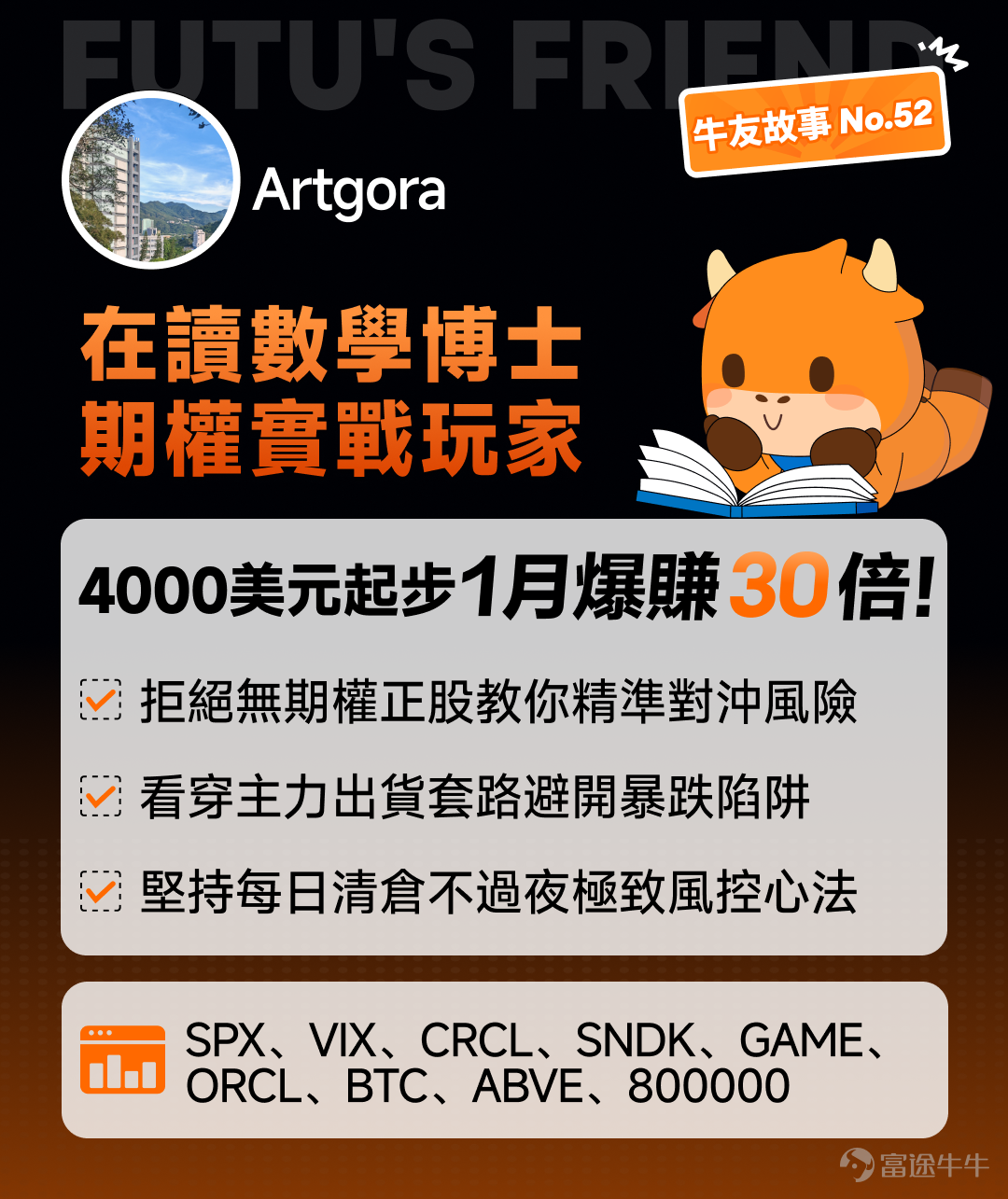
[Investor Story] A Math PhD's Options Experiment: Starting with $4,000, how to achieve 30x returns in one month?
From losing money on stocks at the end of July last year to turning $4,000 into 30 times the amount in a month on S&P options this February. From being burned by GameSquare and vowing never to touch stocks without options, to trading hundreds or even thousands of option contracts daily – what has this mathematics doctoral student gone through in between?
How did he use his mathematical background to understand option pricing and see through liquidity crises? And how does he protect himself in a market flooded with news?
In this Investor Story, we invited a mathematics PhD candidate based in Hong Kong @Artgora, to share hisjourney from losing money on common stocks to profiting from options, from entering the market via Circle to stabilizing gains through options trading. He reveals the unique options mindset and market perspective of a self-deprecating 'poor student' pursuing his PhD.。

I. Market Entry Enlightenment: From Losing Money on Stocks to ‘Never Touching Stocks Without Options’
Q: Can you share with fellow investors how you started trading?
Artgora: I started trading stocks at the end of July last year, quite by chance. At the time, I was watching a show with a classmate, and he suddenly said he wanted to log in to his stock account to buy. $Circle (CRCL.US)$ That day happened to be Circle's IPO. He previously turned 80,000 into over 100,000 by trading Pop Mart, but that night he went all-in on Circle and traded in and out several times; as a result, his gains of over 100,000 reverted back to just a few ten thousand.
I was wondering at the time, how could this stock have such high volatility? So I started trying, initially using another brokerage, but later switched to Futu, and found Futu to be much better.
Q: When was the first time you made money?
Artgora: The first time I made a significant amount of money was indeed with Circle, on the day when Circle hit a new high.I went all-in at over $240 with maximum leverage and then went to sleep. When I woke up, it had surged past $290, and I sold everything at over $260.,After that, I haven't really touched Circle much anymore.
But at the beginning, I lost money in both Hong Kong stocks and US stocks. There was one stock called $GameSquare (GAME.US)$ which didn’t have options, and I lost a lot on it. From that point on, I made a firm decision—Never touch stocks without options.,Because without options, you can't protect yourself.
Second, Awakening of Options: 'The biggest advantage of options is that you can protect yourself.'
Q: What was your thought process in shifting from common stocks to options?
Artgora: After losing money on common stocks, I found that options trading can sometimes better protect my account. You can hedge, implement strategies.
For example, some cryptocurrency-related stocks; many people think their options are expensive. But in my opinion, buying call options can effectively avoid drops in the underlying stock. For many crypto-related stocks, it's normal for them to drop by half in just a few days. If you buy call options several months out to capture potential upside, there’s at least one advantage—When the stock drops by half, you won’t lose too much money.But if you hold the common stock, you'll have to bear all the losses.
Q: Does your mathematics background help in trading options?
Artgora: It definitely helps, but what I want to say is,If you don't understand an options strategy, don't execute it.You must understand what the strategy is about, at least knowing the relationship between the pricing trends of the options strategy and the trend of your chosen investment target before getting involved.
3. 30x Legend: An Experiment with S&P Last-Day Options Starting with $4,000
Q: During the Lunar New Year period, you used $4,000 for S&P last-day options; what was your final return?
Artgora:From February 9th to March 9th, it should be more than 30 times.,In fact, in the first two weeks, I achieved more than 10x returns. The latter two weeks were slower, but on the first day, I really doubled my money.

Q: Can you break down the core strategy during that time?
Artgora: The core strategy at that time was this ——
– During a sharp decline,, then I'll goI went short on volatility.
– It's going up, justa bearish vertical spread on the S&P
– After it drops, to be aa bullish vertical spread
– Closing rally, throughshort volatility through an Iron Condor or Butterfly strategy
– Ifif direction is confirmed, trade a single-leg position,if direction is unclear but expected to move, open a straddle or Iron Condor strategy
In fact, during that time, I mainly relied onVertical strategy,Because the vertical strategy is relatively safe when volatility is low, and at that time, US stocks were at a high position. As long as we pushed it higher, we could simply execute bearish vertical spreads—A decline doesn’t need a reason, but an increase requires money, it's as simple as that.

Q: Why choose S&P index options?
Artgora: First of allThe S&P has daily options settlement, making it a good underlying asset for end-of-day options trading.. Secondly, because these are index options, there’s no pressure to deliver stocks, only cash settlement is required. Moreover, options strategies are generally designed around settlement, and daily settlements allow for higher leverage.
When I first started, it was during the Chinese New Year period, $S&P 500 Index (.SPX.US)$ there wasn’t much trading volume, and price movements were largely driven by a small amount of capital and the distribution of options. Predicting trends was relatively straightforward, and even if wrong, it wouldn't cause major issues.
Fourth, the iron rule of risk control: 'Take profits and run, don’t be greedy; greed often leads to trouble'
Q: Have you ever come close to a margin call when trading end-of-term options?
Artgora:When trading single-leg strategies on expiration day, one must be cautious. My mentality is pretty good. Generally, when there are only a few hours left, I put on at most 20%-30% of my position. But in fact, this is still very risky. I often lose several days’ worth of gains in just a few minutes. However, since my main goal is experimentation, my mindset is better. Normally, one should avoid holding highly leveraged positions in the last few minutes.。
Try not to trade too many single-leg strategies — time decay constantly erodes their value, and more often than not, they result in losses. If you decide to trade, aim for strategies that benefit from time decay, meaning the passage of time generates profits.
Especially in the current market where news is rampant, a single piece of news can move the broader market by one or two points. If you make a wrong end-of-day trade, intraday losses of over 90% are very possible. Therefore, if your position size is large, make sure to hedge — buy deep out-of-the-money call or put options to protect your account, or open a butterfly spread on both sides.

Q: How do you manage your profit-taking and stop-loss levels?
Artgora: Trading optionsTake profits and run; don't be greedy, as greed can easily lead to trouble.。If you’re too eager to win, you’ll end up losing. So don’t expect to make money every day. Once you make too many wrong trades in a day, cut your losses and take a break. No matter the price level, if it's time to stop loss, do so without hesitation. Never hope for miracles when the loss exceeds 2% of your account balance.
Five, liquidity thinking: 'No matter how good NVIDIA’s earnings are, they won’t rise because there’s no money left.'
Q: How do you interpret the current liquidity issues in the market?
Artgora: I see liquidity in two ways—Market fund liquidityAnd investmentLiquidity of the asset itself。
Regarding the market level, I personally believeThe current liquidity situation in US stocks is actually not very good.The recent sharp drop in gold prices happened because the high price of gold made it a liquidity bloodbath. NVIDIA's excellent earnings report didn’t push its stock price higher but instead led to a decline, also due to liquidity issues—There is no more money left in the market. Under the premise of a lack of liquidity, even for $NVIDIA (NVDA.US)$Such a large market cap company, no matter how good the earnings are, it won’t see much upside。
I remember the first time my single-day profit exceeded twenty or thirty thousand US dollars was because I chose to short the broader market the day before NVIDIA's earnings report. The logic was simple: NVIDIA’s results were bound to look good, and there would certainly be many people buying in, but market liquidity dried up——Once there is buying liquidity to support the market, instead of continuing to push prices higher, most funds choose to directly unload their positions. This is the issue of liquidity.。
Q: Do investment targets with poor liquidity actually have opportunities?
Artgora: Yes, poor liquidity doesn’t mean you shouldn’t buy. But it tests one’s knowledge and technical skills. Sometimes expensive options can be an opportunity for retail investors to make money, but the problem is if the options are too costly, retail investors may not afford them or be willing to participate.
VI. Market View: 'Being bearish doesn't mean you have to short.'
Q: You’ve been advocating shorting US stocks in the community. What’s your take on the current market?
Artgora: Personally, I tend to be bearish, butbeing bearish doesn’t necessarily mean you should short.Sometimes I also go long because you need to observe the flow of funds and their intentions. Often, the market is biased because both the market and large funds have the power to be capricious, especially during intraday short-term trading. If you go against them, we retail investors are not even considered speed bumps.
My view is different from the majority of stock investors who advocate value investing. First, what I trade is end-of-term options, which are more focused on short-term and intraday plays—I basically clear my positions every day and convert all assets into cash. Since I don't have much professional financial knowledge, I am very cautious about value investing. Secondly, given that the backdrop of the world has started to change, continuing to calculate stock values using the previous value investing method can be dangerous—The rules of the world may have already changed.。
The logic behind the rise in U.S. stocks is that if no one sells, it will go up. But once it reaches a high level, liquidity will approach exhaustion. Last year, many institutions and quant funds said their cash reserves were at historical lows, but Buffett was selling stocks for cash. If retail investor confidence and market cash flow have dried up, then measuring stocks by bull market valuation standards—That’s unreasonable, but the massive drop in stock prices also means that institutions have a lot of cash. In such cases, it’s as easy for them to rapidly push prices up and squeeze out short sellers as drinking water.。
Q: What’s your take on Hong Kong stocks and A-shares?
Artgora:I’m very bullish on Hong Kong stocks and A-shares.,Hong Kong stocks are undervalued due to a lack of liquidity; value remains in a trough—even if they make money, they can’t rise. So whenever there is panic selling or an oversold situation in Hong Kong stocks, you can simply go long.
However, Hong Kong stocks are heavily influenced by sentiment, and compared to the U.S. market, they’re relatively small and easily controlled by certain funds. Especially—$TENCENT (00700.HK)$ During the pre-market session, prices were basically all over the place.

Seven, the crypto and stock world: 'The crypto game can't beat Wall Street'
Q: How did you transition from crypto to stocks?
Artgora: My entry into the US stock market was actually through Circle. Later, I paid more attention to crypto-related targets. When Bitcoin surged to $120,000, I traded MSTR options and made several times the return in a short period—it happened in October and November last year.
Later, when Ethereum rallied for the second time, I chose SBET between BMNR and SBET because it seemed more like 'the crypto way.' But the difference in how these two stocks performed made me realize—In the stock market, the crypto game can't compete with Wall Street.。 If you want to play in the stock market, you can't think too much like the crypto crowd.
Q: What’s your take on the current crypto market?
Artgora: It's not a good time to be in the crypto market now. With potential liquidity issues in the market, it's hard to tell which companies are genuinely building something and which are just exploiting retail investors—They look very similar.。
For example, some stocks have reached historical highs hundreds of times their current price. Many people don't realize the pattern behind their consolidations and secondary offerings:Consolidation → Pump → Secondary Offering → Buyback → Vote for Consolidation Again → Pump Again → Secondary Offering AgainMany retail investors see that its previous highs were hundreds of times higher than now and jump in, but if they look at the financial reports, they'll find that the company hasn’t been profitable or may even be continuously losing money. Such companies don’t make money. Why have they survived for so many years? One reason is that some retail investors truly believe buying this stock will multiply their investment hundreds of times.
8. Investment Philosophy: 'When you realize you're speculating, you can actually protect yourself.'
Q: What do you think about the concept of 'value investing'?
Artgora: My view might differ from many—If you don’t know how to sell Puts or Calls, don’t consider yourself a value investor. Because you lack fundamental knowledge and basic operations, you’re always just speculating.。
The U.S. stock market isn’t clearly bearish or bullish at this stage. To call yourself a value investor, you must learn to protect yourself using options. If you don’t master basic operations, how can you claim your perception of value is accurate? Buffett still has over $300 billion in cash unused – following his trades might feel safe, but don’t assume copying his techniques makes it value investing because understanding value comes first in value investing.
The most dangerous moment comes when there’s a mismatch between your self-awareness and actual trading behavior.。 You think you’re doing value investing, but in reality, you’re speculating, and then manage speculative positions with a value investing mindset – in such cases, you don’t know when to reduce positions after gains or cut losses after declines, which is the riskiest situation of all.
For instance, many people last year said $Oracle (ORCL.US)$exploded in price,$Applovin (APP.US)$exploded in price, and everyone thought AI must be the future, rushing in to buy only to see it start plummeting afterwards. Oracle fell from over 300 to 140, and AppLovin dropped from six or seven hundred to three hundred. AI might indeed be the future, but whether it’s tomorrow's future or the future twenty years from now, no one currently knows. When you buy, you’d better first ask yourself if you’re aiming for value investing or short-term speculation. The choice of investment targets differs, and so does the psychological expectation you should set.
Investing has its own approach, and speculation has its own method. You cannot engage in speculation while thinking you're investing—that’s dangerous.
Section Nine, Why Choose Futu: 'Option order placement is very convenient; Futu is the best.'
Q: As a high-frequency options trader, which features of Futu do you rely on most?
Artgora:Futu’s option order placement is extremely convenient, which is the most basic and also the most important feature. During the period when I was making money quickly, I traded several hundred option contracts daily, sometimes up to a thousand. I probably contributed quite a bit to Futu’s commission.
After switching from other brokers to Futu, I found the experience to be exceptionally smooth, especially for options trading and high-frequency intraday trading.Order execution speed and interface smoothness are the most critical aspects; Futu does this particularly well.Generally speaking, using basic options strategies is sufficient. The advantage for retail investors is the ability to easily use leverage and trade in and out quickly. Basic options strategies are already enough to protect oneself.

Ten, a Ph.D. student’s daily trading routine: doing research during the day and earning money at night.
Q: How do you balance academics and trading?
Artgora: Generally, if I make money during the day, I only trade the first half of the night session. If I don’t make money during the day, I put in a bit more effort and do some operations before sleeping. I’m still a Ph.D. student, so I also have to do research and work as a teaching assistant. When I have time, I take a quick look, otherwise, I don’t trade.
When the market doesn’t offer opportunities, don’t expect to make a lot of money.。
Q: Have you considered going full-time into trading after graduation?
Artgora: No, the main reason I started trading was that my research wasn’t going smoothly, and I thought about finding other ways to make a living. Later, I felt like I had developed some ability to make stable profits, but I won’t go full-time into trading.
The reason is simple:No one can guarantee they will never face a margin call in their lifetime.。 If you make money this year but not next year, you can't just live on thin air. If you have the skills to make a decent living, that’s enough.
Don't think about getting rich or making big money through stocks; instead, your mindset will improve. Once your mindset is good, you'll actually make money.。 Mindset is very important, especially in the current market.
Eleven, advice for beginners: start with single-leg options and choose large-cap stocks with low volatility.
Q: For fellow investors who haven’t traded options much before, do you have any suggestions?
Artgora: First, take a look atthe CBOE Volatility Index (VIX), which reflects the logic behind the pricing of the entire market’s options — $CBOE Volatility S&P 500 Index (.VIX.US)$ when it's high, options are more expensive, and when it's low, they're cheaper. Currently, the VIX is around 20, so starting with single-leg options as practice could be a viable option.
But when starting out,you should avoid stocks with particularly high volatility.,For instance, $SanDisk (SNDK.US)$Recently, options have been very expensive because of the significant volatility and sharp price increases.
It's best to choose higher-weight stocks—among the Mag 7, except for $Tesla (TSLA.US)$Outside of$NVIDIA (NVDA.US)$ 、 $Alphabet-C (GOOG.US)$ 、 $Microsoft (MSFT.US)$ 、 $Apple (AAPL.US)$, because this way, even if you make a mistake, you won't lose too much money.。

Q: Can you explain how to use options strategies to protect yourself?
Artgora: Generally speaking, options are difficult, but once you master them, the biggest advantage is that you can protect yourself. While taking a certain position, you can reduce your risk exposure and lower expected returns to safeguard your investment. For instance, you can cut down on Theta or implied volatility—Eliminate the direction you think is risky.。
For the current market, I think the best approach isto do less and observe more.Capital is flying around, news is chaotic, and it’s hard to find a good direction. You must wait for a better opportunity before making a move instead of putting all your money in at once.
Q: Are there any fellow investors in the Circle you particularly admire?
Artgora: One person I followed and befriended very early on is@大饼资深韭菜mstr空头,His insights are extremely sharp; he must have been involved in the cryptocurrency circle, as he can easily see through scams. But whenever he goes to the comment section to 'save people,' the comments towards him are usually not friendly. There are many insightful and knowledgeable fellow investors in the Circle, but such individuals often receive less attention compared to those who recommend stocks or only provide general market analysis. Those who can pinpoint current situations and capital movements, their words in the comment section tend to sound harsh.
Q: Any final advice for fellow investors?
Artgora:When you're speculating, you need to be aware that you're speculating—only then are you truly investing.。Control your position size, take profits and run, don't be greedy. Act at the right time—keep your hands idle most of the time, and when a real opportunity arises, even taking a larger position is better than acting impulsively. In this market, having skills and courage can make you money, but only those who can control their impulses can make big money and survive in the long term.
 [Interactive Giveaway]
Share your thoughts on this article in the comment section. The first 150 fellow investors who write over 30 words and make reasonable points will receive 66 points.
If you find this article inspiring for your investment journey, feel free to @ your friends to read it together~
Event deadline: From now until April 24, 2026
If you have more suggestions for our column, feel free to leave a comment! Follow@牛友有料到Stay tuned for the next [Investor Story]!
Disclaimer:The content of this article is provided by@ArtgoraAccept@牛友有料到Compiled from the interview; the images in the text are provided by@ArtgoraThis article is based on interviews and the images in the text are provided and authorized by . The cases in the article are for reference only and do not constitute any investment advice. The information in the article does not constitute any industry or metric recommendation; the stock information and introductions represent the user's personal opinions, do not constitute any stock recommendation, do not represent Futu's position, and are not professional advice. Past performance of stocks does not indicate future results; the stock market involves risks, and investments should be made with caution.
Risk Disclaimer: The above content only represents the author's view. It does not represent any position or investment advice of Futu. Futu makes no representation or warranty.Read more


Comments (206)
to post a comment
342
275