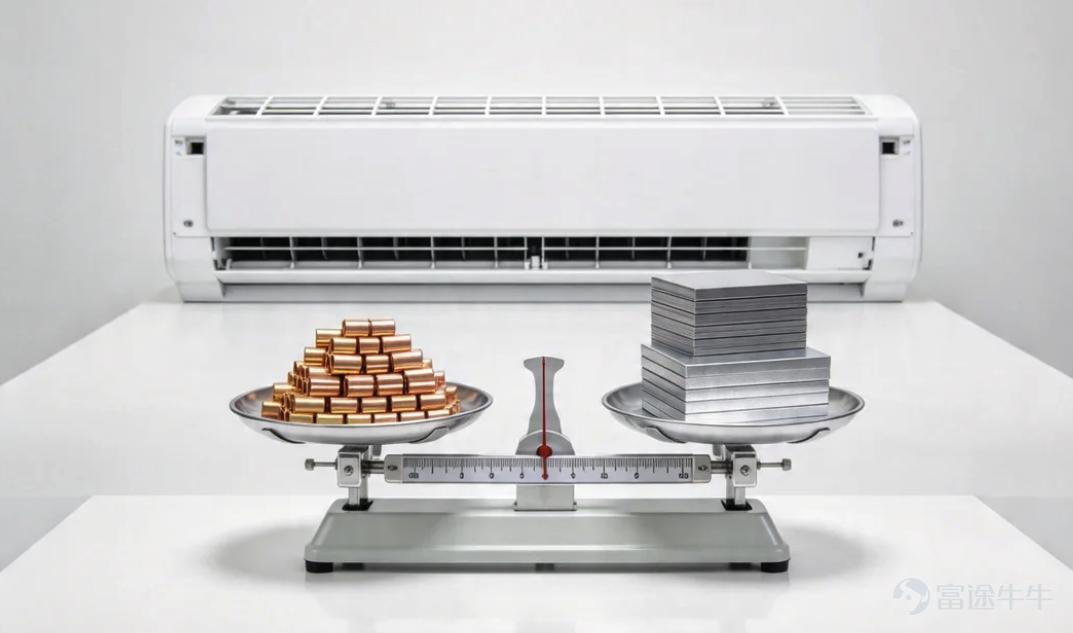

Gree and Hisense clash over 'real copper materials' - who gets the final say?

By / Zero Degree
Source / Node Finance
A single advertising slogan has once again ignited the industry's nerves.
On April 14, a brand dispute centered around the phrase 'genuine copper materials' suddenly heated up on social media. Gree Electric's CMO, Zhu Lei, was the first to post, directly accusing Hisense Air Conditioner of using the phrase 'genuine copper materials' in promotional materials at the Shanghai Home Appliances Expo, claiming that the term originated from Gree’s original creation.
Subsequently, Hisense executives quickly retaliated by releasing what appeared to be an application form showing Gree's participation in an aluminum research working group, sharply countering with the phrase 'hypocritical stance.'
Within just a few hours, this confrontation rapidly gained widespread attention, becoming one of the most discussed public opinion events in the home appliance industry recently. On the surface, it appears to be a dispute over advertising slogans between two brands, but beneath the热闹 exterior lies a deep disagreement over the core material route for air conditioners — a disagreement that had already been foreshadowed several months earlier.
A sovereignty dispute triggered by a single advertising slogan
The starting point of the incident was a detail at a home furnishing expo.
On April 14, Gree Electric's CMO, Zhu Lei, posted on Weibo stating that he noticed Hisense Air Conditioner directly using the phrase 'genuine copper materials' in their promotions at the Shanghai Home Appliances Expo. He clearly stated: 'These four words come from Gree Electric’s original creation.'
Zhu Lei further explained that 'Genuine Copper Materials Made by Gree' is not just an advertising slogan or a concept, but a complete standard system established by Gree. According to this standard, Gree products consistently use copper materials in four core components: evaporator copper tubes, condenser copper tubes, fan motor windings, and compressor motor windings.
His implication was clear and direct: if a brand’s product still uses aluminum wire in the motor windings, it does not qualify to claim 'genuine copper materials.'

This post undoubtedly pointed the finger at Hisense.
Hisense responded quickly. Yang Wanshou, a senior executive at Hisense, was the first to repost Zhu Lei's Weibo, succinctly replying with just four words: 'hypocritical and self-contradictory,' carrying a strong tone of confrontation. Subsequently, Yang Xiangxi, the brand director of Hisense's air conditioning division, provided a more detailed response: all Hisense air conditioners use copper tubing, as do most mainstream brands in the market; Gree's accusations are unfounded.
More damaging was when Yang Xiangxi posted a screenshot of the 'Air Conditioning Aluminum Reinforcement Application Research Working Group Member Application Form,' which clearly bore the signature of Gree. The implication was unmistakable—while loudly advocating for 'genuine copper materials,' Gree had once applied to participate in 'aluminum reinforcement application research.' How should this move be interpreted?

This screenshot quickly sparked heated discussions within the industry. Gree has not yet made a direct response, but this dialogue has rapidly escalated from a dispute over advertising slogans to a public relations battle concerning brand integrity and industry alliances.
A long-standing divergence in approaches
To understand the true nature of this dispute, we need to rewind the timeline to the end of 2025.
At that time, 19 leading home appliance companies, including Midea, Haier, Hisense, and Xiaomi, jointly signed an industry convention, the core content of which was to promote the 'aluminum-for-copper' solution in the air conditioning sector.
According to Node Finance, there is a very pragmatic industrial logic behind this convention: in recent years, domestic copper prices have remained highly volatile, while aluminum has a significant cost advantage—its price being about one-quarter that of copper, its density about one-third that of copper, and overall, the cost of aluminum is only about one-twelfth that of copper. In a market environment where profit margins for complete units are increasingly squeezed, this cost difference is highly attractive to companies.
Gree was one of the few mainstream brands that did not participate in the signing at that time.
Gree's logic is equally clear. Gree Electric stated on its interactive platform that although aluminum has obvious cost advantages, it falls significantly short of copper in key performance indicators such as melting point, thermal conductivity, resistivity, and corrosion resistance. Without full assurance of performance, quality, and reliability, the company currently has no plans to replace copper with aluminum.
Dong Mingzhu’s statements were even more assertive. She repeatedly emphasized in public that aluminum is less reliable than copper and personally pushed 'genuine copper products made by Gree' to the forefront of the company’s brand communication. She cited a specific figure: replacing copper with aluminum could save about 488 yuan per air conditioner in raw material costs, but until technical research reaches 100% certainty, this path remains unfeasible.
From this point on, the air conditioning industry has officially formed two distinct routes: the 'aluminum faction' represented by Hisense, Midea, and Haier, which is actively exploring new material paths under the support of national industrial policies; and the 'copper faction' represented by Gree, which considers the use of copper as a core weapon for brand differentiation.
In the view of Node Finance, both logics have their merits. However, with the intensification of market competition, what originally belonged to a technical-level route dispute has ultimately evolved into a head-on brand battle.
Policy Aspect: Aluminum replacing copper is not without basis
It is worth noting that in this debate, the promoters of 'aluminum replacing copper' are not only enterprises.
The policy signals at the national level are already quite clear. The 'High-Quality Development Implementation Plan for the Aluminum Industry (2025-2027)' explicitly mentions specific application scenarios such as refrigerator and air conditioner heat exchanger aluminum tubes, listing aluminum substitution in the home appliance field as one of the key promotion areas. This means that the signing of the 'aluminum replacing copper' convention by 19 companies is not merely a commercial self-rescue act but an active response to the implementation of the national industrial development direction.

Yang Xiangxi, Brand Director of Hisense's Air Division, also clearly stated that 'aluminum replacing copper' is a concrete manifestation of the internal implementation of the 'High-Quality Development Implementation Plan for the Aluminum Industry (2025-2027)'. He also pointed out that the so-called 'self-discipline convention of aluminum replacing copper' being heatedly discussed online is actually 'a story where a group of naive engineers were exploited and hyped by unscrupulous companies', and his remarks imply criticism towards Gree’s continued hype on this issue.
He characterized Gree’s related actions as 'malicious hype', believing that by widely propagating the concept of 'genuine copper materials', it is essentially leveraging consumers' limited understanding of materials to create anxiety, aiming to exclude competitors.
This statement may not represent the whole truth, but it reveals an objectively existing problem: In consumer markets with information asymmetry, simplistic material labels can easily be packaged as the sole criterion for judging quality, which might not be beneficial for the entire industry undergoing diversified technological exploration.
Industry Voices: Substitution is a gradual process, not an either-or scenario
As the controversy continues to escalate, the China Household Electric Appliance Association has also spoken out, calling on all parties to view the matter rationally.
The association pointed out in the article 'A Rational View of the Practice and Exploration of Aluminum Substitution for Copper in the Air Conditioning Industry' that, despite the objective superiority of copper performance, the industry still has to seriously consider 'aluminum substitution for copper,' driven by two core factors: First,the continuous rise in copper prices has brought tremendous pressure on companies’ cost control; if not effectively addressed, the costs will ultimately be passed on to consumers.Second, domestic home appliance companies have made continuous breakthroughs in key technologies related to aluminum application, achieving significant progress in several core indicators, and the overall performance of aluminum heat exchanger air conditioners has improved noticeably.
The association also emphasized an important judgment: currently, 'aluminum substitution for copper' represents a diversified exploration of technical paths rather than a sweeping industry-wide transition.When promoting 'aluminum substitution for copper' products domestically, air conditioning companies generally adopt a cautious approach, implementing a steady and progressive strategy. This reflects respect for technological principles and adherence to innovation premised on product quality.
The association further offered specific recommendations: companies should scientifically segment the promotional regions and price ranges for aluminum-substituted products based on product positioning, usage environment, and target demographics, while ensuring consumers are fully informed about whether the air conditioner's heat exchanger material is made of copper or aluminum.
In the view of Node Finance, different voices within the industry paint a more complete picture of the industrial landscape: copper and aluminum are not simply a matter of good versus bad or right versus wrong but represent two parallel exploratory paths with their own applicable logic at different technological stages, product positions, and market environments.
Where are the boundaries of marketing battles?
To be fair, Gree’s move to establish 'real copper materials' as a core brand label was an effective step in differentiated marketing. However, as this marketing push expanded, evolving into accusations that competitors were 'not qualified' to use certain terms and even labeling the joint technical exploration involving 19 industry players as irresponsible behavior, the limitations of this brand narrative began to emerge.

In fact, Hisense's choice of material strategy does not reflect a compromise on quality but rather a systematic response to national industrial policies and market cost pressures. Hisense's air conditioners are not inferior in copper tube technology, with their mainstream product lines still using copper tubes as standard; meanwhile, they actively follow the cutting-edge exploration of aluminum technology, preserving flexibility for future product strategies — this approach, which maintains quality standards while keeping strategic flexibility, exemplifies the maturity of large enterprises in facing industrial changes.
Moreover, the government has already explicitly encouraged the promotion of aluminum applications in the home appliance sector through policy documents. Against this backdrop, it is neither fair nor sustainable to uniformly portray companies exploring 'aluminum replacing copper' as engaging in 'cutting corners'.
This debate over 'genuine copper content' is bound to not be the industry's last verbal battle.
The route conflict between copper and aluminum will continue, the competition for brand influence will persist, and consumer awareness will slowly crystallize amidst repeated information barrages. What truly cuts through all the noise and reaches users’ hearts is never the loudest slogan, but a machine that continues to operate stably after three, five, or ten years of use.
Ultimately, trust in the industry is determined by the products themselves.
*Title image generated by AI
Risk Disclaimer: The above content only represents the author's view. It does not represent any position or investment advice of Futu. Futu makes no representation or warranty.Read more
Comments
to post a comment
1