
US launches "economic offensive" against Iran; will oil prices see renewed volatility?

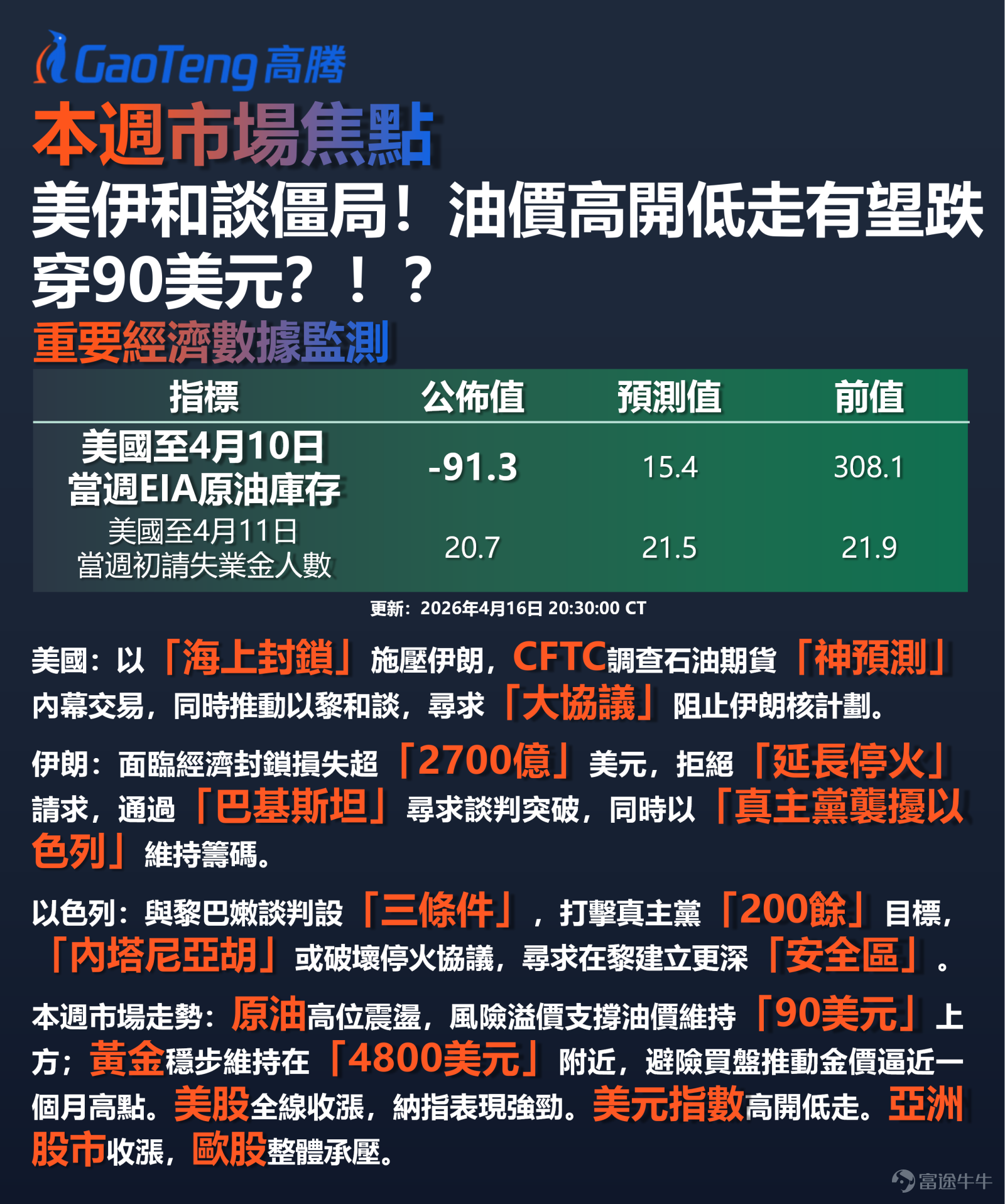
Tengsi's Market Focus This Week | Deadlock in US-Iran Talks! Could Oil Prices Drop Below $90 After a High Open and Low Close?

The US Maximum Pressure and Blockade Strategy
US President TrumpContinued to exert maximum pressure on Iran this week,White House Advisor Stephen Millerstated during an interview with Fox News that the US could continue to impose an “Indefinite Blockade” on Iranian ports. Miller emphasized that Trump is a “Man of Peace”, but the US has made its position clear: "The United States will not be bullied, and the US willnever be threatened by a nuclear-armed Iran. Not now, not ever.
MillerMiller further threatened: 'A military action could destroy Iran's energy infrastructure for generations. But Trump has made it clear he doesn’t want to do that. He hopes Iran will choose the right path to reach an agreement.'This blockade is severely damaging the economic power of Iran's regime, and the US has the abilityto maintain this blockade indefinitely, as long as Iran chooses the wrong path.' This statement shows that the US is forcing Iran to compromise through economic blockades rather than direct military strikes.
In terms of military deployment, the United States continues to strengthen its military presence in the Middle East. U.S. officials stated that the U.S. military will deploy several thousand additional troops to the Middle East in the coming days. The U.S. Central Command notedThe "Tripoli"Destroyers have alreadyJointargeted Iranwith a naval blockade operation. FromApril 13Since the start of the blockade, U.S. naval forces have interceptedeightoil tankers entering and exiting Iranian ports, with the U.S. military claiming to have completely cut off Iran's maritime import and export trade.
Trump also announced that negotiations between Israel and Lebanon will commence onApril 16where leaders from both countries will engage in dialogue in an effort to create some breathing room between Israel and Lebanon. This shows the Trump administration is attempting to push forward diplomatic solutions on multiple fronts simultaneously.
Iran's response and countermeasures
In the face of the U.S.'s maximum pressure, Iran has demonstrated"Outwardly relaxed but inwardly vigilant, using conflict to force a resolution"with a tough stance, while seeking solutions to break the blockade through various channels.
Iranian Foreign Minister AraghchiIt was clearly stated that ending the war depends on the United Statesstopping aggression、and controlling Israelcommitment.Iranian Foreign Ministry spokesperson Baghaeisent negotiation signals, stating that there is room for dialogue regarding the degree and type of uranium enrichment. Iran and the US continue to exchange information via Pakistan. This indicates that while Iran adheres to its core position, it has retained some flexibility for negotiations.
On the military front, Iran continues to attack regional targets. The Israeli army claims to have struck over 200 Hezbollah targetsin southern Lebanon., while Israel stated that Hezbollah launched40 sheetsrockets toward Israel on Wednesday morning. Iran arrested 35 individuals linked to US and Israeli intelligence agencies, claiming that American-made communication equipment in the country collectivelymalfunctioned during the attack on central Iran.。
In response to the maritime blockade, Iran is adopting a multi-pronged strategy. Iran will utilize ports other than those in the south to bypass the US blockade. Iran has proposed allowing free passage for vessels on the Omani side of the Strait of Hormuz, stating that shipping activities in the country’s southern region are proceeding normally without interruption. The Iranian military warned in response to the US maritime blockade: if the safety of Iranian merchant ships and oil tankers is jeopardized,Iran will ban any import or export activities in the Persian Gulf, the Gulf of Oman, and the Red Sea.The Iranian Armed Forces emphasized,that security at regional ports 'either belongs to everyone or no one.'。
International Community's Mediation and Concerns
As the US-Iran standoff continues, the international community is intensifying its mediation efforts to prevent further escalation of the conflict. Pakistan is playing a key role in the mediation process, and according to Iranian state media,a Pakistani delegationhas traveled to Iran to convey messages from the US and plans for a second round of negotiations. Sources say that the visit by Pakistan's Army Chief of Staff occurred because nuclear negotiations achieved a 'major breakthrough.'
US Vice President Vancestated,Trump doesn't want a small-scale deal, he wants a 'big deal'。Trump's fundamental policy is to prevent Iran from obtaining nuclear weaponsThis statement shows that the US negotiating position remains tough, seeking a comprehensive resolution to the Iranian nuclear issue.
Regarding the ceasefire negotiations, the Israeli military has set three basic conditions for reaching a ceasefire agreement with Lebanon.Hezbollah in LebanonAgreed to a ceasefire, but Israel must fulfill its obligations. Sources say the Lebanon ceasefire is planned toApril 16Take effect later, but Netanyahu may disrupt the agreement again. Israel says it has not received any decisions or requests related to a ceasefire with Lebanon.
On the issue of extending the ceasefire, Iranian sources reported on April 15 that despite the US request to extendTwo weeksThe ceasefire,Iran has not yet agreed to the requestThe Iranian side believes that the US should fulfill its commitments under the current ceasefire agreement, rather than request an extension of the ceasefire, and should stop making excessive demands in the negotiations.US White House Press Secretary Karoline Leavittstated earlier thatThe US has not formally requested an extension of the ceasefire agreement with Iran, and reports claiming otherwise are "inaccurate"; both parties remain in ongoing contact and are advancing negotiations.
"Miraculous prediction" in oil futures triggers regulatory investigation
This week’s market focus is not only on geopolitical developments but also involves a high-profile regulatory probe. From Trump's announcement delaying strikes on Iran's energy facilities to the unveiling of a ceasefire agreement with Iran—before every major policy shift, unsettling "predictions" appeared in the oil futures market.Amazing prediction」。
According to a Bloomberg report,The US Commodity Futures Trading Commission (CFTC)is leading the investigation into crude oil futures contract trading on platforms operated by the Chicago Mercantile Exchange Group(CME)and Intercontinental Exchange(ICE), according to sources familiar with the matter. The CFTC is investigating at least two unusual incidents that occurred over a period of approximatelyTwo weeks, where trading volumes surged shortly before major announcements.
Specifically, on March 23, prior to Trump’s indication that the threatened strike on Iran's energy infrastructure would be delayed,15 minutes,billions of dollars worth ofoil and equity futures were traded. Trump's comments on the Truth Social platform caused crude prices to plummet and stocks to soar. This happened again on April 7 when Trump announced an agreement with Iran.Two weeksA similar pattern was observed before the ceasefire agreement. Futures trading activity increased in the hours leading up to the announcement, which caused both oil and gas prices to plummet.
Democratic Senator Elizabeth Warrensaid in a statement: "These suspicious oil trades appear to be a shocking example of market manipulation by insiders." She said that this investigation "is a start, but the CFTC and the Securities and Exchange Commission (SEC) should do their due diligence to investigate any actions that appear to have been carried out by officials in the Trump administrationInsider trading."
Possible future developments
Scenario One: Ceasefire Extension Agreement Reached
Under the mediation of multiple parties such as Pakistan, the two sides mayreach an extension agreement before the expiration of the ceasefire. The US might suspend its blockade in exchange for Iran freezing its nuclear activities, while Iran could open some waterways in exchange for partial lifting of sanctions.US Treasury Secretary Bethcentstated that Middle Eastern counterparts indicated that once the Strait of Hormuz is open, they can immediately begin transporting oil. Such an agreement would be unstable and fragile, akin to a 'ceasefire rather than peace'.
Historical reference:2024 Gaza Ceasefire Agreement— A temporary ceasefire reached under international pressure, which, although failing to resolve fundamental conflicts, provides breathing space for both sides.
Scenario Two: Ongoing Blockade with Fighting and Negotiating Simultaneously
If Iran does not make substantial concessions before the ceasefire expires, the US may continue to maintain the maritime blockade while keeping negotiation channels open. This 'fighting and negotiating simultaneously' model aligns with Trump’s strategy of 'using war to force peace.' Iran will continue seeking ways to bypass the blockade while launching limited attacks on regional targets through proxies to maintain negotiation leverage.
Historical reference:2019 US-Iran Tensions— After the US assassination of Soleimani, Iran retaliated; both sides chose restraint after a brief escalation, avoiding full-scale war.
Scenario Three: Rapid Escalation of Conflict
If Trump orders a large-scale strike on Iran's energy facilities or Iran launches a major attack on critical infrastructure in Saudi Arabia, the UAE, or other countries, the conflict could escalate dramatically.Iran has warned that it will attack critical facilities in Middle Eastern countries hosting U.S. military bases, at which point countries such as Saudi Arabia and the UAE may get dragged into a regional war. Traffic through the Strait of Hormuz has already plummeted compared to pre-war levelsover 90%compared to pre-war levels. If this situation persists for months, it would trigger a global energy crisis.
Historical reference:The 1991 Gulf War— Iraq burned Kuwaiti oil wells, causing a global disruption in oil supply, skyrocketing oil prices, and plunging the global economy into recession.
Key time node
– April 16: Dialogue between Israeli and Lebanese leaders with only hours left
– April 16Tonight: Rumors of Lebanon ceasefire taking effect
– This weekend: The U.S.-Iran ceasefire agreement is expiring, and whether it will be extended is about to be revealed
– Next week: U.S. and Iran may return to Pakistan for a new round of negotiations
Market movements this week
– Crude Oil:risk premium,supporting high price volatility
This week’s oil prices fluctuate between the deadlock of the U.S.-Iran blockade and hopes for peace talksfluctuate violently。 $Crude Oil Futures (OCT6) (CLmain.US)$ This week's report shows $91.76, with a cumulative decline3.77%, the highest within the week reached105.66dollars, with a low of87.05USD; $Brent Last Day Financial Futures Current Contract (OCT6) (BZcurrent.US)$Report93.44USD, with a cumulative increase of 1.63%, the highest within the week was99.79dollars, with a low of91.26dollars. Despite the US maintaining its blockade of Iranian ports, the market still anticipates progress in negotiations. Oil prices started high but ended lower, maintaining volatility above $90.risk premium,continues to support oil prices.
- Gold: Safe-haven buyingdriving gold prices steadily higher
Gold prices continue to be supported amid rising geopolitical risks.Safe-haven buyingsupport. This week$Gold Futures (DEC6) (GCmain.US)$ being4800USD, fluctuating near this level, with a cumulative increase1.39%, the highest within the week reached4871.50dollars, with a low of4644.39The US dollar. Gold, as a traditional safe-haven asset, has demonstrated strong resilience with prices steadily rising and approaching previous highs.
- Stock market: Geopolitical risks intertwined with economic data,increased volatility
Global stock markets showed divergence this week, with geopolitical risks and economic data impacting market sentiment. US stocks closed higher overall this week, $Dow Jones Industrial Average (.DJI.US)$ accumulating an increase of about 1.14%, $S&P 500 Index (.SPX.US)$ rising for three consecutive weeks, accumulating an increase of about 3.0%, $Nasdaq Composite Index (.IXIC.US)$ showing strong performance, surging by approximately 4.8%。
In the Asian stock markets, $Hang Seng Index (800000.HK)$ prices trended upward this week, closing at 26394.26points, with a cumulative increase of approximately1.93%; $Hang Seng TECH Index (800700.HK)$ leading gains by over 4.77%, currently at5092.08points; on the A-share market, $SSE Composite Index (000001.SH)$ this week reported at4055.55points, with a cumulative rise of about1.74%, $Shenzhen Component Index (399001.SZ)$ up by approximately2.05%. On the European stock market, $German DAX Index (.GDAXI)$ this week slightly increased by about1.22%, $UK FTSE100 Index (.FTSE.GB)$ fell by about0.48%,$France CAC40 Index (.CAC.FR)$ opened lower but finished higher, up by approximately0.64%European stock markets are under overall pressure.

Risk Disclaimer: The above content only represents the author's view. It does not represent any position or investment advice of Futu. Futu makes no representation or warranty.Read more

Comments
to post a comment
3
1