
Options Hub: SpaceX's second wave of lock-up expiration takes effect today! How should options strat

Daily Options Outlook | Tesla surged 7.62%, completing the AI5 chip flow design; Robinhood rose 10.41% as the SEC approved the removal of the intraday trading restriction rule
I. Today's Options Opportunities Outlook
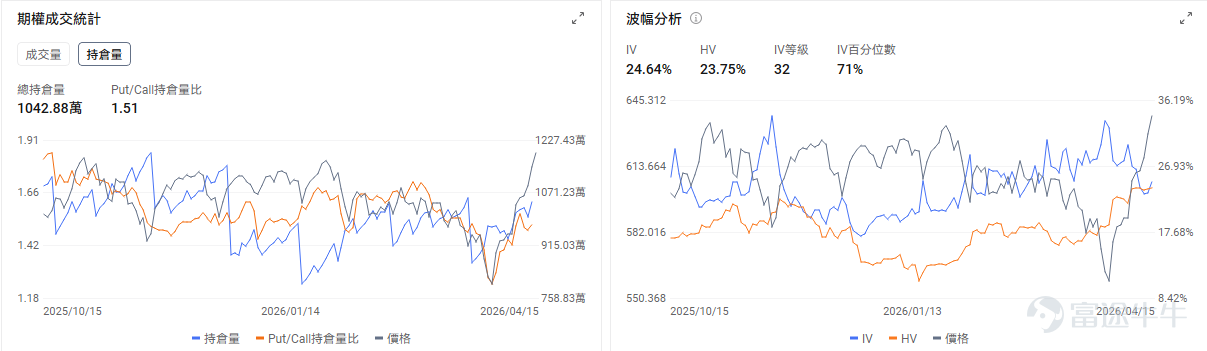
Macroeconomic level, The Nasdaq index achieved an 11-day winning streak, rising 1.49% yesterday. As of press time today, Nasdaq 100 futures were up 0.37%. Trump's latest statement declared that the war with Iran has ended, while Goldman Sachs noted that the market has 'unilaterally declared victory,' with capital rushing in panic-like fashion and short sellers being squeezed out. After yesterday's close, the Put/Call open interest ratio for QQQ was 1.51, implied volatility was 24.64%, and IV percentile was at 71%, indicating a historically high level.

On the individual stock level, $Tesla (TSLA.US)$ Up 1.22% pre-market after closing 7.62% higher yesterday. Tesla completed the AI5 chip tape-out design and advanced the development of AI6 and Dojo3, further promoting the Terafab project. Options market signals show Tesla's Put/Call volume ratio at 0.56, implied volatility at 54.25%, and IV percentile at 48%, reflecting a strong bullish signal.

$Alibaba (BABA.US)$ Up 3.6% pre-market after closing 1.47% higher yesterday. On April 16, Alibaba released its global model Happy Oyster, further expanding its AI product portfolio and targeting content production sectors such as gaming and film. Options market signals indicate Tesla's Put/Call volume ratio is 0.35, implied volatility is 46.70%, and IV percentile is 56%, showing a strong bullish signal.

II. Review of yesterday's options market
Index Options
On April 15 Eastern Time, trading volume in the US index options market declined, totaling 7.25 million contracts traded. The Put/Call volume ratio increased to 0.93.
As the upcoming expiration date approaches,$S&P 500 Index (.SPX.US)$ The distribution of options trading volume shows the following characteristics: the peak volume for put options occurred at 6,950 points, while the peak for call options was at 7,105 points.

Single Stock Options
$Robinhood (HOOD.US)$Closed up 10.41%, with 683,100 options contracts traded, and the put/call volume ratio dropped to 0.29. The SEC approved the cancellationIntraday tradingof the restriction rule, leading to a significant rise of over 10% in Robinhood's stock price.

$Amazon (AMZN.US)$Closed down 0.21%, with 743,500 options contracts traded, and the put/call volume ratio increased to 0.46. Amazon acquired Globalstar for $11.6 billion to strengthen its satellite business and compete with SpaceX.

Top list of options trading volume
Among the top 10 stocks by options trading volume,$Tesla (TSLA.US)$The put/call volume ratio reached the highest at 0.56. Tesla completed the tape-out design of AI5 chip and is advancing the development of AI6 and Dojo3.

The highest put/call open interest ratio is$Palantir (PLTR.US)$, reaching 1.00. Palantir's stock price was pressured by concerns over intensified AI competition and high valuation, but the overall rebound in the software sector drove the stock price up.

Implied volatility rankings (underlying market cap > $10 billion and options trading volume > 100,000)
$Eos Energy (EOSE.US)$Implied VolatilityThe highest increase was 143.89%, up 7.88% from the previous trading day. Eos Energy signed a joint development agreement with TURBINE-X Energy to develop private power infrastructure for AI data centers.

$Quantum Computing (QUBT.US)$Implied volatility showed the largest growth, reaching 122.12%, up 25.73% from the previous trading day. NVIDIA released the Ising quantum AI model, driving continuous gains in quantum computing stocks.

Risk Warning
An option is a contract that gives the holder the right, but not the obligation, to buy or sell an asset at a fixed price on a specific date or before that date. The price of an option is influenced by various factors, including the current price of the underlying asset, the strike price, time to expiration, and implied volatility.
Implied volatility reflects the market's expectation of the option's volatility over a certain period in the future. It is derived inversely from the BS pricing model of options and is generally considered an indicator of market sentiment. When investors anticipate greater volatility, they may be more willing to pay higher prices for options to hedge risks, resulting in higher implied volatility.
Traders and investors use implied volatility to assessOption priceattractiveness, identify potential mispricings, and manage risk exposure.Disclaimer
This content does not constitute any offer, solicitation, recommendation, opinion, or guarantee of any securities, financial products, or tools. The risk of loss in trading options can be substantial. In some cases, losses may exceed the initial margin deposited. Even if you set contingent orders such as 'stop-loss' or 'limit' orders, these may not prevent losses. Market conditions may make such orders unexecutable. You may be required to deposit additional margin within a short period. If you fail to provide the required amount within the specified time, your open positions may be liquidated. However, you will still be responsible for any shortfall in your account. Therefore, before trading, you should study and understand options and carefully consider whether such trading is suitable for you based on your financial situation and investment objectives. If you trade options, you should be familiar with the procedures for exercising options and the rights and obligations upon exercise and expiration. Options trading carries extremely high risks and is not suitable for all investors. Investors should carefully readCharacteristics and Risks of Standardized Options。
This content does not constitute any offer, solicitation, recommendation, opinion, or guarantee of any securities, financial products, or tools. The risk of loss in trading options can be substantial. In some cases, losses may exceed the initial margin deposited. Even if you set contingent orders such as 'stop-loss' or 'limit' orders, these may not prevent losses. Market conditions may make such orders unexecutable. You may be required to deposit additional margin within a short period. If you fail to provide the required amount within the specified time, your open positions may be liquidated. However, you will still be responsible for any shortfall in your account. Therefore, before trading, you should study and understand options and carefully consider whether such trading is suitable for you based on your financial situation and investment objectives. If you trade options, you should be familiar with the procedures for exercising options and the rights and obligations upon exercise and expiration. Options trading carries extremely high risks and is not suitable for all investors. Investors should carefully readCharacteristics and Risks of Standardized Options。
Risk Disclaimer: The above content only represents the author's view. It does not represent any position or investment advice of Futu. Futu makes no representation or warranty.Read more


Comments
to post a comment
6
3