Simultaneous pressure on the Red Sea and the Strait of Hormuz drives international oil prices higher

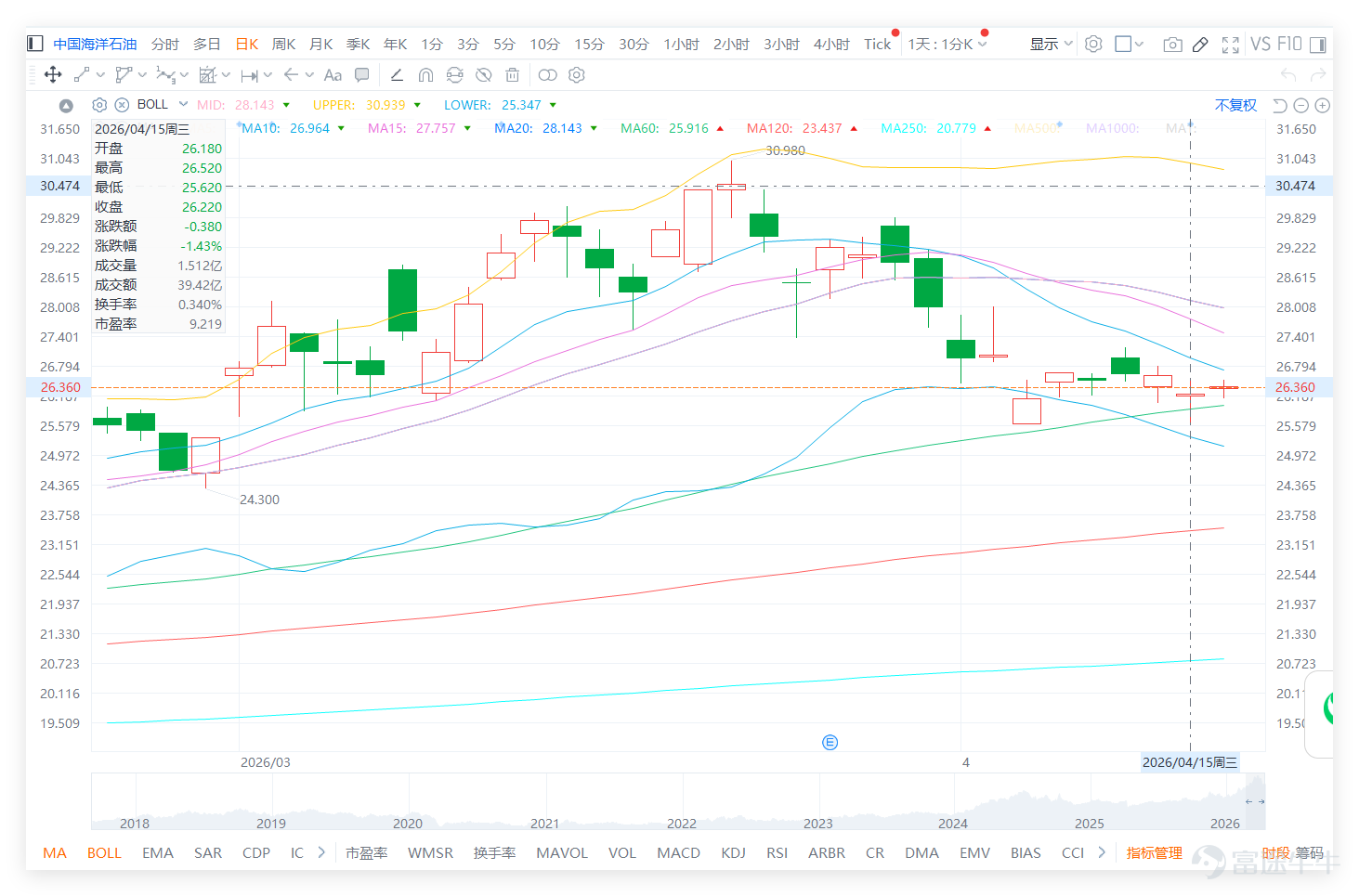
CNOOC has broken below the medium- and short-term moving averages, and it is still advisable to maintain a bearish view unless it can reclaim 26.80 yuan.
On the previous trading day (April 15), the stock closed at 26.22 yuan. After retreating from the high of 30.98 yuan, the price has now clearly broken below the 5-day, 10-day, and 20-day moving averages. The current trend reflects a weak rebound after a retreat from highs rather than a renewed upward strength. The most important technical level in the short term is not how optimistic market sentiment is, but whether 26.80 yuan can be reclaimed. Until this position is stabilized, the overall strategy should focus on selling during rebounds or maintaining a bearish stance, as going long does not offer an attractive risk-reward ratio.
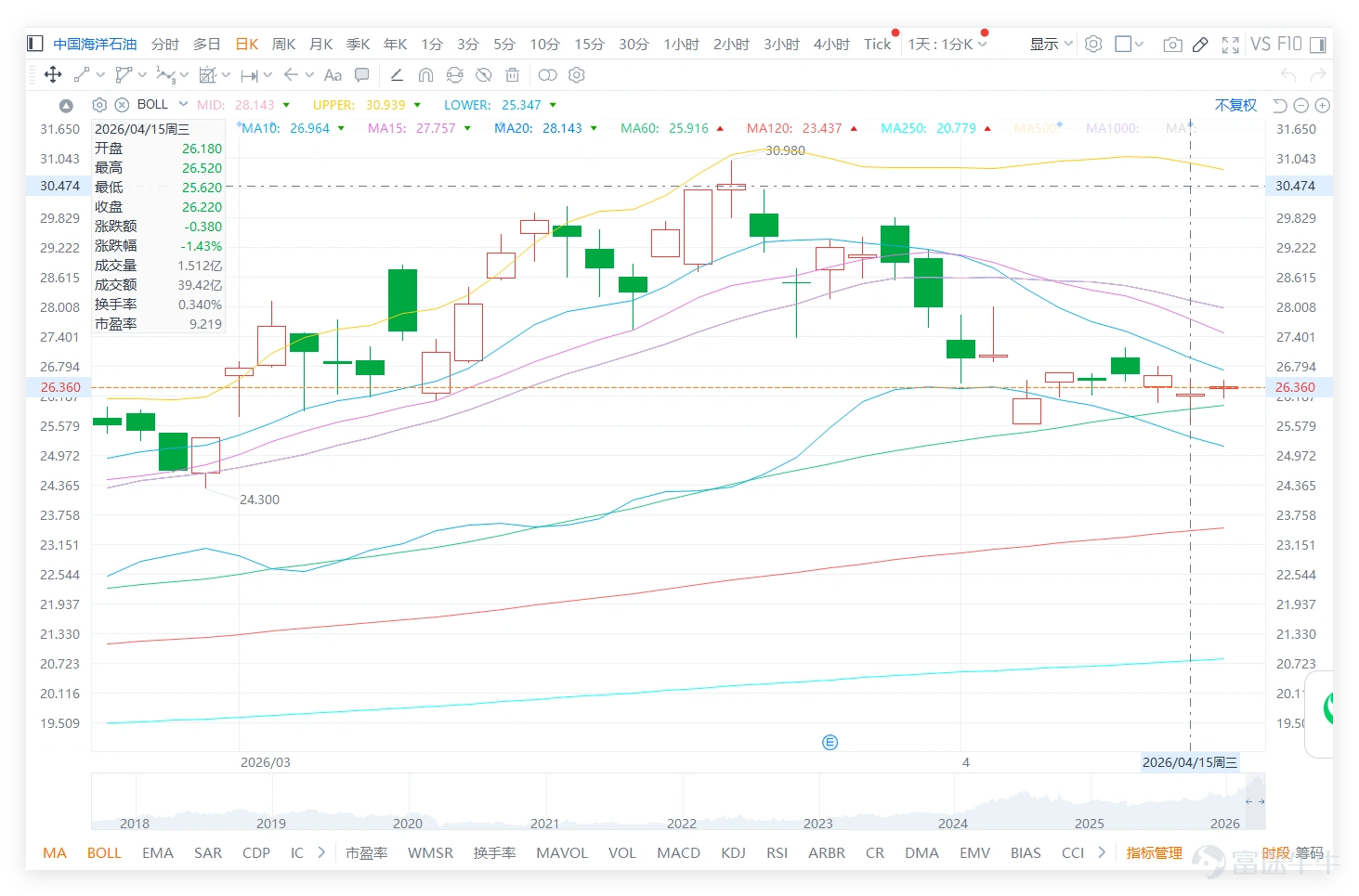
Looking at the energy sector as a whole, the market performance was weak on the previous trading day (April 15), with most stocks declining. Among the 'three major oil companies' and coal stocks, $CNOOC (00883.HK)$ and $SINOPEC CORP (00386.HK)$ both received 'buy' signals from the system, but their share prices also closed lower, reflecting the sector's overall short-term pressure. In comparison, $PETROCHINA (00857.HK)$ the technical signal for the day was 'neutral,' and the decline was larger (-3.02%), indicating weaker short-term performance. Notably, among the major oil, gas, and coal stocks mentioned above, CNOOC is the only one that remains above the MA60 moving average, showing that its medium-term trend structure is still the strongest compared to its peers. However, this does not change the technical reality that it has broken below the medium- and short-term moving averages and is currently in a weak rebound. This indicates that even in an environment where the sector as a whole is adjusting, individual stocks with relatively strong performances still need to prioritize whether they can reclaim key short-term resistance levels.

From a structural perspective, although CNOOC's share price is not completely out of control at the moment, the issue lies in the insufficient rebound strength. Technically, it remains below the medium- and short-term moving averages, indicating that upward pressure still exists. The first support level to watch is HKD 25.60; if that breaks, the next key level would be HKD 24.70. Conversely, the initial resistance is around HKD 26.80, followed by HKD 28.00. This means the current price is in quite an awkward position—there’s no clear breakout upwards, while downside risks remain possible. Thus, the short-term reward-to-risk ratio isn’t favorable, especially for initiating long positions or bullish strategies at this level.
As for @Making9Dishes,@漲漲海油寶寶Regarding the relatively optimistic views like @做9菜 and @dKOb, there are indeed some funds in the market still hoping to treat the pullback in oil prices as an opportunity to increase positions, believing that stock prices won't weaken too much amid capital confrontations. However, from a technical standpoint, sentiment or news-driven expectations alone aren’t sufficient to reverse the currently weak structure. If the share price fails to reclaim HKD 26.80, any rebound will likely just be a weak retracement rather than the start of a new uptrend.
As for@8855The idea that the price could retest HKD 27.00 yesterday is not entirely impossible, but the precondition is that the stock must first stabilize effectively above HKD 26.80. If even this resistance level cannot be breached, HKD 27.00 will remain only a short-term rebound target, not a region where prices can settle sustainably.@邊樹發財The mention of ‘if someone sells heavily, the price will rise’ actually reflects how sensitive the market is currently to whether liquidity loosens up. Weak stocks often don’t lack rebounds, but instead lack sustained buying during these rebounds, which is why they repeatedly get stuck at resistance levels.
@我又菜又爱玩 mentioned setting the price too low and missing the chance to buy; technically, this might not necessarily be a bad thing because this stock isn’t at an ideal entry point right now. If it rebounds to around HKD 26.80 and faces resistance again, it may trigger another round of declines. Rather than forcing an entry midway, it’s better to wait for clearer technical signals—for instance, a pullback near support levels or after truly reclaiming HKD 26.80 before reassessing.
For investors who have exited or started to turn pessimistic, such as @231358525, @231075493, @踏雪爱逐鹿, and @極巨韭菜, the market indeed hasn’t shown strong reversal signals yet, so concerns about weakening trends aren’t unfounded. Particularly, if the share price breaks below HKD 25.60, it would indicate further downside potential, potentially testing HKD 24.70 or lower. However, a complete breakdown hasn’t occurred yet—as long as HKD 25.60 holds, the stock can still be seen as oscillating within a weak rebound phase without entering a sharp decline immediately.
As for@LoVeLe5sRegarding heavy positions entered a couple of days ago, the most important task now isn’t chasing news but observing how key technical levels evolve. If the stock rebounds to around HKD 26.80 and still meets resistance, it suggests selling pressure above remains intact, making position management more critical than relying on emotional judgment. @失落的牛君’s belief that the trend doesn’t follow conventional patterns and that it should rise today precisely highlights the market’s current challenge: stock performance doesn’t always align with news. Technically, decisions should depend on whether the price recaptures key levels, not merely on the expectation that it 'should rise.'
Additionally, @香港特朗普 noted that falling oil prices might not significantly impact the company—a statement with merit since individual stocks don’t always move perfectly in sync with oil prices in the short term. Short-term trading focuses more on capital reactions and technical setups. Even if fundamentals don’t deteriorate immediately, declining market risk appetite can still pressure the stock. @Nanco asked whether something has started and why declines are being followed but not rises; these feelings reflect the current trend characteristics: after retreating from highs, the market’s willingness to chase upward moves weakens, while sensitivity to downward moves increases, leading to feeble rebounds and quicker pullbacks.
Overall, CNOOC’s clearest strategic options at this stage remain divided into three directions. First, if the stock rebounds to around HKD 26.80 and encounters resistance, it can be treated as a bearish bias setup targeting a return to HKD 25.60–24.70. Second, if the stock directly falls below HKD 25.60, it indicates a continuation of weakness, possibly testing HKD 24.70 or lower. Third, only when the stock stabilizes and holds above HKD 26.80 will short-term consideration of bullish trades become appropriate, with targets potentially extending back to HKD 28.00.
Based on the above analysis, the strategies for deployment can be divided into the following main approaches:
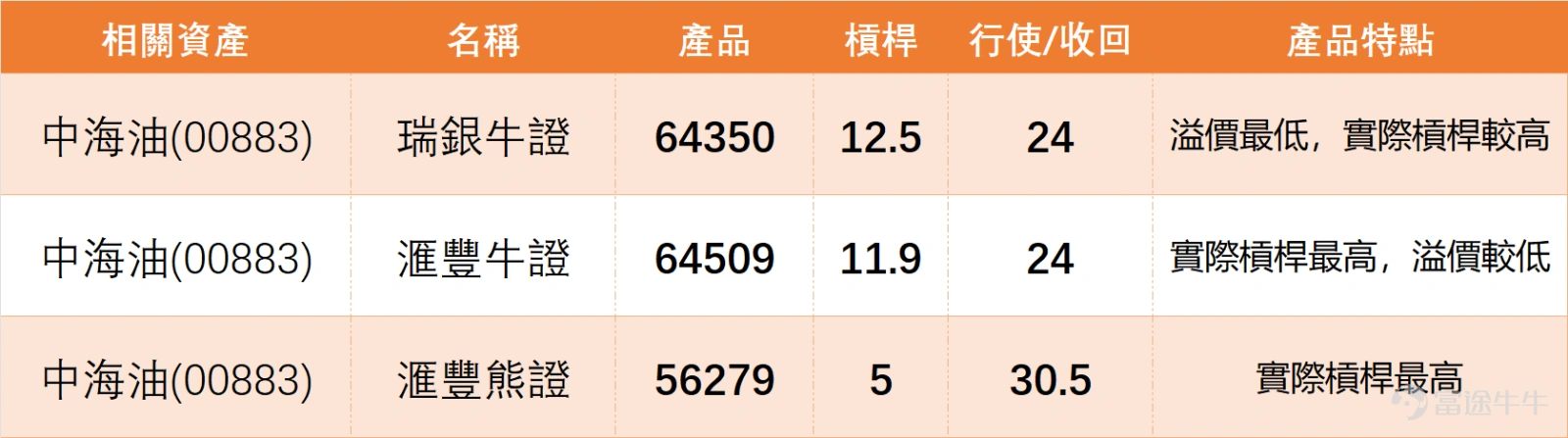
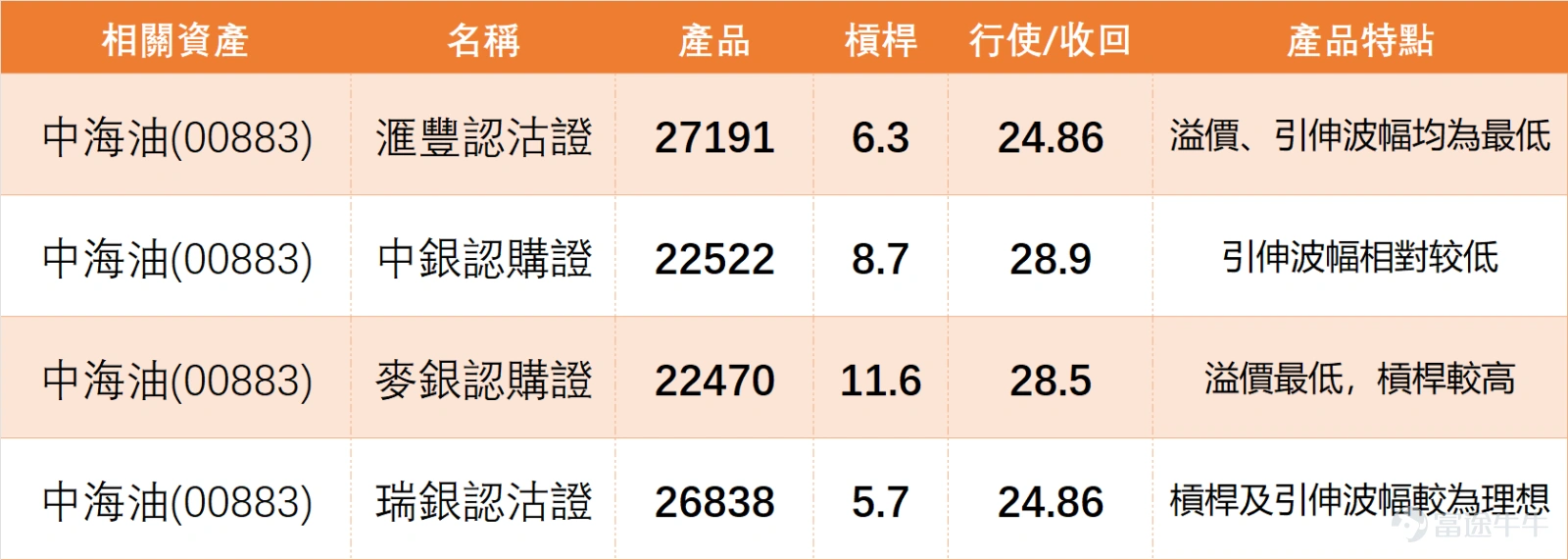
For more market analysis, stay tuned to Jenny's daily updates on 'Hong Kong Stock Warrants'!
Reminder: This article does not constitute any investment advice.
This article is for reference only and does not constitute any investment advice. The market data, opinions, and analysis contained herein may change at any time without prior notice. We are not responsible for any loss or damage caused by reliance on the information in this article. Technical analysis only shows whether certain technical conditions are met; a comprehensive assessment of asset performance should be conducted using additional data. Decisions to trade should not be based solely on this article. Please note that past performance is not indicative of future results.
#HKStocks #CNOOC #Real-TimeAnalysis #WarrantPick #WarrantGuide #DerivativesHedging #HKWarrantsJenny #Blue-ChipStocks #TechnicalAnalysis
Risk Disclaimer: The above content only represents the author's view. It does not represent any position or investment advice of Futu. Futu makes no representation or warranty.Read more

Comment (1)
to post a comment
2