Storage giants launch collective buybacks: Where does the supercycle stand?

Analysis of the A50 Index's Stable Uptrend: Transition from Old to New Drivers and Medium-to-Long-Term Allocation Strategies
Report Date: April 15, 2026
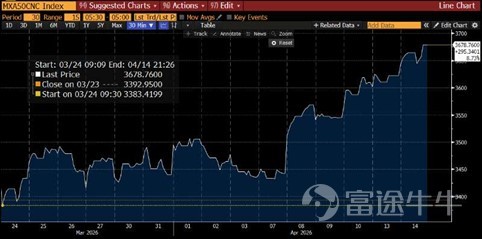
Recently, the MSCI China A50 Connect Index (hereinafter referred to as “A50”) has demonstrated strong upward momentum on the chart. During this wave of market movement from March 24 to April 14, 2026, the A50 rose more than 8%, breaking through its previous range-bound consolidation zone. Accompanying this remarkable rise, the narrative logic for China's A-share market in 2026 may have already changed. One signal cannot be ignored: the leading theme quietly shifting gears, with the A50 undergoing a 'metabolic renewal'.
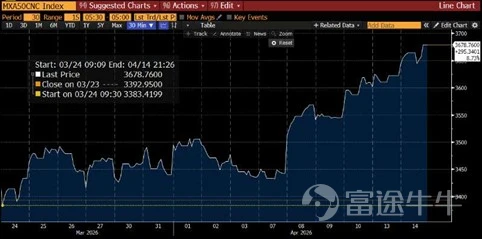
(Price trend of the MSCI China A50 Connect Index over the last 15 trading days, data source: Bloomberg, March 24, 2026 to April 14, 2026)
The continuous push for macroeconomic stabilization and growth, combined with accelerated domestic technological breakthroughs. The driving core of the A50 is transitioning from the past reliance on a single “large infrastructure + large finance” dynamic, to a dual-driven model of “macro support + advanced manufacturing and high-end technology.” In response to this fundamental restructuring of underlying logic, trading strategies must also evolve: de-emphasizing short-term speculation and embracing long-term allocation aligned with China’s economic transition from 'old to new drivers of growth.'
Macroeconomic Floor and Improved Liquidity: The Cornerstone of A50 Valuation Recovery
The current resilience of the A50 index is primarily based on a moderately loose macroeconomic environment. Entering 2026, clear signals indicate that domestic monetary policy will continue to focus on stabilizing growth. Multiple statements from the central bank and other departments reaffirm their commitment to maintaining reasonable liquidity abundance, providing solid bottom support for the equity market, especially for core weighted assets.
At the same time, the resonance effect of the global macro environment is becoming evident. As major overseas central banks enter a rate-cutting cycle, pressure on the China-US interest rate differential has eased somewhat, and expectations for the return flow of foreign capital and northbound capital are heating up. For an index like the A50, which has high representativeness and liquidity in international markets, the inflow of external funds raises its risk appetite baseline. This explains why, despite facing profit-taking pressures at key levels such as 15,000 points, the A50 index has still been able to maintain a consolidating upward trajectory. This combination of liquidity and policy support forms the macro premise for investors to confidently implement medium- to long-term strategic positioning at current levels.
The Rise of New Productive Forces: Reshaping the Pricing Logic of China's Core Assets
If the macro environment determines the 'floor' of the index, then industrial structure upgrading determines its 'ceiling.' Entering 2026, with ongoing policy efforts to stabilize growth and continuous technological breakthroughs, the pricing logic of core assets in China’s market is gradually shifting from being dominated by traditional weightings to a co-driven model of 'macro support + advanced manufacturing + high-end technology.' New productive forces are no longer just keywords in the macro narrative but have become an important thread in the medium- to long-term revaluation of A-shares.
From this perspective, the changes in the MSCI China A50 Connect Index better reflect the evolving definition of China's core assets. The index is based on the investable scope of Stock Connect and, while covering large-cap leaders, achieves a more balanced industry distribution by including representative companies from sectors such as information technology, industrials, new materials, and advanced manufacturing. This means that the index is no longer just a collection of traditional financial and consumer giants but is gradually becoming an important window to observe the transformation between old and new drivers of China’s economy.
Market validation: Technology and manufacturing take the lead in supporting the 'New A50'
The structural changes at the macro level have been clearly validated in recent market trends. In the past, the rise and fall of China's market heavily relied on the unilateral pull from traditional financial giants like banks and insurance companies. However, the recent market has shown a completely different characteristic: during a period when some traditional bank stocks were diverging or even weakening, hard-tech sectors such as semiconductors, telecommunications equipment, and advanced manufacturing have fully taken the lead, successfully picking up the baton of leadership.
Whether it's core sectors on the computing power side of the AI industrial chain or leading companies in high-end manufacturing and embodied intelligence, their continuous strength during trading not only alleviated the pressure brought by the weakening of traditional heavyweights but also provided support for the overall performance of the Chinese market. This new market norm of 'finance stabilizing the broader market while technology provides upward momentum' is the best proof of how technological breakthroughs are being converted into price signals in the secondary market.

(Data source: CSI Index, as of April 14, 2026)
Strategic allocation approach: Downplay short-term speculation, focus on industrial trends
In response to the dual changes in the fundamentals and structural aspects of the A50 Index, investors’ trading strategies can also be upgraded:
1. Maintain a long-term bullish strategy, aligning with structural upgrades
Investors can view the A50 as an important tool for benefiting from China's high-quality economic development and its technological breakthroughs. Against the backdrop of continued policy support and improved liquidity, the index’s long-term upward trend remains unchanged. As the weighting of technology and manufacturing continues to increase, the A50’s profit drivers will become even stronger. Investors may rely on key support levels (such as the 15,000-15,300 point range) for medium-term base position allocation, accumulating on dips and patiently waiting for the index to break through higher resistance levels (e.g., 16,500 points).
2. Core observation variable: Closely monitor the earnings realization of 'new quality productive forces'
The focus of the strategy needs to shift partly from traditional macro data, such as aggregate financing and infrastructure, to tracking the performance trends in the technology and manufacturing sectors. Investors are advised to closely monitor whether the financial results of newly included or heavily weighted tech stocks, such as AI computing power, semiconductors, and high-end shipbuilding, meet expectations.
3. Risk Management and Defensive Bottom Line
Despite being optimistic about the medium to long term, structural revaluation will not happen overnight. Investors should be wary of several key risks: first, the potential short-term valuation digestion pressure on the technology sector following consecutive sharp rises, which could lead to rapid fluctuations at the index level; second, shifts in overseas macroeconomic expectations (e.g., slower-than-expected interest rate cuts) potentially causing staged outflows of foreign capital; and finally, delays in the implementation effects of domestic growth-stabilizing policies, which may still weigh on index performance in the short term. Therefore, in terms of position management, it is recommended to avoid going all-in at a single point and instead use phased position building and futures-spot combinations to mitigate volatility risks.
Conclusion
The A50 Index in 2026 is gradually reducing its one-sided reliance on traditional finance and real estate, showcasing more diversified industrial resilience. Standing at the forefront of China's industrial upgrading, understanding the 'metabolism' of internal weightings within the A50 can help better grasp the revaluation theme for China’s core assets in the coming years.
Driven by both macroeconomic support and improved liquidity, the A50 Index has demonstrated clear medium to long-term allocation value. The China AMC MSCI China A50 Connect ETF (2839.HK) fills the gap in the financial ecosystem for A-share allocation through the Connect mechanism, serving as an ideal tool to capture the benefits of high-quality development.
China AMC MSCI China A50 Connect ETF (2839.HK / 82839.HK / 9839.HK)
• Coverage of leading companies: A basket of 50 large-cap stocks representing indicators of both new and old economies.
• Ecosystem alignment: An A-share allocation tool connected via the Connect mechanism, filling market gaps.
• Flexible strategies: Supports both long-term allocation and futures-spot arbitrage, meeting diverse trading needs.
$SSE Composite Index (000001.SH)$$CSI 300 Index (000300.SH)$$NVIDIA (NVDA.US)$$Amazon (AMZN.US)$$Alphabet-C (GOOG.US)$$Meta Platforms (META.US)$$Tesla (TSLA.US)$$HSTECH (LIST91332.HK)$$Hang Seng Index (800000.HK)$$SSE 50 Index (000016.SH)$$CSI 300 Index (000300.SH)$$CSI 1000 Index (000852.SH)$$SSE Science and Technology Innovation Board 50 Index (000688.SH)$$ChinaAMC CSI 300 Index ETF (03188.HK)$$SSE Composite Index (000001.SH)$$XIAOMI-W (01810.HK)$$JD.com (JD.US)$$TENCENT (00700.HK)$$Shenzhen Component Index (399001.SZ)$$Kweichow Moutai (600519.SH)$$Contemporary Amperex Technology (300750.SZ)$$PING AN (02318.HK)$$Alibaba (BABA.US)$$ICBC (01398.HK)$$CHINA MOBILE (00941.HK)$
Reference Materials:
East Money Network, March 22, 2026:https://finance.eastmoney.com/a/202603223679712110.html
East Money Network, December 24, 2025:https://finance.eastmoney.com/a/202512243600599481.html
Wall Street News, January 16, 2026:
Sina Finance, March 18, 2026:
Investment involves risks, including the possible loss of principal. Past performance is not indicative of future results. Before investing in the ChinaAMC MSCI China A50 Connect ETF (the "Fund"), investors should refer to the fund prospectus and carefully review the risk factors. You should not rely solely on this material to make investment decisions. Please note:
• The Fund's investment objective is to provide investment returns that closely track the performance of the MSCI China A50 Connect Index (the "Index") (before fees and expenses).
• The Fund is passively managed. A decline in the Index is expected to result in a corresponding decline in the value of the Fund.
• This fund's investment in equity securities is subject to general market risks. Its value may fluctuate due to various factors.
• Since the Index is a new index, the Fund may be subject to higher risks compared to other exchange-traded funds tracking indices with longer operating histories.
• The Fund faces concentration risk in a single region (Mainland China), and its volatility is likely to exceed that of more broadly diversified funds.
• The Fund faces risks related to Stock Connect, such as changes in rules and regulations, quota restrictions, or suspension of the Stock Connect mechanism.
• This fund is exposed to securities lending transaction risks, including the possibility that borrowers may not be able to return the securities on time or even at all.
• This fund is denominated in Renminbi (RMB). RMB is currently not freely convertible and is subject to foreign exchange controls and restrictions. Investors in fund units whose base currency is not RMB are exposed to foreign exchange risks.
• Since the trading categories of the fund listed on the Shanghai and Shenzhen stock exchanges may not be priced when their markets are open, the value of securities within the fund portfolio might change on days when investors cannot buy or sell fund units. Differences in trading hours between the Shanghai, Shenzhen, and Hong Kong stock exchanges, as well as trading restrictions on A-shares, could widen the premium/discount levels of the fund's listed category unit prices relative to its net asset value.
• Listed and unlisted categories follow different pricing and trading arrangements. Due to differing fees and costs, the net asset value per unit for each category may vary. The trading hours for listed categories on the secondary market, as applicable on the Hong Kong Stock Exchange, differ from the cut-off times for primary market listed or unlisted categories.
• Listed category fund units are traded at current market prices on the secondary market, whereas unlisted category fund units are sold through intermediaries based on the end-of-day net asset value. Investors in the unlisted category can redeem their units at net asset value, while investors in the secondary market listed category can only sell at the prevailing market price and may have to exit the fund at a significant discount. Investors in the unlisted category may have an advantage or disadvantage compared to those in the listed category.
• The trading price of the listed category is influenced by market factors such as supply and demand for fund units. As such, the trading price of the fund units may trade at a significant premium or discount to the net asset value of the fund.
• This fund involves tracking error risk.
• If cross-counter transfers between two counters for listed fund units are suspended, and/or due to any limitations in services provided by securities brokers and Central Clearing and Settlement System participants, unit holders will only be able to trade their fund units on one counter. There could be significant deviations in the market prices of listed fund units traded on various counters.
• Fund unit holders will only receive distributions in Renminbi (RMB). Unit holders without RMB accounts may incur fees and expenses related to foreign exchange conversion.
• This fund may, at its discretion, pay dividends out of the capital of the fund or effectively from capital. Payment of distributions out of capital or effectively from capital amounts to a return or withdrawal of part of the investor’s original investment or any capital gains attributable to that original investment. Any such distribution may result in an immediate reduction of the net asset value per unit of the fund.
Risk Warning:
Investment involves risks, including possible loss of principal. Past performance is not indicative of future fund returns. Any forecasts, projections, or opinions contained in this document are for your reference only and are not guaranteed to be achieved. This document is for your reference only and does not constitute an offer to buy or sell any securities or funds or an invitation to conduct any transaction or provide any investment advice, nor was it prepared for any such offer. The issuer of this material is China AMC (HK) Limited. This material has not been reviewed by the Securities and Futures Commission of Hong Kong.
Risk Disclaimer: The above content only represents the author's view. It does not represent any position or investment advice of Futu. Futu makes no representation or warranty.Read more

Comment (1)
to post a comment
2
1