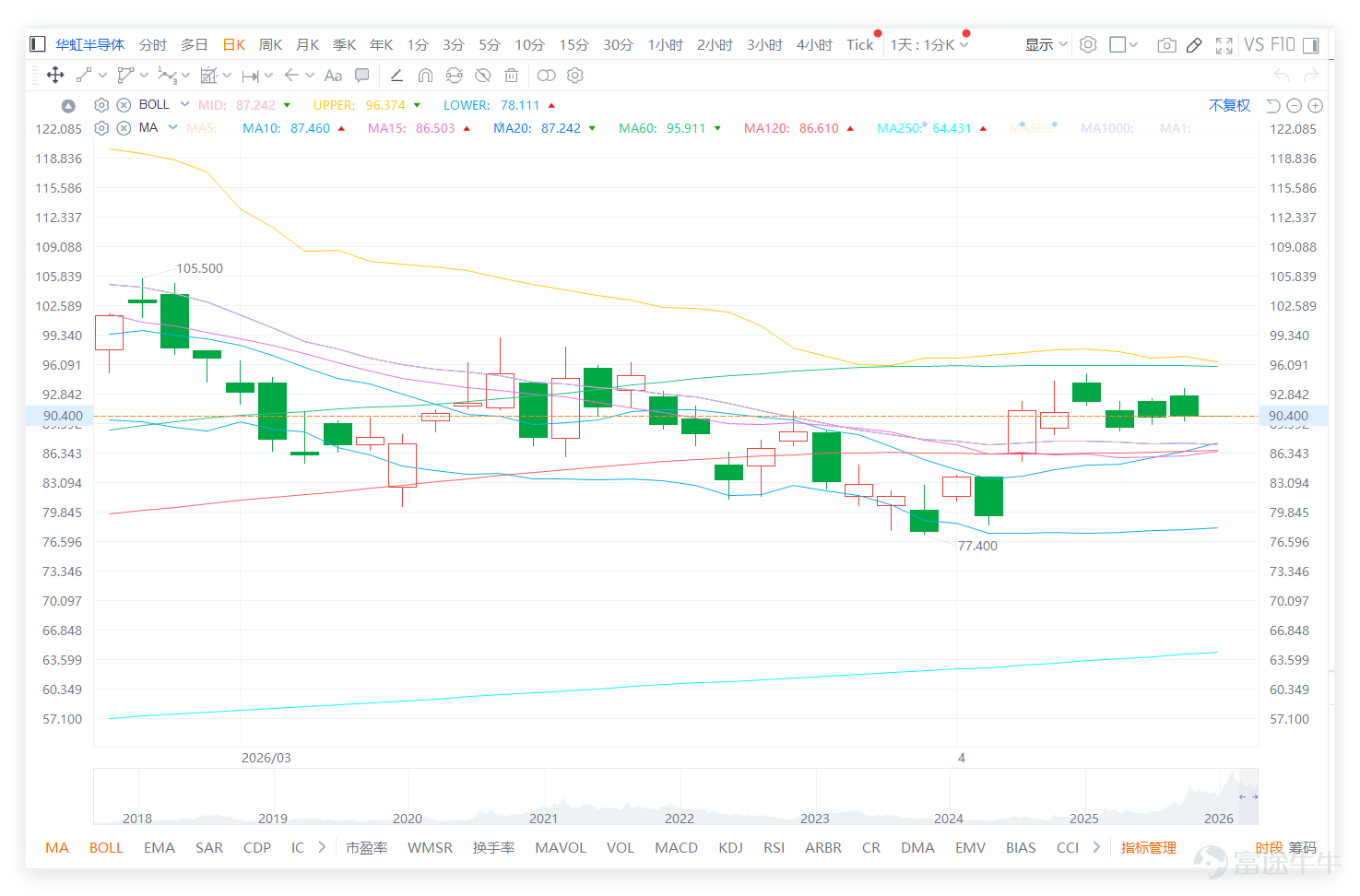

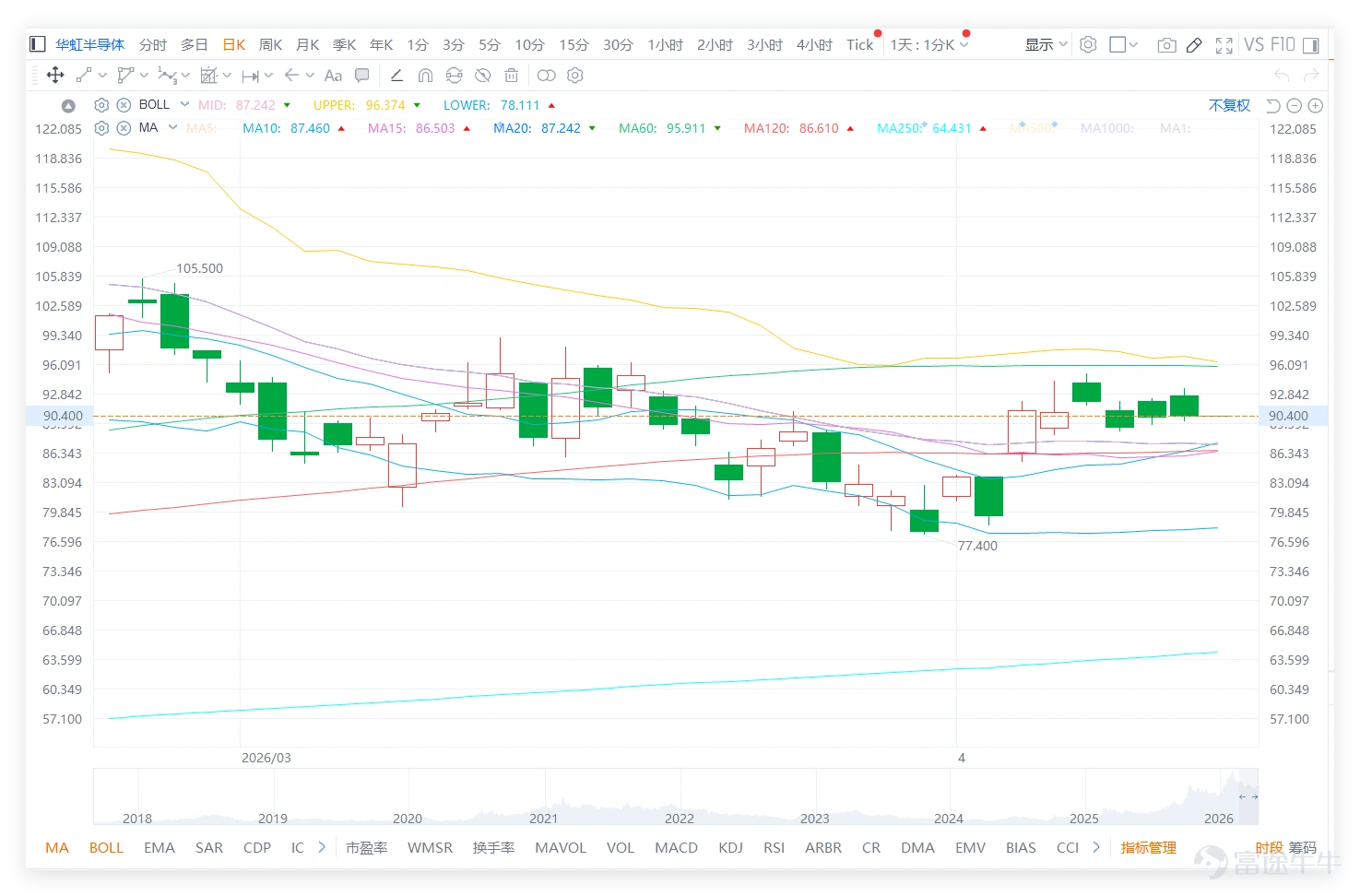
Hua Hong is consolidating around 90 yuan, and while above 92 yuan, it remains in the initial strengthening phase; a direct upward target towards 100 yuan is not yet viable.
On April 15, the stock closed at 90.40 yuan. The short-term trend is still in the consolidation phase following the rebound from the low of 77.40 yuan. The share price has now stabilized above multiple short-term moving averages, showing a structure more stable than before, indicating that a recovery from the lows has begun. However, this recovery has not yet truly evolved into a clear breakout, as the resistance zone between 92.00 yuan and 93.60 yuan remains quite critical. Until an effective breakout occurs, the trend can only be considered to be in the early stage of transitioning from weak to stable, rather than being fully strong.
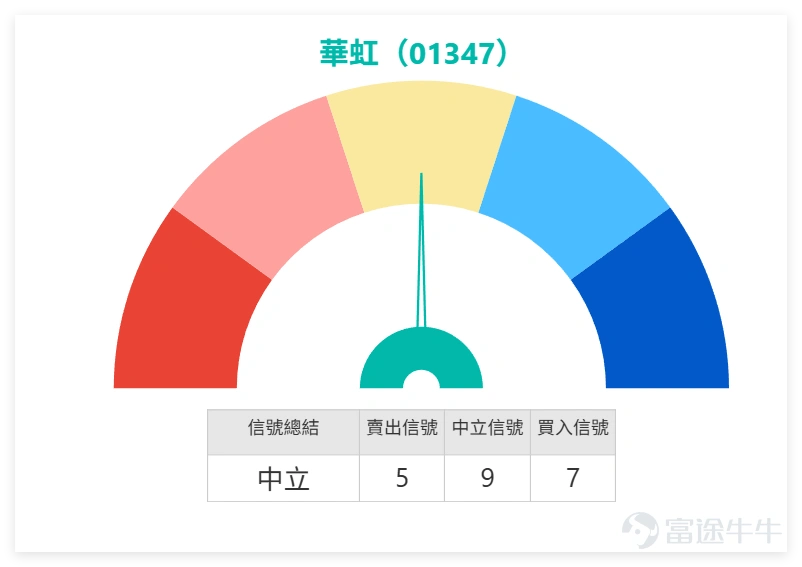
From the internal performance of the semiconductor sector, the market trend was mixed on the previous day (April 15). $SMIC (00981.HK)$ Rose by 2.33% to 59.3 yuan, with technical signals being 'neutral,' and the system holds a positive view of its technical rebound. $SHANGHAI FUDAN (01385.HK)$A slight drop of 0.25%, with the signal also being 'neutral'. What deserves high alert is$ASMPT (00522.HK)$, despite its stock price rising by 1.04%, its RSI has reached 72, entering the extremely overbought zone and receiving a 'strong sell' signal, indicating significant short-term risks. This shows that there are considerable differences in technical positions among individual stocks in the semiconductor sector, and a uniform strong trend has not yet formed. In this environment, Hua Hong Semiconductor's current consolidation trend of 'shifting from weak to stable' still requires further observation and confirmation for upward breakout momentum.
For the $100 target that many investors care about most, it’s important to calmly break it down at this stage.@牛牛宝娃、@天九翅@32079025 is watching targets like $98, $100, or even higher, but technically speaking, the stock price hasn't fully broken through the critical level of $92.00, so it’s naturally unwise to set overly ambitious goals in the short term. If the price can stabilize above $92.00 and then break above $93.60, the stock will have the potential to advance towards $96. Only after that should we discuss reaching $98 or $100 as more realistic. Setting $100 as a short-term goal right now could easily lead to emotions overriding technical analysis.
Looking at the trading rhythm, @231490653 mentioned gaining just a dollar or two daily, which actually reflects the current consolidation characteristics. The stock price isn’t weakening drastically but slowing down as it approaches resistance levels, moving back and forth while waiting for the next direction. The advantage of such a pattern is that it shows no immediate reversal after bouncing from lows; however, the downside is that if resistance isn’t broken, market patience will gradually wear out, leading to disappointment-driven selling pressure. Therefore, whether $92 can be broken remains the core factor for advancing the overall trend.
As for @願世界和平—It closed at $93.5, but only reached a high of $93.45, which precisely demonstrates that the overhead resistance is indeed substantial. When a stock rebounds to a resistance zone, the most common scenario is coming close but never breaking through because profit-taking and观望盘 (wait-and-see positions) start to appear at higher levels. @232554506 likened it to compressing a slingshot, which isn’t unreasonable since the stock price is currently in a compressed range. However, it’s important to note that the slingshot can shoot up or release downward—the key is first to see if $92 can hold effectively rather than prematurely assuming an upward move based on feelings.
Another focus in the market is the earnings and fundamental expectations. @15471982 repeatedly mentioned that Q1 2026 earnings might disappoint and cause a sharp drop when announced, advising against accumulating shares. Such concerns are understandable because when the stock is in the early stages of recovery and the market still doubts the fundamentals, breaking through resistance becomes even harder. However, from a short-term trading perspective, rather than pre-judging that earnings will definitely hurt the stock, it’s better to first see how the price reacts. If the price falls below $88.50 before earnings, it indicates an early market downturn; if it holds, it means funds haven’t completely withdrawn despite concerns.
@How infuriating. Your dad,@裘嘛尼Some feel that Hua Hong’s performance lags behind SMIC, even contemplating exiting. Such comparisons are common in the semiconductor sector, where rotation between leaders and second-tier stocks occurs naturally. Hua Hong’s issue isn’t a lack of recovery but rather a slower pace compared to the strongest performers, making investors feel left behind. @fdhhcf mentioned today following the broader Hang Seng Index, tomorrow possibly aligning with semiconductor pullbacks—highlighting a risk: Hua Hong isn’t strong enough to follow its own rhythm nor weak enough to collapse entirely, leaving it highly susceptible to broader market and sector sentiment.
As for bearish voices like @erdong88, @低吸高抛✅, @戰神007, @今晚又再打老虎, and @戴仲謀, they all converge on one judgment: this stock seems unable to rise at this stage, with deeper underlying risks potentially present. Technically, these worries aren’t baseless because as long as the stock fails to break $92, the possibility of renewed weakness after consolidation cannot be ruled out. However, it hasn’t turned completely bearish yet since support at $88.50 remains intact. In other words, it’s neither confirmed as strongly bullish nor definitively bearish—it remains a waiting-for-direction phase.
A more neutral strategy, on the other hand, fits the current situation better. If the stock price retreats and stabilizes near HKD 88.50, it indicates the range remains valid. At that point, one can consider it a low-risk buying opportunity within the range, with an initial target of a rebound to around HKD 92. If it directly breaks through HKD 92 and stabilizes, this would be a better momentum-based strategy, and the next target could extend to between HKD 93.60 and HKD 96. Conversely, if HKD 88.50 is breached, it signifies that this round of recovery has started to fail, and then one should be prepared for a retest of HKD 85.80. The short-term approach should also shift from cautiously optimistic to defensive.
Overall, Huahong Semiconductor is currently in the early strengthening phase transitioning from weakness to stability, but it hasn't truly completed a breakout yet. In the short term, the risk-reward ratio is moderately positive, and it’s not entirely impossible to be optimistic; however, it’s not yet at the stage where blindly chasing the price is advisable. The most important factor now remains whether HKD 92 can open up room for upward movement and whether HKD 88.50 can hold the structure. Before a breakout occurs, treating it as a consolidating stock would be more prudent; once the breakout is confirmed, the trend will have the potential to accelerate further.
Based on the above analysis, the strategies for deployment can be divided into the following main approaches:
The key short-term level for turning stronger is HKD 92.00. Before a breakout, the focus should be on range trading strategies; if HKD 88.50 is breached, one should switch to defense.
Strategy One | Breakout Momentum (Preferred)
$HSHUAHO@EC2608A.C (22973.HK)$ | Strike Price: HKD 88.93 | Actual Leverage: 3.4x | Close to the current price, suitable for following after a breakout above HKD 92
$CIHUAHO@EC2608A.C (22926.HK)$ | Strike Price: HKD 88.888 | Actual Leverage: 3.4x | Balanced terms, suitable for deployment after confirming a strengthening trend
$HSHUAHO@EC2608B.C (24753.HK)$ | Strike Price: HKD 140.09 | Actual Leverage: 4.5x | Higher leverage, suitable for extending gains post-breakout
Strategy Two | Range Buying (Neutral)
$MSHUAHO@EC2607A.C (20092.HK)$ | Strike Price: HKD 88.93 | Actual Leverage: 4.3x | Close to the support level, suitable for low-risk buying near HKD 88.50
$CIHUAHO@EC2608A.C (22926.HK)$ | Strike Price: HKD 88.888 | Actual Leverage: 3.4x | Stable terms, suitable for range-bound rebound plays
$BIHUAHO@EC2606B.C (23603.HK)$ | Strike Price 80.88 | Actual Leverage 3.9x | Deep in-the-money, suitable for conservative accumulation
Strategy Three | Defensive Pivot on Weakness
$BIHUAHO@EP2607C.P (25020.HK)$ | Strike Price 88.00 | Actual Leverage 3.2x | Suitable for defensive deployment after a drop below 88.50
$CTHUAHO@EP2607A.P (25315.HK)$ | Strike Price 87.95 | Actual Leverage 3.2x | Close to current price, suitable for following up during weakening phases
$MSHUAHO@EP2607A.P (25270.HK)$ | Strike Price 79.99 | Actual Leverage 3.9x | Higher leverage, suitable for deployment during ongoing weakness
For more market analysis, stay tuned to Jenny's daily updates on 'Hong Kong Stock Warrants'!
Reminder: This article does not constitute any investment advice.
This article is for reference only and does not constitute any investment advice. The market data, opinions, and analysis contained herein may change at any time without prior notice. We are not responsible for any loss or damage caused by reliance on the information in this article. Technical analysis only shows whether certain technical conditions are met; a comprehensive assessment of asset performance should be conducted using additional data. Decisions to trade should not be based solely on this article. Please note that past performance is not indicative of future results.
#HKStocks #HuaHongSemiconductor #Real-TimeAnalysis #WarrantSelection #WarrantGuide #DerivativesHedging #HKWarrantsJenny #Blue-ChipStocks #TechnicalAnalysis
Risk Disclaimer: The above content only represents the author's view. It does not represent any position or investment advice of Futu. Futu makes no representation or warranty.Read more

Comments (3)
to post a comment
2