
The 'lobster' doesn't just exist on the screen! iFlytek has made the direction of intelligent agent evolution clear
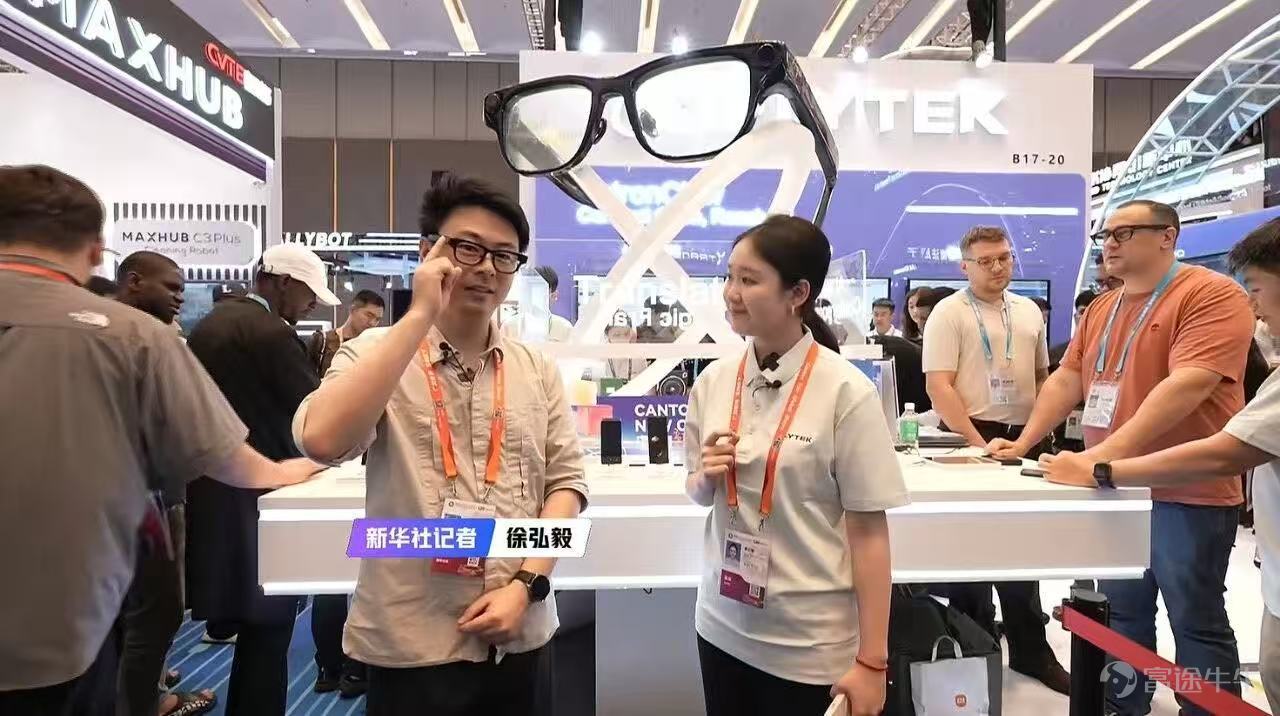
On April 15, the opening day of the Canton Fair, the venue was packed with people from all over the world, but interestingly, a pair of glasses became the 'highlight'.
A Xinhua News Agency reporter wearing a pair of glasses could learn a lot about a product by simply taking a glance and asking a question while touring the exhibition, including details about an iFlytek translator released last year. Most impressively, the glasses could generate an exhibition report based on previously viewed products and send it directly to WeChat.
Whether buyers or other visitors, attendees at the Canton Fair found such an experience incredibly useful.Moreover, throughout the entire exhibition tour, there was no need to take out a phone, unlock it, take photos, or search, yet a whole set of tasks continued seamlessly: product recognition, information search, multilingual translation, material organization, and even silently generating an exhibition report.
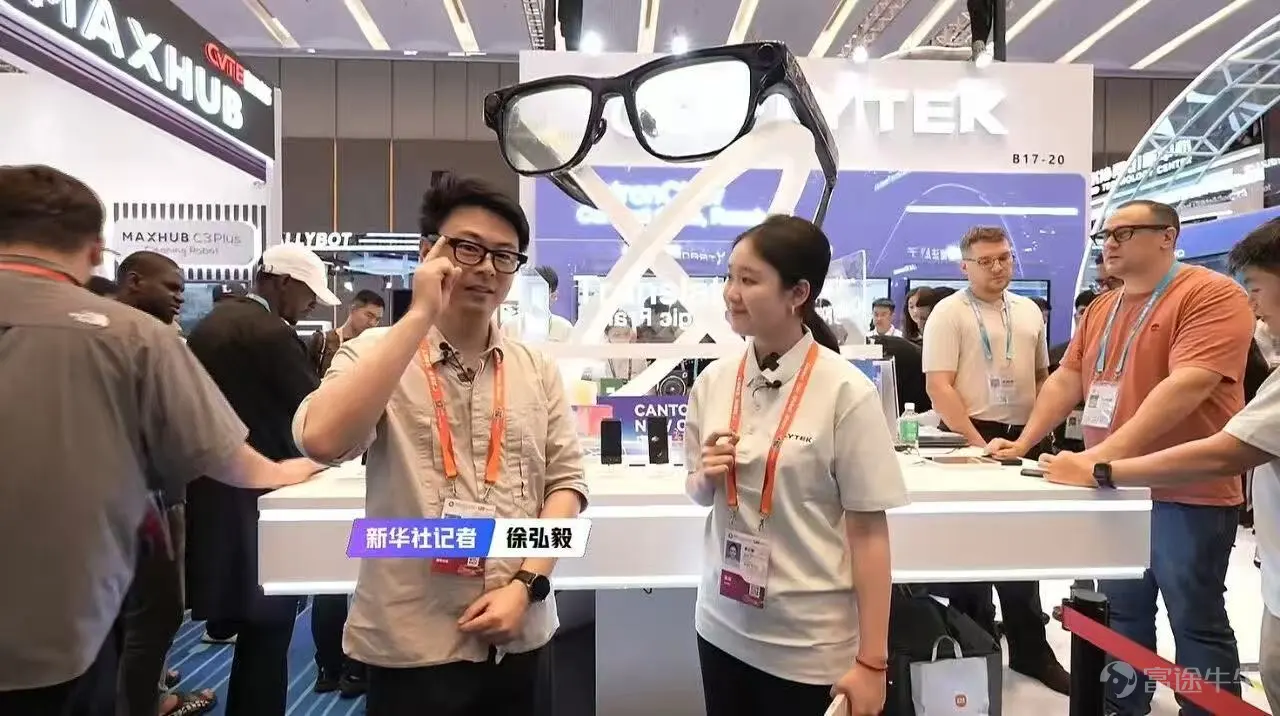
This is iFlytek's AI glasses, currently the world's lightest binocular monochrome display multimodal AI glasses, weighing only 40 grams. However, in the view of Lei Technology, what matters more is the system operating behind it.
Today, the transition of AI from 'being able to chat' to 'getting things done' has become an industry consensus. Intelligent agents (Agent), represented by OpenClaw, have truly taught AI how to utilize tools, break down tasks, and execute processes, making the technical path increasingly clear. However, there is still a noticeable gap between theory and practice, as most so-called intelligent agents remain confined to screens.
They can help you write code and documents, or complete complex processes in browsers and app windows, but essentially, they are still centered around the 'digital world' and struggle to participate in real-world work or assist us with more tasks.
The issue isn't really about the capability of the models but rather the boundaries of the systems. On the opening day of the Canton Fair at the AstronClaw upgrade conference, iFlytek provided a solution.With the newly upgraded AstronClaw at its core, linking software, hardware, and cloud capabilities to build an intelligent agent ecosystem that connects the digital world with the physical world.
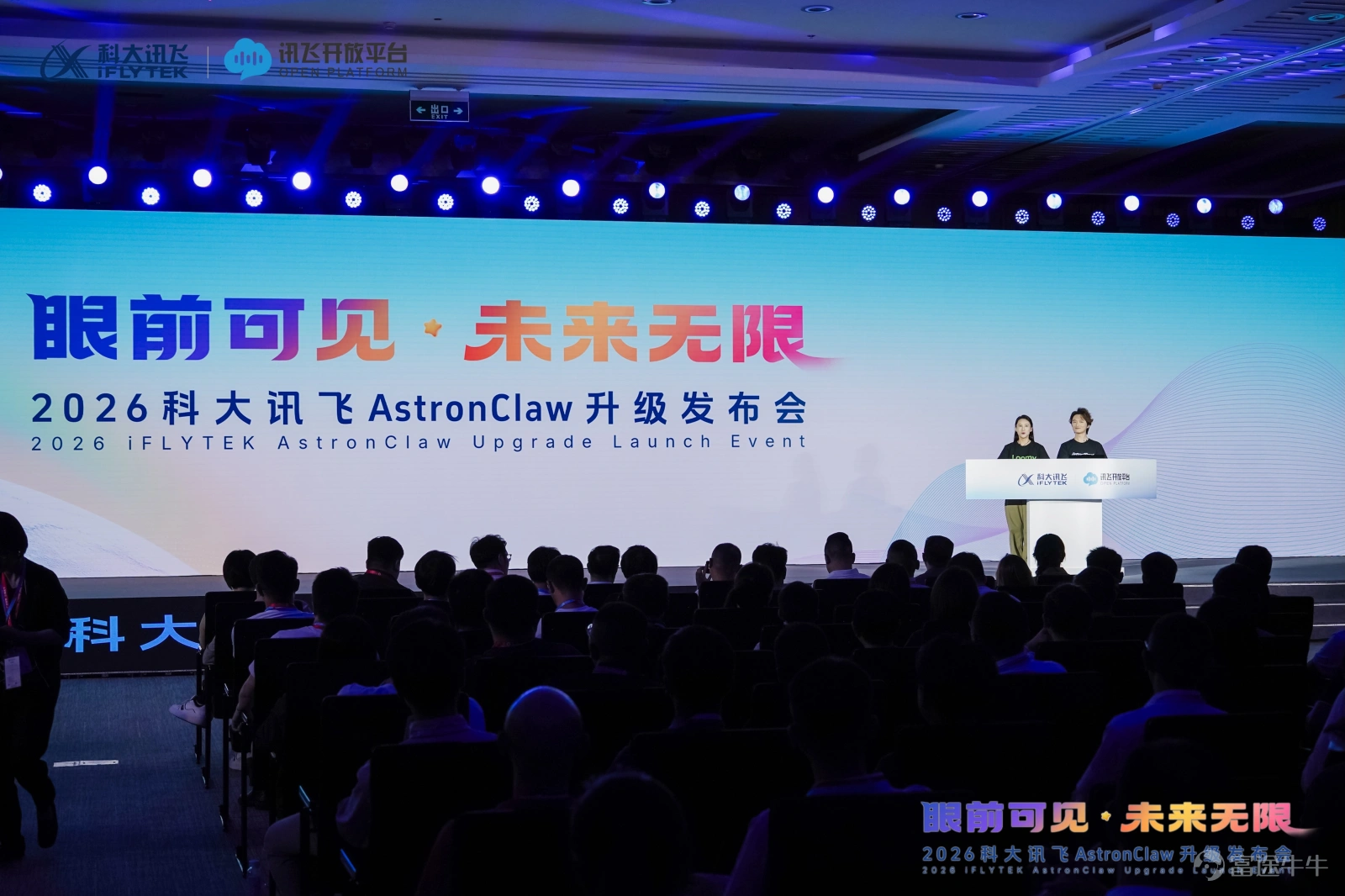
In response to this shift, iFlytek has presented a comprehensive set of solutions. From the newly upgraded AstronClaw, SkillHub to Loomy, from GlassClaw, RobotClaw to WallEX’s full suite of ‘lobster’ products, these offerings collectively point in one direction:
iFlytek is redefining the way AI works, and perhaps even the new working methods of our era.
AstronClaw has been fully upgraded, what exactly has iFlytek done
Back at the Canton Fair site. The GlassClaw featured in iFlytek's AI glasses, with its ability to see, hear, and translate, might be easily understood as a demonstration of multimodal interaction capabilities, but the key actually lies in the underlying connectivity and sustained execution capability.
Simply put, the voice and visual data collected by iFlytek AI glasses will be processed in real time by AstronClaw to understand, invoke capabilities, and generate results, which are then conveyed through iFlytek AI glasses, even further integrated into applications like WeChat, ultimately sending tweet links directly to booth staff. This represents the transformation brought by the upgrade of AstronClaw.
At the platform level, AstronClaw provides comprehensive operational capabilities, supporting cloud deployment, one-click startup, and 24/7 availability, while the Sandbox mechanism ensures secure task isolation, supports massive Skill invocation capabilities, and enables free switching between multiple models. But the truly core change is:
iFlytek's AstronClaw is evolving into an intelligent agent system capable of continuously executing tasks in the real world.
This point was illustrated with a very intuitive demonstration during the conference. Staff used the iFlytek office notebook to capture materials related to the Canton Fair, and AstronClaw automatically integrated the information, analyzed schedules, generated complete exhibition strategies, and synchronized them to devices, directly converting schedules into actionable items. Throughout the process, users hardly needed to participate in detailed operations; the system autonomously completed the full workflow of information acquisition, task planning, content generation, and device synchronization.
Under the new architecture, AstronClaw not only offers extensive support for various software, from office notebooks to glasses, from robots to home panels, allowing different types of devices to connect to this system for intelligent upgrades.

However, whether AI entering enterprise-level applications and real business processes is sufficiently secure, controllable, and trustworthy remains crucial.
On this matter, iFlytek has provided a clear answer.According to the 'OpenClaw-like Intelligent Agent Deployment Risk Management Guidelines' published by the China Academy of Information and Communications Technology (CAICT), iFlytek has become one of the first manufacturers to pass self-inspection, demonstrating to some extent that AstronClaw is already equipped with the ability to enter core enterprise scenarios in terms of security architecture, task execution isolation, and data processing standards.
Security is no longer an add-on but an integral part of system design. This further explains AstronClaw's positioning as not just a useful tool, but also a trusted infrastructure for enterprises to handle complex tasks.
Whether it’s processing on-site information through smart glasses or executing actions via robots, essentially the same system is at work. However, supporting such capabilities requires more than just foundational models and central systems. Therefore, we can see that iFlytek has shifted more focus toward building its ecosystem.
SkillHub is one of the key components in this effort.As the first enterprise-grade open-source and self-hosted AI skill management platform, SkillHub fundamentally addresses a more foundational issue: how AI capabilities can be accumulated, reused, and scaled within an organization.

In the past, many AI capabilities were 'skills within conversations.' They existed in individual calls but were difficult to manage, reuse, or accumulate into long-term assets. SkillHub, acting as a 'skill repository,' transforms these capabilities into reusable organizational assets that AI can repeatedly and directly access. It also provides full lifecycle management, including development, release, version control, permission management, review tracking, and decommissioning mechanisms.
Enterprises can manage their AI capabilities much like managing code repositories.
During the procurement scenario demonstration at the product launch, the value of this system became more tangible. Built on AstronClaw, 'Procurement Claw' leverages both general skills and customized category-specific skills to handle tasks such as drafting procurement documents, reviewing compliance, detecting abnormal behavior, and assisting in bid evaluation. Not only does this improve efficiency, but it also allows for reuse across different projects and teams, transforming individual experience into organizational capability.
This aligns with iFlytek’s core message at the event: the value of AI doesn’t lie solely in isolated capabilities, but in whether these abilities can be interconnected and sustainably operational. Only when AstronClaw facilitates these connections does AI truly gain the foundation to move beyond screens.
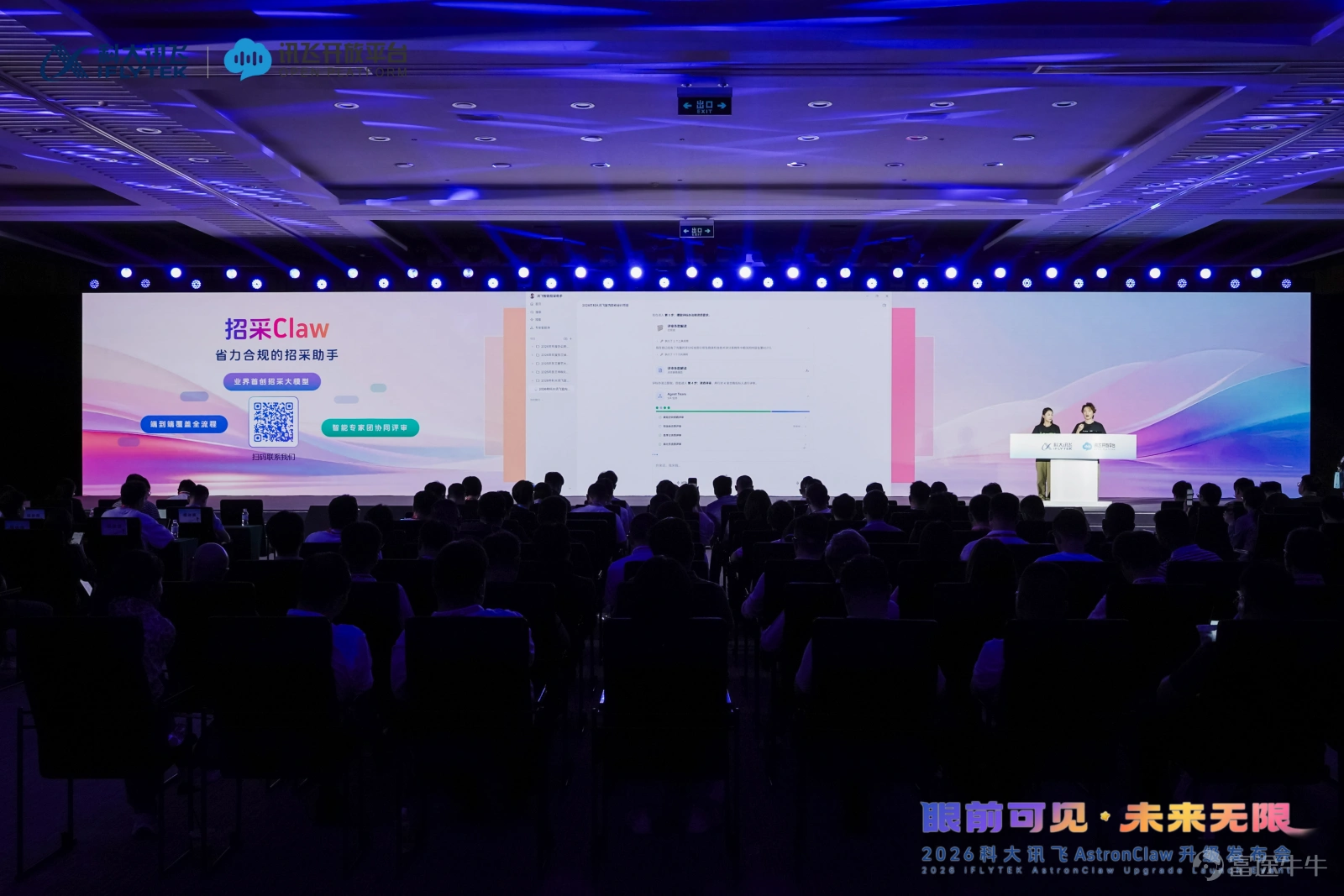
Bridging the digital and physical worlds, AI steps out from behind the screen.
With the upgraded AstronClaw, iFlytek’s desktop assistant Loomy has also received a complete overhaul. During the launch event, iFlytek clearly positioned Loomy as our 'work companion' in the AI era.
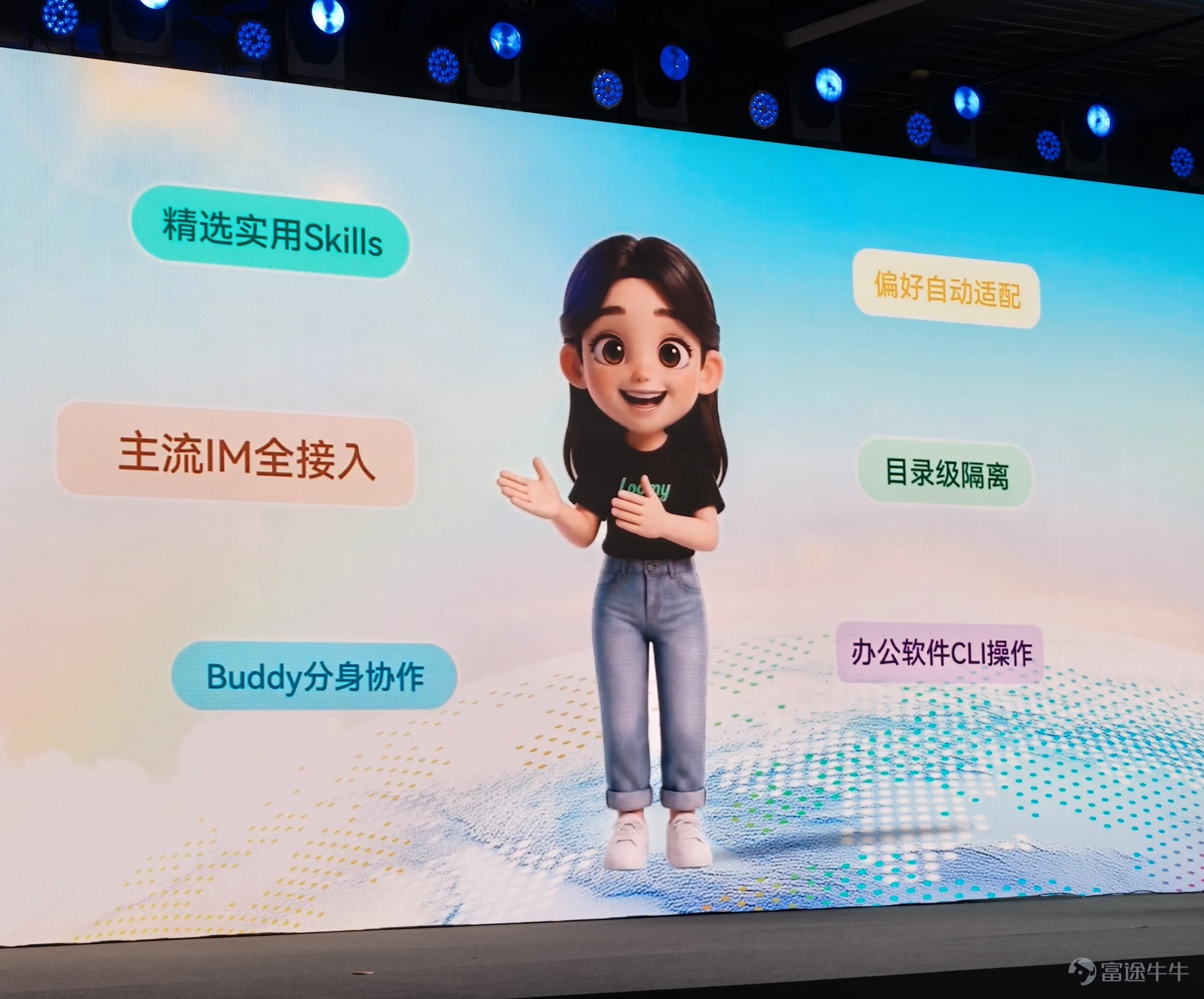
This statement may sound a bit abstract, but the changes behind it are very tangible.The logic of traditional AI assistants is to 'wait for you to speak.' Users give commands, and the AI assistant returns results; the interaction is discrete. However, Loomy’s design is more like a continuously online collaborator that can understand task objectives, make progress in the background, and proactively intervene at key moments.
In the demo, Loomy can automatically organize meeting minutes, arrange schedules, follow up on task progress, and even continue advancing work by accessing IM tools like WeChat or Feishu when the user is away from their desk. It doesn't just respond to commands; it actively responds and continuously executes around a goal.
This capability has been further amplified in the newly launched Loomy Buddy feature.By uploading photos and text, the system can generate an 'avatar,' or a customizable 'personified companion'—based on chat history, personality descriptions, or even an ideal role. The key is that it can not only understand the user's habits but also possess clear personality traits, communication styles, and value preferences, and proactively participate in daily life and work when appropriate.

The logic behind this functionality is clear: to transform AI from a 'tool' into a 'companion.' From this perspective, the relationship between humans and AI is also beginning to change. Users no longer handle specific operations but instead focus on decision-making and judgment, delegating execution-level tasks to AI for continuous advancement. But can AI truly step out of the screen and 'get things done' in the real world?
Part of the answer lies in the previously mentioned iFlytek AI Glasses.
As the latest multimodal AI glasses launched by iFlytek, the 40g ultra-lightweight design makes all-day wear possible while integrating full functionality for display, photography, and voice. More excitingly, iFlytek AI Glasses can precisely recognize speech even in noisy environments like the Canton Fair, accurately identify text under complex indoor lighting, and support real-time translation with millisecond latency.
However, its significance goes beyond being a mere combination of a translator, earphones, camera, and display device—it represents a new entry point for intelligent agents:What users see and hear, the AI understands, and at the same time, the field of vision becomes the interactive interface. In short, through iFlytek AI Glasses, what users see and hear becomes the most natural form of contextual input and interactive experience, and AstronClaw integrates these perceptual capabilities into a complete chain from 'perception' to 'execution.'
This step represents the true turning point, enabling the capabilities and experience of intelligent agents to extend from screens into the real world.
iFlytek has extended the same logic to 'RobotClaw,' a universal robot brain designed specifically for physical robots. During the launch event, with just a simple command from the host, an iFlytek Guide 01 robot integrated with Claw capabilities proactively approached and delivered a cup of coffee. Moreover, RobotClaw can also control on-site lighting and background music by invoking WallEX, the smart home panel.
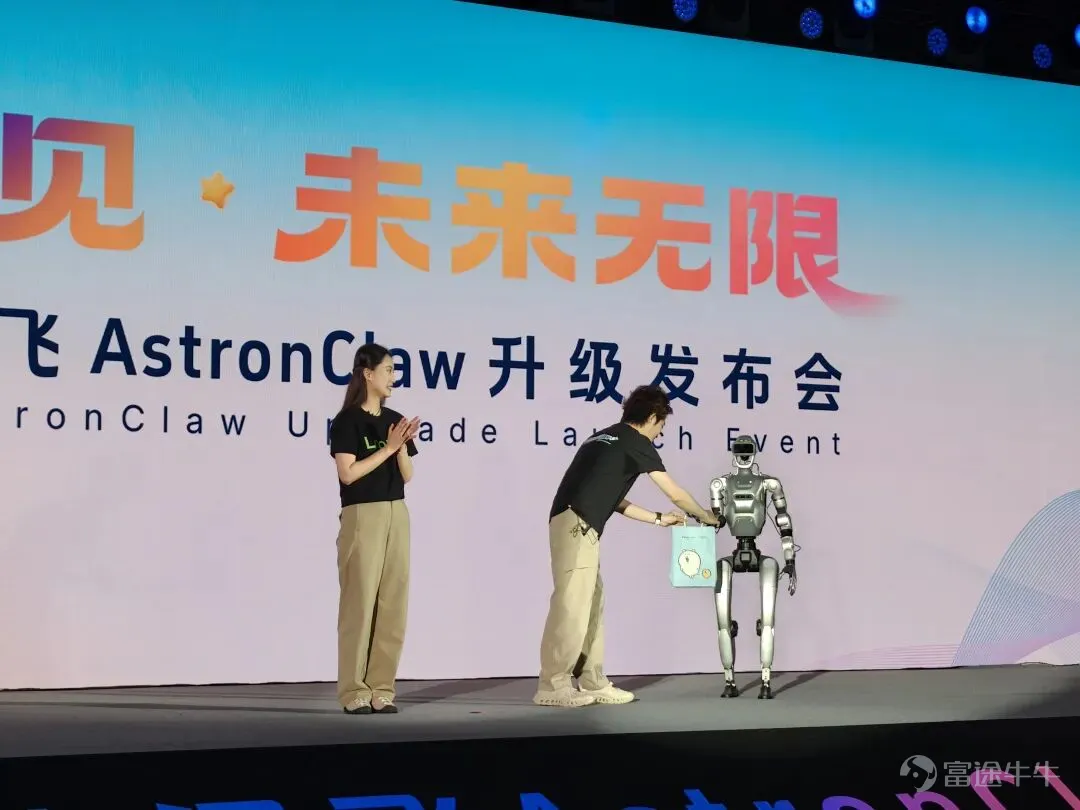
Behind this lies a series of perception, understanding, planning, and execution: the system automatically breaks down tasks, decomposing 'delivering coffee' into multiple steps such as path planning, motion execution, and voice announcements. It simultaneously generates navigation routes for the robot, dexterous hand operation commands, and necessary voice feedback throughout the process.
The entire process requires almost no human intervention and bridges the gap between the digital and physical worlds. A complex task that might have required multiple terminals and systems working in tandem is now compressed into a simple conversation.
It is at this moment that the value of hardware-software integration becomes tangible.
From Loomy continuously advancing tasks on desktops, to GlassClaw bringing perception into reality through iFlytek AI glasses, to RobotClaw driving robot action execution and WallEX managing environmental controls, this system completes a full cycle: AI understands and decides in software, perceives and acts in hardware, tasks flow between different devices, and users interact with AI through various device interfaces anytime, anywhere.
This signifies a more fundamental shift: AI is no longer tied to a specific device or entry point but has become an 'execution system' that spans all devices. Only when this kind of 'hardware-software integration' truly works does AI genuinely gain the ability to operate continuously in the real world.
In conclusion
An interesting aspect of today’s launch event is that it didn’t focus on 'how strong the model is.' At a time when the industry generally emphasizes parameters, rankings, and application formats, iFlytek chose a more systematic approach.They incorporated models, intelligent agent platforms, software, and hardware to create a truly operational intelligent agent system.
The challenge of this approach doesn’t lie in individual technical breakthroughs but in overall coordination.

As AI shifts from 'answering questions' to 'completing tasks,' the competitive landscape has changed. The key is no longer about who is smarter but about who can see a task through from start to finish and ensure stable performance across different scenarios. What this requires goes beyond model capabilities to include system architecture, device integration, ecosystem collaboration, and countless unseen engineering details—often the hardest parts to replicate.
Looking now at AstronClaw's upgrade, its significance lies not in the improvement of a single feature but in enabling agents to connect our digital and physical spaces, stepping out from chat windows on screens and gradually entering the real world. This is likely the core question iFlytek's release truly addressed.
And this development is just the beginning, yet it will undoubtedly transform how all of us work.
Risk Disclaimer: The above content only represents the author's view. It does not represent any position or investment advice of Futu. Futu makes no representation or warranty.Read more
Comments
to post a comment