
Spending over 600 yuan to 'cycle through torture,' another 'middle-class standard' sport is gaining popularity
(The author of this article is E-commerce Online, published by Titanium Media with authorization)
By E-commerce Online
A competition over the weekend once again pushed the torturous sport 'HYROX' to new heights.
On April 11, the HYROX (indoor fitness run) event made its debut in Wuhan, attracting over 4,000 participants. Some were drenched in sweat, some collapsed from exhaustion, and others posed for photos at the finish line with smiles. On social media platforms, many participants showcased their completion banners and "sports portraits," with related topics garnering over hundreds of millions of views.
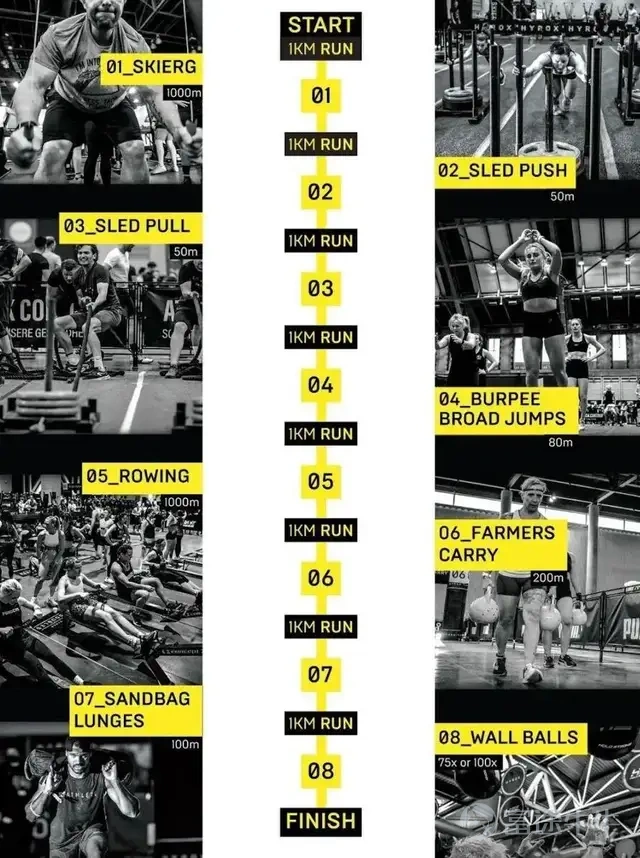
This niche event, born in Hamburg, Germany, in 2017, embraces the motto "FOR EVERY BODY." In terms of execution, HYROX can be described as an intense cycle of "8 one-kilometer runs + 8 fitness challenges."
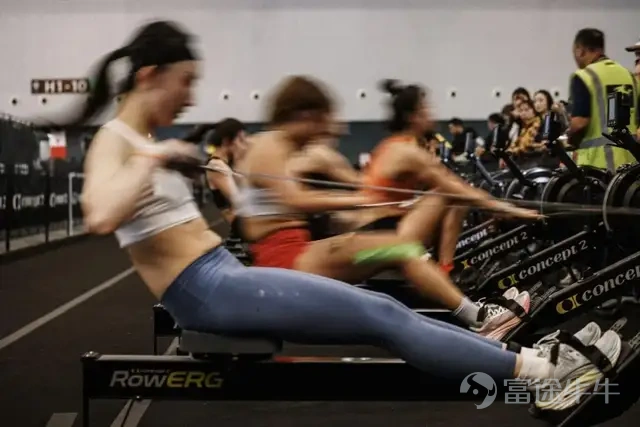
After completing each one-kilometer run, participants must tackle a fitness challenge, repeating this cycle eight times to finish. The eight challenges include using a ski machine, rowing machine, pushing and pulling sleds, long jump burpees, and weighted lunges.

Despite its grueling nature, HYROX has rapidly swept across the globe and become wildly popular in China, unleashing significant commercial potential.
In March this year, the HYROX Beijing event attracted 8,087 registrants, setting a new record for the largest number of participants in mainland China. Notably, among the competitors was Wang Shi, the 75-year-old founder of Vanke.With registration fees ranging from 600 to 800 yuan per person, the direct revenue from ticket sales alone for the Beijing event exceeded 5 million yuan.
How did this costly event manage to break into mainstream popularity within just a few years, drawing in a large number of affluent participants? What unique business strategies lie beneath its rising popularity?
Only on a stage governed by standardized rules can competitiveness be fully highlighted.
Christian Toetzke, a local entrepreneur from Germany, once observed that over 50% of Germans incorporate regular gym workouts as their primary form of exercise. These frequent gym-goers lift weights and run day after day, yet their training lacked a standardized competitive outlet.
In 2017, Christian Toetzke and Moritz Fürste, an Olympic gold medalist in field hockey, co-founded HYROX, creating a quantifiable fitness competition.
Unlike pure running or weightlifting, HYROX integrates common functional training exercises from the gym, combining aerobic and strength workouts into a 'hybrid training' that emphasizes stability, flexibility, coordination, strength, endurance, and explosiveness.
In 2017, the first HYROX event was successfully held in Hamburg, Germany, with 650 participants. Contestants could evaluate their fitness achievements through specific data generated during the competition and clear rankings.

Compared to the high barriers of CrossFit and marathons, HYROX offers an appropriately accessible entry point, not shutting out beginners who have fitness aspirations.
HYROX does not impose a cut-off time; even if participants run slowly or compete for several hours, they are not restricted. The focus is on participation. According to official race data, the completion rate for HYROX is about 98%, and some fitness trainers claim that an average person can participate after 4-6 weeks of training.
Moreover, to allow more people to participate, HYROX also features team events for pairs and groups of four. For example, in the four-person team category, each member only needs to complete two segments of the one-kilometer run and two functional training tasks in a relay format. In the Beijing leg of 2024 and the London leg of 2025, over 60% of participants competed in teams.
For middle-class fitness enthusiasts, HYROX's appeal goes beyond the competitive spirit ignited by its standardized format, extending to its underlying 'social currency' strategy.
Each HYROX competition selects a premium venue with strong local landmark significance. Throughout the race, especially near the finish line, professional photographers are stationed to capture exciting moments of participants, making it easy for them to share pictures and promote themselves on social platforms.
These action-packed photos and videos, edited with storytelling elements, amplify their appeal on social media, becoming more engaging, immersive, and aesthetically pleasing.
These social attributes have greatly helped HYROX rapidly expand globally. After entering China in 2024, participation grew swiftly. From just 650 participants at its inception in 2017, global participation exceeded 550,000 by 2025, increasing over 920 times.
What's boiling over isn't just the competition but also the commercial wave sparked by HYROX.
According to The Times, HYROX's annual revenue is estimated at approximately 84 million pounds (equivalent to 770 million yuan), with about 90% coming from registration fees. In March this year, the Beijing leg of the event attracted 8,087 registrants, compared to around 1,700 during its inaugural race just over a year ago, marking a nearly fourfold increase in scale. With registration fees ranging from 600 to 800 yuan per person, direct ticket revenue for a single event exceeded 5 million yuan.

HYROX China General Manager Yuan Fang revealed in a public interview that there will be around 10 competitions held in mainland China this year, with participants ranging from 6,000 to 10,000. The number of people expected to participate in training or potentially join the events is anticipated to reach between 200,000 and 300,000.
Apart from ticket sales, sponsorship fees are another visible source of revenue.
On the HYROX racecourse, advertisements from brands such as PUMA, Red Bull, Beats headphones, By-Health, and Biotherm can be seen everywhere.
Among them, PUMA established a partnership with HYROX during its first race. In 2023, it became a global partner of HYROX, accompanying the brand's journey from niche to phenomenal status.
In October 2025, PUMA announced the extension of its global partnership with HYROX until 2030, renewing the contract two years ahead of schedule. PUMA also became the exclusive title sponsor of the HYROX World Championships and expanded its roster of globally contracted elite athletes, including Jake Williamson, the men’s doubles world record holder in the open category.

Aside from sponsorships, gyms are also an indispensable ally for HYROX.
In fact, when HYROX was initially expanding its market, to quickly build momentum worldwide, it showed significant sincerity in collaborating with gyms. At the time, CrossFit charged each affiliated gym an annual licensing fee of 2,500 to 4,500 US dollars. However, HYROX set its annual licensing fee at just 1,500 US dollars, rapidly expanding through a 'discount strategy' within the industry.
In 2023, HYROX had just over 2,000 partner gyms worldwide. This number increased to 5,000 in 2024 and surpassed 10,000 in 2025. In the Chinese market, HYROX's officially certified partner gyms have exceeded 200, establishing a complete chain from daily training, pre-race preparation, to participation in competitions.
According to CCTV Finance, in pursuit of better results, some participants' expenses are continuously increasing. For highly involved athletes, annual comprehensive spending often exceeds 40,000 yuan.

More importantly, the potential of China's sports consumption is accelerating.
According to the "Opinions on Unleashing Sports Consumption Potential and Further Promoting High-Quality Development of the Sports Industry," the target for the total scale of the sports industry is set to exceed 7 trillion yuan by 2030. Against this backdrop, the growth potential of new event-based economies like HYROX extends far beyond what is currently visible.
However, as the commercial snowball of offline events grows larger, cracks are beginning to appear between the capital's jubilation and the participants' actual experience.
Placing HYROX on a longer timeline within the sports wave reveals that it is not an isolated case.
From the nationwide running boom sparked by marathons a decade ago to the obstacle challenges of Spartan races or outdoor hiking and cycling, people are increasingly willing to pay for the sense of participation, accomplishment, and belonging offered by sports activities.
A marathon finisher photo, a Spartan race medal, a short HYROX video—they all point to social signals of discipline and perseverance.
Nevertheless, the risks of rapid expansion are equally obvious.
Taking HYROX as an example, complaints about the serious mismatch between event services and fees have become hard to ignore. Some sessions faced insufficient water supplies at aid stations, delayed responses from medical points, no trophies, medals, commemorative T-shirts, or keychains after finishing, and participants only received a flimsy finisher's badge, all of which starkly contrast with ticket prices exceeding 600 yuan.
Moreover, due to HYROX employing a large number of volunteers and part-time referees, inconsistent judgments on action standards (e.g., whether the sled push crossed the line, whether the chest touched the ground during burpees, or whether sides were switched during farmer's walks) have led to disputes over results in different groups, even within the same round. Negative reviews such as 'finish times incorrectly recorded' and 'no video tracebacks for action reviews' are also increasing.

When consumers pay for a 'professional experience' but only receive amateurish execution, trust erosion becomes inevitable.
HYROX’s explosive popularity serves as a mirror reflecting the middle class’s pursuit of a healthy lifestyle while also highlighting the growing pains in the commercialization of sports events.
At present, the overall professionalism of domestic event operation teams still needs improvement. Many organizers remain at a rudimentary stage of 'renting venues, setting up stages, and selling tickets,' lacking foundational capabilities like exercise physiology assessments, risk management plans, and referee certification systems.
The sustainable development of the sports industry urgently requires a group of multidisciplinary teams who truly understand sports, business, and operations. They need to establish standardized talent training systems (e.g., referee grading evaluations, mandatory first-aid certifications, and credential-based employment), introduce technology empowerment (e.g., AI motion recognition timing, direct smart wearable data links, and digital twin trajectory simulations), and promote deeper integration of events with urban sports facilities and Q&M Dental fitness policies.
Only when social influence and professional persuasiveness no longer exist separately can a sports trend truly transcend cycles, evolving from a fleeting online sensation to an enduring annual attraction.
Risk Disclaimer: The above content only represents the author's view. It does not represent any position or investment advice of Futu. Futu makes no representation or warranty.Read more
Comments
to post a comment