
Wang Tao builds fortresses, Liu Jingkang sets up ladders: dissecting the billion-dollar covert battle between Shenzhen's two imaging giants
(This article was authored by TrueView, published by Titanium Media with authorized permission)
By TrueView
In a recent interview by 'The Afternoon Post LatePost' with DJI founder Wang Tao, when asked about the biggest difference between Insta360 and the competitors DJI had previously faced, Wang Tao used a very vivid metaphor: the boss of Insta360 is 'young and energetic, reminding me of the 'Red Boy.'
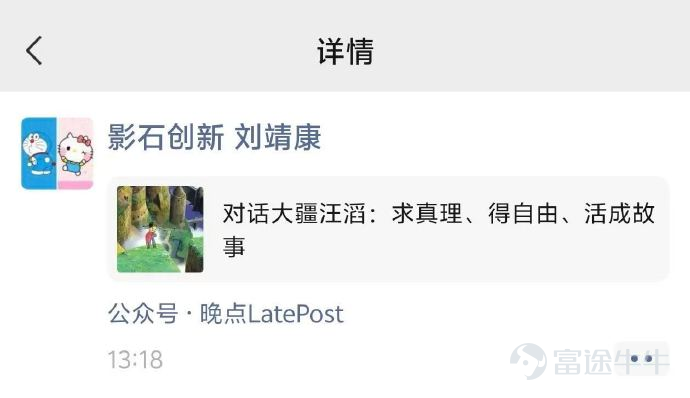
This statement quickly spread. Liu Jingkang, founder of Insta360 Innovation, subsequently reposted the interview on his social media without any additional comment. This silent repost was interpreted by outsiders as an unspoken acknowledgment of the challenge.

In 'Journey to the West,' the character Red Boy was born with great supernatural powers, relying on fire as his strength, fierce and fearless. But ultimately, due to his limited experience and unstable foundation, he was taken in by Guanyin as the Child of Fortune. Wang Tao used this metaphor to express a restrained admiration but also an undisguised sense of superiority.
Behind this literary teasing lies an escalation of tension between the two companies. Just a month ago, DJI officially filed a lawsuit at the Shenzhen Intermediate Court against Insta360 over six patent ownership disputes, directly targeting patents related to several former core R&D staff from DJI.
As early as July 2025, Insta360 released its first panoramic drone, and three days later, DJI countered with a panoramic camera priced at 2,999 yuan. This product war has been ongoing for nine months.
During the interview, Wang Tao added: 'We look forward to a business environment with healthy competition, where entrepreneurs have a higher-level tacit understanding of rules, instead of continuously creating publicity-driven topics in the media.' The statement sounded polite, but everyone understood it as a veiled jab at Insta360’s knack for generating public discourse.
However, Wang Tao himself gave an exclusive interview in the media, made the above comments, and sparked widespread discussion. On this level, both individuals are actually fighting the same narrative battle, just in different ways and with different postures.
What makes this competition most interesting is not only the divergence in product strategies, but also that both sides have completely different understandings of how this battle should be fought.
In Nanshan District of Shenzhen, within less than ten kilometers of each other, lie two streets that are home to the leading companies in China’s smart imaging industry.
On Liuxian Avenue, the glass-walled office building of DJI Innovation is so low-key that you can hardly see the logo, yet it dominates over 70% of the global consumer drone market. Meanwhile, at the other end of the Science Park, Insta360’s office area is plastered with creative posters from young employees. This company, founded less than a decade ago, once claimed the title of 'King of Panoramic Cameras' with an 85% market share.
For a long time, this was the most harmonious dual-power dynamic in Shenzhen's tech ecosystem: DJI ruled the skies, while Insta360 captured the ground. The two even formed an interdependent ecosystem, with DJI drones equipped with Insta360 panoramic cameras, jointly defining the limits of imaging.
But the iron rule of the business world is that when the growth红利 of a vertical market reaches its peak, the only way for giants to find their second growth curve is to cross boundaries and enter each other’s core territories.
Why now?
DJI's challenge lies in the consumer drone market entering its maturity phase. In 2024, China's consumer drone shipments are expected to reach about 3.5 million units, nearing saturation, with price wars and feature homogenization pressuring profit margins.
In the action camera segment, although DJI's Action series boasts impressive hardware performance, it faces tight competition from Insta360's Ace series in terms of young user口碑. Insta360's AI-powered automatic editing and panoramic features have created a strong competitive moat. For DJI, failing to take initiative could lead its product line into a mid-life crisis.
Insta360's challenge is more fundamental. As a publicly listed company, the capital markets demand continuous growth narratives, yet the ceiling for the niche panoramic camera market has always been relatively low.
In 2025, Insta360's revenue neared 10 billion yuan, but growth was primarily driven by action cameras. The absolute market size of panoramic cameras remains limited. If Insta360 cannot penetrate a larger consumer imaging market or evolve its story from a panoramic expert to an all-scenario imaging platform, its market value will eventually hit a ceiling. Drones represent Insta360's narrative anchor for upward突破.
Therefore, the 'ground-to-sky battle' of 2025 was not an impulsive move but rather an almost inevitable collision after both companies reached the limits of their respective growth trajectories.
This war is not just a clash of product lines but a confrontation of two fundamentally different philosophies of survival.
Frank Wang is a quintessential tech geek, obsessive about engineering and meticulous about performance. DJI’s competitive edge—its fully self-developed flight control, image transmission, and gimbal systems, over 38,000 authorized patents, and annual R&D spending accounting for 15% of revenue—is a direct result of this obsession.
DJI Innovations' total revenue for 2025 is projected to reach 85 to 90 billion yuan. As a privately held company, it does not need to report quarterly results to the capital markets, giving it ample resources to wage price wars, patent disputes, and talent battles.
Insta360 has a completely different DNA. Founder Jingkang Liu, with an internet background, behaves more like a product manager. His intuition lies in understanding users, breaking down scenarios, and lowering the barrier for creation through algorithms and user experience. When Insta360 launched its first panoramic camera in 2015, the core selling point was not hardware specifications but a revolutionary creative experience featuring post-capture selection and AI-powered automatic editing.
As of mid-2025, Insta360 has been granted 998 patents, including 222 invention patents, with the remainder being mostly utility model and design patents covering software algorithm areas such as panoramic stitching, FlowState electronic stabilization, and AI post-processing.

In 2025, Insta360's revenue reached 9.858 billion yuan, with R&D investment at 1.649 billion yuan. This gene of prioritizing algorithms over hardware allowed it to pursue a differentiation strategy when competing against DJI.

The two types of corporate cultures can coexist peacefully until they collide, at which point the friction becomes extremely intense.
The July 2025 incursion into each other’s core markets transformed the competition between DJI and Insta360 from a symbiotic offset to head-to-head combat. By now, this war has spread across four domains: panoramic cameras, action cameras, handheld gimbal cameras, and drones.
Panoramic cameras form the foundation of Insta360's business. Having ranked first globally for eight consecutive years since 2018, its market share peaked at 91% in Q1 2025. However, DJI's entry with the Osmo 360 rewrote the landscape within just three months.
According to Jiuqian Zhongtai data, in Q3 2025, DJI captured 43% of the global market share starting from zero, while Insta360 dropped sharply to 49%. LuoTu Technology’s Spring Festival weekly tracking in 2026 showed DJI dominating with a 62.9% total sales share, forcing Insta360 to retreat to 28.6%. In the panoramic camera segment, a single DJI product secured 52.9% of the market, whereas three Insta360 models combined for 45.1%.


But the essence of the panoramic camera competition lies in the battle for content ecosystems. The creator community Insta360 has built over the years, its influencer collaboration ecosystem, and the vast amount of user-generated content are its most genuine barriers to defending against DJI. Hardware can be matched, algorithms can be replicated, but the network effect of a content ecosystem is accumulated over time and cannot be bought with money in the short term.
In the fiercely competitive action camera market, the divergence is most apparent. DJI's Action 5 Pro focuses on mechanical stabilization, a large sensor, and professional color; while Insta360's Ace Pro 2 emphasizes dual-lens switching, AI smart tracking, and fun shooting modes.
The gap between the two products is less about technology and more about a divergence in user positioning: DJI serves professional users, while Insta360 targets young people who prefer effortless creation.
These two groups could have coexisted, but the problem is that with the popularization of AI creation tools, the demand for effortless creation is rapidly penetrating the mainstream user base. If DJI fails to offer an engaging enough experience, its professional label will become an invisible wall.
Insta360’s release of the 'Shadow Feather A1' panoramic drone represents the riskiest surprise attack in this entire campaign. Facing DJI's formidable flight control technology and patent fortress, Insta360 did not directly compete on flight performance but instead introduced the differentiated concept of an 'aerial panoramic camera,' raking in 20 million yuan in sales on the first day. However, this move also fully ignited DJI’s patent barrage.
Whether Insta360 can succeed depends on whether the panoramic shooting experience is compelling enough for users to accept compromises in flight performance. For Insta360, drones are likely to remain a strategically cash-burning track in the short term.
In April 2026, DJI filed six patent ownership dispute lawsuits against Insta360. This marks the first time DJI has initiated an ownership-related lawsuit domestically, focusing not on infringement damages but on the ownership of the patents themselves.
The essence of this lawsuit is DJI's attempt to maintain its technological monopoly through legal means while increasing Insta360's R&D and legal costs, affecting its market valuation and capital market performance. For Insta360, this is also a public opinion battleground it must face head-on—retreating would signal weakness, while boldly counter-suing and portraying itself as an 'innovator suppressed by a giant' could win public sympathy.
Regardless of the outcome of the litigation, the real deciding factor lies in who can define the next-generation paradigm for intelligent imaging?
DJI's organizational culture is designed to create the world's best professional tools, rather than to enable everyone to create easily. As incremental users shift from being professional photographers to ordinary people wanting to capture good content, DJI’s professional tool DNA will naturally filter out some younger users who are more sensitive to fun and ease of use.
The release of Osmo 360 shows that DJI has recognized the issue, but adjusting the product logic is far more complex than launching a new product.
Insta360's biggest survival risk at present is not product competition, but the combination of patent wars and supply chain pressures.
If DJI's patent lawsuit gains support, Insta360 may face product removals and hefty compensation; shrinking profit margins caused by price wars will squeeze R&D investment space.
For a publicly listed company, if it cannot maintain profitability under this dual pressure, the confidence of the capital markets will be the first domino to fall.
However, Insta360 holds a significant card: an algorithmic edge that builds a moat around its content ecosystem. Panoramic content has much higher sharing rates on social media compared to regular action camera content; Insta360’s AI-powered automatic editing feature has already enabled tens of millions of users to create effortlessly.
Once network effects within a content ecosystem take hold, it becomes very difficult to disrupt through hardware competition alone. Insta360’s greatest hope is to leverage the rapid development window of AI technology to push the paradigm of 'panoramic imaging + AI creation' to a large enough user base, positioning itself as the standard-setter for the next generation of creative tools, rather than just a participant.
The high walls of the hardware empire and the flexible defense lines of the AI content ecosystem are clashing fiercely. Regardless of the final outcome, there are bound to be more interesting business stories unfolding on these two streets in Nanshan District, Shenzhen, amid the charge towards mass-market consumer electronics and the wave of AI-driven creativity.

Risk Disclaimer: The above content only represents the author's view. It does not represent any position or investment advice of Futu. Futu makes no representation or warranty.Read more
Comments
to post a comment