‘Top Venture Capital City’ Hefei: Leveraging a New Energy Vehicle Industry Chain Map to Unlock a Trillion-Dollar Market
(The author of this article is CLS from the Industry Alliance, published by Titanium Media with authorization)
By CLS Industry News
On China's new energy vehicle city map, Hefei has been frequently mentioned in recent years.
By 2025, Hefei will produce 1.3707 million new energy vehicles annually, accounting for approximately 8.3% of the national total (16.524 million units), once again ranking first among all cities nationwide. This translates to over 3,750 new energy vehicles rolling out daily from Hefei to various markets.
However, rewinding five years, the situation was vastly different. Back then, Hefei’s state-owned capital announced a 7 billion yuan investment into Nio, sparking considerable controversy – some questioned whether a central provincial capital had the capability to bet on the new energy industry, with no shortage of pessimistic voices.
Over the years, the situation has gradually shifted. BYD, Volkswagen, Changan Automobile, and other automakers have successively established operations in Hefei. Nio reached its one-millionth mass-produced vehicle milestone here, while local companies began achieving scaled shipments in sectors like automotive-grade chips.
The doubts that once surrounded the city have slowly faded, replaced by a renewed external assessment of this CityDev trajectory.
Today, it is hard to overlook Hefei.
In 2019, Nio faced a life-or-death crisis. According to publicly available financial data, Nio reported a net loss of 11.413 billion yuan for the whole year of 2019, and by the end of the fourth quarter, its cash and cash equivalents balance was only about 990 million yuan. Founder Li Bin sought financing from 18 cities, but all efforts hit a wall.
At that point, any rational investor would have walked away.
But Hefei didn’t.
Hefei's state-owned assets injected 70 billion yuan into Nio as a strategic investment. This is not a "gamble," but rather the first deal in Hefei's largest-ever "chain-based investment promotion" in its history.
After Nio's establishment in Hefei, it quickly built an advanced manufacturing base, driving the clustering of upstream and downstream industrial chains. More importantly, this move sent a signal to the world: this city’s attitude toward the new energy vehicle industry chain is not about "testing the waters," but going "all-in."
What Nio brings goes far beyond just one car company.
Nio has promoted localized component support within the Xinqiao Intelligent Electric Vehicle Industrial Park and arranged multiple industrial parks, such as Xinqiao and Lu'an, within Hefei's 1.5-hour radius. Based on a production capacity of 1 million vehicles, at full capacity, logistics costs alone could save companies approximately 3 billion yuan annually. This efficiency has been replicated by later entrants—
BYD Hefei Base: From negotiation to signing took only 23 days, from signing to groundbreaking took 42 days, and from groundbreaking to full vehicle rollout took less than 10 months. By 2024, production capacity will reach 950,000 vehicles. After the completion of Phase III, annual production capacity will reach 1.32 million vehicles, achieving an annual output value of nearly 200 billion yuan.
This is Hefei’s investment logic: it’s not about giving money, but providing a chain. They map out the industrial chain for you; you just need to fill in the blanks.
A map to understand Hefei’s new energy vehicle industrial chain
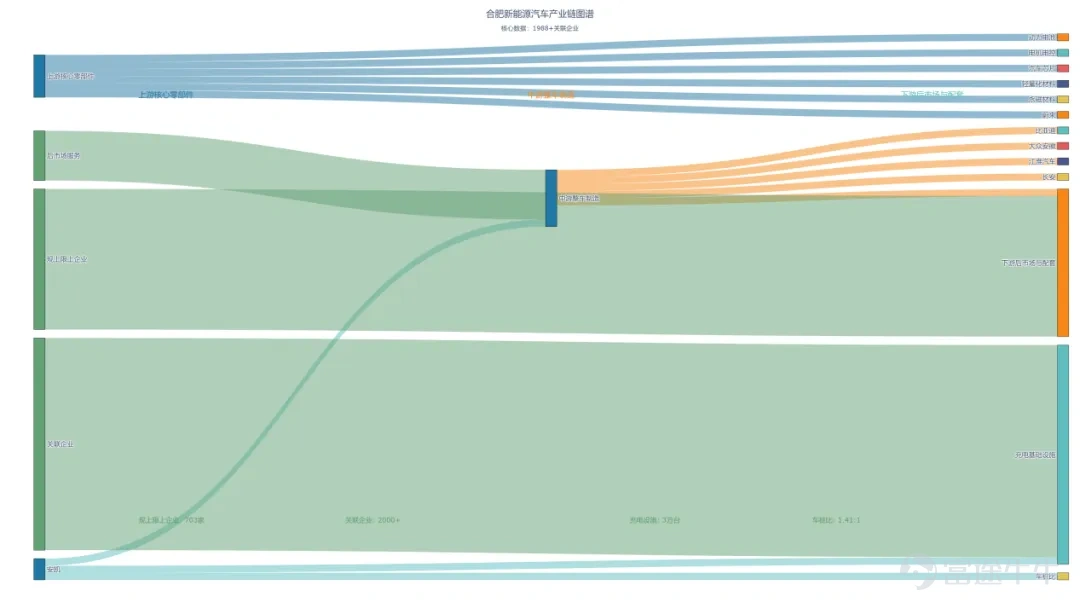
After five years of planning, Hefei has built a complete industrial chain covering 'upstream components – midstream vehicle manufacturing – downstream aftermarket.'

This Sankey diagram clearly illustrates the upstream and downstream relationships of the industrial chain:
Upstream core components (blue): power batteries, motor controls, automotive chips, lightweight materials, permanent magnet materials
Midstream vehicle manufacturing (orange): Nio, BYD, Volkswagen Anhui, JAC Motors, Changan, Ankai
Downstream aftermarket and supporting services (cyan): Charging infrastructure, vehicle-to-charging pile ratio, aftermarket services
Key data annotations (green): 703 large-scale enterprises above designated size, over 2,000 associated companies, 30,000 charging facilities, vehicle-to-charging pile ratio of 1.41:1
[Upstream - Core Components]
Power batteries: Guoxuan High-Tech (top ten in global installation volume), CALB (Hefei base)
Motor control systems: Giant Power (among the top three domestic motor installations, delivering 162,500 units in the first half of 2025)
Automotive chips: Nexchip (one of the top three mainland wafer foundries, with millions of MCU shipments for automotive use), AutoChips (automotive-grade MCU design)
Others: Huitong Shares (lightweight materials), Earth-Panda (neodymium iron boron permanent magnets)
[Midstream - Vehicle Manufacturing]
Nio: China headquarters + advanced manufacturing base, with the one-millionth mass-produced vehicle rolling off the assembly line on January 6, 2026
BYD: Hefei Mega Factory, with the third phase completed, has an annual production capacity of 1.32 million vehicles
Volkswagen Anhui: The model 'ZhongYu 08,' jointly developed with XPeng, officially went into production in Hefei on March 13, 2026
JAC Motors: Partnering with Huawei to create the ultra-luxury flagship model 'ZunJie S800'
Changan and Ankai: Regional production bases
[Downstream - Aftermarket and Supporting Facilities]
Charging infrastructure: As of November 2025, Hefei has built over 30,000 public charging facilities, achieving 100% coverage across all townships
Vehicle-to-charger ratio: As of the end of June 2024, Hefei's vehicle-to-charger ratio was 1.41:1, significantly surpassing the national average
Aftermarket services: Hefei hosts more than 400 aftermarket service companies
This industrial chain includes six complete vehicle manufacturers, 703 regulated enterprises above a designated size, and over 2,000 supply chain-related businesses
Hefei has achieved the capability to produce a fully integrated new energy vehicle without leaving the city
Nio: A million-unit milestone, self-developed and self-produced electric drive systems
On January 6, 2026, Nio's one millionth mass-produced vehicle rolled off the production line at its Hefei Xinqiao No. 2 plant, officially entering the 'Million-Unit Club'.
Two months later, Nio’s two millionth electric drive system rolled off the assembly line at the Hefei No. 2 Electric Drive Manufacturing Plant.
What does this mean? Nio is not just a car manufacturer; its electric drive system has achieved full-stack self-development and local manufacturing in Hefei—from motors to controllers.
BYD: The 'Hefei Speed' of producing one car every 50 seconds
At BYD's Hefei plant, a new car rolls off the production line every 50 seconds on average.
After all three phases are fully operational, the annual production capacity is expected to reach 1.32 million vehicles, accounting for approximately 20% of BYD’s total planned automotive production capacity, driving the upstream and downstream industrial chain's total output value to no less than 300 billion yuan.
Volkswagen Anhui: 24 months from official announcement of cooperation to mass production
On March 13, 2026, Volkswagen and XPeng’s first jointly developed model, the 'Zhong Yu 08,' officially began mass production in Hefei. It took only 24 months from the official announcement of the collaboration to the start of mass production of the co-developed model.
Volkswagen Group's Chairman of the Board of Management, Oliver Blume, publicly stated: "The Zhong Model 08 is a significant step forward in the group's firm march towards becoming a 'global automotive technology leader'." He added that the future hub of technological innovation may not only be Wolfsburg but also Hefei.
Nio, BYD, and Volkswagen, three world-class automakers, stand side by side in Hefei—a rare sight in any city across the country.
A complete industrial chain map should not just focus on the automakers in the spotlight. The 'hidden champions' buried deep within the chain are what truly reflect the depth of Hefei's industrial ecosystem.
[Champion One] Guoxuan High-Tech: From 'Hefei-Made Batteries' to 'World Standards'
On November 20, 2025, Guoxuan High-Tech held a mass production delivery ceremony for its standard battery cells in Hefei, becoming the world’s first company to achieve mass production and delivery of UC battery cells.
This standard battery cell, jointly developed with Volkswagen, offers a cost reduction of up to 50% compared to the batteries previously used by Volkswagen.
Behind this achievement lies five years of joint research efforts. In July 2021, Volkswagen signed an agreement with Guoxuan High-Tech to co-develop the first generation of standard battery cells. Today, this 'Hefei Core' will supply multiple platforms under Volkswagen, forming a key pillar of the automaker's EV cost strategy.
[Champion Two] Nexchip Integration: A Breakthrough Player Among China’s Top Three 'Automotive Chip' Manufacturers
On April 9, 2026, Nexchip Integration and AutoChips Technology, a subsidiary of NavInfo, jointly announced that the cumulative shipment volume of their fully localized automotive-grade MCU AC7803 had exceeded one million units.
One million units mark the "watershed" for automotive-grade chips transitioning from lab samples to mass production. This not only signifies that the chip has withstood rigorous tests under real and complex road conditions, but also demonstrates the comprehensive maturity of China's domestic automotive chip industry chain in terms of "design + manufacturing" collaboration.
Crystal Integrated has now obtained IATF16949 certification in the automotive chip sector. Some automotive-grade platforms have passed AEC-Q100 certification and have been successfully integrated into the supply chains of leading domestic automakers.
[Champion Three] Juyi Power: The "hidden ace" in motor and electronic control
In the first half of 2025, Juyi Power's new energy vehicle motor and electronic control parts business achieved a delivery of 162,500 sets.
The company's electric drive products are supplied in bulk to several mainstream automakers including Honda, Volkswagen, Ford, Jiangling, JAC, Chery, BAIC, and others. Its latest generation oil-cooled flat wire three-in-one system has successfully entered mass production. The product was tested at an electric drive system testing center accredited by CNAS, which possesses a full set of advanced software and hardware simulation, performance calibration, durability testing, EMC, and NVH capabilities.
These three companies operate across three core areas: power batteries, automotive chips, and motor-electronic controls — Hefei’s industrial chain does not "pile up enterprises," but rather "fills key nodes." At each node, there is at least one "hidden champion" that ranks prominently nationwide.

Five years ago, Anhui's automobile production ranked only eighth nationwide. A central province used five years to complete a transformation from being a follower to becoming a leader — Hefei’s "chain-based investment promotion" model played an indispensable role.
In 2025, Anhui Province’s total automobile production reached 3.6865 million vehicles, surpassing Guangdong Province’s total automobile production of 3.0402 million vehicles, making it the top automobile-producing province in the country.
Now, Hefei is striving for even higher goals: By 2026, it aims to push Zunjie's "super factory", Volkswagen Anhui Phase II, and Nio’s third factory to reach full production capacity, targeting 1.55 million new energy vehicles produced and a total automobile output of 1.85 million vehicles. It also aims to exceed 1,000 enterprises in the entire industrial chain, with an industrial scale surpassing 500 billion yuan.
Industry Scale and Future Goals
If you only look at the data, it's easy to mistakenly assume that Hefei's new energy vehicle industry is merely 'growing rapidly'; however, if you extend the timeline, this is almost a textbook example of industrial leapfrogging.
By 2024, the city has pushed the total output value of its industrial chain to 260 billion yuan, with a net increase of 71 billion yuan in just one year. The production of new energy vehicles reached 1.376 million units, accounting for over 10% of the national share, while exports skyrocketed to a growth rate of 3.3 times. In its industrial landscape, 703 large-scale enterprises, from complete vehicles to parts and even after-sales markets, are seamlessly integrated. This isn't a single-point explosion but rather a fully formed system.
As we move into 2027, the city’s ambitions will no longer be confined within domestic borders—a 700-billion-yuan automotive industrial cluster, 2 to 3 brands with international competitiveness, and a comprehensive ecosystem positioning it as an 'internationally leading new energy vehicle capital.' This is an incredibly detailed blueprint for the future.
Looking back at its growth curve makes it easier to understand that all of this is no accident. From 2016 to 2019, annual production hovered below 100,000 units; by 2020, it had jumped to 200,000 units, then surged to 600,000 units within two years. By 2023, it hit 740,000 units, and in 2024 doubled to 1.376 million units—completing the leap from 'low visibility' to becoming a 'core player nationwide' in just a few years.

This growth trajectory perfectly illustrates the 'chain reaction' effect of Hefei's new energy vehicle industry.
This near-exponential growth is not simply about 'riding the wave.' It's more akin to a classic chain progression: starting with key nodes, gradually extending upstream and downstream, ultimately creating synergy across all links. When the system matures, the growth rate amplifies accordingly.
Thus, rather than saying Hefei 'made the right bet,' it's more accurate to say that it built the framework of its industrial structure earlier and continuously filled in the gaps. By the time the outside world took notice, this system had already begun operating autonomously.
When people describe this city as 'gambling' again, perhaps a more fitting description would be—it never relied on chance.
Risk Disclaimer: The above content only represents the author's view. It does not represent any position or investment advice of Futu. Futu makes no representation or warranty.Read more
Comments
to post a comment