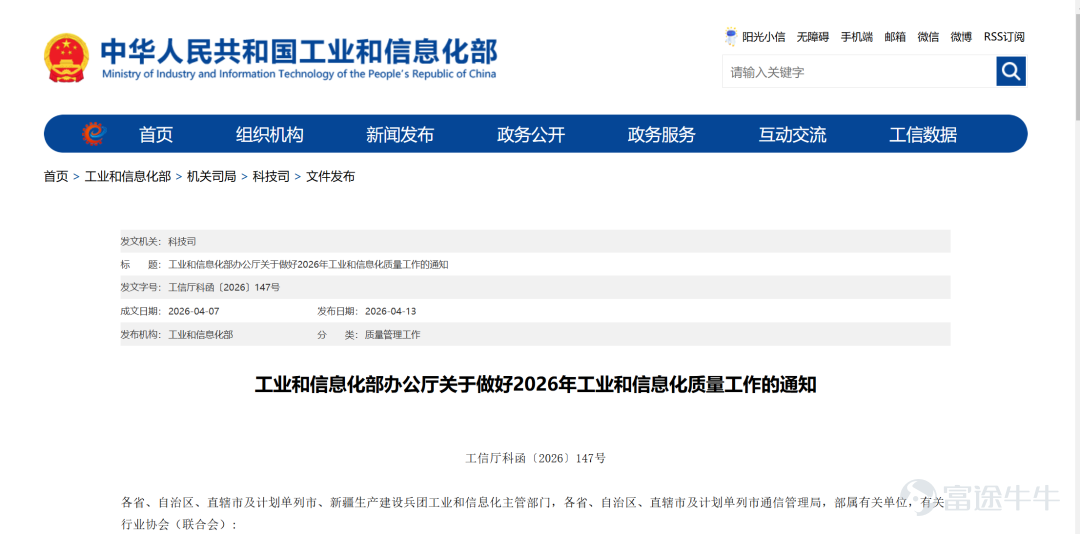

Strict control over low-quality production capacity, the Ministry of Industry and Information Technology issues a significant regulatory document, marking a turning point for the chaotic internal competition in lithium batteries and photovoltaics
(The author of this article is Foresee Energy, published by Titanium Media with authorization)
By Foreseen Energy
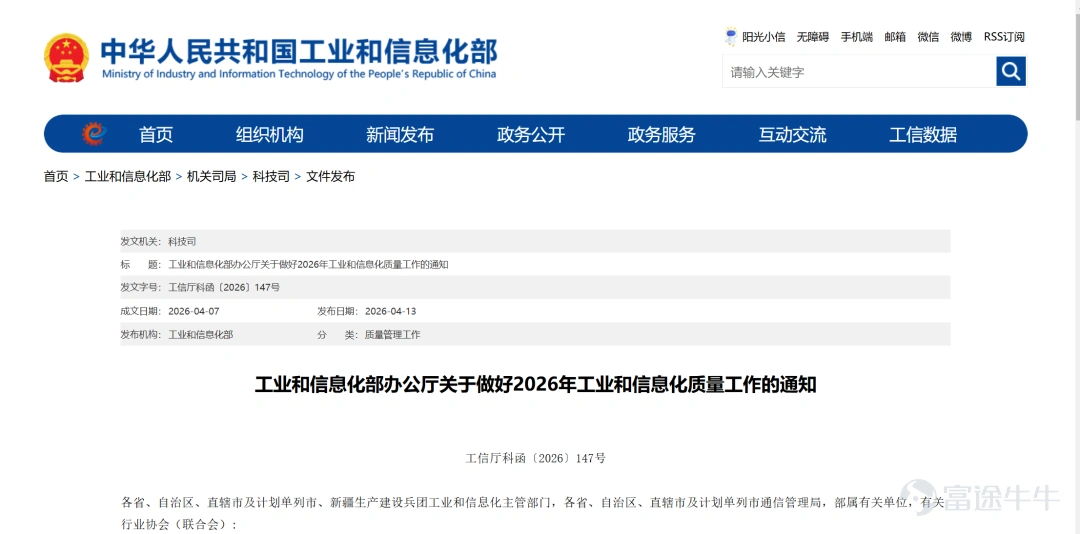
According to the latest information from Foresee Energy, on April 13, 2026, the General Office of the Ministry of Industry and Information Technology issued a notice listing lithium batteries and photovoltaic modules as key targets for product quality inspections. This is not a routine document.
A little over two months ago, Volvo globally recalled more than 40,000 EX30 electric vehicles due to high-voltage battery defects, with the cost of replacing battery modules alone reaching $1.95 billion. During the same period, the State Administration for Market Regulation tested 70 batches of crystalline silicon photovoltaic modules, finding 9 batches不合格, and 4 companies still不合格 after retesting.
On one side, international automakers are paying nearly $200 million for battery quality issues, while on the other, domestically produced photovoltaic modules have collectively failed national inspections. The Ministry of Industry and Information Technology has now elevated quality checks in these two major industries to an annual priority task, signaling a clear judgment: the 'involutionary' price war has pushed quality control to the brink.
The price collapse in the photovoltaic industry is staggering. From 2022 to 2025, domestic photovoltaic module prices dropped from 2 yuan per watt to around 0.6 yuan. Polysilicon prices fell from a peak of 300,000 yuan per ton to approximately 55,000 yuan. In June 2025, module prices briefly fell below 0.6 yuan per watt, with companies' gross profit margins generally below 5%, and many second- and third-tier manufacturers facing cash flow disruptions.
Zhong Baoshen, Chairman of LONGi Green Energy and a National People's Congress representative, stated bluntly: the photovoltaic industry is currently mired in an 'involutionary' price war. The root cause lies in severe overcapacity and lagging quality standards, making it difficult for companies to gain premium pricing through technological innovation, forcing them to rely on price cuts to survive.
Price reductions naturally come with cost-cutting measures.
Data from the National Solar Photovoltaic Product Quality Inspection and Testing Center shows that from 2017 to 2024, the overall pass rate of random inspections of modules significantly declined, particularly from late 2023 onwards, where the declining trend in pass rates closely mirrored the drop in module prices. To save costs, some photovoltaic glass manufacturers compromised on materials and tempering temperatures, with some even using highly toxic arsenic trioxide as a clarifying agent in photovoltaic glass. Sample tests revealed average arsenic content exceeding 100 ppm, with some reaching nearly 2000 ppm.
Non-compliance with chemical composition standards for frames led to reduced mechanical performance. Ethylene-vinyl acetate (EVA) film weight decreased from the standard requirement of over 410g to an average of around 320g. Defects in diode manufacturing processes in junction boxes could potentially cause fires.
These cost-cutting measures ultimately showed up in the national inspection results at the beginning of 2026. Seven batches of products failed mechanical load testing, mostly due to insufficient frame strength and excessive micro-cracks. In the photovoltaic module glass segment, six out of 22 batches inspected failed bending strength tests, involving multiple enterprises such as Hainan Control Sanxin and Jiangxi Ganyue.
The lithium battery industry has also not escaped the vicious cycle of 'low price-low quality.' Energy storage cell prices fell from around 0.4 yuan per watt-hour in 2024 to below 0.318 yuan per watt-hour by the end of 2025, with the lowest touching 0.28 yuan per watt-hour. National People's Congress representative Zhang Tianneng pointed out that some companies cut safety configurations, falsify parameters, or use substandard cells to reduce production costs.
In the first half of 2025, over 30 small and medium-sized system integrators exited the market due to low-price competition, with leading companies' net profit margins generally falling below 3%.
A batch of electric bicycle batteries from Eve Energy failed the 'overcharging' test in Anhui Province's inspection – under circumstances where the protective device malfunctions during prolonged charging, the batteries could emit smoke or catch fire. Qingdao Guoxuan Battery recalled 672 JTM Gold Lithium batteries as they did not meet national flammability standards and could not prevent flame spread after being passively ignited.
Such problems are not exclusive to smaller players. In the first three quarters of 2025, Eve Energy reported revenue of 45.02 billion yuan but its net profit attributable to shareholders fell by approximately 9.07% year-on-year. The phenomenon of 'increased revenue without increased profits' reflects how industry competition is eroding profitability.
This is not an isolated instance of a company's 'technical shortcomings,' but rather an industry-wide compromise forced by price wars.
Price wars are a 'market behavior' spontaneously formed by the industry, while quality inspections represent regulatory intervention as a form of 'counter-cyclical adjustment.' The latter is progressing with a frequency and intensity that exceeds market expectations.
In the first quarter of 2026, the State Administration for Market Regulation conducted quality supervision spot checks on 41 types of products. Among photovoltaic modules, 9 out of 70 batches were found non-compliant, with four companies failing re-inspection, highlighting the stubbornness of the issue. The Ministry of Industry and Information Technology (MIIT) announced that quality control would be elevated from random inspections to an annual priority task.
Foresee Energy predicts that policies targeting 'internal competition' will tighten comprehensively. On April 9 this year, four departments including the MIIT, National Development and Reform Commission, State Administration for Market Regulation, and National Energy Administration jointly convened a symposium with companies in the power and energy storage battery sector to address capacity warning regulation, standardize price competition, and strengthen product quality oversight. A similar high-level symposium was held on January 7, indicating that the frequency itself sends a message.
The same applies to the photovoltaic sector. In March 2026, six departments including the MIIT jointly issued the 'Guiding Opinions on Promoting the Comprehensive Utilization of Photovoltaic Modules.' Deputy Director Wang Shijiang of the MIIT's Electronics Information Department explicitly stated: '2026 is a crucial year for governance in the photovoltaic industry, with addressing internal competition being the top priority.'
When price wars drive profits to unsustainable levels and lead to quality loss, regulatory intervention becomes essential to set a baseline. Without rigorous quality inspections as a hard constraint, 'anti-internal competition' remains merely an industry self-regulatory appeal.
Improving quality is not about shouting slogans; it requires real financial investment.
In photovoltaic modules, the cost difference between high-quality frames and inferior ones can exceed 10%, and the cost gap between flame-retardant encapsulation films and ordinary films is also significant. When module prices fall from 2 RMB/W to 0.6 RMB/W, this cost difference becomes a matter of life and death. Zhong Baoshen’s judgment is straightforward: quality standards lag behind capacity expansion, making it difficult for companies to gain premium pricing through technological innovation, leaving price cuts as the only way to survive.
Leading companies like LONGi Green Energy and TCL Zhonghuan have repeatedly called for industry self-discipline, but in the face of massive overcapacity, no one dares to raise prices first—raising prices means handing over market share to competitors.
The situation in the lithium battery industry is similar. Planned overcapacity rates often exceed 150% or even 300%, leaving price competition as almost the only way out. The Volvo EX30 battery fire incident highlights a harsh reality: when battery safety issues move from recall announcements to fire scenes, the damage is not just to corporate profits but also to consumer trust in the entire product category.
In China, disputes over roof PV leaks, cracks, and fires are emerging in large numbers. Some homeowners have reported on the Black Cat Complaints platform that after installing the Chint Anli photovoltaic system, their roofs suffered severe leaks, and repeated calls to customer service resulted in evasion. Farmers have complained that PV systems installed by a subsidiary of TCL caused fires due to quality issues, burning the roof, damaging the floor slabs, and cracking walls, with no one discussing compensation to date.
The biggest loser in a price war is never the company, but the consumers who ultimately bear the quality risks.
This time, the Ministry of Industry and Information Technology's focus on key product quality inspections is essentially about forcefully 'leveraging' quality in the tug-of-war between price and quality. How much change this lever can drive depends on two variables: the degree of routine inspections and the severity of penalties for non-compliance.
Currently, regulatory measures remain limited to 'removal, seizure, detention, and urging rectification.' Compared to the survival pressures brought by price wars, such penalties may have limited deterrence. Truly effective regulation should make companies that cut corners pay a higher price than the cost advantage gained through such practices.
Photovoltaics and lithium batteries are two of the few fields in China's manufacturing industry that have absolute global influence. However, 'leading' never equates to 'safe'.
It is reported that by 2025, China's newly added photovoltaic installed capacity will reach a peak of 315GW, and the scale of installations in 2026 may face a temporary decline. While demand growth is slowing, overcapacity on the supply side will not automatically resolve itself.
However, the real way out of the predicament for the industry does not lie in mutual commitments between companies but rather through market-driven survival of the fittest.
Vision Energy believes that the premise of survival of the fittest is that quality differentiation can be translated into price differentiation. If consumers and downstream buyers cannot identify quality through price signals, 'quality' will never prevail over 'inferiority'.
The lithium battery industry also faces structural adjustments. Since the second half of 2025, prices for lithium carbonate and energy storage cells have shown signs of stabilization and recovery, with overall profitability gradually improving.
However, this round of recovery has been mainly driven by demand-side factors, such as rapid growth in energy storage needs and a rebound in the electric vehicle battery market. Once demand growth slows, the recurring issue of overcapacity will return. The true factor that can support the bottom of the industry is not a surge in quarterly demand, but quality standards becoming a real competitive threshold instead of a sacrificial cost.
Finally, Vision Energy argues that the competitiveness of China's photovoltaic and lithium battery industries rests on two pillars: a massive domestic market and a complete industrial chain collaboration. The price wars over the past few years have eroded these two pillars. When internal competition leads to industry-wide losses and shrinking R&D investment, companies along the supply chain start 'passing on pressure' to each other. Module manufacturers push down procurement prices for cells, cell manufacturers lower material costs, and material suppliers cut corners on raw materials. This chain becomes more fragile at every stage, and the breaking point often manifests as cracks visible to consumers.
The Ministry of Industry and Information Technology's quality inspection campaign for key products like lithium batteries and photovoltaic modules is akin to applying a 'patch' on this fragile chain. A patch, however, remains just a patch. The true path forward for the industry is to make quality a competitive factor again, turn the phrase 'good products at good prices' into reality, and render price wars unsustainable.
Risk Disclaimer: The above content only represents the author's view. It does not represent any position or investment advice of Futu. Futu makes no representation or warranty.Read more
Comments
to post a comment