
Taiwan Semiconductor Q1 beats expectations across the board! Net profit hits record high

Earnings Options Strategy | Taiwan Semiconductor's earnings release is imminent, focus on the sustainability of AI demand and capital expenditures
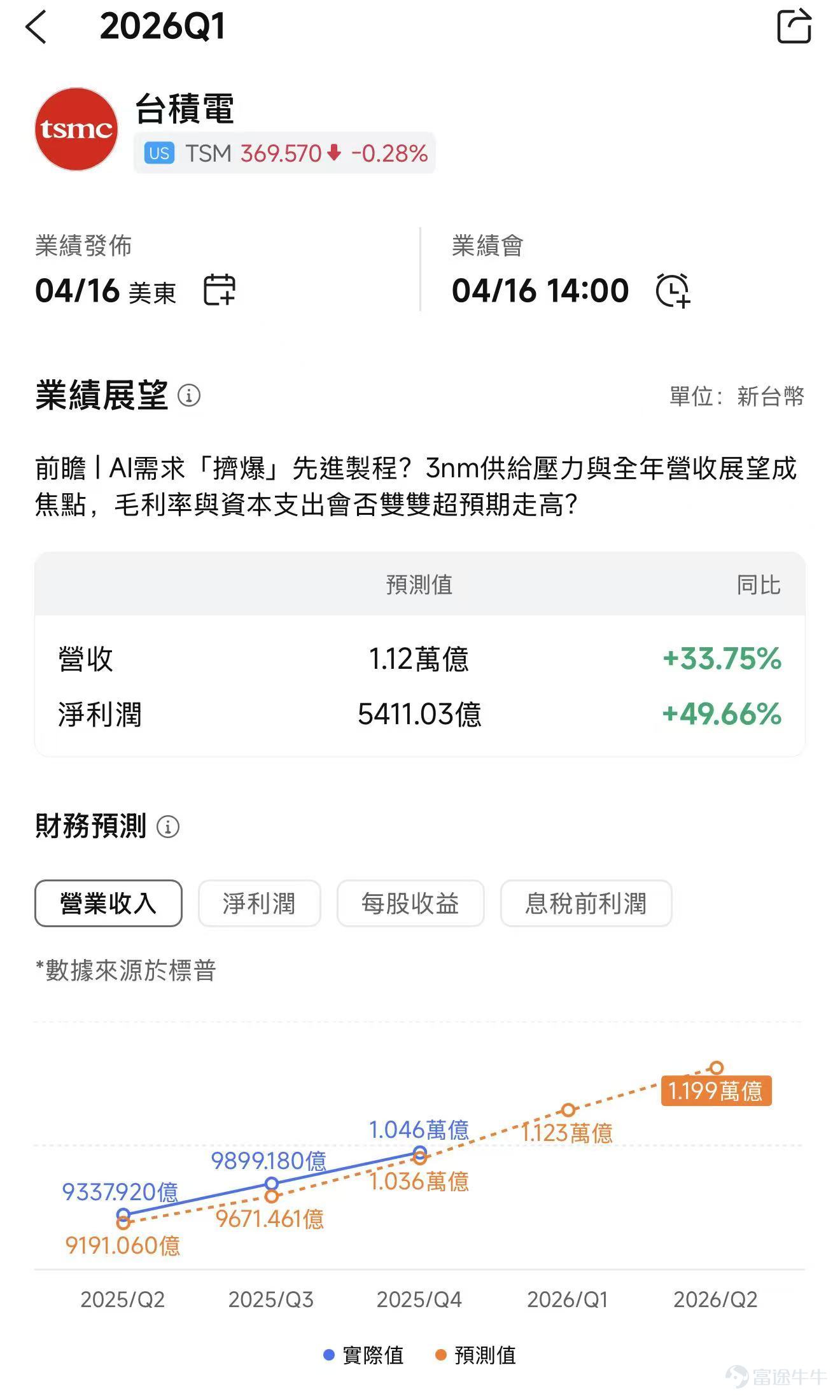
$Taiwan Semiconductor (TSM.US)$The Q1 earnings report is set to be released on April 16,Institutional forecasts expect revenue of 1.12 trillion New Taiwan dollars in Q1 2026, representing a year-on-year increase of 33.75%; projected net profit is estimated at 541.103 billion New Taiwan dollars, reflecting a year-on-year growth of 49.66%.

Revenue reached the upper limit of guidance, with profitability expected to show strong performance
Based on the monthly revenue data disclosed on April 10, the foundation for the quarterly results has become clearIn Q1, the company achieved total revenue of 1.134 trillion TWD, representing a year-over-year growth of 35% and an 8% increase from the previous quarter, hitting the upper end of the previously provided guidance range, and surpassing market consensus by approximately 1 percentage point. Exchange rate fluctuations had almost no impact on this outcome, with core drivers stemming from structural differentiation on the demand side.

From the current market status, part of the Q1 performance has already been priced inAfter the monthly revenue figures were announced earlier, the market reacted to this better-than-expected portion.What will truly drive stock price movements is the long-term guidance discussed during the conference call.
Revenue growth may not be the only highlight,Gross margin and operating leverage might be more noteworthy.In the previous quarter's earnings communication, the company provided a gross margin guidance range of 63.00% to 65.00% for this quarter.Some sell-side analysts further predict that the gross margin could exceed this range, primarily based on premium pricing for expedited advanced process orders and high capacity utilization rates.
The most profitable segments for Taiwan Semiconductor remain advanced process nodes and advanced packaging, both of which have tight supply. High utilization rates are being maintained for 3nm and 5nm processes, with no significant easing in customer demand for high-end AI chips, server CPUs, GPUs, and ASICs. Rush orders and better product mix will continue to push up average selling prices. Many customers, in order to secure capacity, are willing to pay premiums for rush orders. Regular expedited orders are priced 50% higher than standard orders, while super expedited orders can carry a premium of up to 100%, directly lifting overall average selling prices. Additionally, the slight depreciation of the New Taiwan dollar in Q1 also contributed positively to profit margins.
The harder question is,whether high profit margins can be sustained into the second half of this year.The initial ramp-up of 2nm technology will start diluting gross margin in the second half of 2026, as the early stage of 2nm expansion will bring extremely high depreciation costs. Additionally, overseas wafer fab expansions are expected to add another 2% to 3% structural drag on profitability. Any updates to the long-term gross margin target, currently set above 56% cyclical levels, will be closely watched.
This does not mean all business segments are strong. Demand related to smartphones and PCs remains weak, with softness already evident in consumer electronics. The unexpected rise in memory prices since the beginning of the year is squeezing the profit margins of downstream terminal brands, which has also impacted the chip sector. Qualcomm and MediaTek have recently been cutting orders for mature process nodes, and demand in the low-end smartphone market continues to weaken, leading to a noticeable slowdown in growth for this segment.
However, this contraction has not put pressure on Taiwan Semiconductor’s overall capacity. The freed-up capacity from non-AI customers has almost immediately been filled by AI-related clients, keeping Taiwan Semiconductor’s overall capacity utilization at a high level.
Focus on the sustainability of AI demand and capital expenditure trends
For investors, there is little suspense left regarding Q1 results. The real focus will be on the guidance and management commentary during the earnings call.
First, the sustainability of AI demand and the guidance for the second quarter.
The sustainability of AI demand is the issue of greatest concern in the current market. How strong was AI demand in the first quarter, and how long will this wave of demand last? In January, management provided annual revenue guidance of 'close to 30% (in US dollar terms)',
Attention is on whether the explosion of Agentic AI will bring new incremental demand.If management continues to emphasize during the earnings call that the supply and demand tightness for N3, N5, and even N2 nodes will persist until 2027, and there are no signs of a slowdown in advanced packaging demand, then the market will interpret this earnings report as follows: This cycle of AI capital expenditure has not yet reached its midpoint, and Taiwan Semiconductor's boom period is still extending further.
The sustainability of pricing is equally crucial.Taiwan Semiconductor initiated a new round of price hikes at the beginning of 2026, and the impact of this will gradually begin to show in the second quarter. Meanwhile, the current premium for rush orders—is it a short-term phenomenon under tight supply, or will it persist for some time? This directly relates to whether the company can maintain its gross margin at the current high level or if it will gradually decline with the release of capacity. This is also a key factor for the market in assessing the trend in profitability.
Secondly, will the scale of capital expenditures continue to rise?
Long-term capital expenditure plans are also on the market’s watchlist.The company's annual capital expenditure guidance is in the range of $52 billion to $56 billion, with a focus on investments in 2-nanometer capacity construction and advanced packaging expansion.This quarter’s investment pace will constrain the path of supply release for the entire year.
The current tightness in advanced process capacity is no longer a short-term phenomenon., the market had already been speculating whether Taiwan Semiconductor would replicate its 2021 approach by announcing a new three-year large-scale capacity expansion plan, raising the capital expenditure for the next three years to a scale of $180-200 billion. If this plan is implemented, it means the company has sufficient confidence in long-term AI demand and will also open up future growth potential. Of course, in the short term, it may also trigger market discussions on cash flow.
Thirdly, changes in the competitive landscape and supply chain risks cannot be ignored.
Samsung's 2nm process yield has improved significantly recently, and it has secured some external customer orders. Elon Musk's previously proposed Terafab plan has also sparked market discussions. However, in the latest comparison, Samsung’s 2nm-based Exynos 2600 still underperforms compared to Qualcomm's Snapdragon 8 Elite Gen 5, which is mainly manufactured using Taiwan Semiconductor's N3P process.Pay attention to management's assessment of the competitive landscape and whether it will affect the company's future pricing power and market share.
In addition, supply chain risks need to be confirmed.The recent conflict in the Middle East has raised market concerns about the supply chain., as well as fluctuations in the supply of raw materials such as helium and changes in energy prices, which could potentially impact Taiwan Semiconductor's production.
Options strategy
The market has already priced in a significant portion of AI optimism. If Taiwan Semiconductor provides a better Q2 outlook while maintaining a positive stance on full-year growth, AI demand, and the tightness of advanced processes, the stock price is likely to react positively. However, if management starts to tone down expectations on key issues—such as emphasizing slow recovery in consumer demand, faster advanced packaging capacity expansion than demand verification, or adopting a more conservative view on the visibility of AI demand in the second half—the stock price may see short-term pullback despite strong current earnings.
The current implied volatility (IV) is 48.34%, which is at a relatively high historical level (with an IV percentile of 83%).High implied volatility usually means that option prices are relatively expensive.The Put/Call Ratio is 1.07, with put option volume (66,100 contracts) slightly higher than call options (61,700 contracts);The current implied volatility in the options market suggests an earnings day move of ±4.56%.


(1) If you are currently out of the market or lightly positioned and optimistic about the earnings report while wanting to participate in the post-earnings upward momentum,
a more suitable approach would be to execute a Bull Call Spread,as Taiwan Semiconductor's Q1 revenue was strong, and AI demand continues to be favored by the market. However, these 'positive factors' are not entirely new information. The premiums before earnings are usually already high, and buying single-legged Calls directly can easily lead to volatility crush after earnings. Using spreads helps lower costs upfront and reduces the risk of being correct on direction but losing profits due to IV crush. This strategy works well when you expect a strong earnings report but do not want to pay excessive premiums for uncertainty.
(The figure below illustrates the simulated profit and loss scenario of this strategy on the expiration date. The design image displayed on the screen is for demonstration purposes only and does not constitute any investment advice or guarantee; market conditions fluctuate frequently, and the prices shown do not represent actual values.)

(2) If you are already holding a long position in TSM and don't want to sell, but are concerned about profit-taking or uncertainties post-earnings,
the market expectations for Taiwan Semiconductor are already high. If the earnings report is merely 'good,' but Q2 guidance, gross margin, or capital expenditures fail to push market expectations higher, the stock price could see some profit-taking. Investors worried about uncertainties after the earnings report may consider implementing a long collar strategy.
The advantage is that it provides downside protection by purchasing Puts while selling Calls to recover part of the premium, thereby lowering hedging costs. The trade-off is giving up some upside potential, which aligns with defensive investors’ objectives. It is suitable for heavily invested shareholders who have unrealized gains or are deep in the red but are concerned about earnings risks. The strike price selection for Puts depends on where you want to set your floor, and the strike price for Calls reflects the level at which you’re willing to cap your upside.
(The figure below illustrates the simulated profit and loss scenario of this strategy on the expiration date. The design image displayed on the screen is for demonstration purposes only and does not constitute any investment advice or guarantee; market conditions fluctuate frequently, and the prices shown do not represent actual values.)

Finally, Option Sir brings a small perk for fellow investors, welcome to claim it.Options Beginner Pack
This event is exclusively for invited HK users, click to learn moreDetailed event rules >>
Market conditions are complex and volatile,Options strategyOverwhelmed by choices? Futubull helps you build a portfolio in three steps.Options strategymaking investing simple and efficient from now on!

Option Risk Warning:An option is a contract that grants the holder the right, but not the obligation, to buy or sell an asset at a fixed price on a specific date or at any time before that date. The price of an option is influenced by various factors, including the current price of the underlying asset, the strike price, time to expiration, and implied volatility. Implied volatility reflects the market’s expectations for the level of volatility in the option over a future period. It is a data point derived inversely from the Black-Scholes option pricing model and is generally regarded as an indicator of market sentiment. When investors anticipate greater volatility, they may be more willing to pay a higher price for options to hedge risks, resulting in higher implied volatility. Traders and investors use implied volatility to assess the attractiveness of option prices, identify potential mispricings, and manage risk exposure.
Disclaimer:This content does not constitute any offer, solicitation, recommendation, opinion, or guarantee for any securities, financial products, or tools. The risk of loss in trading options can be substantial. In some cases, losses may exceed the initial margin deposited. Even if you set contingent orders such as 'stop-loss' or 'limit' orders, these may not prevent losses. Market conditions may prevent these orders from being executed. You might be required to deposit additional margin within a short period. If you fail to provide the required amount within the specified time, your open positions may be liquidated. However, you will still be responsible for any shortfall in your account. Therefore, before trading, you should study and understand options and carefully consider whether such trading is suitable for you based on your financial situation and investment objectives. If you trade options, you should be familiar with the procedures for exercising options and the rights and obligations upon exercise and expiration. Option trading involves extremely high risks and is not suitable for all investors. Investors should read carefully before engaging in any options trading strategy.Characteristics and Risks of Standardized Options。
Risk Disclaimer: The above content only represents the author's view. It does not represent any position or investment advice of Futu. Futu makes no representation or warranty.Read more


Comment (1)
to post a comment
40
40