
AI layoffs have reached the 'consumer spending' lifeline?
At the HumanX conference held from April 6 to April 9, a very blunt advertisement was posted at the entrance:
Stop hiring humans.
It wasn’t part of the keynote speech, nor was it a statement from any CEO, but it was more direct than anything expressed on stage.
Because inside the venue, people were discussing a different narrative: enhancing critical thinking, improving communication skills, and leveraging uniquely human value.
But the reality is that more and more companies are directly mentioning AI when laying off employees.
Salesforce laid off 4,000 customer service employees, claiming that AI has taken over 50% of the work;
Block CEO Jack Dorsey announced that the company plans to lay off nearly half of its workforce, citing that 'intelligent tools' have fundamentally changed how businesses operate.
On March 2, two researchers from the University of Pennsylvania and Boston University published a paper using mathematical modeling to illustrate a very alarming trend:
AI-driven layoffs will destroy the economy.
Every company replacing workers with AI is also firing its own customers; every laid-off employee was once someone who would spend money.
When enough people become unemployed, purchasing power will be continuously eroded, and those companies conducting layoffs will eventually go bankrupt as they try to sell products in an economy devoid of purchasing power.
01
The title of the paper was very straightforward, simply called 'The AI Layoff Trap.'
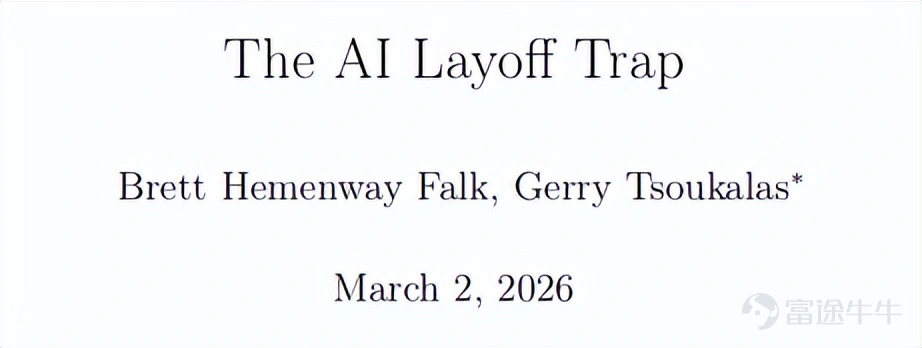
The paper did not discuss the technology itself, nor did it predict exactly how many jobs would be lost. Instead, it explored a very extreme scenario:What happens if all companies replace humans with AI?
It assumes that every company faces a simple choice: to employ humans or to use AI.
The benefit of using AI is the lower cost, as replacing each position allows the company to save part of its expenses.
However, the problem is that from the company's perspective, the replaced employees may be considered 'costs,' but in the market, they are also consumers.
On a macro level, when their income decreases, consumption of goods and services will also decline, and this consumption is originally part of business revenue.
The paper lays out this issue in a very clear structure:Laying off one person leads to a certain loss of demand.
Note that this loss is not entirely borne by the company doing the layoffs but is instead shared across the entire market, with every company (whether laying off staff or not) bearing a small portion of it.
The benefits are private, while the costs become shared. From an individual company’s perspective, continuing automation seems like the optimal choice.
But mere automation isn’t enough; companies must automate faster than their competitors—otherwise, they risk falling behind.
Following this logic, as competition intensifies, companies will accelerate automation to gain temporary advantages.
But as every company automates, these advantages will cancel each other out, while the loss of demand will not.
The paper uses a very vivid concept to describe this situation: the 'Red Queen Effect'.
Everyone is forced to run, but no one actually moves forward.
As the Chinese saying goes, 'You must keep moving forward against the current, or else you’ll fall behind'; or more colloquially, forced into an endless rat race.
More extremely, when automation comes at almost no cost, this system may even evolve into a classic prisoner's dilemma:
Every company will choose full automation because it is the optimal strategy for itself; but when all companies do this, the end result is worse than if they hadn’t automated at all.
The problem is, even though every company knows that layoffs will weaken the market, they will continue anyway.
Continuing to run at least results in mutual damage, but stopping would only lead to being eliminated even faster.
02
So some might ask: what should we do about this situation?
The paper’s solution is to apply the role of the 'visible hand,' taxing companies on automation (Pigouvian Tax) for the greater environment.
Since the problem lies in companies not bearing the full cost of 'weakened demand,' taxation can be used to make layoffs less 'cost-effective.'
From within the model, this conclusion is internally consistent: the ideal tax rate should align as closely as possible with the portion of losses that companies have not borne. This tax revenue can also be used for retraining and improving re-employment rates, making it an almost perfect solution.
But precisely because it is overly idealistic, its problems begin to surface.
This paper compresses the real world into a simple model, leaving only a few basic variables such as cost, demand, and competition.
Within this framework, 'excessive automation' is almost an inevitable result.
But the real world does not operate like this:
Demand does not simply disappear with a reduction in income; it shifts, reorganizes, and can be reignited by new products and services.
Jobs are not merely replaced; they are also created, albeit with changes in their distribution.
Corporate decisions are influenced not only by costs but also by strategy, branding, policies, and other factors.
The real world is dynamic, evolving, and diverse, whereas this model is static.
This does not mean the model is worthless; it simply deliberately ignores other variables in reality.
In other words, this model is not about recreating reality but amplifying one particular path within it. It serves more as a magnifying glass for extreme scenarios, warning us that:If certain conditions are met simultaneously, market mechanisms themselves may push automation in a direction that is not necessarily ideal.
03
The discussions at the HumanX conference actually provided a 'real-world version.'
This four-day conference attracted approximately 6,500 investors, entrepreneurs, and technology executives. Almost every speaker repeated the same set of advice: learn to collaborate with AI, enhance judgment, and cultivate more human qualities.
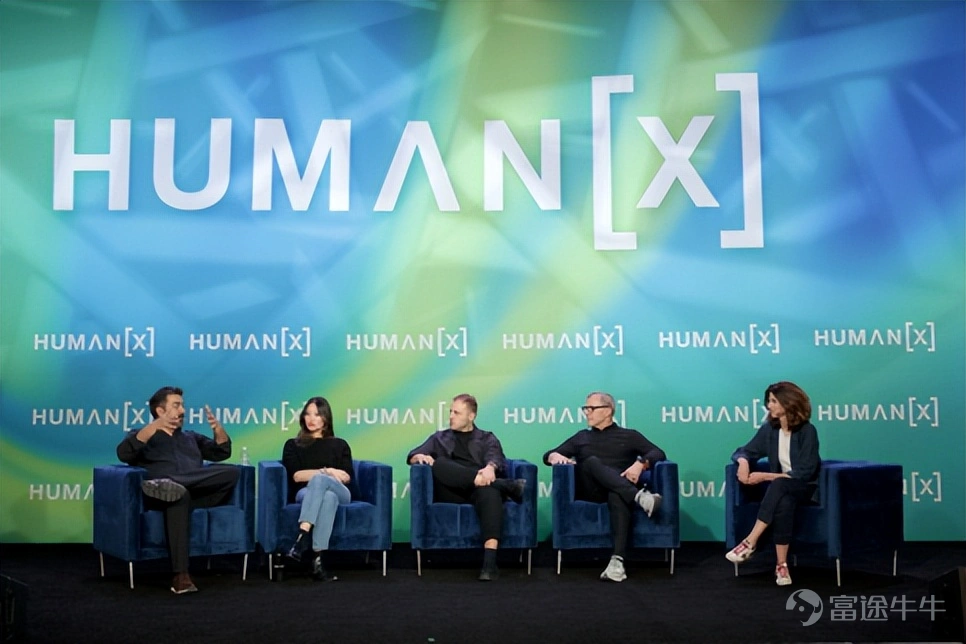
Andrew Ng, founder of DeepLearning.AI, stated that programming will not disappear; AI simply allows more people to participate. What truly makes the difference is how problems are understood and tools are utilized.
Greg Hart, CEO of the training platform Coursera, emphasized 'human capabilities,' such as critical thinking, communication skills, and teamwork. He mentioned that registrations for Coursera's critical thinking course tripled over the past year.
Florian Douetteau, CEO of the French artificial intelligence company Dataiku, offered a more specific description: in the future workplace, AI will handle execution while humans focus on judgment; machines run overnight, and humans review and make decisions during the day.
These statements sound like an upgraded version of career advice, transforming people from executors into decision-makers and from producers into coordinators.
However, entry-level positions are disappearing at the same time.
According to data from the investment firm SignalFire, between 2019 and 2024, recruitment for positions requiring less than one year of experience at major U.S. technology companies fell by 50%.
The jobs that were once meant to help newcomers gain experience have been bypassed by automation; before new entrants can even join the system, the system itself has already been rewritten.
These changes are still far from the extreme scenarios described in academic papers. Demand hasn't disappeared, and new roles are emerging.
But they do indicate one thing:Reality is slowly moving in that direction.
Notably, the key theme of the 2025 HumanX conference was “human connections,” with discussions heavily focused on social interaction and collaboration. But this year, the topics on stage shifted to automation, efficiency, and how AI is transforming everything.
At the HumanX conference, few denied that AI will change work. They took for granted a bright future where “AI handles execution, and humans focus on decision-making,” with more discussions centered around human value and how people should adapt.
They emphasized learning to use AI tools instead of resisting them, shifting time from execution to judgment, and strengthening skills like communication, understanding, and collaboration — abilities that are “difficult to automate.”
Some voices have even begun suggesting that the humanities may become essential preparation for future tech careers. When AI can handle technical details, what truly distinguishes humans is their understanding of other people.
This advice is worth considering, but for individuals, all of this comes with one prerequisite:You are still part of this system.
Only by staying in the game do you have the chance to transition from an executor to a decision-maker, from 'the party being replaced by AI' to 'the party utilizing AI tools.'
They teach you how to adapt to the future, but few discuss how many people have already been excluded from it.
From a research perspective, when all companies are making the same choice, systemic changes may not wait for anyone.
The phrase at the entrance of the HumanX conference, 'Stop hiring humans,' is not a consensus, but it is memorable precisely because it is so direct.
However, when technological advancements improve efficiency, companies actually have another option. If they can convert these efficiency gains into lower prices, faster services, or more diverse product offerings, demand might actually increase.
This phenomenon is not new in economics. As early as the steam engine era, some observed that increased efficiency does not reduce resource consumption; instead, it may lead to greater demand due to reduced costs. This theory is known as the 'Jevons Paradox,' proposed by William Stanley Jevons in 1865.
In the field of AI, a similar trajectory exists: some companies are not using AI to replace humans but to expand their business boundaries.
Aaron Levie (CEO of enterprise software company Box) has offered a different perspective: when AI reduces the cost of knowledge work, many projects that were previously 'unfeasible' could become viable.
However, this is not an automatic process and depends on how companies utilize AI. Efficiency gains may translate into profits, or some portion may be passed on to stimulate demand.
The derivation in the paper might be overly simplistic, and the adjustments in reality are far from over. But at least one thing is becoming increasingly clear:AI will not uniformly change all jobs; it will first alter structures and then determine who remains.
Where these structures ultimately end up depends on how companies choose to utilize this technology. $AI (LIST0535.SH)$$Artificial Intelligence (LIST23586.HK)$$Artificial Intelligence (LIST2136.US)$$Consumer (LIST1294.HK)$$HK Consumer Goods (LIST1263.HK)$$Technology (LIST20763.US)$$Technology (LIST20840.HK)$
Risk Disclaimer: The above content only represents the author's view. It does not represent any position or investment advice of Futu. Futu makes no representation or warranty.Read more
Comments
to post a comment