

Hermes Agent, a firework against the 'lobster' sentiment

These two days, Hermes Agent has surged to the top of OpenRouter’s list of 'Hottest Coding Agents,' with usage in its category reaching 149 billion tokens.
On the OpenRouter platform, Hermes Agent made it into this week's list of fastest-growing applications and agents, achieving a 367% growth within a week, reaching 971 billion tokens. The growth of Nous Research API was even more dramatic, surging by 6,402%, corresponding to 33.7 billion tokens.
Why is Hermes Agent so popular?
Its most captivating aspect isn't a single standout feature but rather an entire product logic.
Hermes Agent is an autonomous agent residing on your server. It can remember what it has learned, actively convert problem-solving experiences into Skills, and thus becomes increasingly familiar with your needs and projects.
It can also integrate with various entry points, including WeChat, schedule tasks, dispatch sub-agents to work in parallel, and isolate risky operations using a sandbox.
So the question arises: Has OpenClaw just been crowned king, only for Hermes to ascend the throne next?
I don’t think that’s the case. On OpenRouter, OpenClaw remains the most popular productivity tool, and its usage far surpasses that of Hermes Agent.
Moreover, as software, Hermes Agent lags significantly behind OpenClaw in terms of code logic.
Thus, it's likely not because Hermes Agent is superior that people started using it. To a large extent, it may be due to the overwhelming promotion of OpenClaw, which led to a sort of backlash.
At this point, it's almost time to draw a final conclusion on Hermes.
But before determining whether it’s the new king, a flash in the pan, or a rebound following the OpenClaw myth, one thing needs to be clarified: What exactly is Hermes Agent?
01
What kind of product is Hermes Agent?
Similar to OpenClaw, Hermes Agent is also an AI assistant that can run continuously on a server.
By connecting to models, it can manage tools, execute commands, link with messaging apps, and store memory. Users can interact with it via CLI or integrate it into platforms like WeChat.
It can perform scheduled tasks or run long-term tasks in the background. Once a task is completed, it pushes the results back to the user.

In all aspects, it’s very similar to OpenClaw.
The core selling point of Hermes Agent is self-improvement. The official slogan for it is 'the agent that grows with you,' which translates to 'this agent will grow together with you.'
This feature corresponds to the memory and skill functions within the product itself.
Hermes Agent retains user preferences and stores task experiences. It doesn’t just remember 'what users like,' but also recalls 'how certain tasks were previously completed.'
If it has encountered pitfalls in a project or been corrected by users, it will immediately turn that experience into a skill.
According to the Hermes Agent documentation, skills are stored in files located in the local directory ~/.hermes/skills/. If you want to review them, simply open the folder. If you no longer need a particular skill, just delete it.
To put it simply, Hermes aims to transform 'past actions' into 'future usable experience.'
For example, if you have it handle a project, it might discover that certain workflows are functional, others are not, a specific folder is crucial, or a particular writing style aligns with user habits.
After completing the task, it converts all its processes into skills that can be called upon for the next task. The next time it encounters a similar issue, it avoids the pitfalls from the previous task, using fewer tokens, less thinking time, and achieving the same result.
This is also one of the key product differences between Hermes and OpenClaw. OpenClaw also has skills, memory, and personas.
OpenClaw excels in its ecosystem, with a fairly complete skill system that can be loaded from multiple locations, as well as a public registry like ClawHub. It resembles a large tool system, but you must install the skills before starting a task.
Hermes emphasizes agents growing skills from tasks themselves. It wants users to believe that the longer they use this agent, the better it understands their projects.
This design is very appealing, especially in an era when everyone is competing to be lazier.
The most annoying thing for users when working with AI is having to repeatedly explain the context: going over the project structure again, repeating preferences, and revisiting past pitfalls.
What Hermes Agent aims to address is this kind of repetitive labor. Its goal is to transform the Agent from a one-time tool into a long-term assistant.
However, after personally experiencing Hermes Agent, I found that the ability to generate Skills does not necessarily mean Hermes Agent will become smarter.
If experience is well accumulated, the next task will be faster; if poorly accumulated, the next task may also be more error-prone. A wrong path written into a Skill will become a new burden.
Therefore, how strong Hermes Agent's self-improvement is depends on the actual tasks, and it cannot be generally assumed that it will always be better than before.
Another feature of Hermes Agent is multi-entry residency.
It's not just for programmers to use in the terminal. It can receive tasks from different entry points and call different tools to complete tasks. If you send an email to it, it understands. If you send a message to it, it still understands. If you send it via CLI, it can execute as well.
You might ask, doesn't OpenClaw also support multiple entry points?
However, Hermes Agent’s multiple entry points lead to the same place—memory and Skills can be shared across conversations and entry points. But with OpenClaw, your Feishu memory stays within Feishu, and your WeChat memory stays within WeChat—they cannot be linked.
Hermes also emphasizes model selection. It can connect to OpenRouter, Nous Portal, local models, and other providers.
In the v0.8.0 version, Hermes enhanced features such as model switching, price display, and cross-platform model selection.
The idea behind this design is that users don't have to assign all tasks to the same model. Simple tasks can be handled by cheaper models, while complex tasks can be switched to more powerful models. This allows for both cost control and reduced reliance on a single model provider.
Hermes Agent has released version 0.9.0 update, which includes two standout features. The first is that it now supports the native WeChat and Enterprise WeChat Callback mode.
This means that when there's a new message on the platform, it will push the message from WeChat to you proactively. Previously, although you could send messages via WeChat to instruct it to perform tasks for you, it couldn't reply to your messages.
Second, this update adds native xAI and Xiaomi MiMo model provider support.
Now you no longer need to go through OpenRouter to access Xiaomi's models. You can configure xAI/Grok and Xiaomi MiMo as top-tier model providers directly within Hermes Agent, allowing them to seamlessly integrate into the model list, setup wizard, and model-switching process.
For Xiaomi MiMo, the update also includes integrations such as model directory access and null response recovery adaptations.
This time, they're coming straight for us!
02
Hermes is gaining popularity, and its operators are very smart.
Whether an open-source project becomes popular usually doesn’t depend solely on the code.
While the explosive popularity of Hermes Agent is partly due to the product itself, much of it is attributed to its operational strategy.
At the time of its release, Hermes Agent did not position itself as an entirely new product but instead emphasized the concept of 'migration'.
As OpenClaw was gaining significant popularity, Hermes Agent highlighted that users could migrate everything from OpenClaw, including Skills, contexts, and workflows, to Hermes Agent. Coupled with the tagline of 'self-evolution,' it quickly gained considerable attention.
If the user is coming from OpenClaw, during the initial installation and configuration, Hermes Agent will detect the ~/.openclaw file and prompt for migration.
This feature appears to be a tool but is actually a form of advertising. It does not require users to start from scratch or try to convince them to forget OpenClaw. Instead, it tells OpenClaw users: 'Everything you’ve accumulated in the past can be brought here without any migration costs.'
When a new project attempts to challenge an established ecosystem, the most difficult part is not downloading but moving. The migration command transforms 'moving' into an executable action. It acknowledges that OpenClaw has already built up user assets and turns those assets into the initial fuel for Hermes Agent's growth.
In this way, since Hermes Agent is a free tool, users can simply copy and paste their OpenClaw configurations to get started, effectively leveraging OpenClaw to complete its spread.
The second key move was support for WeChat.
On April 11, Hermes Agent announced it could integrate with WeChat, and it didn’t rely on unofficial methods like 'simulating the WeChat client' or 'cracking the WeChat protocol.' Instead, it used the official bot interface provided by Tencent.
It does not capture packets or reverse-engineer WeChat’s communication protocols to send and receive messages; it uses the official Tencent Bot API.
Moreover, when the developer of Hermes Agent, Nous Research, announced the WeChat functionality, they did so in Chinese, significantly boosting goodwill within the Chinese community.
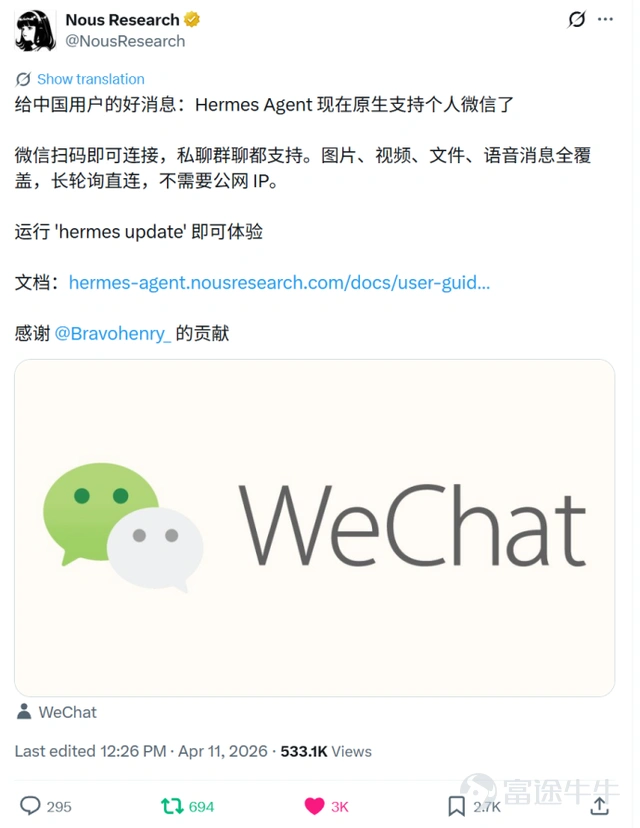
And in response to comments in Chinese, Nous Research always replies in Chinese, further enhancing its appeal to the Chinese-speaking community.

This is particularly important for Agent products. An Agent is not just a simple library or a one-time tool. It needs to integrate with your messaging software, read your files, execute your commands, and may even perform tasks for you in group chats.
Before users grant such permissions, they need to feel understood. The response from Hermes Agents in the Chinese-speaking community precisely fills this trust gap.
Hermes Agents is different from the OpenClaw community, where people only exchange technical knowledge. Hermes Agents is engaging with its users on a deeper level.
Another crucial factor is cost.
If you search the Hermes Agent community now, you'll find that the majority of users are saying 'Hermes Agent is cheaper than OpenClaw.'
This is because OpenClaw by default fully loads all installed skills. The more skills there are, the more each user request must carry the complete skill definition texts.
In a single OpenClaw request, 73% of tokens are fixed costs. Tool definitions account for 46%, system prompts account for 27%, and a typical query often carries a context window of over 100,000 tokens.
Hermes Agent adopts a three-level progressive lazy-loading design. Normally, it only loads the skill names and brief descriptions, and only loads the full content of a skill when the corresponding task needs to be executed.
From my personal experience, for the same task, Hermes Agent's token consumption is approximately only one-twentieth of OpenClaw’s. However, I must clarify that token consumption varies from person to person. Some users assign overly complex tasks to Hermes Agent, which makes it not much cheaper than OpenClaw in those cases.
However, no matter how much is specifically saved, this remains a pain point for OpenClaw. There's no way around it, as not everyone is so financially well-off.
Having discussed geographical advantages and human cooperation, another factor is timing.
Before Hermes Agent went viral, Anthropic had just changed its policy towards third parties.
Starting from April 4th, Claude subscription credits no longer cover the use of third-party harnesses like OpenClaw; users need to pay extra or use an API key.
OpenClaw's own Anthropic documentation also provides similar practical rules: API keys are billed at the regular API rate, and the Claude subscription path will be considered third-party harness usage requiring additional charges.
Although this does not mean OpenClaw can no longer use Claude, if following the API pricing, the cost for the vast majority of workflows based on OpenClaw would skyrocket.
Hermes Agent was unaffected and thus benefited from this period, with many 'refugees' forced to abandon OpenClaw choosing to switch to Hermes Agent.
It turned the turbulence in Anthropic's platform policies into a product opportunity for itself.
03
Hermes has become more of an outlet for anti-OpenClaw sentiment.
Though Hermes’s recent rise in popularity might easily be framed as a new king ascending, such judgment is premature.
On OpenRouter, Hermes Agent ranks first in the Top Coding Agents category with 149 billion tokens and reached 971 billion tokens in the Trending section, showing a weekly increase of 367%. This indicates that it is not only being observed on GitHub but is also actively invoked within the OpenRouter platform.
Meanwhile, in OpenRouter's Top Productivity ranking, OpenClaw remains in first place with 364 billion tokens, while Hermes ranks second.
Hermes Agent has made significant progress in the specialized category of coding agents, but in the broader productivity rankings, OpenClaw still leads.
On the other hand, on GitHub, their common origin. Hermes Agent updates approximately every five days, whereas OpenClaw updates one to two times per day.
The GitHub page shows that Hermes Agent has fewer than 4,000 commits, while OpenClaw has 30,000 commits.
This difference in update frequency means that OpenClaw’s repository structure, documentation, skill systems, and channel entries are more stable and formal, and bugs are fixed immediately when they appear.
Moreover, the community often criticizes Hermes Agent for its rough code.
The GitHub page shows that the run_agent.py file in Hermes Agent contains 10,524 lines in total, with 9,425 lines of actual code (loc). The cli.py file has 9,878 lines, with an loc of 8,720. The gateway/run.py file has 8,836 lines, with 7,861 loc.
These three files are all related to core operational logic, which places immense pressure on subsequent maintenance, testing, and security audits.
OpenClaw also has large files, but they are more distributed across generated code, packaged assets, test files, and local modules rather than core logic files.
This shows that during the development process, OpenClaw clearly considered longevity more than Hermes Agent.
So why does the community still favor Hermes Agent?
Ultimately, it benefited from the backlash against OpenClaw.
Every viral open-source project goes through this phase. At first, everyone is excited. Users share use cases, developers contribute plugins, media talks about new innovations, and communities keep creating buzzwords.
But as the project grows, so do the problems. Too many features, scattered roadmaps, too many issues, overly dense documentation, rising entry costs—all of which make users nostalgic for something cleaner, smarter, and more theoretically grounded.
Just as OpenClaw pushed the imagination of personal agents to new heights, fatigue began to set in among users.
Throughout March, Company A launched a one-click OpenClaw, and Company B followed suit. Almost every major tech company, whether you’ve heard of them or not, had their own XXClaw.
Claw was everywhere. Claw in tutorials, Claw in cloud vendor packages, Claw in plugin markets, and Claw dominating community discussions. One day someone would talk about one-click deployment, the next day about compatibility with certain channels, and the day after about some skill package.
What started as an exciting personal agent quickly turned into an ecosystem requiring constant attention. Before users could even leverage it to save time, they first had to figure out which Claw worked, which Claw was expensive, which Claw might get banned, and which Claw changed configurations.
The popularity of OpenClaw thus evolved into resentment toward the term OpenClaw itself.
Hermes has appeared just in time. Like a newly opened community, with clear slogans, a clean entrance, and a sense that the future hasn't been exhausted yet. Users love this feeling.
It doesn't necessarily mean the new community is more livable, but it makes people want to take a look inside.
OpenClaw has already proven there's huge demand for 'functional AI.' Hermes Agent takes that demand a step further. Users don't just want AI that can perform tasks; they also want AI that can accumulate experience from those tasks.
But this is also where Hermes needs to be tested the most.
If self-evolution doesn't bring compounding benefits for real-world tasks, it becomes mere packaging. If long-term memory can't be controlled by users, it becomes a burden. If automatically generated skills lack auditing and rollback mechanisms, it leads to the accumulation of new errors.
Most importantly, as a software product, if code structure isn’t managed promptly, the pressure to maintain it after its popularity surge will only grow heavier.
Therefore, Hermes Agent is far from being the successor to OpenClaw. It’s more like the first reflection following the myth of OpenClaw.
Hermes Agent isn't just a gimmick; it has commendable aspects as a product.
But it hasn't completed its coronation as the new king yet. OpenClaw still boasts a thicker community, ecosystem, update frequency, and user base.
It's like fireworks in the wave of anti-OpenClaw sentiment. Fireworks do shine brightly, but if Hermes Agent doesn't improve itself, once the light fades, the throne will remain standing where it was. $OpenClaw Concept Stocks (LIST24062.HK)$$AI (LIST0535.SH)$$Artificial Intelligence (LIST23586.HK)$$Artificial Intelligence (LIST2136.US)$$Hermes International SA (HESAY.US)$$Technology (LIST20763.US)$$Technology (LIST20840.HK)$
Risk Disclaimer: The above content only represents the author's view. It does not represent any position or investment advice of Futu. Futu makes no representation or warranty.Read more
Comments
to post a comment