
Micron's market cap surpasses $1 trillion—has the memory sector's 'cyclical curse' been overturned?

Polymarket's Precise Predictions: Insider Trading or Collective Intelligence?
Report Date: April 13, 2026
Recently, the prediction market platform Polymarket has gained significant attention again.
According to reports from multiple media outlets, during the recent ceasefire-related events between the U.S. and Iran at the beginning of this month, dozens of newly created accounts suddenly placed large bets just before the news broke and quickly profited after the outcome was confirmed. This has sparked discussions about possible insider trading. In recent years, prediction market platforms represented by Polymarket have become a new type of "sentiment thermometer" on Wall Street and professional investors’ desks. What is the prediction market? How should we interpret signals provided by prediction markets? How can investors reasonably use this information for trading?
What is the prediction market?
Simply put, Polymarket is a platform that allows users to place “bets” on future real-world events (such as presidential elections, tech releases, or game outcomes).
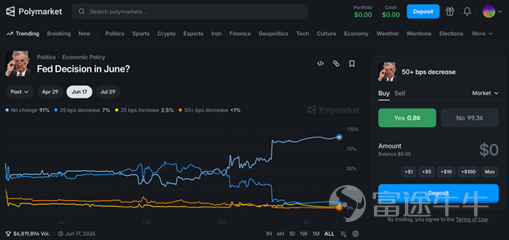
The gameplay is very straightforward: when you believe a certain event will happen, you spend money to buy shares indicating that the event is “true.” For example— the current market price for the event “Fed rate cut in June” is 0.8 cents (0.008 USD). You spend 0.8 cents to buy one share of “true.” By June, if the Fed indeed cuts rates, your share of “true” pays out as 1 USD, netting you a profit of 0.992 USD; if there is no rate cut, you lose your entire 0.8 cents investment.The price of shares reflects the market's probability pricing of the event occurring.
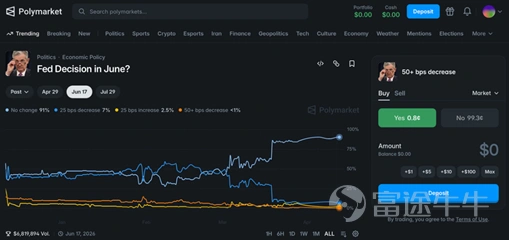
(Image source: Polymarket, April 12, 2026)
Historic 'Prophetic Prediction' – The 2024 U.S. Election
What truly made Polymarket famous was its 'early move' in the final weeks before the election results were announced. At that time, multiple traditional polls still described the race as neck-and-neck, but by mid-to-late October 2024, funds on Polymarket had pushed Trump’s winning probability to about 60%, significantly widening the gap with Kamala Harris. In the end, the direction indicated by the platform fully matched the election outcome, and this case has since been regarded as a representative example showing that prediction markets outperform traditional polls.

(Image source: Polymarket, November 5, 2024)
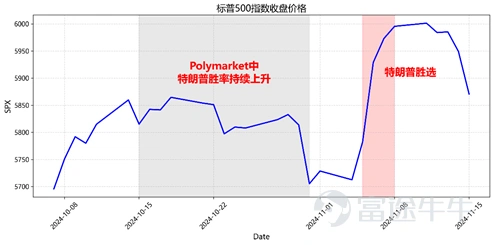
(Data source: Bloomberg, October 7, 2024 to November 15, 2024)
How should we interpret signals from prediction markets?
Compared to traditional stock markets, prediction markets focus more on specific macro events, with less noise and a better reflection of market sentiment and opinions regarding certain events.
In contrast to traditional polls, prediction markets require investors to back their judgments with real money, effectively filtering out most emotional noise. This also enables prediction markets to respond more quickly and accurately to real-time market sentiment.
However, we cannot simply view them as absolutely accurate 'market forecasts,' as insider trading and early information are extremely limited and hard to discern. More importantly, interpreting prediction signals must not ignore market volume: in low-investment, illiquid markets, odds can easily be distorted or even manipulated by a small number of large funds. Therefore, while prediction markets serve as excellent macro sentiment indicators, their signals should be analyzed rationally alongside consideration of capital scale.
How can investors use prediction markets to assist in trading?
As retail investors, we can treat prediction market platforms as a free data source to get ahead of market trends and look for reasonable investment and hedging opportunities:
1. Position related assets based on probabilities of macro events
The greatest value of prediction markets does not lie in telling you whether 'the market will rise or fall tomorrow,' but in reflecting changes in the likelihood of certain macro events earlier, such as election outcomes, tariff policies, recession risks, or interest rate cut expectations. When these probabilities consistently shift in one direction, investors can proactively assess which assets are most likely to benefit or suffer and make their moves accordingly, instead of passively chasing prices after mainstream narratives, institutional reports, and market consensus have fully formed.
2. Forward-looking hedging of macro risks
Treat prediction markets as an 'alarm bell' for the macro economy. For example, if you hold a large position in interest-rate-sensitive small- and mid-cap indices (such as Russell 2000-related products) or innovative pharmaceutical sectors, you can regularly monitor the 'probability of interest rate cuts' on prediction markets. If you notice this probability suddenly reverses and plummets without significant news, consider reducing your positions or buying put options to hedge risk.
Risk Warning: Collective wisdom can also fail
Although prediction markets are a valuable observation window, they do not constitute a stable and reliable single trading basis:
1. Transmission bias: Even if prediction markets first reflect changes in event probabilities, related assets may not immediately or accurately reprice, often being affected by positioning, liquidity, and short-term noise.
2. Whale manipulation: In some low-liquidity, topic-specific areas, well-funded 'whales' may intentionally create misleading odds by dumping or pumping prices, thereby influencing public sentiment.
3. Emotional Contagion: Prediction markets, at their core, remain a collection of people. When macro panic spreads, they might also exhibit irrational overselling or overbuying.
Therefore, the 'precise predictions' in prediction markets are not 'trading answers'; real investment decisions still need to be based on facts, logic, and risk control.
[Related Products Focus]
China AMC Nasdaq 100 ETF (3086 HK)— One-click tracking of the Nasdaq 100 Index during Hong Kong trading hours
China AMC Nasdaq 100 Index Leveraged and Inverse Products:
– China AMC Nasdaq 100 Index Daily Inverse (-2x) Product (7522 HK)
– China AMC Nasdaq 100 Index Daily Leveraged (2x) Product (7261 HK)
• Enhances potential daily returns and provides hedging opportunities in the short term
• Convenient allocation of US stocks within the Asian time zone
$SSE Composite Index (000001.SH)$$CSI 300 Index (000300.SH)$$NVIDIA (NVDA.US)$$Amazon (AMZN.US)$$Alphabet-C (GOOG.US)$$Meta Platforms (META.US)$$Tesla (TSLA.US)$$HSTECH (LIST91332.HK)$$Hang Seng Index (800000.HK)$$SSE 50 Index (000016.SH)$$CSI 300 Index (000300.SH)$$CSI 1000 Index (000852.SH)$$SSE Science and Technology Innovation Board 50 Index (000688.SH)$$ChinaAMC CSI 300 Index ETF (03188.HK)$$SSE Composite Index (000001.SH)$$XIAOMI-W (01810.HK)$$JD.com (JD.US)$$TENCENT (00700.HK)$$Shenzhen Component Index (399001.SZ)$$Kweichow Moutai (600519.SH)$$Contemporary Amperex Technology (300750.SZ)$$PING AN (02318.HK)$$Alibaba (BABA.US)$$ICBC (01398.HK)$$CHINA MOBILE (00941.HK)$
Investing involves risks, including the loss of principal. Past performance is not indicative of future results. Before investing in the China AMC Nasdaq 100 ETF (the "Fund"), investors should refer to the fund prospectus, particularly the risk factors. You should not rely solely on this material to make investment decisions. Please note:
• The Fund aims to provide investment returns that closely track the performance of the Nasdaq-100 Index before fees and expenses. To achieve its investment objective, the Fund has the risk of concentrated investments in the U.S. and Nasdaq markets. Concentrated investments face greater volatility than diversified ones, and the Fund may be affected by adverse conditions in the U.S., leading to value fluctuations.
• When the Nasdaq stock market is open but the Fund’s units are not quoted, the value of the securities in the Fund's portfolio may change on days when investors cannot buy or sell Fund units.
• The trading price of the Fund may differ significantly from its net asset value per unit, potentially trading at a notable premium or discount.
• The Fund faces tracking error risk.
• The Fund is exposed to risks related to financial derivatives, including counterparty/credit risk, liquidity risk, valuation risk, volatility risk, and over-the-counter (OTC) trading risk.
• The Fund is subject to foreign exchange risk.
• If the cross-counter transfer of Fund units between different counters is suspended and/or if there are any limitations in the service levels provided by brokers and Central Clearing System participants, Fund unit holders will only be able to trade their Fund units on one counter, which may restrict or delay investors' transactions.
• Due to factors such as market liquidity, supply and demand for each counter, and exchange rate fluctuations between HKD and USD, the market price of Fund units traded on each counter may deviate significantly.
• Listed and unlisted share classes follow different pricing and trading arrangements. Due to differing fees and costs, the net asset value per unit for each class may vary.
• Units of the listed class are traded at the current market price on the secondary market, while units of the non-listed class are sold through intermediaries based on the end-of-day net asset value. Non-listed class investors can redeem their units at net asset value, whereas secondary market investors of the listed class can only sell at the prevailing market price and may have to exit the Fund at a significant discount. Investors in the non-listed class may have advantages or disadvantages compared to those in the listed class.
• The Fund may, at its discretion, pay dividends out of its capital or effectively out of capital. Paying distributions out of capital or effectively out of capital amounts to returning or withdrawing part of an investor's original investment or any capital gains attributable to that original investment. Any such distribution may result in an immediate reduction in the Fund’s net asset value per unit.
China AMC Nasdaq 100 Daily Inverse (-2x) Product ("Product")Aims to provide daily investment returns that closely track twice the inverse (-2x) of the daily performance of the NASDAQ-100 Index ("Index") before fees and expenses. This Product differs from traditional Exchange Traded Funds. It is not designed to be held for more than one day, as its performance over periods longer than one day may deviate from twice the inverse performance of the Index during the same period and could be unrelated. This Product is designed for short-term trading or hedging and is unsuitable for long-term investment. This is a derivative product, targeted at sophisticated investors who understand the potential consequences and risks associated with seeking twice the inverse daily performance and monitor their holdings regularly.
Investing involves risks, including the loss of principal. Past performance is not indicative of future results. The value of the Product can be highly volatile and may decline significantly within a short period; you could lose your entire investment. Investors should refer to the prospectus and product key facts statement, paying close attention to the risk factors, before making an investment decision. You should not rely solely on this material to make investment decisions. Please note:
• The Product will use leverage to achieve twice the inverse (-2x) of the daily return of the Index. Both gains and losses will be magnified. The risk of loss when investing in the Product may far exceed that of funds that do not utilize leverage, especially in certain circumstances such as bull markets.
• This product is not designed to be held for more than one day, as its performance over periods longer than a day will likely differ from twice the inverse performance of the index in both magnitude and possible direction (for example, losses may exceed negative two times the increase of the index).
• Investing in this product differs from holding a short position. Due to rebalancing, the return profile of this product is not the same as that of a short position.
• The risk investment outcome of this product is opposite to traditional investment funds. If the value of the index rises over the long term, this product is likely to lose most or all of its value.
• Investing in futures contracts involves specific risks, such as high volatility, leverage, roll-over, and margin risks. There may be imperfect correlation between the value of the underlying reference asset and the futures contract. Futures trading accounts generally have extremely high leverage. Therefore, even relatively minor price movements in E-mini NASDAQ 100 futures may cause proportionally larger impacts and substantial losses to the product.
• This product tracks twice the daily inverse (-2x) performance of the index. If the securities related to the index appreciate, it could have an amplified negative impact on the performance of this product.
• There is no guarantee that the product can rebalance its portfolio daily to achieve its investment objective. Market disruptions, regulatory restrictions, or extreme market volatility may adversely affect the product’s ability to rebalance its portfolio.
• The product faces liquidity risks associated with E-mini NASDAQ 100 futures. Additionally, the product's rebalancing activities generally occur at or around the close of Nasdaq trading to minimize tracking deviation.
• The product typically rebalances around the Nasdaq closing time. Therefore, investors whose investment horizon is less than an entire trading day will generally experience returns greater or less than the inverse ratio of the index.
• The daily rebalancing of the product’s portfolio results in a higher number of transactions compared to traditional exchange-traded funds. A higher number of transactions increases brokerage commissions and other transaction costs.
• By tracking the inverse performance of technology sector companies and being concentrated in the US market, which may be more volatile than other markets, the product is exposed to concentration risk. Therefore, the value of the product may be more volatile than funds with broader exposure.
• The product may be subject to tracking error risk. Tracking errors can arise from the investment strategies employed, high portfolio turnover, market liquidity, and fees and expenses, which could reduce the correlation between the product’s performance and the index's daily inverse two-times (-2x) performance. There is no guarantee that it will precisely or fully replicate the index's inverse two-times performance at any time, including intraday.
• Distributions (if any) will be made in US dollars. If unitholders do not have a US dollar account, they may incur associated costs and charges for converting such dividends from US dollars into Hong Kong dollars or any other currency.
• The product is passively managed. Due to its inherent investment nature, the fund manager does not have discretion to adapt to market changes. When the index moves in an unfavorable direction (i.e., if it rises), the value of the product will decrease.
• The daily price limits of NASDAQ differ from those of E-mini NASDAQ 100 futures. Therefore, if the daily price movement of the index exceeds the price limit of the E-mini NASDAQ 100 futures, the product may not achieve its investment objective.
• Since the CME may operate on days when there is no pricing for the units of the product, the value of the E-mini NASDAQ 100 futures within the product's portfolio, or the value of the constituent stocks of the indices linked to these futures contracts, may fluctuate on days when investors cannot buy or sell the product’s units. Different trading hours between the CME and the Stock Exchange of Hong Kong may increase the premium/discount level of the unit price relative to its net asset value. The trading hours of Nasdaq and the CME differ. Settlements of purchases and sales of index constituents occur earlier than those of E-mini NASDAQ 100 futures, so even when there is no trading in the index constituents, E-mini NASDAQ 100 futures may still experience price fluctuations.
• The trading price of units on the Stock Exchange of Hong Kong is driven by market factors such as supply and demand for the units. As a result, units may trade at significant premiums or discounts to their net asset value.
Important Information about China AMC Nasdaq 100 Daily Leverage (2x) Product
This is a leveraged product, different from traditional exchange-traded funds, as it seeks to deliver leveraged investment results relative to the index on a daily basis only. This product is not designed for holding periods longer than one day, as its performance over periods longer than one day may deviate from the leveraged performance of the index over the same period and may not be correlated. This product is designed for short-term trading or hedging and is not suitable for long-term investments. The target investors are limited to sophisticated investors who actively trade, understand the potential consequences and risks of seeking daily leveraged returns, and frequently monitor their position performance on a daily basis.
Investment involves risks, and past performance is not indicative of future results. The value of the product may be highly volatile and could decline significantly in a short period of time; you may also lose your entire investment amount. Before making an investment decision, investors should refer to the prospectus and product key facts statement, including reading the risk factors carefully. You should not rely solely on this material to make investment decisions. Pay special attention to the following items:
• The purpose of the product is to provide daily investment results that closely correspond to twice (2x) the daily performance of the index before fees and expenses. This product will not seek to achieve its stated investment objective over periods longer than one day.
• This product is a derivative instrument and is not suitable for all investors. Repayment of the principal is not guaranteed. Unitholders investing in this product may incur substantial or total losses.
• This product is not designed to be held for more than one day, as its performance over periods longer than one day will likely differ significantly from the leveraged performance of the index over the same period (e.g., losses may exceed twice the decline of the index).
• Investing in futures contracts involves specific risks, such as high volatility, leverage, rollover, and margin risk. There may be incomplete correlation between the value of the underlying reference asset and the futures contract, which could prevent the product from achieving its investment objective. The product may be adversely affected by the cost of rolling forward when the futures contracts are nearing expiration. Futures trading accounts generally have extremely high leverage. Therefore, even minor price movements in futures contracts may result in proportionally larger impacts and substantial losses for the product.
• This product will use leverage to achieve daily returns equivalent to twice (2x) the index return. If the value of the index-related securities decreases, the use of a 2x leverage factor will accelerate the reduction of the product's net asset value compared to the index. Both gains and losses will be amplified. Under certain circumstances (including bear markets), unitholders may face very low or zero returns on these investments, or even total losses.
• There is no guarantee that this product can rebalance its portfolio daily to achieve its investment objectives. Market disruptions, regulatory restrictions, or extreme market volatility may adversely affect the product’s ability to rebalance its portfolio.
• This product faces liquidity risks associated with futures contracts. Additionally, the product’s rebalancing activities generally occur around the Nasdaq closing time to minimize tracking error. As a result, the product may be more sensitive to market conditions within shorter intervals and exposed to greater liquidity risks.
• This product typically rebalances around the Nasdaq closing time. Thus, investors whose investment duration is less than an entire trading day may experience returns generally greater or less than the 2x leverage ratio depending on the index movement from the end of one trading day until the time of purchase.
• The daily rebalancing of this product’s portfolio results in a higher number of trades compared to traditional exchange-traded funds. A higher number of trades will increase brokerage commissions and other transaction costs.
• This product's investment in equity securities is subject to general market risks.
• Due to the leveraged exposure to technology sector companies coupled with concentration in the potentially more volatile U.S. market compared to other markets, the product is exposed to concentration risk. Hence, the product’s value may be more volatile than funds with broader foundations.
• The product may be subject to tracking error risk. Tracking error risk may arise from the investment strategy adopted, high portfolio turnover, market liquidity, and fees and expenses, which would reduce the correlation between the product's performance and twice (2x) the daily performance of the index. It cannot be guaranteed that the product will precisely or fully replicate twice the performance of the index at any time, including intra-day.
• Distributions, if any, will be made in US dollars. If unitholders do not have a US dollar account, they may incur related costs and charges for converting such dividends from US dollars to Hong Kong dollars or any other currency.
• This product is passively managed; therefore, the fund manager will not have discretion to adapt to market changes due to the inherent investment nature of this product. A decline in the index is expected to result in a decrease in the value of the product.
• The NASDAQ’s daily price limit (triggered when the S&P 500 Index falls by 20% in one day) differs from the futures contracts’ daily price limit. Therefore, if the daily price movement of the index exceeds the price limit of the futures contract, the product may not achieve its investment objective when the futures contract cannot deliver returns beyond its price limit.
• Since the CME may be open on days when there is no price for units of the product, the value of the futures contracts in the product’s portfolio, or the value of the constituent stocks of the index linked to those futures contracts, may fluctuate on days when investors cannot buy or sell units of the product. Different trading hours between the CME and the SEHK may increase the premium/discount level of the unit price relative to its net asset value. The trading hours of NASDAQ and CME differ. Settlement of purchases and sales of the constituent stocks of the index occurs earlier than for futures contracts. Therefore, even when the constituent stocks of the index are not being traded, the futures contracts may still experience price fluctuations. The trading price of units on the SEHK is driven by market factors such as supply and demand for the units. As a result, units may trade at a significant premium or discount to their net asset value.
News source:
TVB News, April 10, 2026. https://news.tvb.com/tc/world/69d8d8b24a71c3f57afe0166/International-Reports suggest that at least 50 mysterious accounts accurately predicted the US-Iran ceasefire and profited hundreds of thousands of dollars.
Investment involves risks, including possible loss of principal. Any forecasts, outlooks, or opinions contained herein are for your reference only and are not guaranteed. The information contained herein reflects market conditions and our views as of the publication date, and any changes will not be notified separately. This material is issued by China AMC (Hong Kong) Limited. This material has not been reviewed by the Securities and Futures Commission of Hong Kong. For full details and risks related to the funds mentioned, please refer to our official website and prospectus.
Risk Disclaimer: The above content only represents the author's view. It does not represent any position or investment advice of Futu. Futu makes no representation or warranty.Read more

Comments
to post a comment
2
1