
Focus on the Google Cloud annual conference, how will it impact market trends?

Google TPU secures another major order + annual conference coming soon! Which companies in the supply chain should be closely watched?
Recently, driven by Anthropic's signing of a computing power agreement with $Alphabet-C (GOOG.US)$and$Broadcom (AVGO.US)$ , along with the upcoming dual catalysts of two major Google conferences, the Google chain has once again become a market focus.
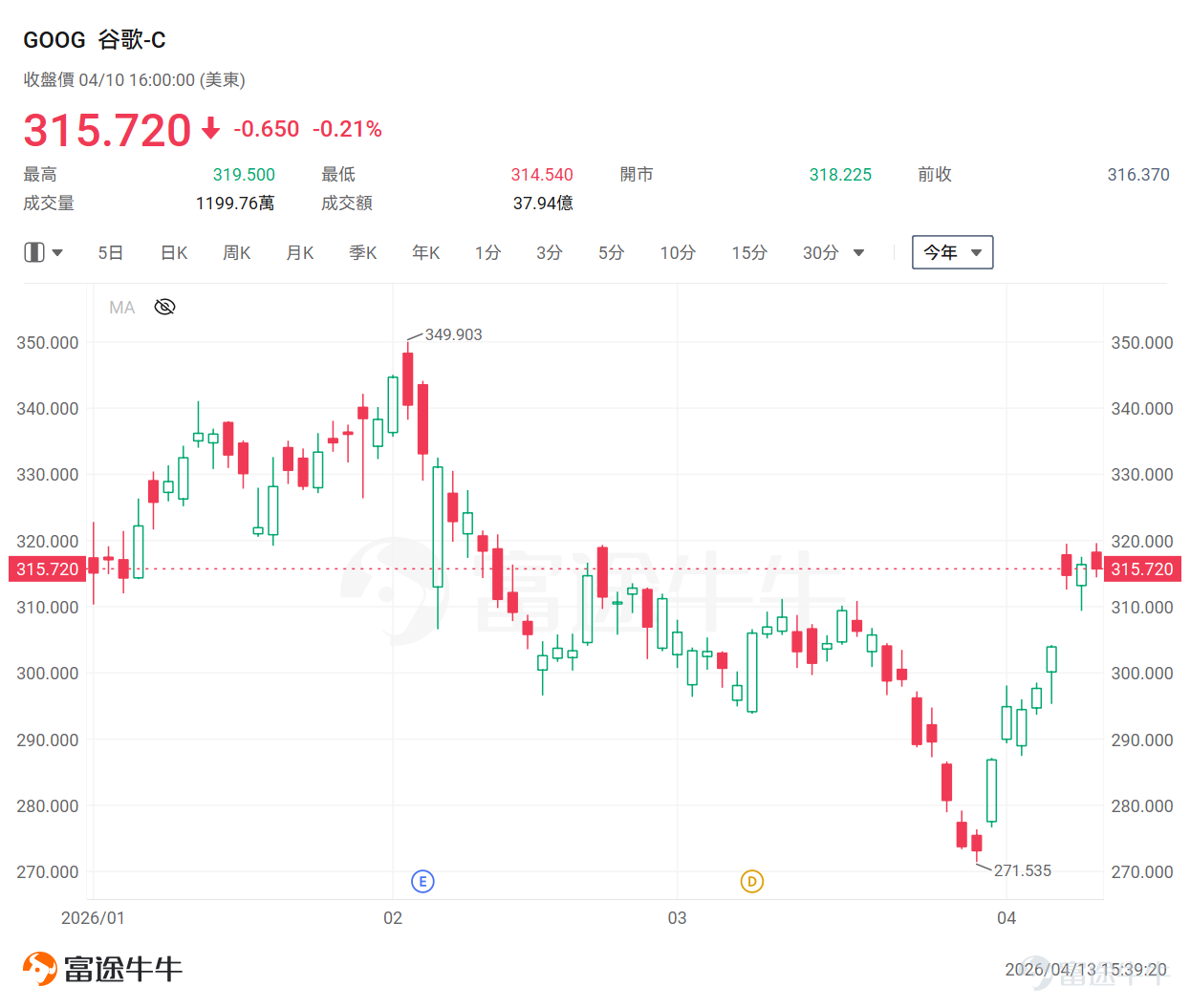
Looking back at the year-to-date performance, after Google's stock price retreated from its February high, it has quietly started a new round of rebound recovery amid easing macro geopolitical risks.

With the stock price recovery and dense industry catalysts, now is an excellent window to reassess the sector allocation risk-reward ratio. This article will provide fellow investors with an in-depth review of Google’s recent industry developments and uncover golden investment opportunities within the supply chain.
What key developments should we watch for regarding Google?
The rising attention towards Google's supply chain this time is primarily driven by three substantial positive factors: ‘new order fulfillment, upcoming major conferences, and doubling of long-term capacity guidance.’ Specifically:
Massive computing power order secured: According to Broadcom's disclosure, AI unicorn Anthropic has signed a latest agreement with Google and Broadcom, locking in up to 3.5 GW of next-generation TPU computing power.
Preview of the major conference, new architecture on the horizon:Google Cloud Next '26 will be held in Las Vegas, Nevada, USA, from April 22-24, focusing on enterprise AI, cloud innovation, and agent-based AI. The next-generation TPU architecture is expected to debut at the event, showcasing the new OCS configuration ratio and product roadmap timing. Subsequently, Google I/O 2026 Developer Conference in May is expected to further disclose the latest breakthroughs in large models like Gemini. These two conferences will act as catalysts, marking not only the starting point for Google's new technology roadmap but also a key window for expanding hardware opportunities.
Significant increase in production guidance:According to market reports, total shipment expectations for TPUs from 2026 to 2028 have been significantly increased to 50 million units: 4.3 million units in 2026, up from 6.5 million to 10 million units in 2027, and exceeding 35 million units in 2028.
Which companies are worth watching?
With the substantial increase in TPU shipment expectations, the underlying AI infrastructure supply chain is set to benefit deeply. We have compiled a list of companies related to the TPU industry chain for fellow investors' reference:
Due to the specific ratio relationship between TPU cluster expansion and network components such as optical circuit switches (OCS), scaling up cluster sizes will exponentially drive demand for high-speed interconnect hardware. Considering the development trends of the industry,This adjustment in TPU production capacity will primarily impact areas such as optical modules, liquid cooling, OCS, MPO and AOC, and server power supplies.

1. Optical Modules and High-Speed Interconnect Chips
In the expansion of computing networks, there exists a rigid ratio of 1:2.5 to 1:3 between TPUs and optical modules. As overall computing density continues to break through, optical modules are rapidly evolving from 800G to 1.6T, with 1.6T expected to account for the majority of future demand growth. This dual resonance of 'quantity expansion' combined with 'speed upgrades' will directly drive the rising demand for upstream DSP and analog chips in the supply chain.
Optical module assembly and components: $Coherent (COHR.US)$、 $Lumentum (LITE.US)$、 $Applied Optoelectronics (AAOI.US)$、 $CIG (06166.HK)$
2. OCS full-optical path switch
According to CignalAI data, the total market size of OCS dominated by Google will be approximately $400 million by 2025. Driven by Google's continuously rising AI computing power demands, the OCS market size is expected to exceed $2.5 billion by 2029, with a compound annual growth rate (CAGR) of up to 58% during this period. The upcoming industry conference is expected to further establish OCS’s technical configurations, opening up long-term growth potential for this niche market.
Optoelectronic devices:The foundational components enabling optical transmission within OCS. Related companies $Coherent (COHR.US)$,This company previously stated that it has over 10 clients in the OCS segment, with backlogged orders showing a quarter-on-quarter increase. The company’s management believes that the previous estimate of the OCS market size (approximately $2 billion in the coming years) may be too conservative and the actual figure could far exceed this number.
MEMS micromirrors:The core micro-mechanical structure enabling lossless dynamic switching of optical paths in OCS, with extremely high technological barriers. Related companies are $Lumentum (LITE.US)$,The company previously stated that it is rapidly expanding its OCS production capacity to meet 'extraordinary customer demand.' The current order backlog has exceeded $400 million. The management team also highlighted the growth potential of the two main businesses, OCS and CPO. Additionally, the company forecasts that from 2025 to 2028, the compound annual growth rate (CAGR) of OCS shipments will exceed 150%, with a target of achieving over $1 billion in annualized revenue by 2027.
Extremely high-precision assembly contract manufacturing:The internal structure of OCS is extremely complex, imposing strict requirements on yield control and ultimate precision for contract manufacturers. Related companies$Fabrinet (FN.US)$。
3. PCB
The significant upward revision of TPU production capacity represents a classic case of‘Dual drivers of volume and price growth’for the PCB (Printed Circuit Board) industry. New-generation TPUs (such as TPUv7, TPUv8) are architecturally more complex, demanding higher performance from PCBs, such as supporting faster signal transmission rates, lower signal loss, and better heat dissipation.
And$TTM Technologies (TTMI.US)$As one of the largest PCB manufacturers in the United States,TTM holds a leading position globally in high-frequency, high-speed, and high-reliability PCBs. In the current macro environment where North American tech giants increasingly prioritize supply chain localization and security, TTM, as the U.S.-based manufacturer with the most abundant advanced PCB capacity, has a strong ‘identity advantage’ and secured order share when securing contracts.
$VGT (02476.HK)$is a domestic leading high-end multilayer PCB and HDI manufacturer currently in the Hong Kong IPO subscription phase. Shenghong Technology has demonstrated impressive breakout and delivery capabilities in recent years, successfully entering the supply chain system of global top-tier AI chip giants and becoming a major supplier of advanced artificial intelligence computing boards.
4. Liquid Cooling
In this round of valuation reshaping for the liquid cooling sector, the ramp-up of Google's TPU has been the most decisive catalyst. Technologically, TPU v7 and subsequent generations are fully embracing liquid cooling, essentially declaring that the ASIC computing ecosystem has completed its transition to liquid cooling. Industry penetration is officially moving from 'phased improvement' to 'structural explosion,' opening up the sector’s long-term logic and sustained growth potential. Related companies include: $Vertiv Holdings (VRT.US)$ 、 $Modine Manufacturing (MOD.US)$$nVent Electric (NVT.US)$ 、。
Among them,$Vertiv Holdings (VRT.US)$ is an important partner of core GPU/ASIC vendors like NVIDIA, deeply involved in setting the next-generation standards for high-power cabinet cooling. It is one of the few companies in the industry capable of providing a complete solution from grid to chip, covering high-density power management and a full set of cooling solutions (including traditional air cooling, cold-plate liquid cooling, and immersion liquid cooling).
$Modine Manufacturing (MOD.US)$ primarily provides large cooling equipment such as chillers, cooling towers, and precision indoor thermal management systems, helping maintain low temperatures across entire data center facilities. With data center business rapidly increasing as a proportion of overall revenue, the company has significant earnings elasticity and room for valuation reshaping.
$nVent Electric (NVT.US)$ is a global leader in electrical connection and protection solutions. While Vertiv offers comprehensive solutions and Modine Manufacturing provides large chillers, nVent focuses on extremely critical physical components. They provide high-density cabinets for liquid-cooled servers, Cooling Distribution Units (CDUs), manifolds, and leak-proof quick connectors.
5. Server Power Supplies
The growth in Google’s number of racks will directly drive demand for high-power server power supplies. Investors in the US market can keep an eye on $Monolithic Power Systems (MPWR.US)$ 、 $Vicor (VICR.US)$ 、 $Advanced Energy Industries (AEIS.US)$ 、 $INNOSCIENCE (02577.HK)$ 。
Among them,$Monolithic Power Systems (MPWR.US)$ the absolute leader in high-performance power management chips globally, focusing on high power density and highly efficient integrated power solutions.
$Vicor (VICR.US)$ is currently the only company in the industry to achieve mass production of 48V direct-to-PoL (Point of Load) technology. The company has provided Google with 48V data center power solutions for several consecutive years.
$Advanced Energy Industries (AEIS.US)$ is a leader in rack-mounted power supplies and front-end AC-DC conversion equipment. As Google builds new data centers and deploys higher-density TPU computing racks, AEIS’s customized high-efficiency rack power solutions, which can reach up to 30kW or even 100kW, are expected to become essential infrastructure.
$INNOSCIENCE (02577.HK)$It is the world's first IDM manufacturer to achieve mass production of 8-inch silicon-based gallium nitride (GaN) wafers and is the sole Chinese GaN supplier in NVIDIA's 800V HVDC power alliance.At the beginning of the year, it also officially announced that its GaN-related products had successfully completed key design integration into Google’s AI hardware platforms, with a formal compliant supply agreement signed.
6. MPO and AOC
The correlation between MPO and optical modules is roughly 1:2; theoretically, the more optical modules there are, the higher the demand for MPO. Investors may focus on$Amphenol (APH.US)$ 、 $TE Connectivity (TEL.US)$ 、 $TIME INTERCON (01729.HK)$ are notable.
Additionally, $Corning (GLW.US)$ 、 $YOFC (06869.HK)$other fiber optic companies are also worth watching. Institutions report that Google has officially placed an order for 12 million NPO optical modules for the construction of its next-generation TPU clusters, marking the substantial start of 'fiber-to-the-rack'.
7. Other Key Links: Chip Design, Foundry Services, etc.
ASIC chip design and IP — the ‘chief designer’ for customized computing power and provider of high-speed interfaces, $Broadcom (AVGO.US)$is the most important co-developer behind Google’s TPU project. Google primarily handles the definition of logical architecture like the matrix multiplication unit core of the TPU, while Broadcom provides extremely critical high-speed SerDes (serializer/deserializer) interface IPs, memory interface IPs, and highly complex backend physical layout and packaging designs.
Wafer fabrication and advanced packaging — the ‘manufacturing chokepoint’ that determines the upper limit of TPU computing performance and the scale of final capacity delivery.Google TPU relies on$Taiwan Semiconductor (TSM.US)$ Production involves everything from the most advanced wafer fabrication processes to the integration of TPU computing cores with HBM through Taiwan Semiconductor's CoWoS advanced packaging technology. The core bottleneck in increasing TPU production capacity often lies in the allocation of Taiwan Semiconductor’s CoWoS capacity.
As Taiwan Semiconductor's CoWoS capacity has long been in a state of extreme shortage, cloud giants like Google will inevitably seek secondary suppliers to ensure supply chain security and capacity delivery. Amkor, with its deep expertise in 2.5D advanced packaging, stands as a key beneficiary of the overflow of top-tier AI chip packaging capacity.
Semiconductor test probes – the 'yield gatekeepers' under advanced processes and high manufacturing costs. $FormFactor (FORM.US)$ A leading global supplier of advanced probe cards for semiconductor wafer testing, this company benefits from the large die size and expensive advanced packaging of AI chips like TPUs. If a defect is discovered after packaging, it results in significant losses. Thus, extremely rigorous testing at the wafer stage is essential. With TPU shipments expected to skyrocket into the tens of millions, consumption of FormFactor’s high-precision probe cards will grow exponentially.
System integration and EMS manufacturing – the 'super factories' that assemble tens of thousands of components into end-user computing power racks.
$Celestica (CLS.US)$ A top EMS provider specializing in enterprise-level network communication and cloud infrastructure, this company was cited by Open Source Securities as having scaled the application of Google’s internally developed OCS across multiple generations of TPU clusters. The company disclosed that by 2026, it will require approximately 15,000 300-port OCS switches, with around 12,000 units internally designed and manufactured by Celestica, while the remaining 3,000 units are externally sourced.Celesticamanufactured externally.
$Jabil (JBL.US)$ A global giant in integrated manufacturing services, Jabil is now responsible for assembling highly complex liquid-cooled AI cabinets as TPUs fully transition to liquid cooling architecture. This process is no longer just about 'plugging in boards'; it involves intricate liquid cooling pipeline layout, heat dissipation module integration, and high-power electrical connections. Leveraging its robust capabilities in precision manufacturing and thermal management integration, Jabil has become the core vendor handling these challenging liquid-cooled AI cabinet assemblies.
$Flex Ltd (FLEX.US)$ A leading global provider of supply chain and manufacturing solutions, Flex excels in power system integration and rack-level assembly for data centers. It plays a crucial role in ensuring that Google’s TPU clusters can be rapidly deployed across data centers worldwide.
Summary
Overall, investors need to closely follow the upcoming Google Cloud Next and Google I/O major tech conferences, which will be a key catalyst for verifying the mix of next-generation technologies and observing the rhythm of supply chain order fulfillment. In this era where 'computing power equals authority,' the certainty of demand for underlying infrastructure remains extremely high.
While capturing the benefits of industry expansion, investors must also closely monitor potential risks such as AI capital expenditure falling short of expectations, delays in technological iteration and production expansion, geopolitical issues and supply chain disruptions, and valuation pullbacks in high-priced sectors.
Risk Disclaimer: The above content only represents the author's view. It does not represent any position or investment advice of Futu. Futu makes no representation or warranty.Read more


Comments (5)
to post a comment
210
712