
Storage giants launch collective buybacks: Where does the supercycle stand?

Options Sir Breaks Down Hot Topics | Will SanDisk's Entry into the Nasdaq 100 Index Lead to a Thousand-Dollar Stock Price?
Before the market opened on April 13, global storage giant $SanDisk (SNDK.US)$ stood out by rising more than 1% against the market trend, carving out its own independent performance, with an accumulated increase of 34% in April. Throughout 2026, when large technology stocks generally fell, SanDisk repeatedly pushed towards new highs. The AI-driven surge in storage demand is reshaping the capital flow of the entire semiconductor industry.
Two recent major positive developments
Positive 1: Inclusion in the Nasdaq 100 Index
Late on April 11, Nasdaq officially announced that SanDisk would replace Atlassian (TEAM) to formally join the Nasdaq 100 Index on April 20.Historical experience shows that flexible investors in the market usually build positions ahead of these passive funds' purchases, thereby pushing up stock prices (known as the 'inclusion premium'). However, it is worth noting that some of the positive effects have already been priced in. Investors who bought earlier may choose to take profits at recent high points, potentially causing short-term declines in the stock price.
Positive 2: Multiple analysts collectively raised target prices
On April 9, the day before the index inclusion announcement,Renowned institution Cantor Fitzgerald significantly raised SanDisk's target price from $800 to $1,000, directly prompting a 9% surge in SanDisk's stock price on the same day.Since January this year, well-known institutions such as Citigroup, Jefferies, and Bernstein have substantially increased their forecasts for SanDisk. This collective behavior indicates that mainstream capital has reached a consensus on SanDisk's sustained profitability in the AI era and remains optimistic about its future.
Core support for SanDisk's stock price: The thriving storage industry and the company’s strong fundamentals
Industry foundation: Enormous demand driven by AI
The current training and application of large AI models require processing massive amounts of data. This demand directly translates into procurement orders for high-capacity, high-bandwidth memory chips. The scale of storage purchases by data centers saw a leap in growth between 2025 and 2026, a trend clearly evidenced in the financial reports of multiple memory companies.
Corporate earnings: Rapid growth in financial data
Based on the latest financial data, SanDisk's fundamentals are exceptionally strong. In the second quarter of fiscal year 2026, the company achieved revenue of $3.02 billion, a year-over-year increase of 61%; net profit reached $800 million, surpassing estimates ($480 million) by 66%.
Potential risk: Elevated valuation
It is worth noting that along with rapid earnings growth, SanDisk’s stock valuation has also risen sharply. Since its listing, its share price has surged over 2,314%, with a current market capitalization of approximately $125.7 billion. This implies the market has already priced in the company’s promising future. If, in the future (for instance, in the Q3 earnings report expected in May-June), its business growth slows and fails to meet sky-high market expectations, this high valuation could lead to a significant correction in the stock price.
Looking at the recent candlestick chart, SNDK underwent a textbook event-driven rally. On April 6, the stock closed at $724.63, up 3.28%, with bulls beginning to build momentum; on April 7, it briefly pulled back to $710.80, down 1.91%, marking the last fluctuation before the ceasefire announcement; on April 8, news of a Middle East ceasefire was announced, sentiment across the broader market improved significantly, and SNDK surged 9.86% in a single day, closing at $780.90; on April 9, Cantor Fitzgerald raised its target price to $1,000, coupled with speculation over inclusion in the Nasdaq index, pushing the stock up another 9.05%, closing at $851.57.
Options Investment Strategies
Due to the recent sharp rise and the inclusion in the Nasdaq, SNDK's implied volatility (IV) has significantly increased. The higher the IV, the more expensive the options premiums become. In a high IV environment, the cost of directly purchasing single-leg call options is higher, with significant premium erosion risk. Below are some options strategies for your reference.
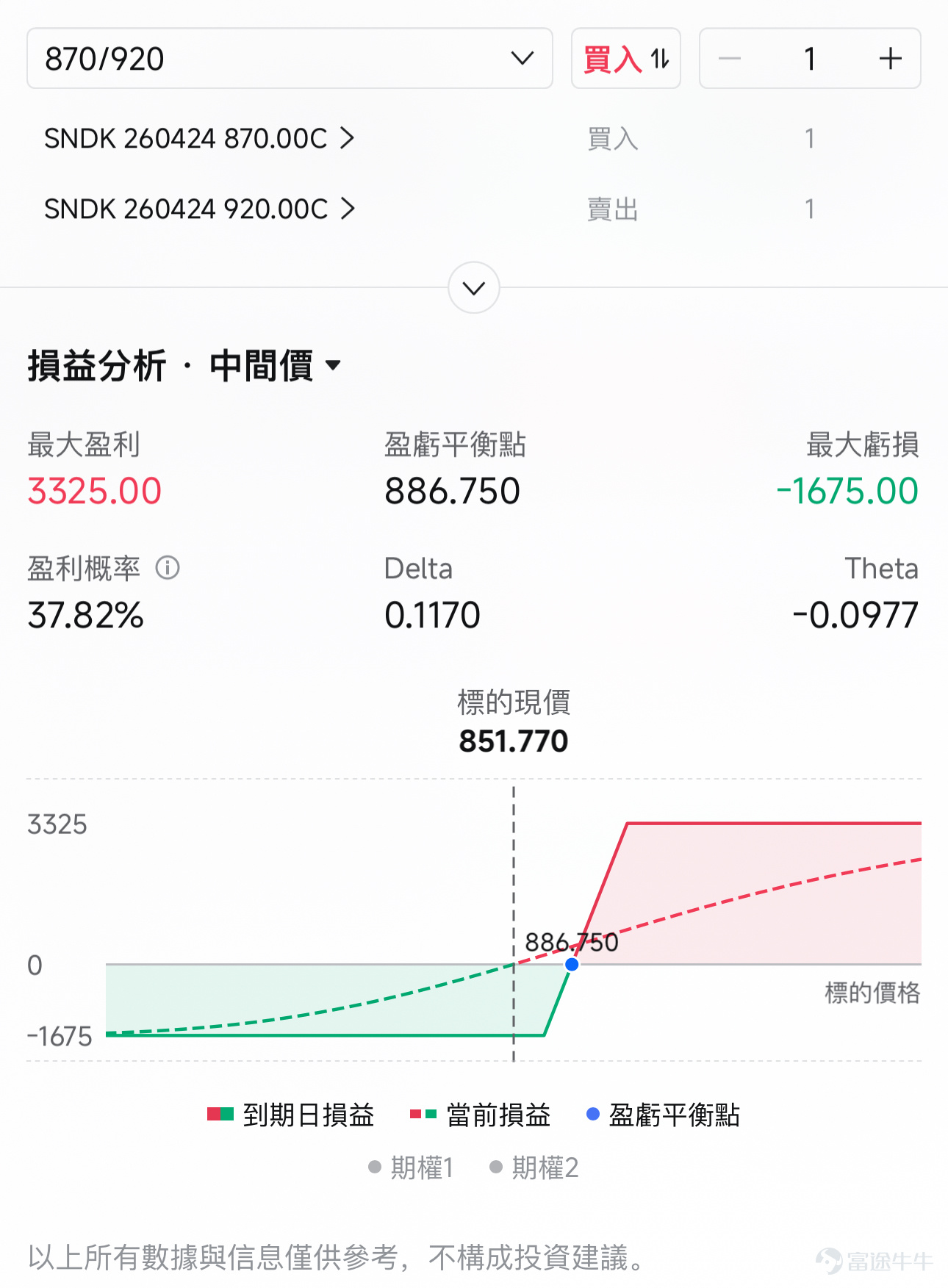
(1) Bull Call Spread
This is an options structure suitable for a moderately bullish outlook. The way it works is: simultaneously buying a call option and selling another call option with a higher strike price that expires at the same time. Buying the call option allows participation in potential stock price gains, while selling the call option with a higher strike price helps hedge against the currently elevated implied volatility and lowers the overall position cost. Both options have the same expiration date, and after offsetting the purchase cost with the income from the sale, the net premium expenditure will be much lower than buying a single-leg option.
Compared to simply buying a call option, the spread structure sacrifices some upside potential in exchange for a lower initial cost and better risk-reward ratio, making it a more rational choice in a high IV environment.The maximum loss is limited to the net premium paid, which makes risk control easier.
(The figure below illustrates the simulated profit and loss scenario of this strategy on the expiration date. The design image displayed on the screen is for demonstration purposes only and does not constitute any investment advice or guarantee; market conditions fluctuate frequently, and the prices shown do not represent actual values.)

(2) Protective Put
If you hold SNDK shares but are concerned about short-term pullbacks caused by market instability such as Middle East tensions, you can directly purchase a single-leg put option as 'insurance' for your SNDK shares, hedging against profit retracement or losses due to a drop in share price.
Overall, SNDK is one of the rare companies in the current market that combines 'expectations of rapid corporate earnings growth' with 'clear event-driven catalysts tied to specific timelines.' However, no stock rises indefinitely. Risks from oil price fluctuations driven by Middle East tensions, along with the company’s high valuation at current levels, are unstable factors that could trigger a price correction at any time. In specific trading scenarios, patiently waiting for price pullbacks, avoiding emotionally driven chasing of highs, and strictly setting stop-loss rules are key to navigating today’s complex market environment.
Finally, Option Sir brings a small perk for fellow investors, welcome to claim it.Options Beginner Pack
This event is exclusively for invited HK users, click to learn moreDetailed event rules >>
Market conditions are complex and volatile,Options strategyOverwhelmed by choices? Futubull helps you build a portfolio in three steps.Options strategymaking investing simple and efficient from now on!

Option Risk Warning:An option is a contract that grants the holder the right, but not the obligation, to buy or sell an asset at a fixed price on a specific date or at any time before that date. The price of an option is influenced by various factors, including the current price of the underlying asset, the strike price, time to expiration, and implied volatility. Implied volatility reflects the market’s expectations for the level of volatility in the option over a future period. It is a data point derived inversely from the Black-Scholes option pricing model and is generally regarded as an indicator of market sentiment. When investors anticipate greater volatility, they may be more willing to pay a higher price for options to hedge risks, resulting in higher implied volatility. Traders and investors use implied volatility to assess the attractiveness of option prices, identify potential mispricings, and manage risk exposure.
Disclaimer:This content does not constitute any offer, solicitation, recommendation, opinion, or guarantee for any securities, financial products, or tools. The risk of loss in trading options can be substantial. In some cases, losses may exceed the initial margin deposited. Even if you set contingent orders such as 'stop-loss' or 'limit' orders, these may not prevent losses. Market conditions may prevent these orders from being executed. You might be required to deposit additional margin within a short period. If you fail to provide the required amount within the specified time, your open positions may be liquidated. However, you will still be responsible for any shortfall in your account. Therefore, before trading, you should study and understand options and carefully consider whether such trading is suitable for you based on your financial situation and investment objectives. If you trade options, you should be familiar with the procedures for exercising options and the rights and obligations upon exercise and expiration. Option trading involves extremely high risks and is not suitable for all investors. Investors should read carefully before engaging in any options trading strategy.Characteristics and Risks of Standardized Options。
Risk Disclaimer: The above content only represents the author's view. It does not represent any position or investment advice of Futu. Futu makes no representation or warranty.Read more


Comments
to post a comment
41
64