
Negotiations remain deadlocked—will the U.S.-Iran deal materialize on schedule?

Gaozhan Weekly Interest Rate Analysis | US-Iran talks collapse! Oil prices hold steady above $95, supporting a surge in inflation?!
The202605phase

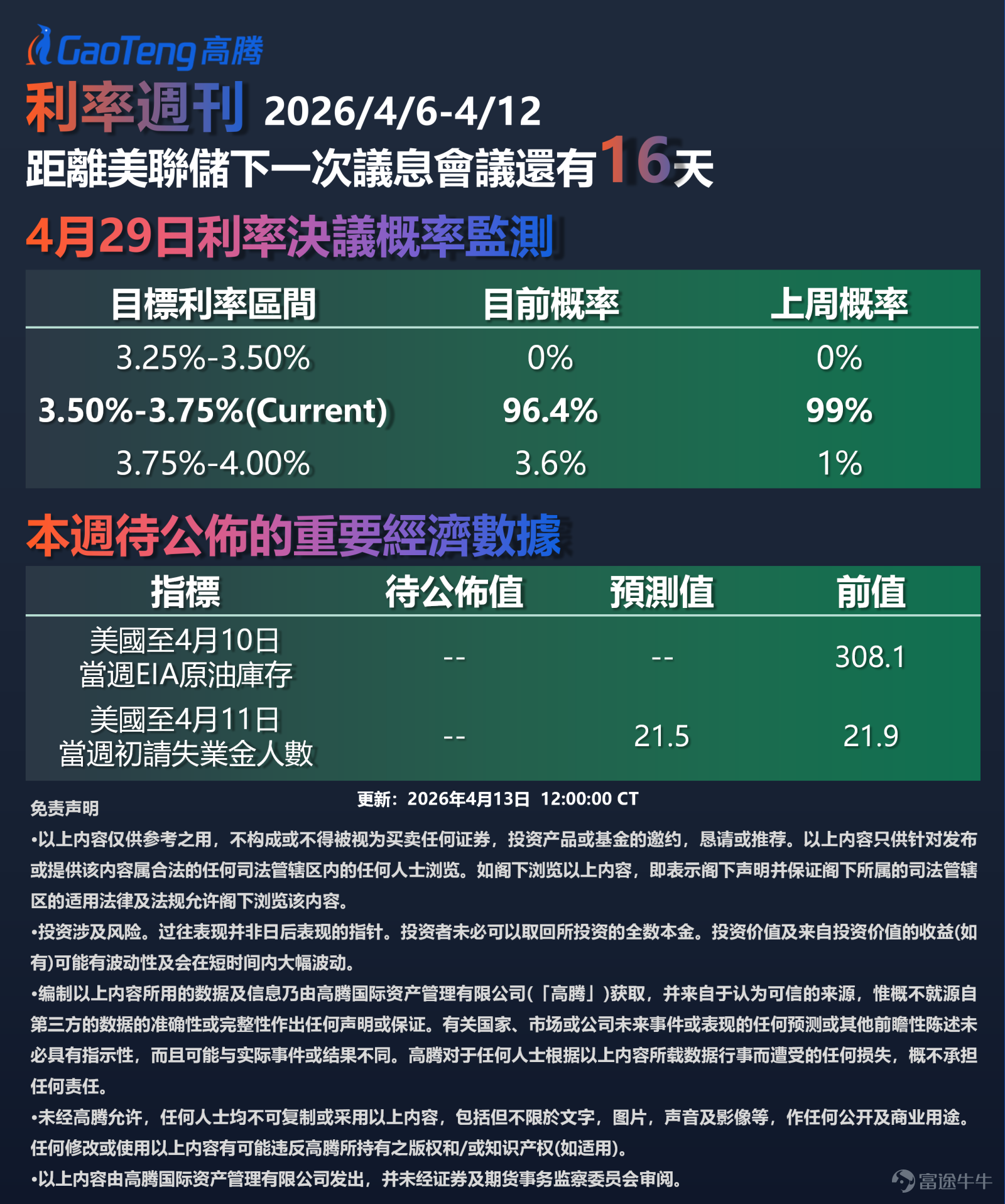
According to CME FedWatch data, there is still16 daysCurrently, the market expects that the probability of maintaining interest rates3.50%-3.75%unchanged in the Fed’s next rate decision is96.4%, raising interest rates to3.75%-4.00%with a probability of3.6%. Compared to one day ago (April 12), the probability of remaining unchanged is97.9%, showing a slight rise in rate hike expectations; compared to one week ago (April 6), the probability of remaining unchanged is99.0%. While market expectations for the Fed to maintain the current interest rate range still dominate, subtle changes have occurred at the margin; compared to one month ago (March 13), the probability of remaining unchanged was94.1%, cut interest rates to3.25%-3.50%Probability is5.8%, now there are indications of a slight increase in interest rate expectations.
US-Iran situation: Negotiations collapse, escalation of the blockade of the Strait of Hormuz
Last Sunday (April 12), the US-Iran situation experienced a dramatic reversal. The United States and Iran held marathon peace talks inIslamabad, Pakistan, but the negotiations ultimately collapsed,US President Trumpannounced that starting fromApril 1310 PM (Beijing time) a maritimeblockade on Iranian ports will be implemented.The U.S. Central Command stated that thisblockade on Iranian ports will be implemented.will be enforced impartially on all national vessels entering or leaving Iranian ports and coastal areas (including all Iranian ports in the Arabian Gulf and the Gulf of Oman), but will not obstruct shipsStrait of Hormuztraveling to and from non-Iranian ports.
Trump said after the breakdown of negotiations that the Iranians have not left the negotiating table and are expected to return, giving the US everything it wants. He threatened that he might strike Iran's desalination plants and power plants, stating that 'any Iranian firing on us or peaceful ships will be blown to hell.' Trump also mentioned that due to Iran’s actions, the whole world is relying on the US for oil, saying, 'We have more oil reserves than the combined total of Russia and Saudi Arabia.'Strait of HormuzThe whole world relies on the US for oil, 'our oil reserves are larger than the combined total of Russia and Saudi Arabia.'
Iran has responded with strong rhetoric.The Spokesperson for Iran's Armed Forces' Khatam al-Anbiya Central Headquartersstated that the security of ports in the Persian Gulf and the Gulf of Oman 'either belongs to everyone or to no one,' and vowed to firmly enforce 'control'Strait of Hormuzpermanent mechanism'.Moshen Rezaei, military advisor to Iran's Supreme Leaderstated that Iran 'is not a place that can be (social media) posted about and fantasized about with solutions'blockade on Iranian ports will be implemented., and that the US has experienced a 'historic failure,' with its maritimeStrait of Hormuzblockadeblockade on Iranian ports will be implemented.Similarly 'doomed to fail.'
According to reports,Seyyed Mahmoud Nabaviyan, a member of the Iranian Islamic Consultative Assemblyonce posted on social media listing three 'excessive demands' made by the US: the US demanded to share benefits jointly with IranStrait of Hormuzthe US requested that all uranium enriched to60%ofconcentrated uraniumbe removed from Iran; the US demanded that Iran not engage in uranium enrichment activities for20 yearsin the future. These demands were later deleted but already reflect the difficulty of the negotiations.
Federal Reserve Dynamics: Officials express cautious stance as rate hike expectations subtly rise
This week, statements from Federal Reserve officials leaned overall hawkish, but they remained cautious about whether to raise rates.Fed's Dalystated that bringing inflation down to 2% is crucial, and high inflation data would not surprise anyone. She outlined several possible scenarios for either cutting rates or standing pat, indicating that a rate hike was unlikely. However, she also emphasized that the real issue lies in whether the ceasefire can last — if it does, then CPI data becomes irrelevant.
Fed's Williamssaid that US GDP growth is expected to be between 2% and 2.5% this year, with the unemployment rate remaining stable.White House economic advisor Hassettindicated that the prospect of the Fed having room to cut interest rates remains very solid. However, the market doesn't seem to be convinced. Traders have increased their bets on the Fed cutting rates once this year but have also started pricing in the risk of a rate hike.
"Fed whisperer" Nick Timiraos stated that the US core CPI for March was slightly lower than expected, but data from a single month doesn't reveal much. The Fed wants to see energy prices fall and has more confidence that the impact of tariffs has ended, while the knock-on effects of energy (such as airfare and shipping costs) are more likely still to come.
The Fed's Marchmonetary policy meeting minutesshowed that some central bank officials believe the conflict in Iran poses"two-way risks"—it could either push up inflation or suppress economic growth. At the March 17-18 monetary policy meeting, the Fed announced it would keep the federal funds rate target range steady at 3.5% to 3.75%, marking the second consecutive time rates were left unchanged.
Possible chain reaction
Geopolitical escalation
The US may use"protecting freedom of navigation"as a reason to send an aircraft carrier strike group into the strait
Iran might deploy anti-ship missiles and swarms of fast boats for"gray zone"harassment
Gulf states like Saudi Arabia and the UAE could be forced to pick sides, exacerbating regional polarization
Economic chain reaction
Global inflationary pressures are surging; the European Central Bank and the Bank of England maybe forced to raise interest rates earlier than expected
Asian manufacturing countries (China, Japan, South Korea) are facingsoaring energy costs and deteriorating terms of trade
US domestic gasoline prices have exceeded $5/gallon,impacting midterm elections
Window for diplomatic resolution
China and the EU may jointly proposean 'international co-management'plan as a compromise
UNSC holds emergency meeting, but vetoes by the US and Russia impede resolution progress
Parties may eventually return to the negotiating table, but both sides will demand higher stakes
Historical reference: 1980s‘Tanker War’: Iran and Iraq attacked each other’s tankers, prompting international intervention for escort operations
2011-2015 Iran nuclear negotiations: A game of sanctions and counter-sanctions eventually led to an agreementJCPOA agreement
Internal divisions: Intensifying hawk-dove dynamics result in unclear policy pathways
Doves:Fed's DalyEmphasized the importance of inflation easing, suggesting that raising interest rates prematurely amid current geopolitical uncertainties could exacerbate downside economic risks.White House economic advisor HassettExpressed optimism about the prospect of the Fed lowering interest rates, believing that inflationary pressures will ease as energy prices decline.
Hawkish: Market traders have started pricing in rate hike expectations, with cumulative Fed rate hikes by June25 basis pointsnow having risen to1.5%; The monthly increase in the US March CPI reached its highest level since 2022, pushing the yield on the 10-year US Treasury bond above4.3%, and further rising to4.35%on Monday; Traders and strategists at Pacific Investment Management Company, Brandywine Global Investment Management, and Natixis North America are preparing foryields to remain elevated.
Key data: US March CPI surged, intensifying inflationary pressures
The overall inflation in the US for March rose significantly due to soaring oil prices, while core inflation showed moderate performance. Last Friday, the monthly increase in the US March CPI reached its highest level since 2022, pushing the yield on 10-year US Treasury bonds above4.3%, and prompting traders to reduce expectations for interest rate cuts this year. On Monday, the yield rose another 3 basis points to reach4.35%。
A research report from CITIC Securities stated that the risk of secondary inflation in the US is relatively low. The month-on-month CPI in April may remain relatively high due to a compensatory rise in rental inflation. If oil prices fall slowly, the year-on-year CPI in the US for the remainder of the year may continue to exceed3%. This will pose a significant challenge to the Fed's monetary policy – if inflation remains persistently high, the Fed may be forced to delay rate cuts or even consider raising rates; if economic growth slows due to geopolitical conflicts, the Fed may need to make a difficult choice between inflation and growth.
Historical reference: The tug-of-war between geopolitical conflict and Fed policy
Historically, the impact of geopolitical conflicts on Fed policy has usually been short-lived unless it has a lasting effect on inflation and economic growth. After the outbreak of the Russia-Ukraine conflict in 2022, the Fed faced a difficult choice between surging inflation and slowing economic growth, ultimately opting for an aggressive rate hike path. The uniqueness of the current US-Iran conflict lies in its direct impact on the chokepoint of global energy supply –Strait of Hormuz, making the inflation risk more prominent.
In 2020As tensions between the US and Iran escalate, the Fed is in a rate-cutting cycle, with geopolitical risks reinforcing the necessity for accommodative policies. However, the Fed is currently in a 'higher-for-longer' interest rate environment, and rising energy prices brought about by geopolitical conflicts may further delay the timing of rate cuts. Investors should pay attention toApril 30the upcoming Fed interest rate meeting, where the Fed will update its economic forecasts and hold a press conference.
Market Sentiment Snapshot
Investors are currently in a mixed state of 'anxious观望' and 'defensive risk aversion.' On one hand,US-Iran talksthe rupture andthe blockade of the Strait of Hormuzhave heightened geopolitical risks, with rising energy prices boosting inflation expectations and pushing back market forecasts for Federal Reserve rate cuts. On the other hand, markets still hope that the second round of negotiations can take place within days, as the door for diplomatic resolution has not been fully closed. Caught between dual pressures of inflation and geopolitical risks, market volatility is expected to remain elevated.
Other major central bank activities
PBOC: This week, the People's Bank of China conducted a 7-day reverse repo operation worth 5 billion yuan, keeping the interest rate unchanged. Recently, Pan Gongsheng, Party Secretary and Governor of the People’s Bank of China, visited Tsinghua University, where both parties signed a cooperation agreement. They aim to deepen collaboration in cultivating high-level financial talent, conducting major theoretical and policy research on finance, and building platforms for fintech innovation.1.40%No change. Recently, Pan Gongsheng, Secretary of the Party Committee and Governor of the People's Bank of China, led a delegation to Tsinghua University, where the two sides signed a cooperation agreement aimed at deepening collaboration in areas such as cultivating high-level financial talent, conducting research on major financial theories and policies, and establishing platforms for fintech innovation.
ECB: Monetary market pricing indicates the probability of a European Central Bank rate hike in April is about50%, compared to approximately last Friday.20%。Yves MerschOpen to a rate hike in April, and further hikes are possible if the crisis persists.ECB President Christine LagardeIt is stated that it is too early to determineApril 30whether a rate hike is necessary. The risk of a further escalation in the US-Iran conflict has kept traders cautious, and the market is once again convinced that the European Central Bank will carry out three rate hikes of25 basis pointseach.
Bank of Japan:Bank of Japan Governor Kazuo UedaIt was noted that Japan's economy is experiencing a moderate recovery but still shows some signs of weakness; underlying inflation is gradually accelerating toward the Bank of Japan’s target; due to the impact of theMiddle East conflict,financial markets have been experiencing unstable fluctuations; rising oil prices have worsened trade conditions, putting pressure on Japan's economy.Japanese Cabinet Secretary Minoru Kiuchistated that it is expected the Bank of Japan will implement appropriate monetary policy to achieve its price stability target sustainably and steadily. Former Bank of Japan Policy Board member Seiji Adachi indicated that the Bank of Japan is highly likely to raise interest rates before July, as the Middle East war has driven up oil costs, increasing the risk that the central bank may fall behind the curve in addressing growing inflationary pressures.
Bank of England: Sources say the UK has ruled out participating in the USStrait of Hormuzofblockade on Iranian ports will be implemented.operations. A UK government spokesperson said they are working with France and other partners to form a broad coalition to protectStrait of Hormuzfreedom of navigation.
Market reaction: Gold falls below $4,650, Hong Kong stocks under pressure decline
In the gold market,$Gold Futures (AUG6) (GCmain.US)$ dropped below$4,650during the day, down2.11%. Previously, gold surged due to heightened geopolitical risks but has since pulled back afterUS-Iran talksthe collapse, reflecting market demand for dollar liquidity and some investors taking profits.
In the stock market,April 13Hong Kong stocks closed,$Hang Seng Index (800000.HK)$ closing at25,660.85 points, dropup 232.69 points, with losses0.9%; $Hang Seng TECH Index (800700.HK)$ closing at4,822.01 points, dropup 38.25 points, with losses0.79%. The situation in the Middle East is tense andthe blockade of the Strait of HormuzConcerns are putting pressure on Asian stock markets.
In the bond market, the failure of peace talks between the US and Iran has further shifted focus to inflation concerns and reinforced expectations that interest rates will remain higher for longer. For investors in the $31 trillion US Treasury market, rising energy costs could exacerbate existing price pressures, delaying the Federal Reserve’s rate cuts.
Strategist's View: Proceed with Caution, Focus on Negotiation Progress
Joe Kent, former Director of the U.S. National Counterterrorism Centersaid that negotiations between the US and Iran could have worked but were broken due to a demand for 'zero'concentrated uraniumenrichment' causing the breakdown, he urged sticking to the US demands rather than Israel's stance to salvage the situation within the remaining ceasefire window. Kent said the US government's red line was never 'zero'concentrated uraniumenrichment,' but rather 'Iran must not possess nuclear weapons,' which Iran also agreed upon.
Citigroup stated that due to tensions in the Middle East, South Korea’s crude oil imports in April and May are expected to drop to 58% and 80% of normal monthly import levels, respectively. South Korea’s crude oil imports will fall to 50 million barrels in April and 69 million barrels in May, compared to an average monthly import volume of 85.7 million barrels in 2025. South Korea is expected to increase crude oil imports from the US while reducing imports from the Middle East.
The European Commission will propose reducing energy taxes and grid fees to promote the adoption of clean energy technologies, while mitigating the impact of soaring oil and gas prices. According to a report by the Jacques Delors Institute, sinceIran warthe outbreak, 22 member states of the EU have introduced more than 120 individual measures, spending over 9 billion euros (approximately 10.5 billion US dollars), to alleviate the impact of rising energy prices.
Chinese Foreign Ministry calls for calm and restraint, urging constructive role
Chinese Foreign Ministry spokesperson Guo Jiakun said at theApril 13regular press conference that the initiation of talks between the US and Iran represents a step towards easing tensions. China hopes that relevant parties adhere to the temporary ceasefire arrangement and resolve disputes through political and diplomatic means, avoiding reigniting conflicts, and creating conditions for restoring peace and stability in the Gulf region as soon as possible.PakistanThe initiation of negotiations represents a step in the direction of de-escalation. China hopes that all relevant parties will abide by the temporary ceasefire arrangement, steadfastly pursue political and diplomatic solutions to the dispute, prevent a resurgence of hostilities, and create the conditions for the early restoration of peace and stability in the Gulf region.
Regarding Trump's threat to impose additional tariffs if China supplies weapons to Iran, Guo Jiakun stated that 'a tariff war has no winners.' Regarding Trump’s reiteration of his plan toblockade on Iranian ports will be implemented.Iranian ports, Guo Jiakun stated thatStrait of Hormuzis an important international channel for goods and energy trade, and maintaining security, stability, and smooth flow in this region serves the common interests of the international community. The root cause of obstructed strait navigation lies in the conflict in Iran, and the solution is to achieve a ceasefire and end hostilities as soon as possible. All parties should remain calm and exercise restraint. China is willing to continue playing a positive and constructive role.

Risk Disclaimer: The above content only represents the author's view. It does not represent any position or investment advice of Futu. Futu makes no representation or warranty.Read more

Comments
to post a comment
2
1