
Zhilian has joined the ranks of Hong Kong-listed stocks trading above HKD 1,000. The second AI leader in Hong Kong stocks this year may reshape the market landscape.
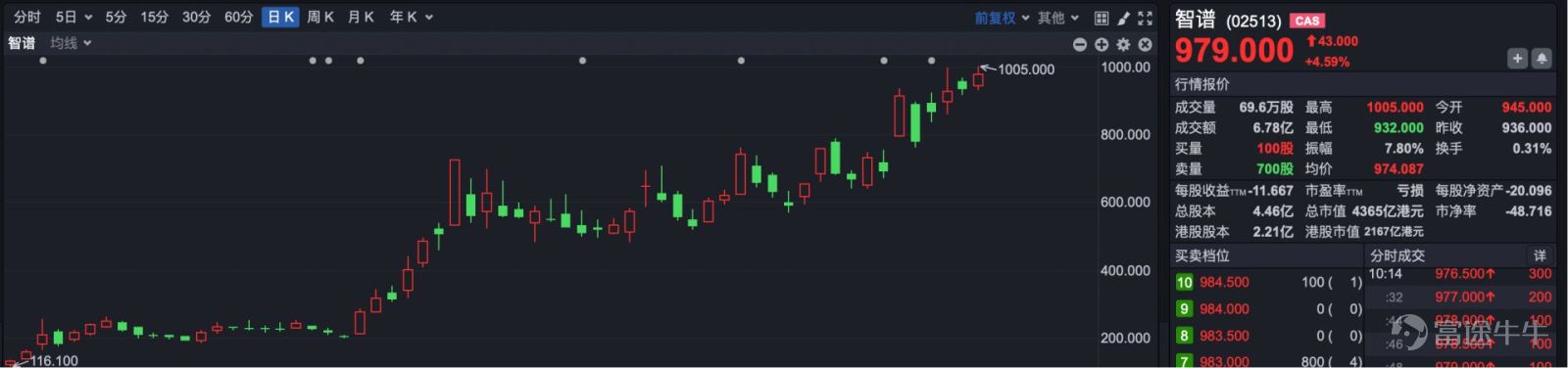
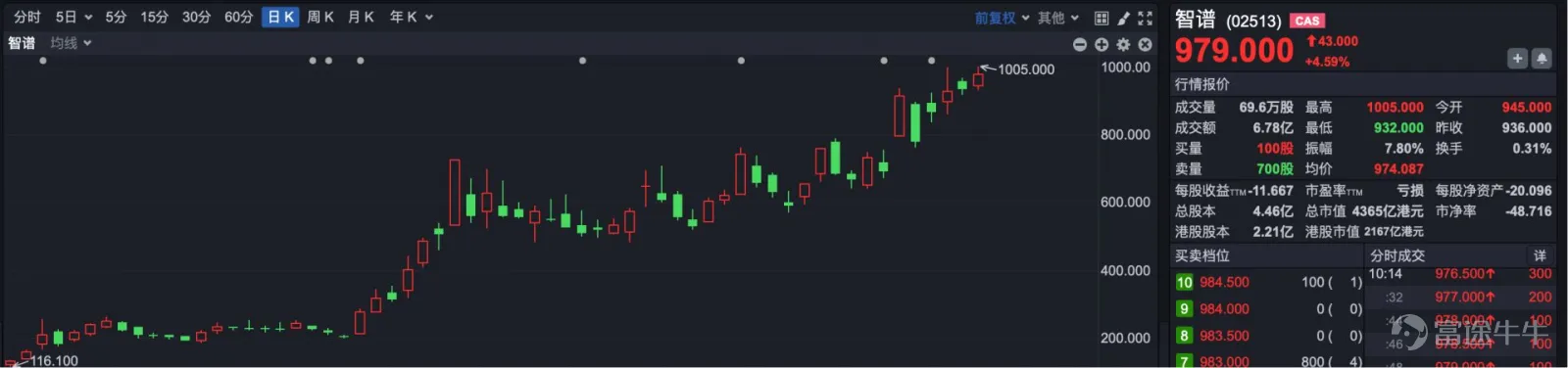
On April 13, the share price of Zhilian (HK02513), a domestic AI leader, broke through the HKD 1,000 mark during intraday trading, reaching a high of HKD 1,005. This made it the second individual stock in Hong Kong this year to join the ranks of stocks trading above HKD 1,000.
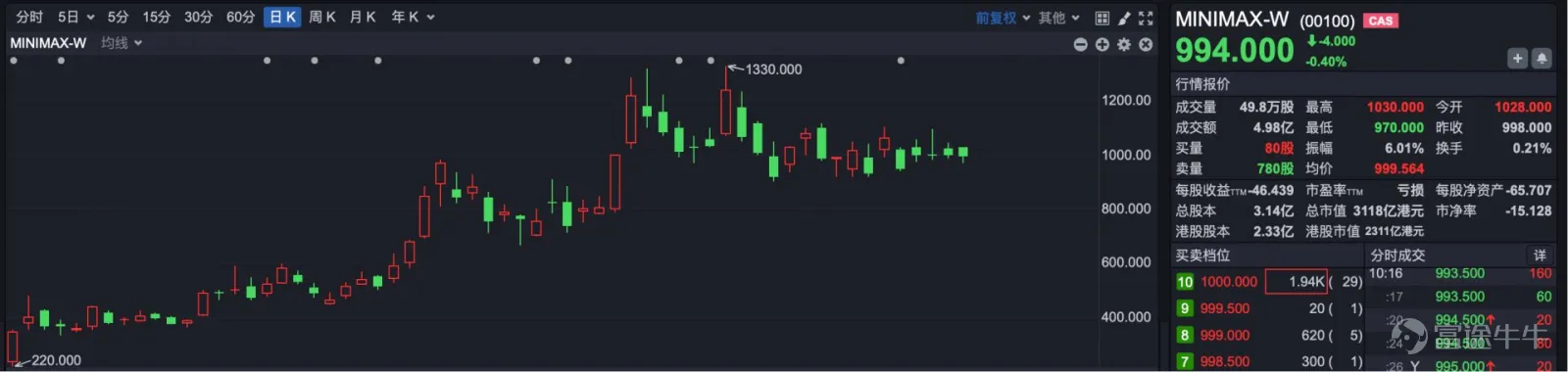
Previously, MINIMAX-W (HK00100), also from the AI sector, had already broken the HKD 1,000 barrier on March 9. The explosive performance of these two new listings not only rewrote the landscape of high-priced stocks in Hong Kong but also marked that the new force centered around artificial intelligence has officially replaced traditional technology and internet stocks, becoming the core growth engine of the Hong Kong tech sector.
On January 8 this year, Zhipu officially listed on the Hong Kong Stock Exchange. The issue price of Zhipu was HKD 116.2. Notably, Zhipu's journey to the thousand-dollar mark was not smooth sailing. On its first day of trading, the stock briefly fell below the issue price, touching a low of HKD 116.1. Subsequently, driven by the rising prosperity in the AI sector and the acceleration of the company's commercialization process, the stock price entered a steady upward trajectory, shifting into a rapid growth phase from late February. On April 1, after Zhipu released its financial report, the stock surged 30% in a single day, eventually crossing the thousand-dollar threshold on April 13. Just over three months since its IPO, Zhipu’s share price has risen more than 760%, with a total market capitalization exceeding HKD 430 billion, surpassing long-established internet giants like JD.com and Baidu, placing it among the top tier of technology stocks in Hong Kong.
Prior to Zhipu, MINIMAX-W, which went public on January 9, broke through the thousand-dollar mark as early as March 9, reaching a high of HKD 1,330. The two AI new listings successively reached the summit in a short period, jointly reshaping the landscape of high-priced stocks in Hong Kong.
Founded in 2019, Zhipu set “making machines think like humans” as its sole goal from the outset. In the pursuit of AGI (Artificial General Intelligence), Zhipu has consistently believed that “breaking through the upper limit of intelligence” is the only fundamental physical principle of this era. In its 2025 annual report, Zhipu stated: If the upper limit of intelligence determines the pricing power of technology, then the scale of Token consumption determines the magnitude of commercial value. Internally, Zhipu derived a concise formula: AGI commercial value = upper limit of intelligence × Token consumption scale.
Behind Zhipu’s robust stock price growth lies the dual support of solid fundamentals and industry tailwinds. The latest financial data shows that in 2025, the company achieved revenue of CNY 724 million, representing a 131.9% year-on-year increase, maintaining a doubling growth trend for three consecutive years. Revenue in the second half of the year amounted to CNY 533 million, marking an 180% sequential leap from the first half, showing clear signs of accelerating commercialization.
Technical barriers are Zhipu’s core competitiveness. The company continues to iterate on the GLM series models, and with frequent updates from GLM-4.5 to GLM-5, Zhipu has consistently ranked first globally in open-source evaluations, firmly holding its position in the top tier worldwide.
Technological advantages have translated into strong pricing power. After raising API call prices multiple times in Q1 2026, usage volume actually grew significantly, creating a virtuous cycle of “both price and volume increasing.”
Authoritative institutions have issued positive ratings. On April 8, Xinda Securities released a research report stating that Zhipu’s revenue structure is clear, with rapidly growing demand driving continuous scaling of cloud-deployed API businesses. In 2025, the company continuously explored the upper limit of intelligence with the GLM series models, achieving comprehensive and rapid development from the developer ecosystem to a globalized MaaS platform. ARR accelerated, high-quality Tokens experienced both volume and price increases, and the API platform’s commercial scale entered a new phase. Driven by the “upper limit of intelligence,” high-quality Tokens entered a stage of simultaneous volume and price increases, leading to faster ARR growth and sustained improvement in MaaS commercial quality.
On April 11, Guosen Securities published a research report noting that Zhipu, as a leading independent large language model company, has rapidly expanded its product portfolio. For the first time covered, it was given an “Outperform Market” rating.
A Dongwu Securities research report forecasted that Zhipu’s revenue for 2026 to 2028 would be CNY 3 billion, CNY 7.8 billion, and CNY 21 billion respectively. The drivers of rapid revenue growth include: enhanced capabilities of the GLM-5 series models leading to exponential growth and price increases in API calls; Agent products such as Claw Plan entering a significant scaling phase; and overseas sovereign AI model expansion. Dongwu Securities believes that the company has deep technological barriers and a clear commercial path, issuing a “Buy” rating.
In addition to MINIMAX-W and Zhipu, a group of newly listed stocks this year have driven significant changes in the high-priced stock segment of the Hong Kong market.
Among them, Tianshu Zhixin (HK09903), which went public on January 8, surged 16% today, hitting a record high with its peak price reaching HKD 372.6.
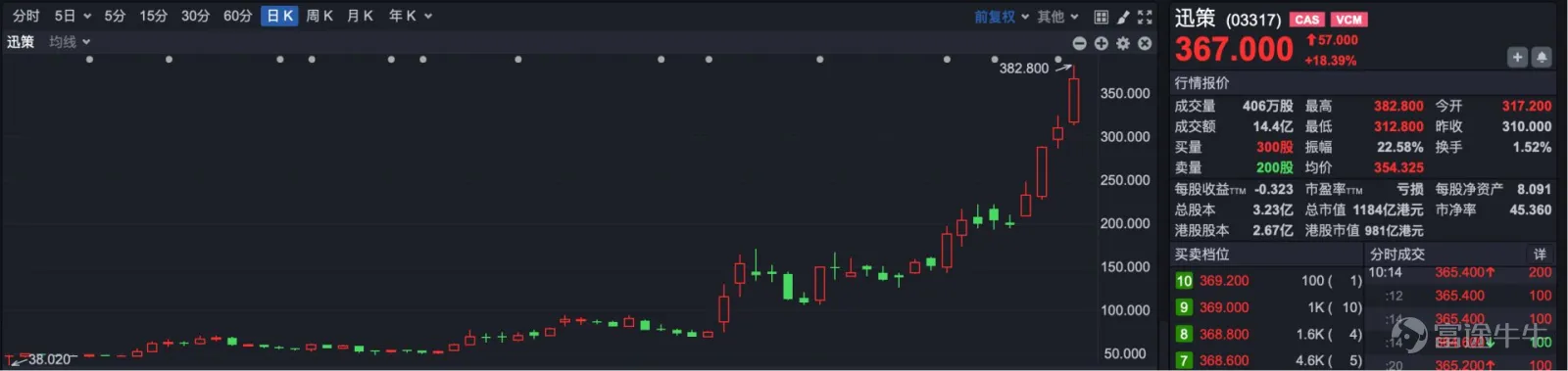
The 'token-first stock,' Xunce (HK03317), rose over 20% at one point today, reaching a high of HKD 382.8. Since its listing, its cumulative increase has reached an impressive 697%.
Market analysts pointed out that the standout performance of new stocks such as Zhipu, MINIMAX-W, Xunce, and Tianshu Zhixin reflects profound structural changes in the Hong Kong market. The traditional tech giants that once dominated are gradually losing their luster, with Meituan reporting a net loss of nearly RMB 23.4 billion in 2025 and revenue growth of only 8.1%. Kuaishou’s annual revenue grew by 12.5%, significantly lower than the explosive growth rates of AI enterprises. Even NetEase, with its stable performance, currently trades at a PE-TTM of just 15x, far less attractive compared to the AI sector.
Capital flows clearly indicate a shift in market preferences. In the first quarter of 2026, southbound funds recorded a net inflow exceeding HKD 220 billion, with the information technology sector receiving over HKD 90 billion in net purchases. The AI supply chain has become a key area for concentrated investment. As demand for AI computing power surges, sectors like chips and optical communications in Hong Kong’s hard tech space have strengthened in tandem. Notable gains were seen in individual stocks such as Huahong Semiconductor and Yangtze Optical Fibre and Cable, creating a dual upward trend in 'AI models + infrastructure.' Market analysis suggests that Hong Kong is transitioning from being driven by 'traffic dividends' to being powered by 'technological innovation.' Traditional tech companies relying on user growth and ad monetization face bottlenecks, while AI enterprises centered on large models and intelligent agents are becoming the core force defining the new valuation framework due to their rapid technological iteration and industrial penetration potential.
For the Hong Kong market, the emergence of two AI stocks priced above HKD 1,000 each not only reflects individual stock movements but also mirrors the broader transformation of the global technology industry. As AGI implementation accelerates, AI newcomers are expected to continue dominating market discourse. Hong Kong is reshaping its position in the global tech capital markets by attracting quality AI firms. Investors should focus on the sustainability of technological iterations and the quality of commercial implementation, seizing structural opportunities within high-growth sectors.
Disclaimer: The content and data provided in this article are for reference only and do not constitute investment advice. Verify before use. Any actions taken based on this information are at your own risk.
Copyright owned by National Business Daily
Risk Disclaimer: The above content only represents the author's view. It does not represent any position or investment advice of Futu. Futu makes no representation or warranty.Read more
Comments
to post a comment
1