
Under the catalyst of AI themes, can Alibaba break away from the volatile pattern?
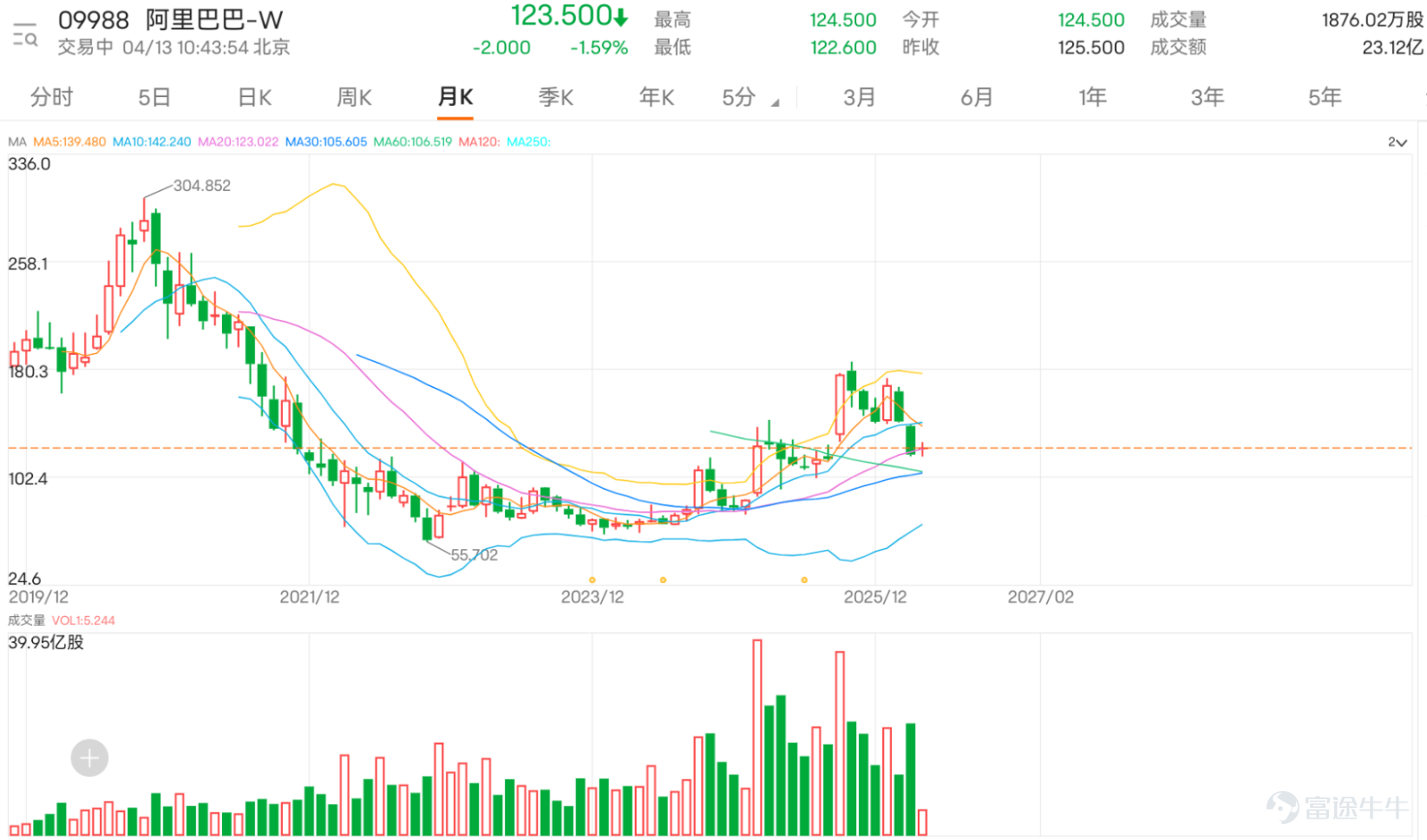
$BABA-W (09988.HK)$ What the market is most concerned about now is not just how much it rose in a single day, but Whether the range between HKD 125 and HKD 130 can be upgraded from a rebound zone to a true strengthening zone. The latest daily chart shows that Alibaba closed at HKD 125.5, with an intraday high of HKD 127.5, while the low was HKD 125. Although the stock price has regained its footing above HKD 125, the short-term sentiment has clearly improved compared to the previous days, but the overall structure has not completely broken away from the volatile consolidation pattern, as the resistance zone of HKD 128 to HKD 130 remains the key focus of the market. As for support levels, one can first look at HKD 124 to HKD 123, looking further down from 121 yuan to 120 yuan; the resistance level is first seen at 127.5 yuan to 128 yuan, and if it can break through further and stabilize, the next target would be 130 yuan. Therefore, at this stage, Alibaba is closer to stabilizing at a low position before repeatedly attempting to rise, but it hasn't fully confirmed regaining upward momentum yet.

From investor comments, market focus is actually very concentrated. The first type of question is Whether Alibaba can hold above $125 and further challenge $128 or even $130. For example, @Conned directly mentioned 'seeing $128',@今日份涨停 while others are more inclined to see 'a breakthrough above $130 tomorrow,' reflecting that a lot of short-term capital has already set its sights on higher resistance levels. However, whether this perspective holds true does not depend on a single day's spike but rather on whether it can stabilize after breaking through the $127.5 to $128 range.If it just touches that level and then retreats, market confidence in this upward trend will be hard to truly establish.
The second type of comment focuses on whether this rise is sustainable or if it’s being manipulated by major players who might shake out positions before retreating.. Like @我又不亂來 Some worry about 'starting to return to the opening price,' while @開平一醬 pays attention to 'closing at the day’s lowest point.' These voices reflect a very real state of the market: although everyone sees Alibaba showing some short-term vitality, they don’t fully trust the stability of this uptrend. In other words, the current market isn't completely bearish, but rather willing to follow along, though still with caution.This is also why whether 125 yuan can hold is particularly important, as it’s not just a price level but also the emotional bottom line of this rebound.
The third focal point is whether news such as AI, HappyHorse, and organizational restructuring can sufficiently re-support Alibaba's tech narrative.. For example, @開心的馬雲@Elon Musk elonmusk, @葉雨_Leo, and other comments are no longer just about short-term price levels; they’re questioning whether Alibaba has any new catalysts that would allow funds to reevaluate it from a tech stock perspective. This is crucial because Alibaba’s biggest issue over the past period was not just the price pullback but that the market’s imagination of its potential had narrowed. If factors like AI, cloud business, and technical architecture adjustments can be reaccepted by the market, Alibaba might have the chance to experience more than just a technical rebound—it could gradually see valuation recovery.
However, the comment section also reflects another kind of reservation. For instance, @@有时候真难, @被00431割韭菜的老李, @新时代韭菜子 These relatively cautious voices represent many investors who still view Alibaba as a stock that has lots of news, high volatility, but hasn’t fully proven itself to be stable yet. The real question behind this mindset isn’t whether Alibaba has themes but rather whether these themes can truly translate into sustained support in terms of profitability, valuation, and price.This also explains why, although the market has reacted to AI-related news, it has not unreservedly chased prices across the board.
Looking at the short-term reward-to-risk ratio, Alibaba currently falls under worthy of observation but still leans towards a trading-oriented reward-to-risk profile rather than a completely clear one.The reason is simple: the current price has stabilized above 125 yuan, not far from the support zone between 123 yuan and 124 yuan. If this level can be maintained, theoretically, there is still room for a push towards 128 yuan to 130 yuan, and the risk-reward ratio is not bad. However, on the other hand, if 125 yuan is quickly breached or even falls below 123 yuan, it would indicate that the quality of this rally remains insufficient. At that point, the market may easily reinterpret it as 'another rise followed by consolidation,' and the reward-to-risk ratio would rapidly decline.
This also explains why both optimistic and skeptical comments appear in the comment section. Views like those from @Conned, @LimitUpToday, and @LittleCircleRush represent the market's hope that Alibaba can use this momentum to climb higher; however, users like @ImNotMessingAround, @OpenPeaceSauce, and @OptionsOvernight remind everyone that for stocks like these, if they haven't fully stabilized, their performance in the closing session and the next trading day often matters more than single-day gains. In other words, Alibaba is not completely directionless right now but is instead in a transitional phase attempting to move from 'short-term volatility' towards 'structural improvement.'。
In summary, the most crucial issue for Alibaba at this moment is not about daily fluctuations, but rather whether the 125 yuan level can hold firm and whether 128 yuan to 130 yuan can truly break through and stabilize.@Conned’s expectation of 128 yuan, @LimitUpToday’s idea of breaking through 130 yuan, @ImNotMessingAround and @OpenPeaceSauce’s caution against pullback risks, and the market’s reassessment of AI and HappyHorse themes are all actually centered around one thing:Whether Alibaba’s current rally is merely driven by short-term capital or is beginning to have the conditions to enter a more complete recovery structure. At this stage, Alibaba shows relatively strong recovery but has not completely escaped the seesaw pattern. The true short-term watershed remains the battle between the support at 125 yuan and the resistance zone between 128 yuan and 130 yuan.
Strategy One: Only consider bullish rebound warrants after a firm hold above 126.60 yuan and a breakout above 128.70 yuan.If the stock price can stabilize above 126.60 yuan and further break through 128.70 yuan, it would indicate not only a recovery of the 20-day moving average but also a challenge to the resistance area of the 30-day moving average. At that point, the rebound is more likely to evolve from a technical recovery into a clearer upward continuation. Before the breakout, the current situation should still be viewed as a seesaw rebound, so warrant positions should only be considered after confirming the breakout.
$UBALIBA@EC2609D.C (27403.HK)$ | Strike Price 166.98 yuan | Actual Leverage 6.4x | Suitable for short-term rebound continuation plays after the stock price stabilizes above 126.60 yuan and breaks through 128.70 yuan.
$HSALIBA@EC2609E.C (27431.HK)$ | Strike Price 166.98 yuan | Actual Leverage 6.5x | Similar terms, suitable for momentum-based warrant plays following a confirmed breakout.
$HUALIBA@EC2611C.C (27912.HK)$ | Strike Price 155.98 yuan | Actual Leverage 5.2x | Lower strike price, suitable for balanced post-breakout rebound positioning.
Strategy Two: If the stock price retraces to around 123 yuan and holds steady, a relatively stable rebound position can be established.If the stock price retraces to around 123 yuan and manages to hold steady, it indicates that the short-term rebound structure remains intact. The market may still consolidate near the support level before resuming the rebound. This type of positioning does not rely on chasing breakouts but instead leverages effective support to capitalize on continued rebounds, making it more suitable to choose warrants with balanced terms for a relatively stable deployment.
$UBALIBA@EC2609B.C (26544.HK)$ | Strike Price 145.98 yuan | Actual Leverage 5.8x | Suitable for relatively stable rebound positions after the stock price retraces to around 123 yuan and holds steady.
$BPALIBA@EC2609C.C (26771.HK)$ | Strike Price 145.95 yuan | Actual Leverage 6.0x | Slightly higher leverage, suitable for short-term rebound continuation after confirming the support level is valid.
$BIALIBA@EC2611B.C (27859.HK)$ |Strike Price 155.98 yuan|Actual Leverage 5.0x|Balanced leverage, suitable as a rebound tool after a support level holds.
Strategy Three: If the price falls below 123 yuan and then further breaks below 121.80 yuan, switch to bearish options.If the stock price falls below 123 yuan and then further breaks below 121.80 yuan, it indicates that the short-term rebound structure has been broken, and the trend may turn weak again, potentially seeking support at 120 yuan or even lower levels. In this scenario, deploying bearish options would align better with the current structure, shifting focus from defending support and betting on a rebound to following the renewed weakness after the support fails.
$UBALIBA@EP2606A.P (20688.HK)$ |Strike Price 126.78 yuan|Actual Leverage 5.9x|Suitable for a bearish deployment after the stock price falls below 123 yuan and then further breaks below 121.80 yuan.
$CIALIBA@EP2606A.P (20444.HK)$ |Strike Price 126.88 yuan|Actual Leverage 5.9x|Similar terms, suitable as a short-term bearish tool if the support level is broken.
$CTALIBA@EP2606A.P (20698.HK)$ |Strike Price 126.78 yuan|Actual Leverage 5.9x|Also a choice close to the current level, suitable for capturing a weakening trend after a failed rebound.
Key Deployment PointsAlibaba's rebound remains unconfirmed at this stage; improvement begins only above 126.60 yuan, while 128.70 to 129.60 yuan represents the true test of strength. Until it breaks above, maintaining a cautious approach by defending support for a rebound is advisable; if both 123 yuan and 121.80 yuan are successively breached, be prepared for a potential short-term re-weakening, making bearish deployment more aligned with the trend.

For more market analysis, stay tuned to Jenny's daily updates on 'Hong Kong Stock Warrants'!
Reminder: This article does not constitute any investment advice.
This article is for reference only and does not constitute any investment advice. The market data, opinions, and analysis contained herein may change at any time without prior notice. We are not responsible for any loss or damage caused by reliance on the information in this article. Technical analysis only shows whether certain technical conditions are met; a comprehensive assessment of asset performance should be conducted using additional data. Decisions to trade should not be based solely on this article. Please note that past performance is not indicative of future results.
#HKStocks #Real-TimeAnalysis #WarrantSelection #WarrantGuide #DerivativesHedging #HKWarrantsJenny #Alibaba #09988 #TechStock$Hang Seng Index (800000.HK)$$Hang Seng TECH Index (800700.HK)$
Risk Disclaimer: The above content only represents the author's view. It does not represent any position or investment advice of Futu. Futu makes no representation or warranty.Read more

Comment (1)
to post a comment
2