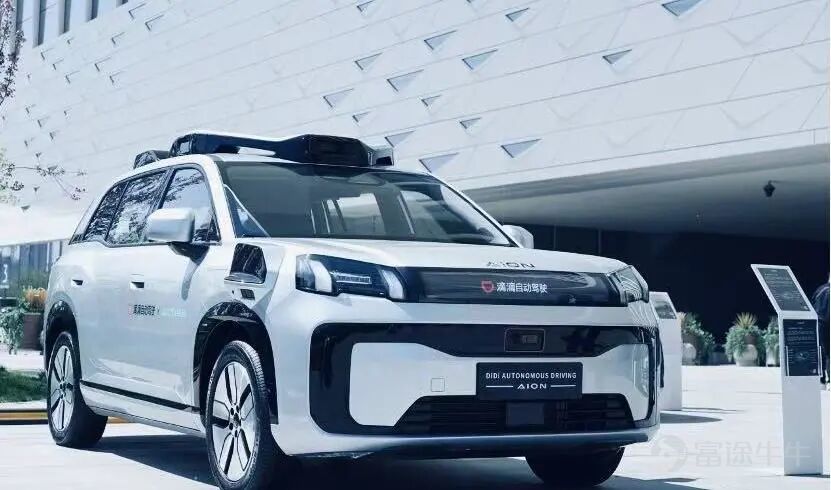

Didi's Autonomous Driving: How to Deliver 'Responsible Innovation'?

In the early stages of autonomous driving development, 'technical feasibility' was almost the sole theme of industry competition. People were enthusiastic about discussing computing power, model capabilities, and road test mileage, attempting to use a set of ever-growing numbers to approach an uncertain future.
But as L4 autonomous driving gradually moves from closed testing to public roads, key variables in industry development are quietly changing.
What kind of autonomous driving companies can secure a 'long-distance race ticket'?
This might be glimpsed from a recent public speech by Zhang Bo, co-founder of Didi and CEO of Didi's Autonomous Driving Company.$DiDi Global Inc (DIDIY.US)$
On April 11, Zhang Bo delivered a speech titled 'The Future and Exploration of Autonomous Driving in the AI Era' at the High-Level Forum on Intelligent Electric Vehicle Development (2026).

Zhang Bo Delivers a Speech
We try to summarize the core message of this speech in three sentences: safety is the threshold for autonomous driving to gain policy and legal access, user experience is the commercial stickiness that retains users, and the hybrid mobility network is an important path to solving the issue of L4 technology not being able to cover all scenarios.
Hardware and AI are the backbone, but what truly determines the success or failure of autonomous driving's implementation in China and globally are the localized operational safety systems and service details.
The ability to deliver safety at scale is the bottom line.
In Zhang Bo’s speech, which lasted less than 15 minutes, 'safety' was mentioned 14 times, making it one of the most frequently used words in the entire presentation. Why does Zhang Bo repeatedly emphasize 'safety'?
Unlike most internet products, autonomous driving directly impacts the physical world, carrying the weight of human lives and public transportation order. Its deployment does not depend on user growth or whether the business model works, but first and foremost on whether regulators and society recognize its risk boundaries.
In this sense, safety is not an outcome metric but a kind of 'access capability.' Without a verified and trusted safety system, even the most advanced algorithms will struggle to enter real-world roads.
Globally, around 1.35 million people die from traffic accidents each year. Zhang Bo believes that with technological advancements, this number will drop significantly. 'This was a prediction ten years ago; at this moment, it has become a reality—autonomous driving technology has been proven to be safer than human drivers.'
In the new generation of Robotaxi model R2, jointly developed by Didi Autonomous Driving and GAC, the autonomous driving system features triple safety redundancy.
The first layer is algorithm redundancy, specifically designed to determine whether there could be a collision between the vehicle and surrounding traffic participants. If there’s a risk, it will either apply emergency braking or steer to avoid the collision. The second layer is software redundancy—if the autonomous driving software malfunctions, there is a system in place to help safely bring the vehicle to a reliable stop. The third layer is hardware redundancy—if the autonomous driving hardware encounters issues, an independent system will ensure safe parking.
Safety determines whether autonomous driving can achieve scale. Success in isolated instances or small-scale trials does not indicate the system’s ability to operate at scale. Only when the system can maintain stable performance under varying weather conditions, road conditions, and interactions with traffic participants, can autonomous driving move from demonstration zones to broader urban networks.
This is also why Zhang Bo emphasized the safety capabilities of engineering: by implementing multi-layer redundancy through algorithms, software, and hardware, occasional risks are transformed into controllable issues, ensuring the system can still provide deterministic responses in extreme situations.
Didi's autonomous driving team and GAC spent a year and a half conducting multiple rigorous validations on the reliability of the Robotaxi’s overall vehicle and the stability of its systems. These included two winters and one summer of testing, comprehensive endurance assessments, corrosion aging tests, and simulated high and low-temperature environments, all adhering to automotive-grade standards for reliability verification. The new model is also equipped with Didi Autonomous Driving's latest-generation hardware platform, which features 33 sensors, 10 of which are LiDAR units, ensuring there are no blind spots around the entire vehicle.
Safety represents a hidden cost of commercializing autonomous driving.
Every system anomaly or accident directly impacts user trust and the regulatory environment, which in turn affects the pace of business expansion. Therefore, safety is not only a technical issue but also a long-term operational capability and scaled delivery ability, determining whether a company can advance its services at a steady pace rather than fluctuating between pilot programs and contraction.
Safety capabilities are also a prerequisite for business expansion overseas.
In the context of globalization, safety also plays the role of a 'universal language.' While countries differ in traffic rules, road environments, and regulatory systems, there is widespread consensus on the importance of safety. For autonomous driving companies attempting to expand internationally, establishing a safety framework that can be understood and accepted across different markets often outweighs single technical metrics in significance.
Experience Redefined: Robotaxi as a New Type of Mobile Space
In Zhang Bo’s speech, 'experience' was elevated to the same level of importance as 'safety,' an uncommon prioritization.
For a long time, the autonomous driving industry tended to view experience as an added value following technological maturity, rather than a core variable that needed to be defined upfront.
However, as autonomous driving gradually enters real-world operational stages, this logic begins to change.
When driving behavior is taken over by the system, the time and actions traditionally centered around the steering wheel are freed up. The transition between different physical spaces is no longer fragmented by the act of driving but forms a continuous experience, which Zhang Bo refers to as a 'mobile space.'
What DiDi's autonomous driving is attempting to achieve in its Robotaxi product is to extend user behaviors from outside the vehicle into the car itself. For instance, after a user places an order, the vehicle can pre-adjust the seat angle, air conditioning temperature, and lighting environment according to their preferences. With the user’s authorization, the in-car system can also synchronize the music or video they were playing, ensuring seamless content integration.
These functions themselves are not complex, but they point to a new product logic: vehicles are no longer just passively responding to needs but are starting to proactively anticipate them. This change can also be understood as an extension from 'hard functionalities' to 'soft services.'
The past automotive experience focused more on physical metrics such as power performance, interior space, and comfort features, whereas autonomous driving shifts the focus to the service process itself. How users spend their time inside the vehicle and whether they can receive a stable and predictable experience have become new evaluation criteria.
On this dimension, being 'more comfortable' is just the baseline; being 'smarter about you' is the competitive edge.
Technology can be caught up with, and hardware can be purchased, but user experience relies on long-term accumulated user data, an understanding of travel scenarios, and continuous operational feedback. These elements need to be refined repeatedly through real-world services and cannot be quickly obtained through short-term investment.
Through long-term operations, DiDi has accumulated a vast amount of real-world travel data and built a mature dispatch system, allowing it to dynamically match user demands, vehicle supply, and environmental conditions. Whether users are picked up at the right time, whether vehicles are in proper condition, and whether services remain consistent all feed back into the overall experience. As autonomous vehicles are integrated, this system becomes the infrastructure for optimizing experiences, forming a continuously iterating closed loop.
If autonomous driving merely replaces human drivers with system-driven ones, its form will still resemble traditional taxis, with differences mainly lying in cost and efficiency. However, if vehicles are redefined as a combination of space and service, then the dimensions of competition also shift. From asking 'is it cheaper?' to 'does it offer a more tailored user experience?'
In this process, experience is no longer an added value after technological maturity but rather a core capability that needs to be designed in advance and continuously optimized.
With safety gradually becoming an industry consensus, user experience is emerging as the new dividing line. Whoever can consistently provide stable, predictable, and differentiated travel experiences in real-world scenarios is more likely to gain an advantage in the next phase of competition.
In other words, whoever defines the Robotaxi experience is more likely to define the future form of autonomous driving products.
The real challenge of globalization is not technology.
As autonomous driving begins to move from demonstration zones to broader applications, a more complex issue arises: can this capability be replicated across different cities and countries? On the surface, this seems like a technology export, but an underlying judgment in Zhang Bo's speech suggests that the real difficulty does not entirely lie in the technology itself.
Autonomous driving still operates within the dual boundaries of policy and technology. In most countries and regions, relevant regulations are still focused on pilots and demonstration zones, making it difficult to support a fully open operational network. Relying solely on Robotaxis to build a complete mobility supply is not feasible at this stage.
Against this backdrop, Didi's 'hybrid mobility network' has become a more feasible path. Its core logic is straightforward: Didi integrates autonomous vehicles into its existing mobility system, working alongside human-driven networks to provide better services rather than replacing the latter with the former.
In practical operations, the system can dynamically assign orders based on road conditions, real-time supply and demand, and vehicle capabilities, calling on Robotaxis in scenarios suitable for autonomous driving while relying on human drivers for other services. The key to this model is not about maximizing the usage ratio of autonomous driving, but ensuring the stability and continuity of the overall network.
This approach has already been reflected in practice in Guangzhou. After users place orders on the platform, they do not actively distinguish whether the order is fulfilled by an autonomous vehicle; instead, the dispatch system completes the matching in the background. Autonomous vehicles become part of the supply, not the only option.
For users, the core of the experience is not 'whether it is driverless,' but 'whether they can be served promptly and reliably.' This method of embedding autonomous driving capabilities into existing networks allows for gradual expansion without disrupting the original service structure.
The overseas expansion of autonomous driving is not a simple replication of technology, but the establishment of a workable system within the traffic rules, infrastructure, and user habits of different countries. Didi's mobility service experience across 14 countries provides it with a certain foundation for localized operations when entering new markets. This foundation is not reflected in algorithms or hardware but in the understanding of supply and demand dynamics, dispatch logic, and user behavior.
From an industry perspective, autonomous driving has become a focal point of global technological competition. Zhang Bo revealed that Didi will also promote autonomous driving overseas this year, deploying Robotaxi mobility services.
Tesla emphasizes single-vehicle intelligence, promoting a unified technical solution globally; NVIDIA provides underlying computing power and software platforms, serving automakers and developers. In contrast, Didi's autonomous driving explores a path based on massive global mobility scenarios, using a hybrid mobility network model to advance autonomous driving AI technology and transform automotive design.
Going global is not about code transplantation but the holistic export of safety standards, operational experience, and social responsibility: the safety system must comply with regulatory requirements in different markets, service processes need to adapt to local user habits, and operational strategies must be adjusted according to supply and demand structures.
These elements together constitute 'responsible innovation': focusing not only on whether the technology is feasible but also on how it operates within specific social environments.
The challenge of autonomous driving may never have been about teaching machines to drive, but about enabling a new system to operate continuously in a complex world. As technology gradually converges, what truly sets companies apart are often those hard-to-quantify capabilities: how to handle uncertainty, how to understand humans, and how to balance efficiency with safety.
So-called 'responsible innovation' is precisely the long-term management of these boundaries.
Author: Yu Mi
Cover image source: Official company release
Risk Disclaimer: The above content only represents the author's view. It does not represent any position or investment advice of Futu. Futu makes no representation or warranty.Read more
Comments
to post a comment