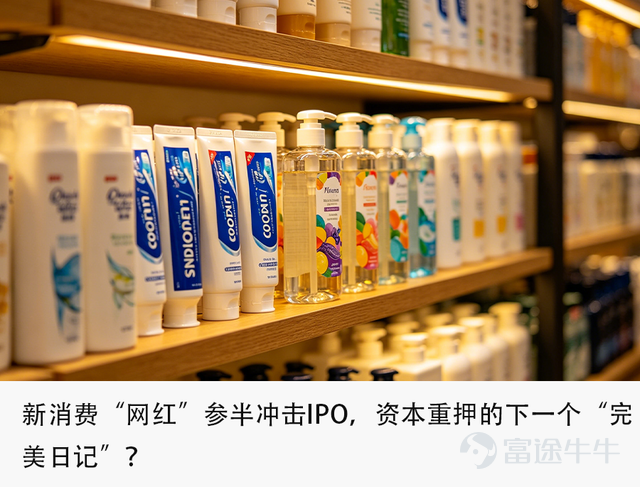

Raked in 5 billion in 3 years, TikTok-backed internet-famous toothpaste brand files for IPO

Source | Tech Planet
Author | Lin Jing
Against the backdrop of a general cooling down and contraction among new consumer brands, Canker, known for its 39.9-yuan 'internet sensation' toothpaste, has recently submitted its prospectus to the Hong Kong Stock Exchange.
According to the prospectus, from 2023 to 2025, the operating revenue of Little Broad Technology, the parent company of CANYE, was 1.096 billion yuan, 1.369 billion yuan, and 2.499 billion yuan, respectively.
Since its establishment, CANYE has completed 10 rounds of financing. Especially in 2021, when new consumer investments were at their peak, with ByteDance (Quantum Leap) joining, the company's valuation quickly doubled, attracting well-known institutions such as Innovation Works, Huaxing New Economy Fund, Clearvue Capital, and Jinding Capital to follow up on investments. As of the filing date, ByteDance holds 4.94% of CANYE’s shares through Quantum Leap, making it the second-largest external institutional shareholder.
Behind the halo of capital support lies the countdown pressure of a 580 million yuan valuation adjustment agreement, which might be one of the major factors driving the IPO push.
Selling for 39.9 yuan with a cost of 4 yuan, this internet-famous toothpaste has earned nearly 5 billion yuan in three years.
CANYE's growth can be divided into two phases: initially entering the market via the niche mouthwash segment, and later relying on toothpaste for the majority of its revenue. In particular, the single product of 39.9-yuan toothpaste has driven the main growth narrative of CANYE.
The prospectus shows that Little Broad Technology’s product portfolio covers three core segments: basic oral care, including toothpaste and toothbrushes; professional and beauty oral care, including mouthwash, oral sprays, and dental floss; and other personal care products, including hair and body care items.

Image source: Canban's prospectus
From 2023 to 2025, revenue from basic oral care was 952 million yuan, 1.265 billion yuan, and 2.322 billion yuan, accounting for 86.8%, 92.4%, and 92.9% of total revenue, respectively.
Although CANYE’s toothpaste is priced between 9.9 yuan and 49.9 yuan, competition in the low-price range is intense and has long been dominated by brands such as Colgate-Palmolive, Crest, and Darlie (formerly known as Black Person). CANYE broke through in the premium market. According to the prospectus, in the premium toothpaste market (priced above 30 yuan/100g), CANYE ranked first with a 19.2% market share.
This gave CANYE extremely high gross margins. The prospectus shows that from 2023 to 2025, the gross margin remained stable at around 70%, far exceeding the industry average of 40%-50%.

Caption: KKV store's Shenyang toothpaste (left) and Shenyang mouthwash (right), photographed by Tech Planet
An employee at a contract manufacturing plant for Shenyang told Tech Planet that Shenyang began producing toothpaste in 2022, seizing a critical window of opportunity. In 2021, the 'Cosmetic Supervision and Administration Regulation' came into effect, officially incorporating toothpaste into the cosmetic production licensing system, opening application channels to all eligible enterprises. 2021 was a pivotal year for contract manufacturers applying for 'toothpaste unit' production licenses; the factory where this employee works was among the first batch of applicants.
According to the employee, a tube of Shenyang toothpaste priced at 39.9 yuan has a factory price of about 4 yuan. A box containing 20 portable mouthwash strips has a factory price ranging from 4 to 7 yuan. The gross profit margin for toothpaste is much higher than categories like mouthwash, and the larger the order volume, the stronger the bargaining power with the factory.
Shenyang is now a typical 'Douyin-based' new consumer brand, with 80% of its revenue still dependent on online sales, particularly via Douyin. Third-party data shows that Shenyang has ranked first in sales through Douyin’s channel for four consecutive years, solidly occupying the top spot in Douyin's oral care category. Additional data indicates that between August 2021 and August 2022, Shenyang cumulatively released 6,576 promotional short videos, averaging about 18 per day.
By the end of 2025, Shenyang will have a total of 568 employees, with 276 dedicated to online operations and video creation, accounting for nearly half of the workforce.
Tech Planet observed from Shenyang's live streaming room that its strategy aligns with other brands that have risen through reliance on 'Douyin,' such as BKT and Half Mu Flower Field—celebrity endorsements featured prominently in the livestream, 24/7 broadcasts, selling large single items with fewer SKUs, combined with a 7-day no-questions-asked return policy covering shipping costs, attracting fans to place orders continuously. According to the prospectus, a single SP series toothpaste endorsed by Hua Chenyu generated 1.3 billion yuan in revenue for Shenyang in 2025, accounting for half of its total revenue.
Moreover, in recent years, the toothpaste category has become a battleground for many emerging consumer brands, including Usimle, Bunny Mom, and BOP (Pop Research), with some of their toothpaste and toothbrush products manufactured at the same contract facility as Shenyang's.
This wave has also allowed upstream factories to reap substantial profits. The aforementioned contract manufacturer informed Tech Planet that annual revenue at their factory surged from millions to 200 million yuan over the past two years, with a new target set to reach 300 million yuan this year.
Sales expenses hit 3 billion yuan over three years, with R&D accounting for less than 1%
From niche mouthwash to mainstream toothpaste, carving out a niche in the cracks of giants—this is one side of Shenyang’s success. But on the other hand, with the submission of its IPO prospectus, Shenyang still faces challenges common to all emerging consumer brands.
A consumer investor told TechPlanet that 2021 was the peak of the valuation bubble for new consumer brands, when Perfect Diary and Pop Mart both soared to a market capitalization of hundreds of billions. It was also in this year that CanYao secured five rounds of financing in quick succession, with the final round including a family fund managed by Zeng Ming, former executive vice president of Alibaba Group. At that time, investors generally believed this would be the 'Perfect Diary' of the oral care sector.
The industry went wild; many hardcore technology investors, having missed out on Perfect Diary, turned to seek other emerging consumer companies. In some cases, even popular companies required investors to 'write essays' just to secure a meeting.
Afterward, the investment bubble for new consumer brands began to burst, and CanYao did not receive any new funding. In a sense, during these years when new consumer brands were on the decline, CanYao’s good fortune lay in capturing the market dividend of toothpaste.
When this first-generation internet-famous consumer brand finally embarked on its IPO journey, it didn't bring much new excitement. If the strategy for past new consumer brands was the Perfect Diary model—notes + KOL matrix + Li Jiaqi livestream promotions—the new consumer brands now have adopted a different approach: pouring money into celebrity endorsements + Douyin short videos/live streaming. The playbook has changed, but the core focus remains heavy marketing and light R&D.
CanYao's cash-burning rate is almost a repeat of Perfect Diary's story. According to the prospectus, from 2023 to 2025, CanYao’s sales and distribution expenses reached 685 million yuan, 835 million yuan, and 1.534 billion yuan respectively, burning through over 3 billion yuan in three years, with an annual sales expense ratio consistently above 60%. This means that when you buy a 39.9-yuan tube of toothpaste, about 24 yuan goes toward marketing.

Image source: Canban's prospectus
In contrast, CanYao’s R&D expense ratio fell from 1.63% in 2023 to 0.78% in 2025, with total R&D spending over three years amounting to just 54.09 million yuan. Among its 568 employees, only 27 are responsible for R&D. The company heavily relies on OEM manufacturing, with property, plant, and equipment valued at only around 8.52 million yuan.
Simply put, in the fiercely competitive toothpaste market dominated by giants, CanYao’s products carry a high premium, but require substantial marketing spend to sell.
Fortunately, both online and offline fan economies have supported CanYao’s growth. Since its founding in 2018, CanYao has signed 13 brand ambassadors, including Zhao Lusi, Tan Jianci, Xin Zhilei, and Hua Chenyu. Additionally, through music festivals and anime expos, they have created themed pop-up stores and limited-edition merchandise, collaborating with celebrities to host 'One-Day Store Manager' events to boost brand awareness.
In 2025, as it prepared to go public, CanYao’s revenue surged to 2.499 billion yuan, up 82.5% year-on-year, but net losses widened to 18.25 million yuan. It was also in May 2025 that CanYao signed Hua Chenyu as its brand ambassador, which quickly boosted revenue but also eroded profits.
Like many new consumer companies, one of the factors driving Canban's push for an IPO is that the countdown for its valuation adjustment mechanism (often referred to as a 'gamble agreement') has already begun. According to the prospectus, by the end of 2025, Xiaokuo Technology had accrued redemption liabilities of 582 million yuan on its books, accounting for about 60% of its total current liabilities. The core clause of this gamble agreement states that if the company fails to complete a qualified IPO within 60 months from the investment date, it must repurchase the shares held by investors at its own expense.
More than 80% of Xiaokuo Technology’s major institutional shareholders participated in investments in 2021, meaning 2026 is the deadline for the IPO.
Doubling down on celebrity partnerships and expanding into the daily chemical products sector
As Canban pushes for its IPO, it urgently needs to craft a brand-new narrative for both the secondary market and consumers.
On one hand, although Canban is accelerating its offline channel expansion, up to 80% of its revenue still comes from online sales. For daily chemical products, offline channels are a key battleground—one that has long been dominated and deeply entrenched by traditional giants.

Image source: Canban's prospectus
Tech Economy observed in physical stores that retailers like Hema, Bianlifeng, and Miniso have launched their own private-label toothpaste, dental floss, and mouthwash products. These items are often priced lower to gain market share. For instance, a 100-gram tube of Hema’s private-label toothpaste costs just 8 yuan.
This means that as supermarkets and convenience stores increasingly adopt the ‘Costco-style’ strategy and expand their private-label offerings, Canban will face stiffer competition in offline markets.
Additionally, Canban has expanded its product placement to include OTC pharmacies and medical device stores. However, a 24-hour online supermarket owner in Beijing told Tech Economy that Canban’s best-selling products in medical device stores are small travel-sized packages. Compared to younger, trendier packaging, customers entering these stores tend to focus more on health-related ingredients and some anti-inflammatory functions, making the context mismatched.
On the other hand, Canban is speeding up its category expansion, extending from toothpaste and mouthwash to broader daily chemical sectors such as shampoo and hand cream.
Canyon Choice has deepened its ties with celebrities. On March 22 this year, Canyon's parent company, Xiaokuo Group, co-founded a new home and personal care brand named 'Focus' with Hua Chenyu, who also serves as a co-founder. The current product lineup includes floral water, hand cream, lip balm, essential oil patches, and more.
Tech Planet observed in KKV stores that a 120ml bottle of floral water is priced at 49.9 yuan, higher than brands like Liushen and Pechoin. It continues to avoid the low-price battleground, targeting the premium market while operating under a lightweight model reliant on contract manufacturing.
Compared to the niche track of oral care, competition in the home and personal care sector is undoubtedly more intense. Canyon not only faces international giants like Procter & Gamble but also competes with emerging consumer brands like Banmu Hua Tian, which has already filed for an IPO on the Hong Kong Stock Exchange.
Canyon founder Yin Kuo once stated, 'After the final round of financing ended, the first thing I said was to tell the finance team to deposit all the funds in the bank, stop all advertising, and accept any drop in sales performance until we develop a profitable model.'
However, judging from Canyon’s development, this cash-burning game clearly cannot be stopped. Among some of Canyon’s contract manufacturing partners are brands like JD.com’s private label Jingzao and Aldi, which have launched products similar to Canyon’s. This indicates that Canyon’s products do not have an absolute competitive edge. Continuous investment in marketing remains crucial to carve out a position, especially as traffic costs rise, potentially trapping the company in a cycle of cash burn.
Canyon's push for an IPO represents a 'stress test' amid the cooling of the new consumer trend. Its success or failure will directly address a fundamental industry question: Can new consumer brands truly endure over time when capital is no longer pouring in recklessly?
Risk Disclaimer: The above content only represents the author's view. It does not represent any position or investment advice of Futu. Futu makes no representation or warranty.Read more
Comments
to post a comment