
AI wrote less than 2,000 lines of code, and SBTI created the first viral sensation of 2026
What is MBTI? Its full name is Myers-Briggs Type Indicator, developed by American Katharine Cook Briggs and her daughter Isabel Briggs Myers in the 1940s based on Swiss psychologist Carl Jung's theory of psychological types.
The purpose of MBTI is to summarize your personality with four letters, along with the different psychological preferences you have when making decisions. It is one of the most widely used personality tools globally, with over 300 million people having taken the test.
So what is SBTI? It is the community's deconstruction, meme, and adaptation of the classic MBTI personality test. The full name is Silly Big Personality Test, which translates literally to 'Silly Big Personality Test'.
The original SBTI test contains 31 life-related multiple-choice questions, which can be completed in about 3 to 5 minutes, without registration and completely free of charge.
This test was created by Bilibili UP主 @Qu Rou Er Chuan, initially as a prank to persuade a friend to quit drinking, but it unexpectedly took over WeChat, Weibo, and Xiaohongshu overnight.

Many netizens commented, 'Is this still 2016? Can it really be possible for a product to go viral on social media in 2026?' 'We haven't seen such widespread sharing on the internet in a long time.'
However, there isn’t any highly sophisticated technology behind SBTI. It’s vibe coding, an 'amateur project' using the free version of Cloudflare for hosting and personally paying for the domain name.
01
The Fission of SBTI
When taking the MBTI test, at least it distinguished between introverts and extroverts, whether one recharges by being alone or with others—still somewhat refined and classy. But SBTI doesn’t hold back at all, hitting users with the darkest, gloomiest, and most heartbreaking statements:
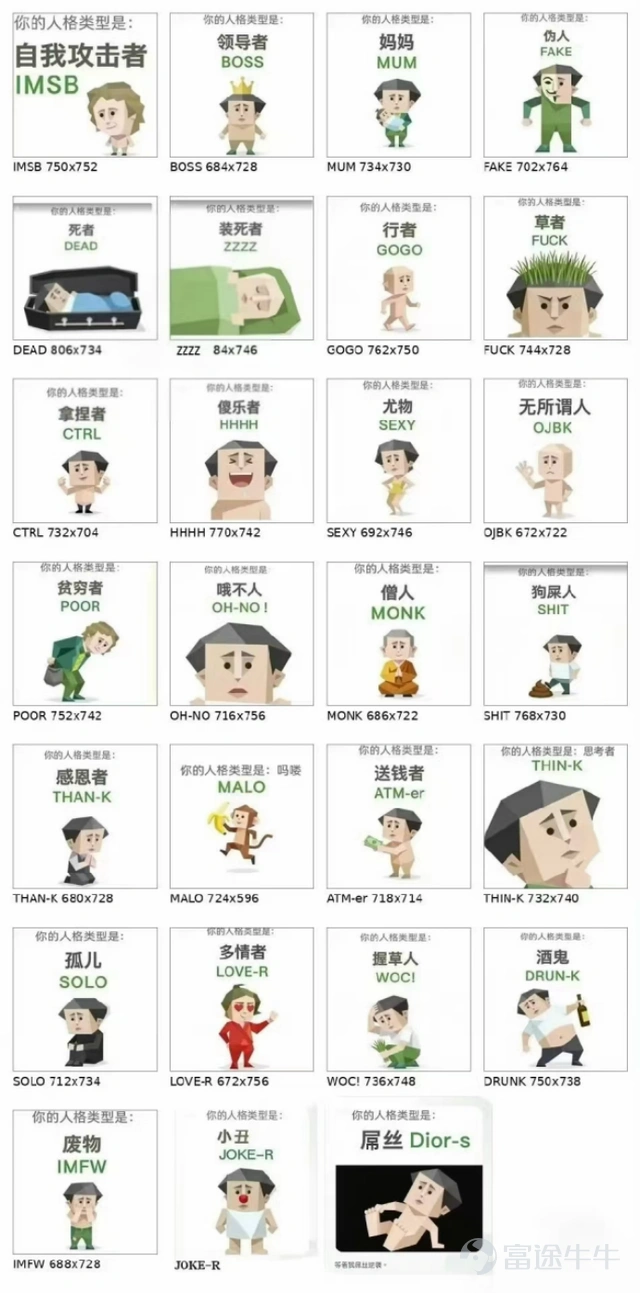
Self-Attacker IMSB: Overwhelmed by internal monologues, always self-negating first when encountering issues, constantly feeling inadequate;
Clown JOKE-R: Masking sadness with humor, hiding pain behind jokes, laughing until silence takes over;
Grass Person FUCK: Outwardly loud and panicky, but inwardly clear-headed, not nosy.
ATM-er: Always paying with time, energy, patience, and emotional value, habitually covering for others.

Other personality tests rush to flatter, but this SBTI strips people down to their bare essentials.
As netizens summarized well: MBTI asks, 'What kind of gifted personality are you?'
While SBTI asks, 'Which kind of 'human tragedy' do you belong to?'
Before SBTI went viral, we didn’t realize how strong the demand was for 'how to tell others who I am without pretense or effort.'
I can't just get in your ear and shout that I'm a cynical, gloomy, ambitionless person who just wants to stay at home and live off their parents. But I can take advantage of the trend of everyone posting their SBTI results and discreetly let everyone know in my social circle that I’ve been diagnosed as one of the SB types like a loser/indifferent person/commoner.
Not only is the SBTI compendium like this, but the entire test process exudes a laid-back vibe of 'Hey, just for fun.'
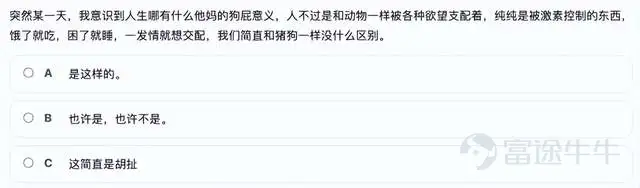
What a wonderful mental state; who hasn't thought this pessimistically and given up during tough times?
Towards the end of the test, the webpage suddenly displays a message: 'Only after all options are selected will you proceed. The world is chaotic enough; at least finish the questions properly.' People with ADHD are caught red-handed and have no choice but to go back and complete the test.

From start to finish, there wasn't an ounce of seriousness. The SBTI test genuinely let netizens experience the joy of finally being able to slack off openly and go wild in a dignified way.
02
How do you determine your SBTI?
This was originally just a stunt by a Bilibili content creator aiming to persuade a friend to quit drinking. The creator, known for sharing daily interactions with GPT as part of a human-AI romance, initially gained traction on Bilibili through this unique content.

The source code for SBTI has also been made available on GitHub. The entire codebase is less than 2,000 lines, and the download size is under 1MB, smaller than a high-definition meme on your phone.
The testing mechanism itself is quite straightforward. First, all answer choices are pre-assigned scores: Option A is worth 1 point, Option B is worth 2 points, and Option C is worth 3 points.
For example, the classic question: 'I am not only a loser, but I’m also the joker, I'm also a salted fish…' If you choose Option A ('I cried...'), you get one point; if you choose Option C ('This is not me!'), you get three points.
Next, the scores are added up. There are a total of 30 regular questions in the test, with every two questions corresponding to one personality dimension, making up a total of 15 dimensions (e.g., 'Self-esteem,' 'Sense of boundaries,' 'Execution ability'). The system adds the scores from the two questions under the same dimension to obtain the total score for that dimension.
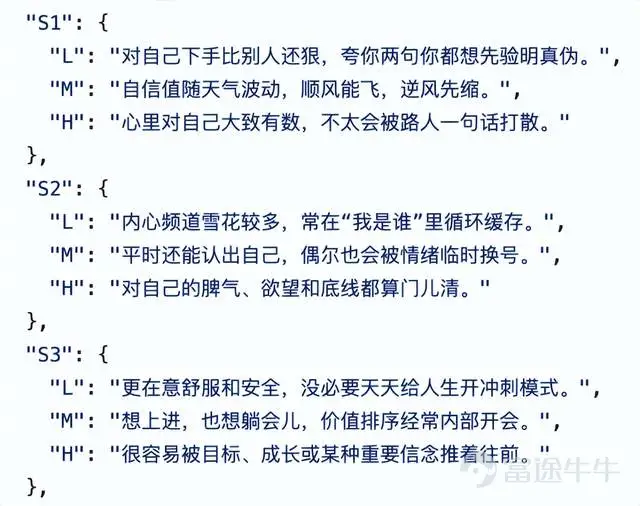
Then, a level tag is assigned to each dimension based on the total score:
Total score ≤ 3 → L (Low)
Total score = 4 → M (Medium)
Total score ≥5 → H (High)
In the end, you will receive a string of 15 L/M/H characters, such as: HHH-HMH-MHH-HHH-MHM. The system has pre-written 25 standard character strings representing different personality types.
For example, the standard string for the Controller personality is: HHH-HMH-MHH-HHH-MHM; the standard string for Dior-s is: MHM-MMH-MHM-HMH-LHL.
The system will compare the string you obtain after the test with these 25 templates letter by letter: no points are deducted if the letters match; one point is deducted if the letters differ by one level (e.g., L and M, M and H); two points are deducted if the letters differ by two levels (e.g., L and H).
The fewer points deducted, the more similar you are to that personality type. The system will assign the personality with the least points deducted as your "main type."
Such a simple mechanism has achieved astonishing dissemination effects.
By searching the SBTI entry on Google Trends, it can be seen that the spread began at 9:20 PM on April 9th and reached its peak search popularity at midnight on April 10th, taking only two hours and forty minutes in total.
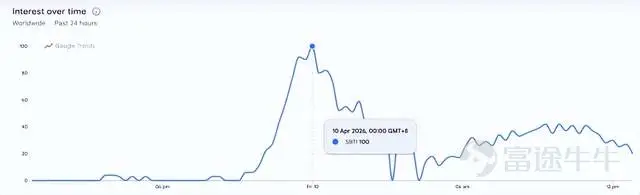
Due to a sudden surge in traffic, the test page crashed multiple times from the evening of April 9th to the early morning of April 10th.

This morning, Su Xing shared his SBTI test result - The Poor, and posted: 'Everyone should just leave, it's definitely inaccurate. This is the first time anyone on the entire internet has said this about me.'
Additionally, celebrities such as Huang Xiaoming, Lan Yingying, and Hua Chenyu shared their SBTI personality types, further confirming the trend's popularity.
It can be said to be truly 'achieving big results with small efforts' and 'leveraging limited resources for maximum impact.'
SBTI is a vibe coding product. The emergence of vibe coding amplifies the average person’s insight into public sentiment, giving an ordinary individual the potential to create a phenomenon-level viral event.
Products created by ordinary people using vibe coding may be rough, have bugs, and be imperfect, but they carry emotion and attitude, resembling a friend everyone has who complains, jokes around, and occasionally uses strong language.
The widespread sharing of SBTI may not last long. In another month, people might forget about it and move on to the next trending topic. Nevertheless, it offers some inspiration.
The original purpose of the internet was to provide a space for ordinary people to express and share themselves. The emergence of SBTI allows us to see the internet in its most authentic form: fun, genuine, free, and full of human warmth. $AI (LIST0535.SH)$$Artificial Intelligence (LIST23586.HK)$$Artificial Intelligence (LIST2136.US)$$Technology (LIST20763.US)$$Technology (LIST20840.HK)$$Baidu (BIDU.US)$$BIDU-SW (09888.HK)$
Risk Disclaimer: The above content only represents the author's view. It does not represent any position or investment advice of Futu. Futu makes no representation or warranty.Read more

Comments
to post a comment
1