
Samsung strike alert lifted! Where are memory stocks headed?

Blade's Quick Recap | Storage & Crude Oil, Which Trend Did You Catch This Week?
This week, the market experienced sharp fluctuations — the storage sector narrative erupted, and the geopolitical logic of crude oil reversed.Low-priced options (typically referring to contracts priced between $1-$5 or even lower),are precisely the tools with the highest elasticity in this kind of 'event-driven + high volatility' environment. A single options contract costing tens to hundreds of dollars can leverage returns several times or even more than tenfold — provided you get the direction right, choose the timing correctly, and control your position size.
$SanDisk (SNDK.US)$ — The underlying stock has surged consecutively, expanding its elasticity
This week, the memory sector was one of the strongest main themes in the market, with very clear logic:
Price hike cycle confirmed: Continuous upward revisions in NAND/DRAM contract prices, with Q2 quotes expected to rise further
AI demand boost: Explosive growth in demand for enterprise SSDs driven by large model training and inference, directly benefiting leading memory companies
Sector sentiment resonance: On April 7, semiconductor packaging and memory-related stocks collectively surged on heavy volume, signaling a clear inflow of capital
SNDK, as a pure-play memory stock, is one of the most elastic tickets in this round of price hikesWhen a sector's logic is solid, recognized by capital, and the trend established, it may present an opportunity to use low-priced options to bet on elasticity
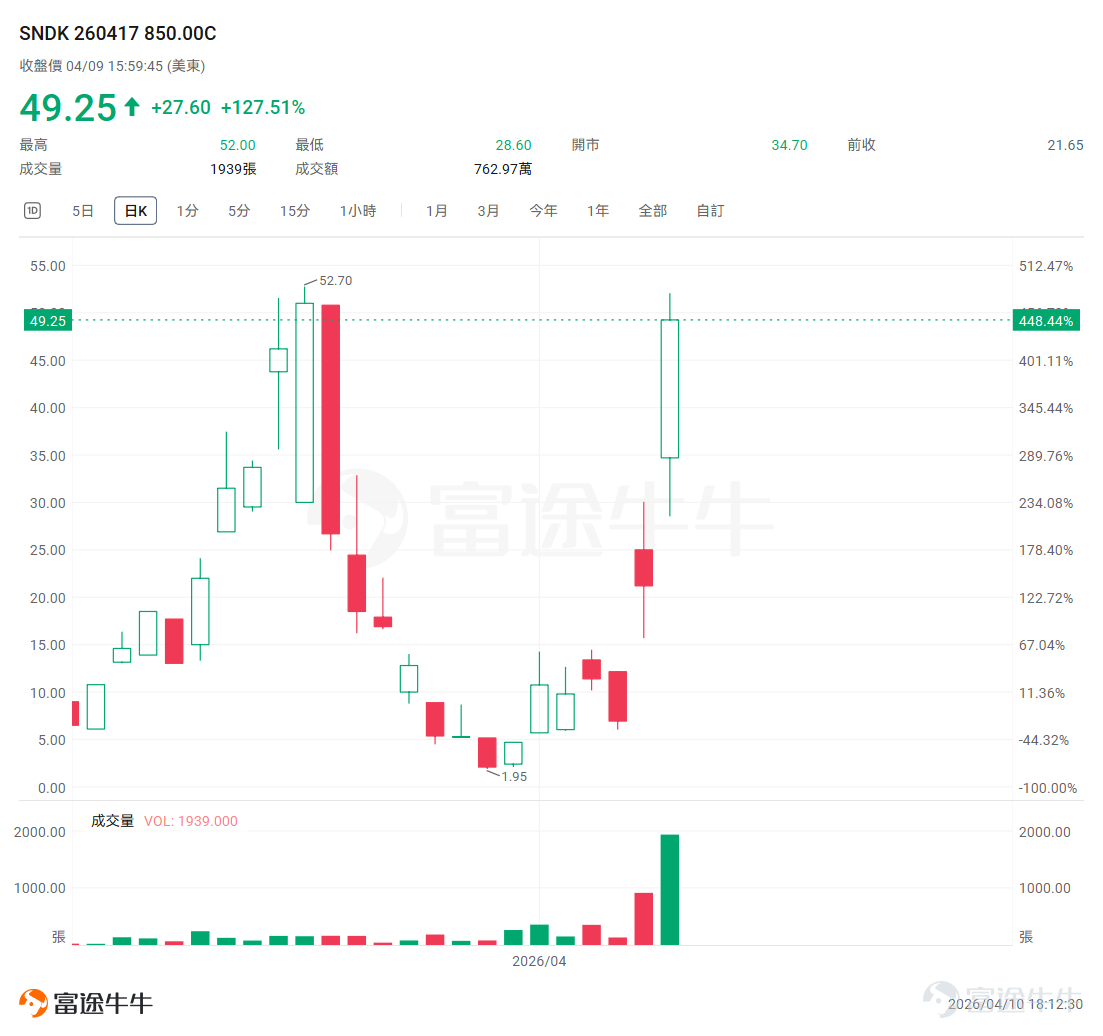
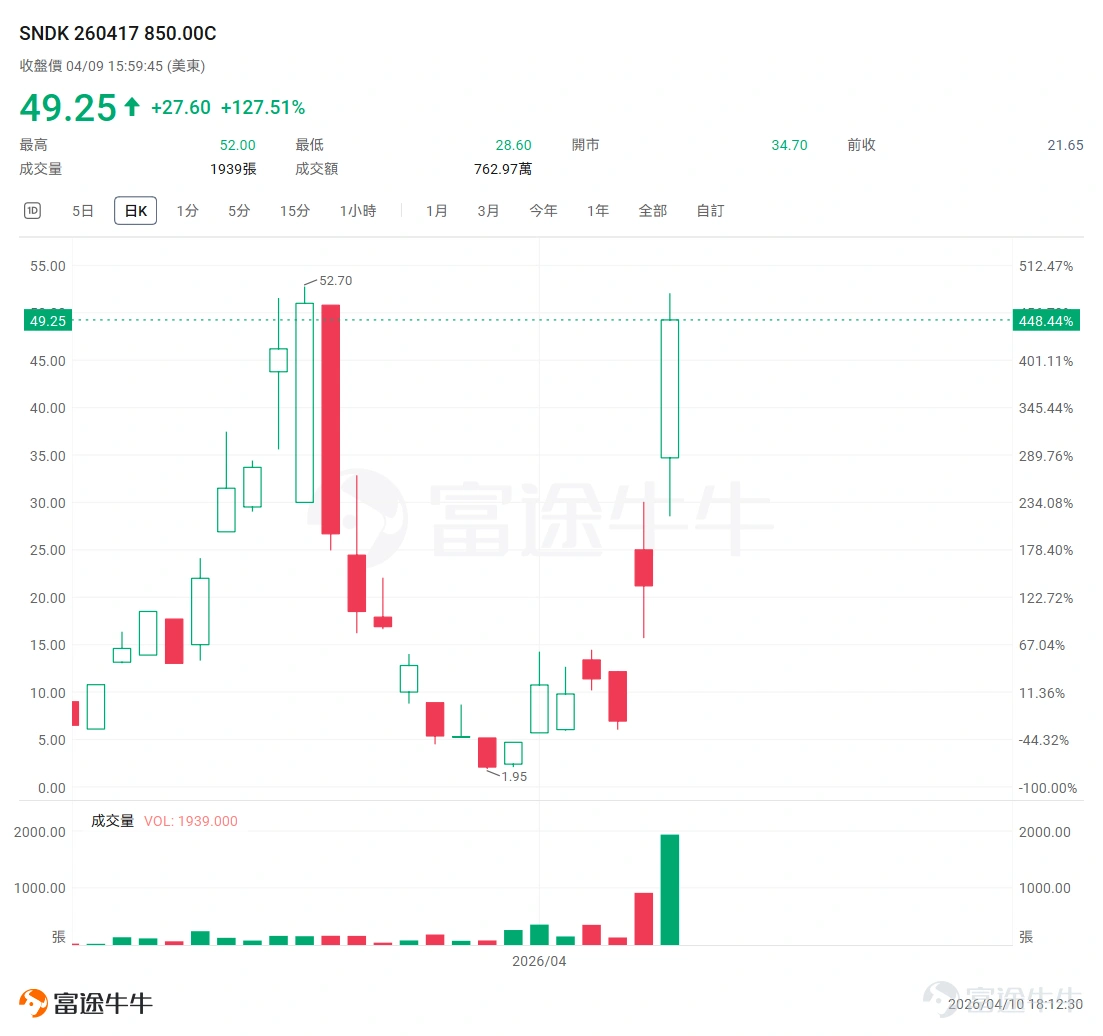
SanDisk surged significantly for two consecutive days +9.86% and +9.05%, skyrocketing from the April 7 closing price of 710.8 to the April 9 closing price of 851.57. The weekly Call option with a strike price of 850 (expiring on April 17) was deep out-of-the-money on April 7 (stock at 710 versus strike at 850, a difference of $140), resulting in a relatively low premium; by April 9, when the underlying stock hit 855, this contract had turned into an at-the-money/slightly in-the-money position, with gains easily multiplying several times.
$United States Oil Fund LP (USO.US)$ — Explosive Put activity amid the crude oil crash
Crude oil is the most direct 'thermometer' of geopolitical tensions. Escalating US-Iran conflict drove oil prices higher, while signals of a ceasefire midweek erased fears of supply disruptions, triggering the core cause behind the oil price collapse.
USO experienced a single-day plunge of -9.78% on April 8, marking an extreme level of daily decline. The Put option with a strike price of 130 was out-of-the-money on April 7 (stock at 138 versus strike at 130). On April 8, USO opened with a gap down to 119 and continued to break through 130, instantly turning the Put deeply in-the-money. However, subsequent fluctuations in crude oil prices made its performance less smooth compared to SanDisk’s Call.

These two underlying assets represent completely different trading logics:SNDK capitalizes on the momentum of a storage narrative breakout,USO reflects the collapse inertia following a reversal in geopolitical expectations. It is crucial to note that short-term options carry both high elasticity and high risk; positions must be strictly controlled, and stop-loss plans should be prepared in advance.
Low-priced options are not equivalent to 'lottery tickets'
Although the returns from this week's case may seem astonishing, it is crucial to stay level-headed:
Survivorship bias: What you see are Calls that have surged several-fold; what you don't see are countless worthless contracts that went to zero on the same day
Time value decay: With limited time until expiration, your option value is "eroding" daily. If SNDK's stock pulls back next week, its Call could plummet from $49 back to single digits quickly
Position discipline: Allocate no more than 2-5% of total capital to a single options trade and be mentally prepared for it to go to zero
Risk WarningAn option is a contract that gives the holder the right, but not the obligation, to buy or sell an asset at a fixed price at any time on or before a specific date. The price of an option is influenced by various factors, including the current price of the underlying asset, the strike price, the time to expiration, and implied volatility. Implied volatility reflects the market's expectation of the option’s volatility over a certain period in the future. It is derived inversely from the Black-Scholes (BS) pricing model and is generally considered an indicator of market sentiment. When investors expect greater volatility, they may be more willing to pay higher prices for options to help hedge risks, leading to higher implied volatility. Traders and investors use implied volatility to evaluate.Option priceattractiveness, identify potential mispricings, and manage risk exposure.
DisclaimerThis content does not constitute any offer, solicitation, recommendation, opinion, or guarantee for any securities, financial products, or tools. The risk of loss in trading options can be substantial. In some cases, losses may exceed the initial margin deposited. Even if you set contingent orders such as 'stop-loss' or 'limit' orders, these may not prevent losses. Market conditions may prevent these orders from being executed. You might be required to deposit additional margin within a short period. If you fail to provide the required amount within the specified time, your open positions may be liquidated. However, you will still be responsible for any shortfall in your account. Therefore, before trading, you should study and understand options and carefully consider whether such trading is suitable for you based on your financial situation and investment objectives. If you trade options, you should be familiar with the procedures for exercising options and the rights and obligations upon exercise and expiration. Option trading involves extremely high risks and is not suitable for all investors. Investors should read carefully before engaging in any options trading strategy.Characteristics and Risks of Standardized Options。
Risk Disclaimer: The above content only represents the author's view. It does not represent any position or investment advice of Futu. Futu makes no representation or warranty.Read more

Comment (1)
to post a comment
2
6