Options Hub: Oil prices break $100, PPI beats expectations! How to position with options for tonight

Daily Options Seller Strategy | With the crypto market remaining sluggish, how to use options strategies to position Robinhood and Circle at lower levels?
I. Market Barometer: US-Iran ceasefire boosts US stocks, but concerns linger as the strait remains closed
On April 9 Eastern Time, the US stock market continued to be buoyed by news of a two-week negotiation following the US-Iran ceasefire. After a brief period of sideways trading at the open, it rose steadily, with the S&P 500 index closing at 6824.66 points, marking a very strong rebound.
However, Trump stated that 'Iran has performed very poorly in ensuring oil circulation,' and the Strait of Hormuz remains not fully operational, with tanker traffic still far below pre-conflict levels.The outcome of the US-Iran talks set to begin this weekend will determine whether US stocks can maintain their rebound momentum, which requires close attention.
II. Focus on Hot Targets
The downturn in the crypto market has caused Robinhood's stock price to decline continuously after breaking through the $150 mark last October. In the previous trading session, it opened high but closed low, barely holding on to the $70 integer support level, currently down by half from its peak.The next round of earnings, to be released on April 28, could be key in determining whether Robinhood can initiate a rebound.
Following Circle’s impressive Q4 2025 earnings report surpassing expectations, its stock price rebounded strongly from a low of $50 and climbed all the way to the $130-$140 resistance zone but failed to break through. Recently, the stock has been significantly affected by multiple negative factors such as poor market conditions, slow progress on the CLARITY Act legislation, and lawsuits stemming from Drift Protocol’s stolen crypto assets. The stock fell sharply, opening high but closing low in the previous session, ending at $85, with prices still trending downward.
The recent negative factors for Circle mainly stem from two major news items:
1. Slow progress of the CLARITY Act:On April 8 Eastern Time (Wednesday), US Treasury Secretary Scott Bessent again pressured Congress to quickly pass the CLARITY Act, emphasizing that these rules are crucial to ensuring the continued development and investment in cryptocurrencies within the United States.
2. Drift Protocol Hack Incident:The American law firm Gibbs Mura has officially announced an investigation into a class-action lawsuit regarding the security breach incident involving Drift Protocol on April 1st, with estimated funds involved between $280 million and $285 million. Gibbs Mura believes that Circle, despite having the technical ability to freeze on-chain USDC, took no action during this attack, which may constitute a breach of liability.
III. Seller Options Strategy

Opportunity filtering logic:
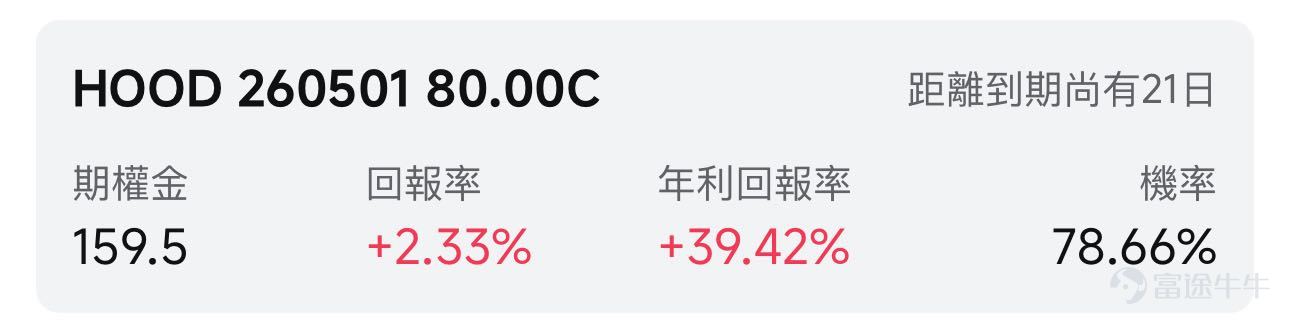
Robinhood is currently oscillating in the $70-$80 price range. This 'lack of direction' market is precisely where the Covered Call strategy can be utilized - even if the stock price does not rise, you can still receive premiums to indirectly lower holding costs. Additionally, the high implied volatility (IV) environment near earnings season is also the best helper to increase premium income.
2. Sell 1 contract $Circle (CRCL.US)$ 20260515 65P, estimated required margin (for reference only): $6500 ($65 × 100)

Opportunity filtering logic:
The strike price is $65 vs the current price of $85, providing a safety cushion of approximately 23.5%, which is very ample. Circle, as the first stock in the stablecoin sector, holds a strong industry position and has very stable and robust fundamentals. Even with a small probability of acquiring shares at $65, it would represent a relatively low entry point for long-term investment value in Circle.
IV. Risk Control Reminder
Although the seller strategy has a high probability of success, investors must still manage risks effectively:
Position management is key:The biggest risk for the seller strategy lies in black swan events.It is recommended that margin usage for a single position should not exceed 20% of total capital. Never sell options beyond your capacity to handle them just for the sake of greedy premium collection.
Timely rolling of covered call options:When a covered call option becomes deeply in-the-money (stock price far exceeds the strike price), and if the underlying stock is still viewed favorably, decisively 'roll' the position — that is, close the current option by buying it back and simultaneously sell an option with a later expiration date and a higher strike price to avoid having the stock called away at a low price.
Cash-secured put options should beware of 'left-tail risk':For cash-secured puts,if the stock price collapses due to deteriorating fundamentals (rather than normal pullbacks), don’t hold on stubbornly.。At this point, you should either cut losses and exit or use 'rolling down the position' to buy time while waiting for volatility to normalize.
Case Selection Criteria
Open Futubull >> Market >> Options >> Seller Zone >> Filter; Common screening criteria for Cash Secured Put and Covered Call strategies: IV Percentile > 40%; Total option volume > 60,000 contracts; Days to expiration 0-45 days; Daily option volume/open interest > 500 contracts; ROI > 2%; Annualized ROI > 30%. Cash Secured Put: OTM Probability > 60%; Covered Call: OTM Probability > 70%;
Underlying selection rule: For each strategy, select the underlying asset with the highest probability of profit. Probability refers to the likelihood that the option contract will not be exercised, i.e., the out-of-the-money probability. The higher the probability, the lower the chance of assignment, and the greater the likelihood of earning steady option premiums. Data source: Futubull, information as of the closing price of the previous trading day; All data and information in the Option Seller Zone are for reference only and do not constitute any investment advice.
 Finally, here's a small perk for fellow investors. Welcome, fellow investors, to claim your benefit.Options Beginner Pack
*This event is exclusive to invited HK users. Click to learn more.Detailed event rules>>
Market conditions are complex and volatile,Options strategyOverwhelmed by choices? Futubull helps you build a portfolio in three steps.Options strategymaking investing simple and efficient from now on!
Options Risk Warning
An option is a contract that grants the holder the right, but not the obligation, to buy or sell an asset at a fixed price on a specific date or at any time before that date. The price of an option is influenced by various factors, including the current price of the underlying asset, the strike price, time to expiration, and implied volatility. Implied volatility reflects the market’s expectations for the level of volatility in the option over a future period. It is a data point derived inversely from the Black-Scholes option pricing model and is generally regarded as an indicator of market sentiment. When investors anticipate greater volatility, they may be more willing to pay a higher price for options to hedge risks, resulting in higher implied volatility. Traders and investors use implied volatility to assess the attractiveness of option prices, identify potential mispricings, and manage risk exposure.
Disclaimer
This content does not constitute any offer, solicitation, recommendation, opinion, or guarantee of any securities, financial products, or tools. The risk of loss in trading options can be substantial. In some cases, losses may exceed the initial margin deposited. Even if you set contingent orders such as 'stop-loss' or 'limit' orders, these may not prevent losses. Market conditions may make such orders unexecutable. You may be required to deposit additional margin within a short period. If you fail to provide the required amount within the specified time, your open positions may be liquidated. However, you will still be responsible for any shortfall in your account. Therefore, before trading, you should study and understand options and carefully consider whether such trading is suitable for you based on your financial situation and investment objectives. If you trade options, you should be familiar with the procedures for exercising options and the rights and obligations upon exercise and expiration. Options trading carries extremely high risks and is not suitable for all investors. Investors should carefully readCharacteristics and Risks of Standardized Options。
Risk Disclaimer: The above content only represents the author's view. It does not represent any position or investment advice of Futu. Futu makes no representation or warranty.Read more

Comments
to post a comment
12
8