

Exclusive | Baidu's Counterattack in Local Life Services: With AI Support, Can It Break Through Meituan and Douyin’s Defense?

Source| Tech Planet
Text| Chen Qiaohui
Tech Planet has learned exclusively that the Baidu App has launched a dedicated section for local life services. Users can access it directly by searching for 'local life.' In addition to the heavily promoted food and dining options, the zone also includes multiple vertical categories such as repair services, education, and moving services. Moreover, this service section features an embedded AI assistant called 'Xiao Hui Helper,' which can help users make shopping decisions. This move marks a further deepening of Baidu's layout in the local life services sector.
In the past year, local life services have become a key focus for major tech companies. For instance, during the Spring Festival, Douyin launched its group-buying app 'Dou Sheng Sheng,' creating what could be described as Douyin's version of Meituan. Subsequently, Kuaishou introduced its lifestyle services information platform, 'Kuaishou Circle,' an app that includes services like recruitment and housekeeping, similar to a Kuaishou version of 58.com. Didi has also added independent entry points for housekeeping and moving services within its Didi Chuxing app, further expanding into lifestyle services. JD.com, through an app redesign, has integrated services like housekeeping and laundry into a comprehensive portal and established new housekeeping service companies in cities such as Shanghai, Nanjing, and Guangzhou.
It is not difficult to see that the competition in the local life services sector continues, extending to broader public service scenarios. Baidu’s entry and increased efforts epitomize this fierce battle.
From traffic giants to transportation leaders, platforms across industries are entering the lifestyle services arena. Behind this lies the enormous appeal of the trillion-dollar local life services market, as well as the fight for existing value amid dwindling traffic dividends.
Integrated AI assistant, Baidu boosts local life services
The local life section of the Baidu App uses direct search as an entry point. Overall, the interface is clear and function-focused, adopting a lightweight approach that covers high-frequency daily scenarios for public welfare needs. The interaction is simple and easy to use, suitable for quickly checking information, finding services, and pre-sales inquiries before placing orders.
The homepage layout is intuitive, with a top search bar for quick service location. Categories such as repairs, housekeeping, education, moving, dining, and car rescue are divided above, allowing one-touch access to frequently used services without repeated navigation.
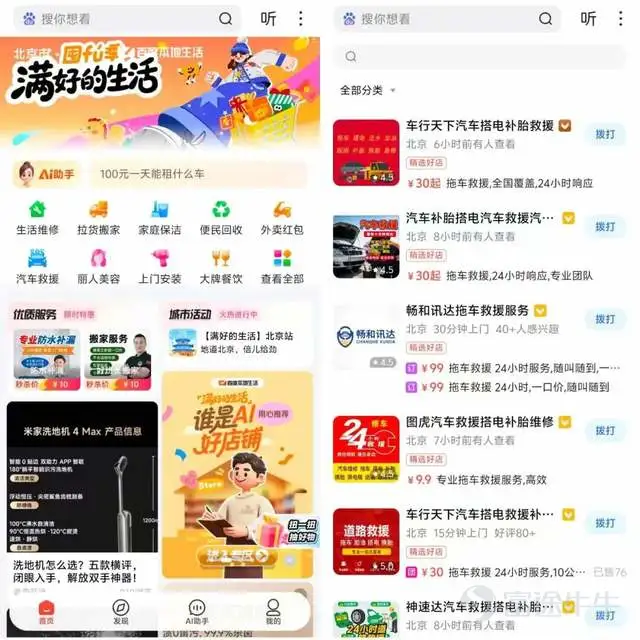
The product list page presents services in card format, with concise and clear information including service items, prices, time, and basic descriptions, making it convenient for users to compare and filter quickly. Detailed information like merchant qualifications, package comparisons, and after-sales explanations require opening the service card to view. Users can purchase group-buying packages online or make phone reservations, with different merchants offering either on-site or in-store services.
The Discover channel focuses on graphical content, highlighting local guides, consumer tips, and service education. The content is closely related to daily life, helping users understand service details and common knowledge. This channel emphasizes practical insights, ideal for fragmented browsing and supplementing the purely tool-based pages’ lack of information. However, the update frequency is low, with some posts being three months old, resulting in weak timeliness and acting more as an information display.

An AI assistant named Xiao Hui is embedded within the zone, supporting voice and text interactions. Users can directly inquire about prices, compare plans, and make decisions, such as asking “How much does it cost to move nearby?” or “How to choose tile grouting?” The assistant consolidates information and provides references, upgrading traditional search into a one-stop question-and-answer and service recommendation system, significantly shortening the decision-making process. However, the assistant mainly focuses on information recommendations and cannot, like Alibaba’s Qwen, directly complete reservations, payments, and order tracking. The service chain remains in the pre-decision phase, failing to form a closed loop.
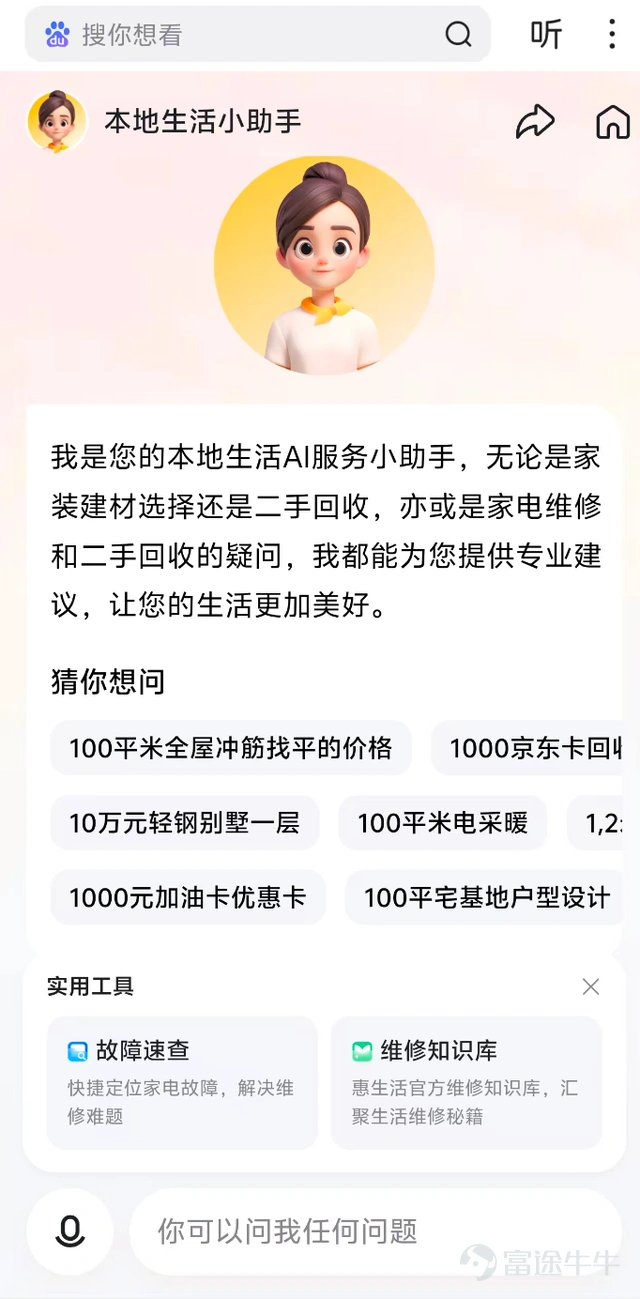
Overall, the Baidu local life zone has convenient entry points, full scenario coverage, and simple operations. The AI assistant enhances decision-making efficiency, making it suitable for quickly finding public welfare services. Although Baidu's local life service appears to be an efficient local life information and decision-making entry point, there is still room for optimization to become a full-service platform.
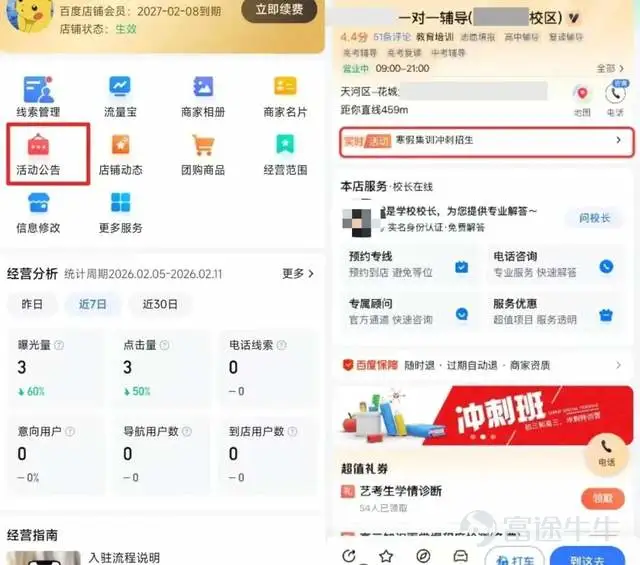
Tech星球 also learned that, aside from local life services within search, maps have become an important entry point for Baidu’s local life services, displaying store details and coupons for merchants.
Additionally, in October last year, Baidu Maps collaborated with Meituan and Ctrip to launch distinctive products like 'AI Go·Rankings,' competing with Amap’s 'Street Sweep Rankings.' Through an open alliance model, they deeply tapped into the trillion-dollar market, potentially becoming a new growth point for Baidu’s lifestyle services.
Why Baidu is 're-attempting' local life services
In fact, this is not Baidu's first attempt to enter the local lifestyle sector. Previously, it launched a local lifestyle service platform called 'Duolibear,' but the project ultimately failed.
Reportedly, Duolibear went live in 2022, focusing on group-buying discounts for dining, entertainment, and leisure. Baidu's MEG (Mobile Ecosystem Group) allocated top-tier traffic, ample funding, and a professional team for the project. Chongqing was chosen as the launch city, and Dai Zhenkai, who had served as vice president of Ele.me, was invited to lead the initiative, highlighting its significance. However, after only a few months of operation, the project was shut down as part of the spin-off of Baidu’s Smart Mini Program business unit, marking the end of this local lifestyle venture.
Even so, the domestic local lifestyle market remains enormous, and Baidu still has opportunities. According to a report by iiMedia Consulting titled 'China's Local Lifestyle Service Market Competition Landscape and Consumer Survey Research Report 2025-2026,' China's O2O market size is expected to reach 3.89 trillion yuan in 2025, growing 17.6% year-on-year, with projections to exceed 5.9 trillion yuan by 2028. Meanwhile, iResearch predicts that the overall market size of local lifestyle services will hit 35.3 trillion yuan in 2025, with online penetration rising to 30.8%.
Although Meituan, Douyin, and Alibaba dominate most of the market share, vertical sectors like repairs and moving services still have significant untapped potential, providing Baidu with an opportunity for differentiated entry and serving as a core driver for its intensified efforts.
From the merchants' perspective, Baidu's entry offers new customer acquisition pathways. By integrating search, maps, and feed traffic across the board, Baidu reaches users seeking services proactively. Additionally, Baidu keeps the threshold low for small and medium-sized businesses to join while using the 'Xiaohui Assistant' to shorten user decision-making paths. Paired with certification qualifications and multi-entry conversion tools, these features help merchants achieve online operations at minimal cost.
A merchant who attended one of Baidu's offline meetings for local life service providers and has since joined the platform told Tech星球 that the registration process was more convenient than expected. The merchant simply needed to submit basic information and complete qualification verification on the merchant service platform, and within a few days, they were live. The merchant noted that the most noticeable benefit after joining was increased customer traffic due to precise exposure.
However, the merchant also admitted that the platform still has notable shortcomings. On one hand, user activity lags behind platforms like Meituan and Douyin, leading to inconsistent order conversions. Moreover, some users consult on the platform but end up completing transactions with merchants on other platforms because the full-service loop isn’t closed, resulting in lost potential orders.
For Baidu itself, intensifying efforts in local lifestyle services represents strategic positioning amid competition over existing resources. As is well-known, internet traffic growth has plateaued, making the local lifestyle sector a crucial battleground for capturing residual value. By upgrading its search entry point to a direct service portal, Baidu prevents users from seeking local services on competing platforms, reinforcing its advantage in information distribution. Simultaneously, it collaborates with Baidu Maps, adopting a lightweight approach to avoid heavy asset fulfillment competition, thus creating a differentiated barrier.
That said, a practical challenge is that some merchants in Baidu’s local lifestyle section have yet to implement a fully integrated booking, payment, and order-tracking system, making it hard to build user stickiness. Additionally, content timeliness needs improvement, which might be an area for future optimization—otherwise, it could hinder further growth of Baidu’s local lifestyle services.
With competition heating up, does Baidu still stand a chance?
The competition in the local life sector has already reached a fever pitch. Baidu's latest push not only faces direct pressure from giants like Meituan and Douyin but also grapples with internal challenges such as the weakening of its AI advantage and profitability pressures, making its situation far from easy.
Looking at Baidu’s latest financial report data for 2025, revenue stood at 129.1 billion yuan, down 3% year-over-year, marking the lowest growth rate in the past five years. Its core search business continues to slow down. According to a report by market research firm QuestMobile, as of June 2025, Baidu's media position index has dropped to ninth place, trailing behind Douyin, Taobao, WeChat, Kuaishou, Xiaohongshu, and others.
Local life services, positioned as a key growth area, have yet to achieve scale profitability and still require ongoing capital investment in the short term. Baidu's investments in the local life sector are aimed more at strengthening its ecosystem loop rather than seeking short-term profits.
In terms of external competition, Baidu faces rivals with distinct advantages, forming an encircling threat.
Meituan, the leader in the local life sector, maintains a dominant position thanks to its robust fulfillment system and extensive merchant resources, particularly in core scenarios like food and delivery, where user stickiness is extremely high. Douyin leverages its content traffic advantage, further penetrating group-buying scenarios through the 'Dou Save' app, using short videos to drive transaction conversions and precisely targeting young users. Alibaba utilizes the nearly 800 million monthly active users of AutoNavi Maps to launch the 'Street Sweep Rankings,' relying on Alibaba's supply chain resources to comprehensively cover local life scenarios. Additionally, it collaborates with Qwen to experiment with AI ordering and payment models in areas like ticketing, ride-hailing, and food delivery. Moreover, cross-industry players like Kuaishou, Didi, and JD.com are leveraging their strengths to divert traffic and squeeze Baidu’s room for survival.
More notably, Baidu’s once-proud AI advantage is now being caught up to or even surpassed. The event of Minimax surpassing Baidu’s market value on March 10 also reflects the weakening trend of Baidu's AI barriers. While Baidu's local life offerings include 'Xiaohui Assistant,' it remains at the information recommendation stage, unable to provide end-to-end services. Compared to the rapid progress of Qwen and Minimax in implementing AI in specific scenarios, Baidu’s AI advantage has not been fully translated into a competitive edge in the local life sector.
For Baidu, the current competition in the local life arena is both a battle for existing traffic and a test of AI technology implementation capabilities. On one side, there is the external challenge of being surrounded by giants and a crowded playing field; on the other, internal pressures loom with profitability struggles and a weakened AI advantage. Baidu’s task of gaining a foothold in the trillion-yuan local life market naturally comes with significant challenges.
Risk Disclaimer: The above content only represents the author's view. It does not represent any position or investment advice of Futu. Futu makes no representation or warranty.Read more

Comments
to post a comment
1