
Is Pop Mart (9992) currently in the initial stabilization phase or experiencing a technical rebound within a weak trend?
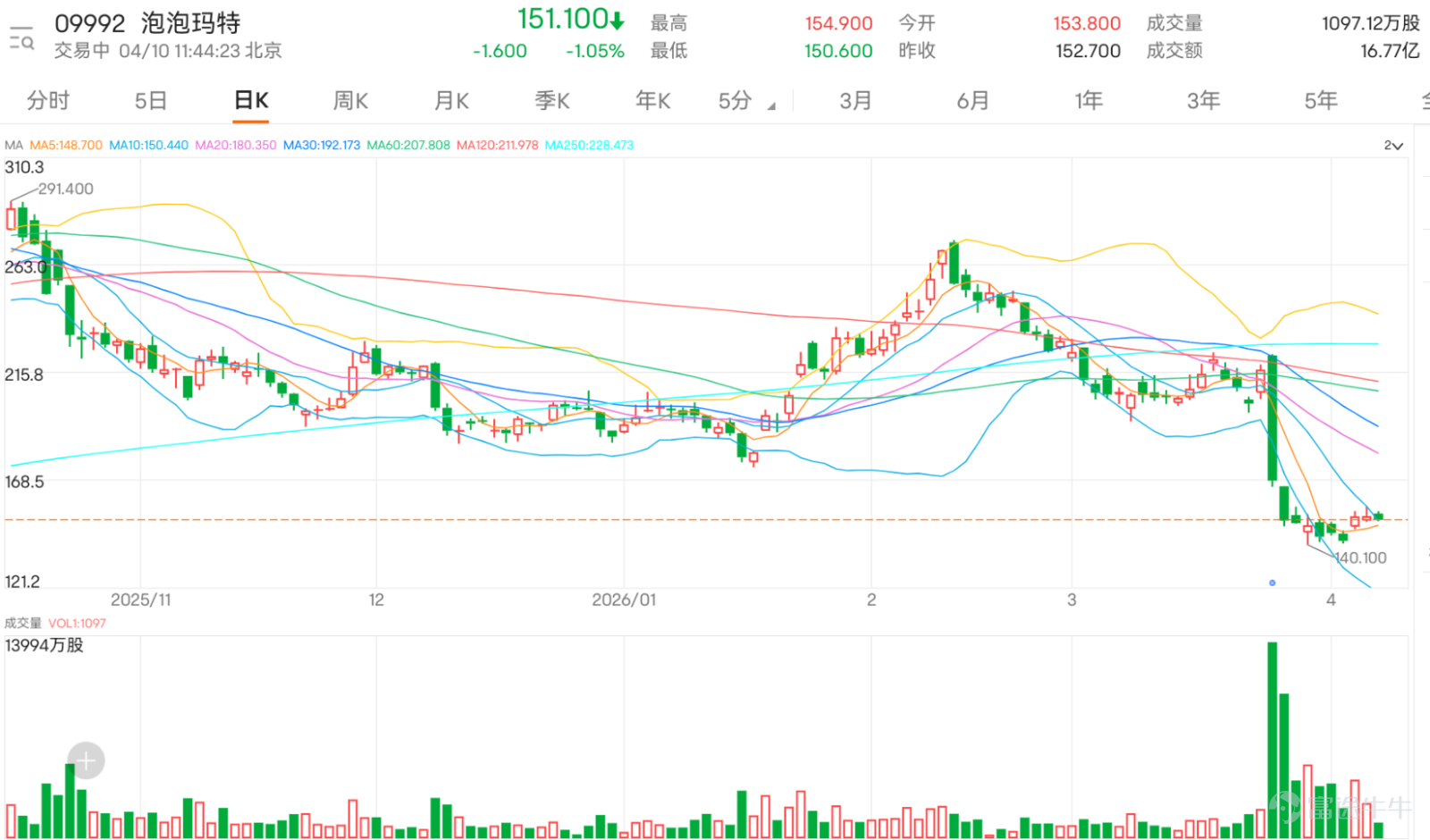
$POP MART (09992.HK)$ The latest price is reported at HKD 151.20, with an intraday high of HKD 154.90 and a low of HKD 150.60. After the stock price plunged to HKD 140.10 earlier, it has recently started consolidating repeatedly around HKD 150. Looking solely at the latest trend, the stock price has indeed stabilized from its lows and returned above HKD 150. However, considering the overall structure, this stage is still insufficient to define as a stable rebound; it’s closer to the initial recovery phase after a sharp decline.

Technically, Pop Mart remains in a clearly weak structure. The 5-day moving average is around HKD 147.20, and the stock price has temporarily risen above it. However, the 10-day moving average is near HKD 157.05, the 20-day moving average is about HKD 183.10, the 30-day moving average is roughly HKD 194.93, and the 60-day moving average is near HKD 208.61, indicating that the short-to-medium term moving averages are still declining layer by layer, with dense resistance above. In other words, although the current price has stabilized from the lows, it is still only in the preliminary stabilization phase after nearing the bottom, and there is still some distance to truly reversing the downtrend.
In terms of support levels, the immediate focus is between HKD 150 and HKD 147, which is the preliminary support area for recent consolidation and close to the 5-day moving average. If this level is breached again, the next target would be the recent low at HKD 140.10, which is also the most critical short-term line of defense. Regarding resistance, the first level to watch is HKD 157.10, the recent rebound high, which is also close to the 10-day moving average. If it can break through, the next step could test HKD 165 to HKD 170. Further out, significant resistance will remain around HKD 183, near the 20-day moving average. The RSI is approximately 36, still in a relatively weak zone, reflecting that selling pressure has not completely dissipated, but the stock price has slightly pulled away from the low area. Thus, the short-term focus will be on whether it can sustainably hold above HKD 150 and whether HKD 157.10 can be effectively broken.
In terms of short-term trading strategies, a more reasonable approach for Pop Mart at present is not to simply assume the stock has completely bottomed out but to respond in layers based on different positions and rhythms. If the stock price stabilizes only around HKD 150, the strategy should lean toward betting on a technical rebound. If it breaks through HKD 157.10, it can be seen as an initial signal of strength. If it further rises to HKD 165-170, then consider adopting a more aggressive stance to chase the next leg of the recovery trend.
Strategy One: Defend the support zone between HKD 150 and HKD 147, betting on a technical rebound from the lows.
This type of deployment represents a rebound trade near the support level. The core focus is not on achieving maximum explosiveness but on capturing the first phase of recovery as the stock price stabilizes after holding the support, rebounding from around 150 to 157 or even 165. In this scenario, products with moderate leverage and balanced timing are more suitable.
$UBPOMRT@EC2609B.C (27684.HK)$ This can be considered one of the main choices in this group, with an exercise price of 228.88 and actual leverage of approximately 4.6 times. The characteristic of this product is that its leverage is moderately high—it offers some elasticity without being overly aggressive—making it well-suited for short-term rebounds after the stock holds the support near 150. If the stock price can stabilize at the support and gradually recover toward 157, this type of product will more easily reflect changes in the underlying stock.
$HSPOMRT@EC2609B.C (27794.HK)$ This product also works well as part of this strategy, with an exercise price of 189.92 and actual leverage of about 4.1 times. Comparatively, this product has a closer exercise price and slightly lower leverage, making it a more balanced option. It’s ideal for use during the early stages of a rebound when the trend hasn't been fully confirmed. If the market merely transitions from a sharp drop to stabilization without a rapid surge, this type of product often allows for better rhythm control.
The premise of this strategy is that the support zone between 150 and 147 must hold. If it breaks down, the attractiveness of a rebound-based deployment will significantly decline.
Strategy Two: Follow up after breaking through 157.10, targeting a test of 165 to 170.
If Pop Mart can effectively break through 157.10, it indicates that the stock price isn’t just holding the consolidation zone at the low end but is also beginning to attempt a recovery above the 10-day moving average. At that point, the trend could upgrade from 'temporary stabilization at the lows' to 'initial strengthening.' In this case, the deployment can shift from defensive rebound strategies to following the upward momentum.
$UBPOMRT@EC2609A.C (27683.HK)$ This is a noteworthy product in this group, with an exercise price of 258.88 and actual leverage of about 4.9 times. The feature of this product is that it’s slightly more aggressive than those used in Strategy One, making it suitable once the stock confirms a breakout. If Pop Mart breaks through 157 and moves toward 165, this type of product will show more pronounced elasticity, making it appropriate for following the trend after the initial breakout.
$CTPOMRT@EC2609C.C (27704.HK)$ This product is also suitable for follow-up after a breakout, with an exercise price of 202.00 and actual leverage of about 4.4 times. Its feature is that the exercise price is relatively close, and its leverage is moderate, offering responsiveness without being overly aggressive. If the stock price doesn’t surge immediately after breaking out but instead rises gradually, this type of product would be more suitable for capturing a more orderly upward trend.
The key to this strategy is to see a breakout first before considering follow-up. If the stock price continues to fluctuate between 150 and 157, the attractiveness may not justify entering prematurely.
Strategy Three: After regaining 165 to 170, pursue the second phase of the recovery uptrend.
If the stock price can further stabilize between $165 and $170, it indicates not only a recovery of the short-term rebound high, but also an opportunity to push this round of movement from a technical rebound towards a more complete recovery phase. At this stage, the market's view on the stock price tends to improve significantly compared to now, and higher elasticity products can be considered for deployment.
$UBPOMRT@EC2607A.C (24863.HK)$ One of the more notable choices among aggressive deployments, with an exercise price of $266.08 and actual leverage of about 6.7 times. The feature of this product is that its leverage is significantly higher than the previous two groups, making it suitable for use after the stock price has clearly strengthened. If Pop Mart moves from around $165 to near $180, these types of products will respond more directly to the increase.
$DSPOMRT@EC2711A.C (27899.HK)$ Represents another type of strategic choice, with an exercise price of $180.10 and actual leverage of approximately 1.6 times. Although the leverage is not high, the exercise price is relatively close, and its characteristic is a more natural following trend. It is suitable for capturing the second wave of increases in a more balanced manner after confirming that the stock price has entered a more stable recovery phase. If the market trend is a gradual recovery rather than a rapid rise in a short period, these products are more valuable in practice.
The focus of this group strategy must be based on the premise that the stock price has clearly recovered above $157 and stabilized further at $165. If the movement remains stuck in the lower range, highly elastic deployments may deplete prematurely.
Short-term Trading Strategy Summary
Overall, Pop Mart has now stabilized from the low of $140.10 and established initial support around $150. However, from the overall moving average structure and resistance distribution, it is not yet sufficient to define as a steady rebound; a more reasonable judgment would still be the initial phase of technical recovery after a sharp decline. Therefore, short-term trading strategies should primarily adopt layered approaches, rather than prematurely viewing it as a one-sided restart of the uptrend.
If the stock price holds between $150 and $147, moderately leveraged products can be used to bet on a rebound; if it breaks through $157.10, momentum-based products can be deployed to follow up, targeting $165 to $170. If it stabilizes further above $165, then more flexible products can be considered to chase the second phase of the recovery uptrend. Conversely, if $147 or even $140.10 successively break down, it would indicate consolidation is incomplete, and the short-term value for betting will decrease again.

For more market analysis, stay tuned to Jenny's daily updates on 'Hong Kong Stock Warrants'!
Reminder: This article does not constitute any investment advice.
This article is for reference only and does not constitute any investment advice. The market data, opinions, and analysis contained herein may change at any time without prior notice. We are not responsible for any loss or damage caused by reliance on the information in this article. Technical analysis only shows whether certain technical conditions are met; a comprehensive assessment of asset performance should be conducted using additional data. Decisions to trade should not be based solely on this article. Please note that past performance is not indicative of future results.
#HongKongStocks #RealTimeAnalysis #WarrantsSelection #WarrantsStrategy #DerivativesHedging #HongKongWarrantsJenny #PopMart #09992 #NewConsumptionStocks$Hang Seng Index (800000.HK)$
Risk Disclaimer: The above content only represents the author's view. It does not represent any position or investment advice of Futu. Futu makes no representation or warranty.Read more

Comments
to post a comment
1
1