
"Cash is king"! SanDisk surges to a new all-time high, breaching USD 2,000

Options Sir Breaks Down Hot Topics | Intel Surges 50% in Six Trading Days: Is the Chip Giant Making a Comeback?
Following the US government's decision to revitalize domestic manufacturing, $Intel (INTC.US)$ became one of the key beneficiaries and recently played three major strategic moves—a $14.2 billion buyback of full control of the Fab 34 plant in Ireland, restarting the New Mexico wafer fab to go all-in on advanced packaging, and officially entering Elon Musk’s Terafab superchip factory. The stock price surged approximately 50% over the past six trading days (from $40.63 to $59.17).Looking at these three steps together, Intel CEO Lip-Bu Tan’s strategic intent can be summarized in one sentence: using manufacturing as the baseline, building a moat with advanced packaging, and leveraging Terafab to shape the future.
$14.2 billion buyback of Fab 34
In June 2024, Intel faced a cash flow crisis and had to sell 49% of its Fab 34 wafer plant in Ireland to Apollo Global for $11.2 billion. Less than two years later, on April 1, 2026, Intel announced a full buyback for $14.2 billion, which is $3 billion more than the selling price.
Why do this?
This super wafer plant, located in Leixlip, Ireland, is one of Intel's most advanced manufacturing bases, producing core chips on Intel 3 and Intel 4 process nodes, including the Core Ultra 'Meteor Lake' processors for PCs and Xeon 6 'Granite Rapids' processors for data centers.
More importantly,For Intel, full autonomy is the cornerstone of everything。The $3 billion premium bought back not the factory, butcontrol.
On the day the news was announced, Intel's stock price soared — the market cast its vote with real money in approval.
All In advanced packaging
Intel announced the restart of its wafer fab in Rio Rancho, New Mexico, transforming it into one of the world’s largest advanced packaging bases.
Why has packaging suddenly become so important?
Because the industry consensus is:Future chip competition will not only be about 'how small you can make it,' but also about 'how well you can package it.'。
EMIB and Foveros technologies are among the few areas where Intel is widely recognized as 'leading' in the industry. As CEO Lip-Bu Tan repeatedly emphasized during the earnings call: 'Advanced packaging initiatives continue to progress well, especially in areas like EMIB and Foveros where we have true differentiation.'
If this move succeeds, Intel will not only secure packaging orders from cloud giants like Google and Amazon but also create an effective closed loop of 'manufacturing + packaging' with its own wafer production.
Entering Terafab
The Terafab project led by Musk aims to build the largest chip super factory in human history, uniting $Tesla (TSLA.US)$ , SpaceX, and xAI, three major giants.
Intel's official announcement of joining this alliance is not just a simple foundry contract but a completely new industrial model—collaboratively completing the entire process of chip design, manufacturing, and packaging. SpaceX officially refers to it as the 'Trinity' manufacturing model.
For Intel, Terafab addresses their most critical issue: the lack of major clients.
The core problem for Intel's foundry business (IFS) is the lack of substantial external clients. However, Musk’s ecosystem—including Tesla’s Optimus robots (with a long-term goal of producing 1-10 billion units annually), SpaceX’s million AI satellites, and xAI’s large-scale model training—represents astronomical levels of chip demand. This alliance provides Intel with an excellent platform to prove its manufacturing capabilities with real products.
Objectively speaking, Intel's road to a comeback is far from complete, but the following risks cannot be ignored.
Foundry operations are still 'burning cash': IFS posts annual losses exceeding tens of billions of dollars. Although the yield rate for the 18A process is improving, it is still far from achieving scaled profitability.
Uncertainty surrounding Terafab:Details about Intel's specific role in the project, revenue sharing, investment obligations, and other specifics have not been disclosed, creating significant uncertainty.
Geopolitical and competitive pressures:Taiwan Semiconductor still holds a substantial lead in advanced process technology, while Samsung is also aggressively catching up. Whether Intel’s roadmap of 'four years, five process nodes' can be delivered on schedule remains the biggest question for the market.
Options strategy
Intel's stock price has surged 190% year-to-date, hitting a 52-week high, with strong short-term momentum. However, the RSI indicator is above 70, reaching overbought territory, warranting caution.
The current implied volatility (IV) is as high as 74.37%, suggesting significant short-term fluctuations. Focus on whether the 5-day and 10-day moving averages (in the $48-52 range) provide effective support.
(1) If you don’t currently hold a position but are unwilling to chase higher prices, planning instead to buy at a lower price after a pullback,
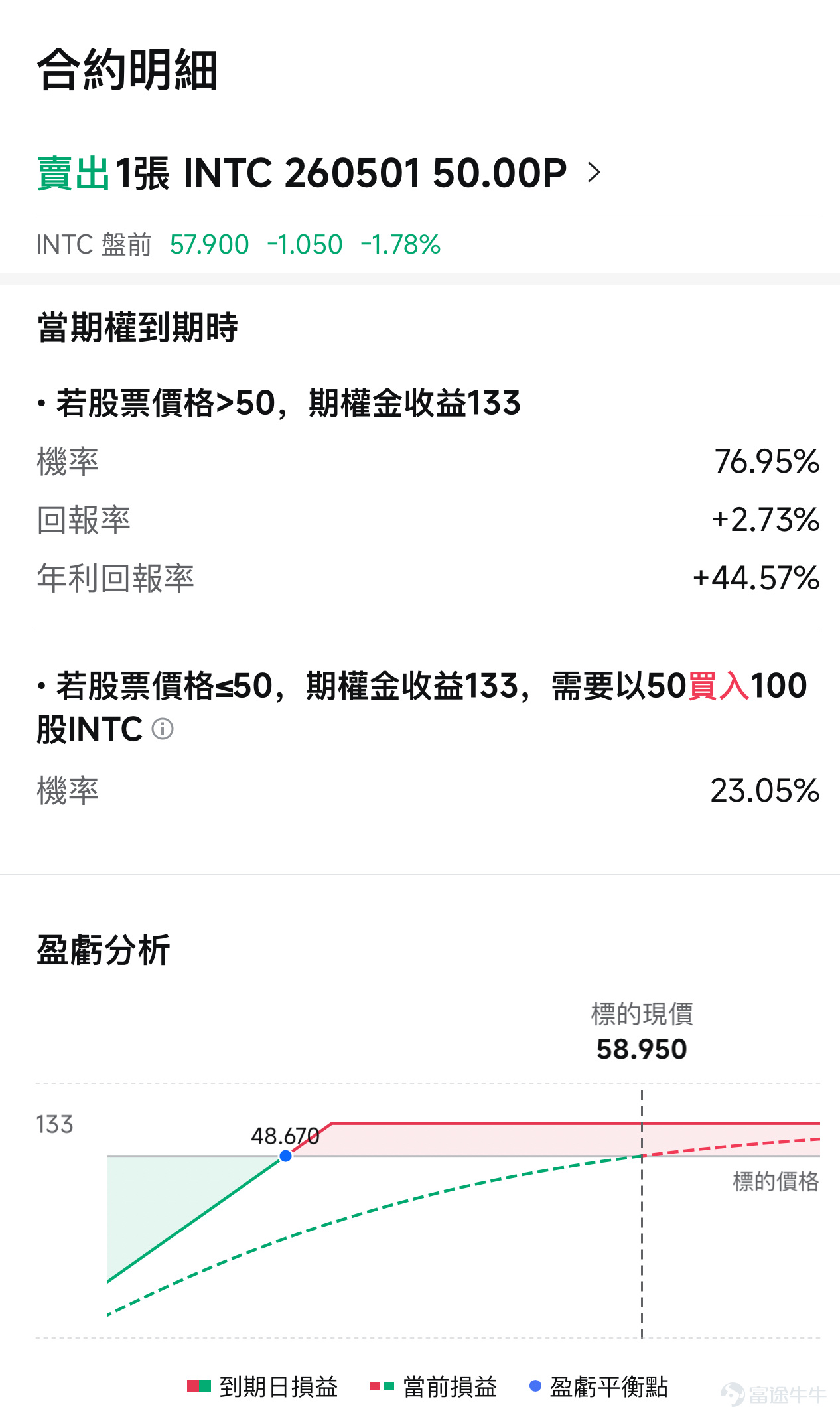
Recommended strategy:Cash-Secured Put
Core strategy:Instead of chasing highs, reverse the approach,Let the market pay you while waiting for a pullback.。Sell put options to collect substantial premiums, and if the stock price indeed falls, you can acquire the shares at your ideal price.
Key Reminder:The premise of this strategy is — you genuinely wish to hold 100 shares of INTC at the strike price. If you don't have the intention to hold the shares, do not execute this merely for collecting premiums.
(The figure below illustrates the simulated profit and loss scenario of this strategy on the expiration date. The design image displayed on the screen is for demonstration purposes only and does not constitute any investment advice or guarantee; market conditions fluctuate frequently, and the prices shown do not represent actual values.)

(2) If you already own Intel's stock and remain bullish, but are concerned about a short-term pullback after a sharp rise,
Recommended strategy:Covered Call (Overwriting Strategy)
Core strategy:Insure your stock by purchasing put options. If the stock rises, you will only earn slightly less (stock value increase > put premium). However, if a short-term pullback occurs, the appreciation in the put option could offset or even exceed the loss from the stock decline, allowing you to break even or potentially profit.
(The figure below illustrates the simulated profit and loss scenario of this strategy on the expiration date. The design image displayed on the screen is for demonstration purposes only and does not constitute any investment advice or guarantee; market conditions fluctuate frequently, and the prices shown do not represent actual values.)

Finally, Option Sir brings a small perk for fellow investors, welcome to claim it.Options Beginner Pack
This event is exclusively for invited HK users, click to learn moreDetailed event rules >>
Market conditions are complex and volatile,Options strategyOverwhelmed by choices? Futubull helps you build a portfolio in three steps.Options strategymaking investing simple and efficient from now on!

Option Risk Warning:An option is a contract that grants the holder the right, but not the obligation, to buy or sell an asset at a fixed price on a specific date or at any time before that date. The price of an option is influenced by various factors, including the current price of the underlying asset, the strike price, time to expiration, and implied volatility. Implied volatility reflects the market’s expectations for the level of volatility in the option over a future period. It is a data point derived inversely from the Black-Scholes option pricing model and is generally regarded as an indicator of market sentiment. When investors anticipate greater volatility, they may be more willing to pay a higher price for options to hedge risks, resulting in higher implied volatility. Traders and investors use implied volatility to assess the attractiveness of option prices, identify potential mispricings, and manage risk exposure.
Disclaimer:This content does not constitute any offer, solicitation, recommendation, opinion, or guarantee for any securities, financial products, or tools. The risk of loss in trading options can be substantial. In some cases, losses may exceed the initial margin deposited. Even if you set contingent orders such as 'stop-loss' or 'limit' orders, these may not prevent losses. Market conditions may prevent these orders from being executed. You might be required to deposit additional margin within a short period. If you fail to provide the required amount within the specified time, your open positions may be liquidated. However, you will still be responsible for any shortfall in your account. Therefore, before trading, you should study and understand options and carefully consider whether such trading is suitable for you based on your financial situation and investment objectives. If you trade options, you should be familiar with the procedures for exercising options and the rights and obligations upon exercise and expiration. Option trading involves extremely high risks and is not suitable for all investors. Investors should read carefully before engaging in any options trading strategy.Characteristics and Risks of Standardized Options。
Risk Disclaimer: The above content only represents the author's view. It does not represent any position or investment advice of Futu. Futu makes no representation or warranty.Read more

Comments
to post a comment
23
3