Gold prices have climbed above $4,600. Is the metals bull market back?

Has the logic of gold as a safe-haven asset failed? Three key truths unravel the fluctuations in gold
In March, with escalating conflicts in the Middle East, surging oil prices, and dual tailwinds from geopolitical risks and inflation expectations, the gold price unexpectedly retreated from its high levels, with volatility significantly amplified. Many investors are puzzled: Has the rule of 'When cannons roar, gold rises' failed? Is it still worth holding gold? In fact, this round of market action does not represent the collapse of the safe-haven logic but rather a shift in market trading dynamics. Understanding the following three truths will help rationally navigate market fluctuations.
Truth One: Interest rate pressure dominates, not the failure of the safe-haven logic
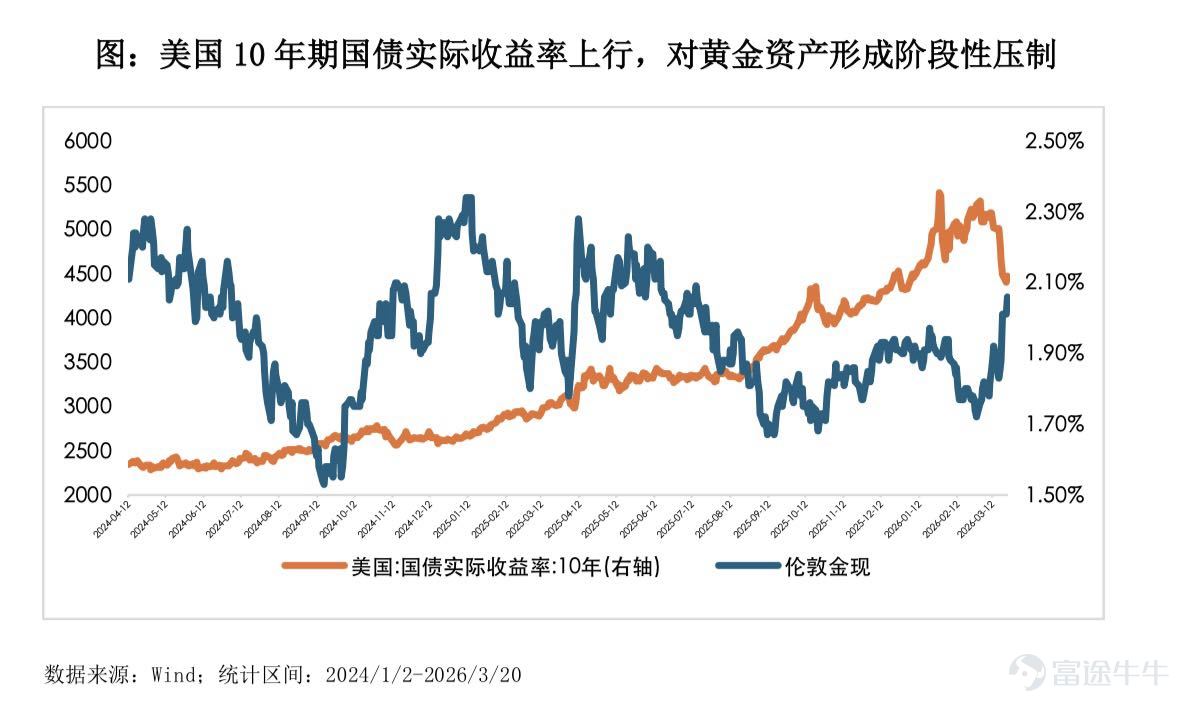
The ingrained thinking of 'buying gold in turbulent times' has left many investors confused. In reality, the core driver behind this round of gold price fluctuations is not geopolitical conflict but the strong suppression by interest rate factors – the rapid rise in the 10-year US Treasury yield and the significant cooling of Federal Reserve rate cut expectations are the real culprits behind the pullback in gold prices.
On the surface, the correction in gold prices seems like a failure of its safe-haven attribute, but in essence, it reflects a shift in market pricing logic:Investors trade not on risk events themselves, but on the chain effects of these events on core macro variables such as inflation, interest rates, and the US dollar.J.P. Morgan once said, 'Gold is money. Everything else is credit.' In today's context, this statement precisely captures the crux: The monetary nature of gold has not disappeared due to heightened risk; it’s just that the market’s short-term focus has shifted to 'how risk alters the interest rate and credit environment,' rather than gold itself.
Specifically, the ongoing escalation in the Middle East, with rising transportation risks in the Strait of Hormuz, has directly driven international oil prices higher. The impact of high oil prices extends far beyond the energy sector, spreading along global cost chains such as transportation and manufacturing, thereby disrupting overall inflation expectations. In this context, upward revisions in inflation expectations also suppress rate-cut expectations, leading the market to downgrade its assessment of easing paths and pushing up U.S. Treasury yields, especially real interest rates. Data shows that the real yield on 10-year U.S. Treasuries rose to 2.01%. Gold itself does not generate coupon or interest income, so when real interest rates rise, the real return on holding interest-bearing assets like bonds increases, raising the opportunity cost of holding gold and reducing its relative attractiveness in the short term. (Data source: Wind, metric definition: 'U.S.: Real Yield on 10-Year Treasury'; data as of March 20, 2026)
Thus, we can outline the complete transmission chain behind this fluctuation in gold prices:Escalation of Middle East conflict → Rising transportation risks in the Strait of Hormuz → Surge in international oil prices → Rebound in inflation expectations → Cooling of Federal Reserve rate-cut expectations → Rise in 10-year U.S. Treasury yields → Increase in gold holding opportunity costs → Capital shifts to interest-bearing assets like U.S. Treasuries → Downward pressure on gold prices.
In summary: The recent pullback in gold prices cannot simply be interpreted as the failure of safe-haven logic. More accurately, at this stage, the influence of interest rate factors on gold prices temporarily outweighs the support from safe-haven sentiment.

Truth Two: Short-term capital outflows from gold ≠ reversal of medium- to long-term logic
Faced with short-term corrections in gold, many investors tend to panic and over-interpret the signals behind the fluctuations. In fact, there is no need to overly amplify short-term volatility, and the medium-term allocation value of gold requires stepping back from short-term ups and downs for a broader perspective.
Last week, the SPDR Gold ETF holdings were 1,056.99 tons, with an outflow of 14.57 tons during the week. This data indeed reflects short-term capital adjusting positions, but this outflow is more about rebalancing at the trading level, not a reversal of the medium-term allocation logic for gold. The current round of adjustments is better viewed as a phased correction against the backdrop of interest rates and policy paths being repriced, following a significant accumulation of gains in gold prices. (Data source: Wind, as of March 20, 2026)
If we extend the view beyond short-term price fluctuations, what gold is currently experiencing is akin to a car driving on the main road suddenly encountering a gust of side wind and a bumpy road surface—its speed momentarily slows down, and its direction slightly wavers, but this does not mean the destination has changed. The core variable disturbing gold now is the repricing of interest rate expectations; however, from a longer-term perspective, the global macro environment has not entered an ideal state of 'strong growth, low inflation, loose policy,' but remains in a complex phase characterized by disruptions to growth prospects, lingering inflation stickiness, and constrained policy space. Against this backdrop, market uncertainty has not truly subsided, and gold tends to demonstrate its allocation significance in portfolios when macro constraints increase and asset volatility rises.
More importantly, the medium-to-long term allocation logic for gold is not solely centered around rate cut expectations. Over the past few years, global central banks have continued to increase their gold reserves, reflecting optimization of reserve structures, reduced reliance on a single fiat currency, and a reassessment of credit risk amid geopolitical realignments. Such demand is long-term, strategic, and non-trading in nature, and typically does not reverse easily due to short-term price pullbacks. Meanwhile, from the perspective of multi-asset allocation, gold still possesses characteristics such as low correlation, inflation resistance, and risk hedging. When equity market volatility increases and the defensive efficiency of bonds in portfolios faces marginal changes, gold remains one of the few assets that combines liquidity and defensive attributes while providing portfolio diversification value.
Truth Three: Look beyond volatility to see the essence—gold's defensive value has never been absent.
In September 2008, the collapse of Lehman Brothers triggered a severe deleveraging mode in global financial markets. At that time, equity markets plummeted across the board, and credit asset valuations collapsed. Many assets that had long touted diversified risk also became ineffective under the shock of extreme liquidity shortages. However, gold demonstrated hardcore resilience during this epic stress test, posting a counter-trend rise of 4.94% for the year. (Data source: Wind, based on 'London Gold Spot')
The lesson from this history is not that gold necessarily rises during crises, but rather that it reminds the market: when correlations between assets suddenly increase and the buffering capacity of traditional stock-bond portfolios weakens, gold is the asset that protects portfolio resilience. It may not always be the most dazzling performer day-to-day, but when the market truly enters high-pressure conditions, its strategic defensive attributes become significantly prominent.
This logic remains valid in the current environment. In the short term, gold prices will continue to be influenced by factors such as Fed interest rate expectations, the US dollar trend, and oil price fluctuations, potentially leading to further amplified volatility. However, as long as global macro uncertainties persist and the central bank gold-buying trend remains intact, gold’s long-term allocation value should not be defined by short-term price movements. What truly matters is not whether gold prices rebound immediately, but whether your portfolio retains assets with independent resilience when the market again enters a complex and fragile phase.
To seize both short-term rebounds and long-term allocation opportunities in gold, it is recommended to focus on the E Fund Gold Mining ETF (2824.HK) $EFUND GOLD MI ETF (02824.HK)$As the only ETF currently listed on the Hong Kong market that focuses exclusively on global gold mining, this product closely tracks the Solactive Global Gold Miners Select Index. It covers 30 leading mining companies across four major gold-producing regions: China, Canada, the United States, and Australia. This provides both global diversification and concentration in industry leaders. (Data source: Solactive, as of March 20, 2026.) During periods when gold prices rise, gold mining stocks benefit from relatively fixed costs, which enhance profit margins. Additionally, improved earnings expectations can lead to a revaluation, creating an amplified return pattern akin to the 'Davis Double Play.' However, during times of falling gold prices, gold mining stocks may exhibit greater volatility. In summary, whether capturing the current rebound in gold or making medium- to long-term allocations to gold-related assets, the E Fund Gold Mining ETF (2824.HK) is an efficient tool for investors.

Note: As of March 30, 2026, the E Fund (Hong Kong) SOLACTIVE Global Gold Mining Select Index ETF is the only gold mining-themed ETF listed on the Hong Kong Exchange and recognized by the Hong Kong Securities and Futures Commission. This statement is based on (i) a comprehensive review of all collective investment schemes authorized by the SFC under the Code on Unit Trusts and Mutual Funds contained in the SFC's product database, and (ii) a full review of all exchange-traded funds listed on the Hong Kong Exchange as of the reference date. If other similar products are authorized by the SFC or listed on the Hong Kong Exchange, the accuracy of this statement may change. This statement does not include unlisted funds, private funds, or overseas-listed products.
[Important Information] The issuer of this content is E Fund Management (Hong Kong) Co., Ltd. This content does not constitute an invitation or recommendation to invest in fund units. Investment involves risks, and fund prices can go up or down. Before investing, investors should carefully read the fund prospectus (including the 'Risk Factors' section) related to the investment risks associated with the fund. This content has not been reviewed by the Hong Kong Securities and Futures Commission. For detailed important notices and disclaimers regarding the above funds, please visit the E Fund (Hong Kong) website: https://www.efunds.com.hk/sc/products/51/important/
Risk Disclaimer: The above content only represents the author's view. It does not represent any position or investment advice of Futu. Futu makes no representation or warranty.Read more


Comments
to post a comment
4
1