
Selling three properties and experiencing 300 failures: He spent 17 years completing a逆袭 against Japanese robots

One is a rapidly rising 'first humanoid robot stock,' and the other is an international giant selling four million cars annually. Together, they have completed a romantic cross-time dialogue.
On April 7, Ubtech Robotics and Honda Trading signed a strategic cooperation agreement. The two parties will collaborate on the application research, scenario validation, and model exploration of intelligent solutions such as humanoid robots and unmanned logistics vehicles.$UBTECH ROBOTICS (09880.HK)$

The founding of Ubtech Robotics can be traced back to 2009. That year, founder Zhou Jian first saw Honda's bipedal humanoid robot ASIMO at an exhibition in Japan. However, the reception staff were rather arrogant, which inspired his dream to 'build China’s own humanoid robot.'
Seventeen years later, Honda's ASIMO has long ceased development, and now Honda is turning to promote the application of Ubtech Robotics' industrial humanoid robots.
This time, it’s Honda coming to Ubtech Robotics’ home turf.
For China’s humanoid robotics industry, this is not only an inspiring journey of a Chinese tech company going global, but also a ceremony of role transformation. From an awestruck observer to a partner walking side-by-side, this long road of catching up has taken Zhou Jian and Ubtech Robotics seventeen years.

Chasing the light, becoming the source
Zhou Jian’s connection with Honda began with a life-changing encounter.
In 2009, at a technology expo in Japan, Zhou Jian first saw ASIMO, the most advanced humanoid robot in the world at that time developed by Honda. It could walk on two legs, go up and down stairs, run, and even dance, with smooth and flexible movements. This left Zhou Jian deeply impressed, making him realize for the first time that the dream of 'Transformers' could truly become a reality.
But he was also deeply stung by ASIMO's exorbitant price and the stranglehold of its technology.
At that time, ASIMO cost over $2 million to build, with annual rental fees alone reaching hundreds of thousands of dollars. More crucially, core components forming the 'joints' of humanoid robots—servo drives—were monopolized by Japan and South Korea, leaving a void domestically. A single servo drive sold for $200, and dozens were needed for one humanoid robot, making the overall cost staggering.
He clearly realized that if the Chinese wanted to create their own humanoid robots, they had to overcome this technological barrier.
At that time, Zhou Jian was an inexperienced but passionate young man, a dreamer inspired to follow; Honda, on the other hand, was an untouchable giant perched high on its pedestal, an object of admiration.
After returning home, in a rented office in Shenzhen, Zhou Jian led his team starting with imported servo drives, painstakingly solving problems related to precision algorithms, micro-motors, and gear transmissions, embarking on a difficult path of independent research and development.
Before going all-in on this extravagant dream, his life had been smooth and privileged: after returning from studying in Germany, he became the youngest general manager of Michael Weili Group’s China branch within four years, then started a business in automation equipment earning tens of millions annually.
After starting his venture into humanoid robotics, to cover the high R&D costs, he sold three properties in Shenzhen, spending tens of millions of his personal wealth. At the toughest times, he had to borrow money to keep the company running. After experiencing over 300 failures in the lab, in 2012, Ubtech Robotics finally cracked the servo drive technology for humanoid robots and reduced the cost to one-tenth of similar foreign products.
This key breakthrough allowed Ubtech Robotics to establish a firm foothold in the industry and marked the beginning of China’s ‘independent and controllable’ humanoid robotics sector.
Before Ubtech Robotics, China’s humanoid robotics industry had long suffered from a 'lack of core technology,' relying solely on imported core components. Ubtech Robotics broke through this core technological barrier, providing a technical foundation and confidence for the rise of domestic humanoid robotics supply chains and inspiring a wave of entrepreneurs to enter the field.
In 2026, the former 'student' began walking side by side with the erstwhile 'teacher.' Ubtech Robotics officially partnered with Honda, becoming a supplier and collaborator for humanoid robots and unmanned logistics vehicles.
Under the strategic cooperation agreement, both parties will jointly explore the application possibilities of humanoid robots and unmanned logistics vehicles in industrial manufacturing, warehousing, and logistics scenarios. When conditions are ripe, they will promote demonstration applications and experience replication within Honda's trade supply chain, building an all-scenario intelligent ecosystem combining 'humanoid robots + automobile manufacturing'.
At this point, Ubtech Robotics is the leader in China’s humanoid robotics industry, while Honda plays a dual role as both a super buyer and technology validator, acting as the ‘gatekeeper’ of industrial resources.
This story of achieving dreams with unwavering determination is a microcosm of China’s transformation from follower to leader in intelligent manufacturing. Zhou Jian spent 17 years completing a closed-loop delivery of his dream, using almost obsessive persistence to gradually reach a position of parity.

From imitation to surpassing
Honda Trading, with 56 branches across 19 countries and regions globally, serves as the global supply chain hub for the Honda Group and is also a hidden giant in the automotive supply chain. It can mobilize the world's top material and equipment resources and screen out the most promising innovative technologies through stringent entry standards.
It can be said that Honda Trading’s selection criteria represent the 'gold standard' of the automotive supply chain.
Why did Honda Trading choose Ubtech Robotics? A set of data provides a sufficient answer.
In 2025, Ubtech Robotics achieved total revenue of 2.01 billion yuan, ranking first globally among humanoid robot companies. Among this, revenue from full-size embodied intelligent humanoid robots (over 160 cm tall, not remote-controlled or toys) reached 820 million yuan, representing a year-on-year increase of 2203.7%, with sales reaching 1,079 units, marking a staggering year-on-year growth of 35,866.7%, also ranking first globally.
These figures indicate that Ubtech Robotics’ humanoid robots have not only moved beyond laboratory settings to achieve scaled commercial implementation but also possess strong competitiveness on a global scale.
Honda’s ASIMO, which pursued technological perfection at any cost, ultimately failed to leave the laboratory due to commercialization challenges. In 2018, after more than 30 years of deep involvement in humanoid robotics, Honda gradually de-emphasized the ASIMO project, shifting focus to the development of practical robots such as wheelchairs, walking aids, and disaster-relief robotic arms.
This serves as a wake-up call for the industry: technology without commercial viability is merely an expensive toy.
Zhou Jian, who from the very beginning aimed to 'make humanoid robots affordable for everyone,' chose a path of 'surviving first, then pursuing ideals' due to practical constraints. While benchmarking against ASIMO, he emphasized that Chinese companies must develop their own technological roadmap.
From stable bipedal walking, obstacle avoidance, climbing stairs, object grasping, to human-robot interaction, each generation of Walker has been catching up to ASIMO’s capabilities. However, the cost is a hundred times lower, and mass production has been achieved. In Ubtech Robotics’ product philosophy, humanoid robots are not about showing off skills but about being stable, durable, and solving real-world problems.
Over the past few years, Ubtech Robotics’ humanoid robots have danced on the CCTV Spring Festival Gala stage, served as guides at the World Expo pavilion, and even won first place in the world’s first humanoid robot half-marathon race. Their capabilities have long surpassed ASIMO, once the global benchmark for excellence.
Starting from 2024, Ubtech Robotics’ humanoid robots are entering industrial settings to perform tasks such as automotive manufacturing, smart logistics, 3C electronics production, semiconductor manufacturing, aerospace manufacturing, and industrial data collection. More than a thousand Ubtech Walker S series industrial humanoid robots are now deployed, handling repetitive tasks like material handling and sorting, with continuously improving efficiency.
These advancements signify that Ubtech Robotics has successfully completed the commercialization loop that Honda’s ASIMO could not achieve.
Behind these achievements lies both the long-term commitment of enduring hardships for a decade and the relentless investment regardless of short-term gains or losses.
From 2022 to 2025, Ubtech Robotics invested 1.9 billion yuan in cumulative R&D, focusing heavily on areas like embodied AI and world modeling. This deep accumulation of capabilities has enabled Ubtech Robotics to engage on par with the world's leading technology companies.
From scratch to full-stack technological independence, China’s humanoid robotics technology, represented by Ubtech Robotics, has undergone leapfrog development. What Honda values is its ability to achieve rapid iteration and cost advantages through the global supply chain.

China’s intelligent manufacturing takes center stage.
In the era of fuel-powered vehicles, Honda was synonymous with engineering culture and technological faith. In the age of embodied intelligence, as a new wave sweeps in, the former technology leader chooses to participate in the transformation in a different way—by opening up its supply chain and embracing Chinese innovation.
The collaboration with Ubtech Robotics epitomizes this industrial paradigm shift: Honda no longer insists on 'making everything itself' but becomes a testing ground and amplifier for new technologies, leveraging a century of manufacturing expertise to provide global innovators with the most demanding industrial 'training ground.'
The shift in home turf and the passing of the baton are both inevitable trends and survival wisdom.
From Honda's ASIMO igniting Zhou Jian’s dream 17 years ago to today's technological breakthroughs by Ubtech Robotics feeding back into Honda's supply chain, this逆袭story of domestic substitution demonstrates that technological innovation often stems from the pursuit of excellence, while industrial upgrading requires cross-disciplinary collaboration.
Automobile manufacturing is one of the most complex industrial scenarios, with extremely high demands for precision, stability, and intelligent levels.
Traditional automation equipment excels at standardized, repetitive tasks but often faces significant limitations when dealing with flexible manufacturing and non-standard scenarios. The advantage of humanoid robots lies precisely in their versatility and adaptability. They can penetrate human workspaces, solving complex tasks like assembly in narrow spaces and handling non-standard parts—the 'last meter' challenges.
However, how to control costs and achieve scaled applications while ensuring top-tier performance remains a core issue facing the industry, and it is also the deeper logic behind Honda's collaboration with Ubtech Robotics.
After reaching the agreement, Ubtech Robotics will provide full-stack technology and mass production capabilities for humanoid robots, while Honda Trading offers world-class supply chains and industrial scenario validation. Ubtech Robotics leverages Honda’s global supply chain and manufacturing experience to accelerate technology implementation and market expansion; Honda, on the other hand, enhances automotive manufacturing intelligence through humanoid robotics, building new competitive advantages.
More importantly, this bidirectional empowerment, which breaks traditional client-contractor boundaries, accelerates the accumulation and iteration of real-world data, further driving the evolution of embodied intelligence technologies and their deep application in the automotive industry, forming a closed loop of 'technology validation-data feedback-iterative upgrades.'
Conclusion
From admiration to independent research and development, from expensive toys to industrial implementation, Ubtech Robotics’ growth story is also a microcosm of China's rise in hard technology.
In this sense, the growth trajectory charted by Ubtech Robotics represents not only the success of a single company but also symbolizes the repositioning of China's intelligent manufacturing within the global industrial chain: from passively accepting technology spillover and undertaking low-end assembly at the bottom of the value chain, to becoming a core hub that develops cutting-edge technologies, defines industry standards, and exports products and solutions. It marks the shift from the periphery to the center of the global industrial landscape.
On the trillion-dollar humanoid robotics track, Chinese strength has evolved from catching up to running alongside competitors, and is now advancing toward taking the lead. It is fully prepared to embrace its defining moment.
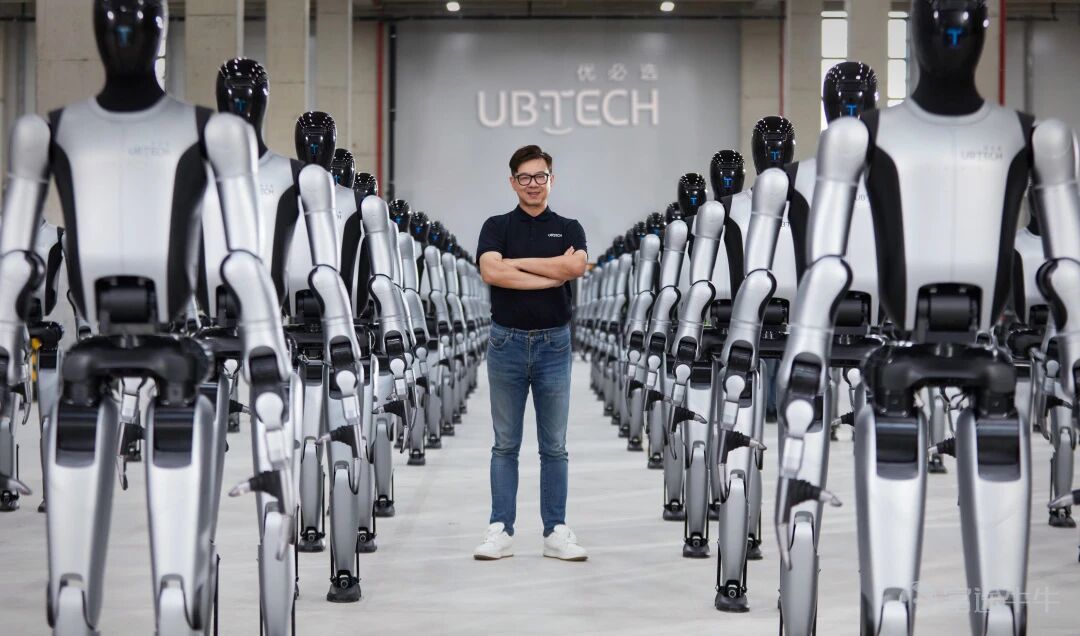
(Cover by Zhou Jian)
Author: Yu Mi
Risk Disclaimer: The above content only represents the author's view. It does not represent any position or investment advice of Futu. Futu makes no representation or warranty.Read more

Comments
to post a comment
1