
Mediators have proposed a 10-day ceasefire—will the U.S. and Iran enter a 'cooling-off period'?

Playing Options with a Hundred Bucks | Two weeks after the US-Iran ceasefire, global markets soar. How to use options to follow the trend at a low cost?
Today, the US-Iran conflict, which has roiled global markets for over a month, suddenly showed signs of significant easing.
The US-Iran conflict saw a dramatic reversal just before the 'deadline.' Under urgent mediation by Pakistan, the US and Iran agreed to an immediate 'full ceasefire' for two weeks, with negotiations set to begin on April 10 in Islamabad. President Trump confirmed the suspension of military action, while Iran announced it would reopen the Strait of Hormuz.
Market sentiment reversed instantly, sending global risk assets into a jubilant rally.
This wave of positive news directly ignited the Asia-Pacific stock markets today:
Hong Kong stocks: At the close on April 8, the Hang Seng Index surged 3.09%, and the Hang Seng Tech Index skyrocketed by 5.22%! Semiconductors, AI computing power, and tech stocks all took off.
Japan and South Korea: The Nikkei 225 index soared over 5% on the day, strongly reclaiming the 56,000-point level; South Korea's market even jumped over 7% at one point!
As of this writing, Nasdaq futures had already risen more than 3% in pre-market trading!
In short, the long-suppressed 'risk appetite' has been fully unleashed, with capital switching from risk-averse mode to 'buy-buy-buy' mode. So, the question arises: with only a 'hundred bucks' (a few hundred dollars) budget and wanting to seize this opportunity, what should one do?
"Low-cost small buyer" tactic
For newcomers to options trading with limited funds but aspirations for higher returns,"Buyer strategy" is an approach worth considering. The core concept is straightforward: you pay a small 'premium' to gain the right to buy or sell an asset at a specific price in the future. If the market moves in your favor, the potential gains can be significant; if your prediction is wrong, the maximum loss is limited to the premium you paid.
Simply put, it’s: 'If expecting a big rise, buy call options; if expecting a big drop, buy put options.'
Today, we'll explore two classic instruments within a budget of a few hundred dollars: one representing tech growth — $Invesco QQQ Trust (QQQ.US)$ and the other representing crude oil assets — $United States Oil Fund LP (USO.US)$ (to date, the largest ETFs representing these two asset classes), and examine how they could be traded in the current environment.
QQQ - The Vanguard of the Tech Rebound
The easing of geopolitical risks often leads to a rapid rebound in interest-rate-sensitive tech growth stocks. Today's surge in Hong Kong-listed tech stocks is clear evidence. QQQ, as a basket of top-tier tech companies, is an efficient tool for participating in this wave of market movement, allowing investors to capitalize on the entire sector's rebound without needing to pick individual stocks.For investors without experience in options trading, the active trading volume of QQQ index options, coupled with their lower mid-week expiration prices, makes them particularly suitable for beginners looking to understand the market.
Current logic: Conflict eases → Inflation concerns decrease → Fed's pressure to raise interest rates diminishes → Favorable for valuation recovery and rise in tech stocks.
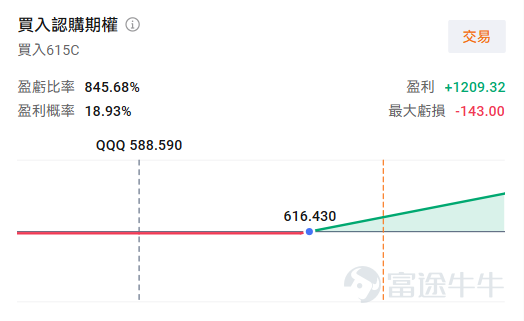
Buy one contractNear-term, slightly out-of-the-moneyQQQ Call. Slightly out-of-the-money contracts are relatively inexpensive while still offering good sensitivity to upside movements (leverage effect), making them suitable for smaller capital bases.
(The design image displayed on the screen is for illustrative purposes only and does not constitute any investment advice or guarantee; Market conditions fluctuate frequently, and the option prices shown do not reflect real-world values; filtered based on an option premium price of approximately 1 USD)

If QQQ rises significantly due to continued market sentiment improvement, the value of this option may increase notably. If the market moves sideways or declines, the maximum loss would be the entire premium paid.
Conversely, if you are not optimistic about the strength of this rebound, you can also deploy out-of-the-money puts. Round-number levels, being psychological price points for most investors, see higher trading volumes and better liquidity.
(The design image displayed on the screen is for illustrative purposes only and does not constitute any investment advice or guarantee; Market conditions fluctuate frequently, and the option prices shown do not reflect real-world values; filtered based on an option premium price of approximately 1 USD)

USO - Playing the 'Sentiment Reversal' with High Volatility
Crude oil is the most direct 'thermometer' of geopolitical risk. Each escalation in the US-Iran conflict triggers concerns over supply disruptions, pushing oil prices higher; conversely, a de-escalation in tensions quickly pressures oil prices lower. The emergence of this 'ceasefire' signal was the core reason behind the overnight plunge in oil prices. For USO, this constitutes a classic 'expectation reversal' scenario.
The significant short-term negative factor (the dissipation of geopolitical premium) has been initially realized, causing a sharp drop in oil prices. However, market sentiment often overreacts, and two possibilities need attention: 1) If the decline is too steep, a technical oversold rebound may occur; 2) The peace negotiation process could experience ups and downs, and any fluctuation might trigger violent volatility in oil prices.
If the easing trend becomes established, oil prices will face further downward pressure, and deploying put options on USO could be considered.
(The design image displayed on the screen is for illustrative purposes only and does not constitute any investment advice or guarantee; Market conditions fluctuate frequently, and the option prices shown do not reflect real-world values; filtered based on an option premium price of approximately 1 USD)

If negotiations proceed smoothly, or concerns about demand arise, causing a further significant drop in crude oil prices, this put option could surge significantly. If negotiations collapse, geopolitical risks re-emerge, or crude oil prices remain range-bound, the maximum loss would be the entire premium initially paid.
Key Considerations
Position size is your lifeline: A hundred-dollar strategy,Only execute one strategy at a time, and your position size represents your total budget.Never bet all your money on a single option, and never borrow to play. Remember, the maximum loss for a buyer's strategy is the premium, but losing it all is common.
Time is your enemyOptions have an 'expiration date,' and as the expiration date approaches, their time value will erode more quickly. Therefore, don't buy deep out-of-the-money options with a long time horizon, and don't forget about them after purchasing.
Focus on volatilityOptions are expensive when the market is in panic (high volatility) and cheap when the market is calm (low volatility). As the market shifts from panic to calm, option prices may not be too expensive, but beware that if the market remains calm, the value of options could experience a 'slow decline.'
Plan aheadBefore buying, think clearly: how much do you expect the underlying asset to rise? How long will you hold? If the price moves against you, at what loss will you admit defeat and exit? Set a mental stop-loss point and stick to it.
The easing of US-Iran tensions has brought a warm breeze to the market, but the market is always changing, and today’s strategy is based on the premise of 'easing.' It is crucial to closely monitor subsequent news because any further statements from Trump or Iran could cause the market to shift again. Playing options with a hundred dollars is not just about technique; it's also about mindset and discipline.
Disclaimer
This content does not constitute any offer, solicitation, recommendation, opinion, or guarantee regarding any securities, financial products, or tools. Trading options may involve substantial risk of loss. In some cases, your losses may exceed the initial margin deposited. Even if you have set up contingency instructions such as 'stop-loss' or 'limit orders,' these may not necessarily prevent losses. Market conditions may cause these instructions to fail execution. You may be required to deposit additional margin within a short time frame. If you fail to provide the required amount within the specified period, your open positions may be liquidated. However, you will still be responsible for any account deficits resulting from this. Therefore, you should study and understand options trading and carefully assess whether such trading suits your financial situation and investment objectives before proceeding. If you trade options, you should familiarize yourself with the procedures related to exercising options and their expiration, as well as your rights and obligations during exercise and expiration.
Risk Disclaimer: The above content only represents the author's view. It does not represent any position or investment advice of Futu. Futu makes no representation or warranty.Read more

Comments
to post a comment
12
8