
The United States and Iran are sticking to their respective positions—can peace talks proceed smooth

Glimmer of hope for US-Iran ceasefire | What is the TACO trade that thrives on panic?
On April 5 local time, U.S. President Trump made another strong statement on social media, demanding that Iran lift its blockade of the Strait of Hormuz by the evening of April 7. He threatened, "If they continue to close the strait, they will lose all power plants and other factories in their country." On the evening of April 7, as the deadline approached, Trump announced a conditional two-week ceasefire agreement with Iran. This high-tension situation reminded many people of a buzzword in financial circles — the “TACO trade.” So, what is the TACO trade? Is this strategy still effective? How can investors reasonably attempt the TACO trade?
What is the TACO trading strategy?
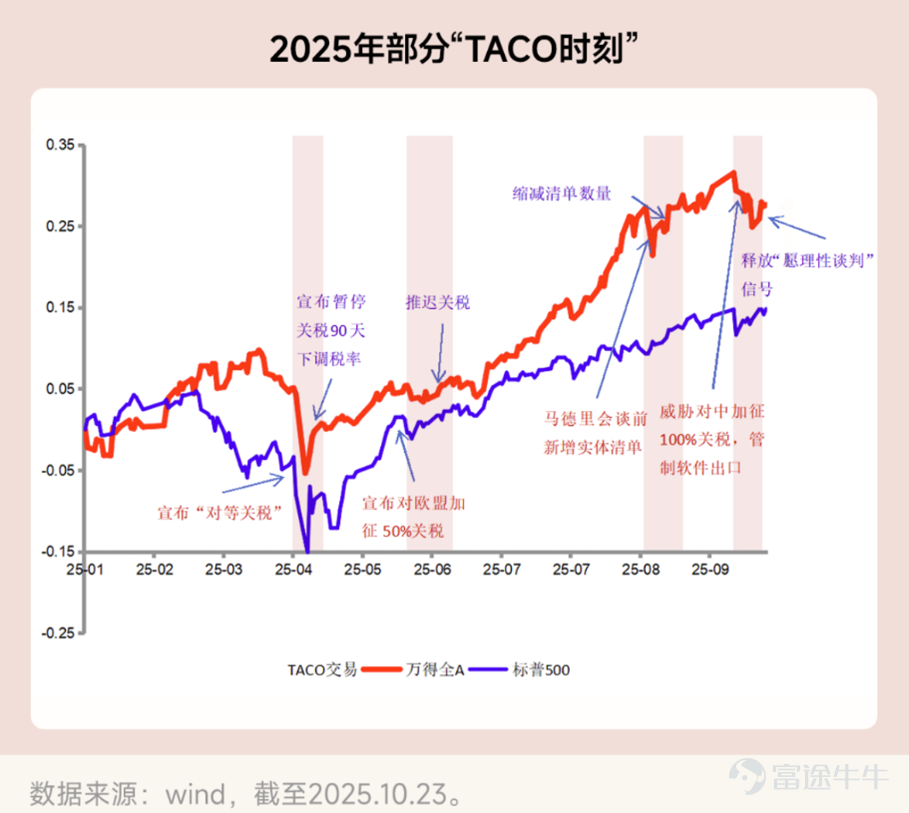
TACO stands for 'Trump Always Chickens Out,' a contrarian arbitrage strategy tailored by Wall Street to fit Trump’s governing style of 'extreme pressure first, then compromise and retreat.' The core logic lies in the fact that Trump tends to use extreme threats (such as imposing devastating tariffs or military strikes) as bargaining chips, which often trigger short-term market panic and asset sell-offs. However, he usually softens his stance at the last moment, allowing funds that buy the dip during sharp declines to profit from rebounds.

Image source: China AMC
This strategy originated in April 2025 when Trump’s proposal of 'reciprocal tariffs' triggered severe market panic, causing the deepest plunge of the year in both the Wind All A Index (red line) and the S&P 500 Index (blue line). However, the subsequent announcement of a '90-day tariff suspension with reduced rates' led to a stunning V-shaped reversal. This dramatic turn allowed Wall Street and global capital to keenly identify Trump’s pattern of 'inevitable retreat after extreme pressure,' thereby establishing the TACO trading logic of 'buying the dip during panic.'
Is TACO still effective? Combining实战review of the US-Iran conflict
In a series of strategic maneuvers concerning the Strait of Hormuz since late March, the TACO strategy of 'panic buying, cooling off, and cashing out' once again found operational space:
• On March 21, Trump issued an ultimatum to 'destroy Iran’s energy facilities within 48 hours.'
• On March 23 and March 26, Trump hit the brakes twice, announcing a temporary suspension of strikes on Iran’s energy facilities for five days and then extending the deadline to April 6.
• On March 30, Trump announced on social media that significant progress had been made in negotiations with Iran; on March 31, White House spokesperson Levitt announced that Trump would deliver a nationwide televised address on Iran at 9 PM Eastern Time on April 1.

Data source: Bloomberg, March 20, 2026 to April 2, 2026
The chart above records three TACO moments for the S&P futures index in March 2026. On March 23, during the first TACO moment, futures surged about 2% pre-market, perfectly validating the strategy; on March 26, during the second TACO moment, the market unexpectedly plummeted, breaking through previous lows, rejecting the logic of retreat; and from March 31 to April 1, during the third TACO moment, futures rebounded sharply over 3% from a low position, with the TACO trade proving effective again. The three events presented starkly different market outcomes.
This shows thateven as Trump's policy fluctuations continue to unfold and the TACO pattern becomes widely known in the market, TACO trading opportunities will not be completely eroded. The reason is that every time a policy signal materializes, market participants’ assessments of the current situation are not uniform—some believe risks have spiraled out of control and refuse to buy in, while others feel the situation remains manageable and actively enter the market. It is precisely this divergence in fundamental judgment that creates contrasting market reactions at different points in time, continuously generating arbitrage opportunities for the TACO strategy. In other words, as long as there is disagreement in the market over 'whether Trump will really back down this time,' price dislocations will keep occurring, and opportunities for TACO trades will persist.
How can investors reasonably implement the TACO strategy?
For this type of 'TACO strategy,' which heavily relies on news-driven events and aims to capture short-term rebounds, blindly placing large bets is not only highly risky but could also result in catastrophic losses due to sudden reversals in market logic (as seen in the failed crash on March 26).
However, if investors still wish to participate in such high-volatility games while controlling risk,the 'Core-Satellite Strategy'is undoubtedly a wiser choice. The essence of this strategy lies in 'playing it safe while taking bold actions': the vast majority of capital is treated as the 'core,' anchored in quality assets with long-term growth potential; simultaneously, only a very small portion of 'satellite' funds are allocated to take advantage of risk assets undervalued due to TACO-related panic. This way, extreme black swan events can be effectively isolated from impacting principal, while still allowing flexibility to capture impulsive excess returns driven by presidential policy swings.
Which types of assets are suitable for TACO trading
Since TACO trading profits from 'macro sentiment mispricing and subsequent recovery,' it's evidently unwise to bet on individual stocks with complex fundamentals. Capital typically prioritizes highly liquid assets or broad-based indices that are extremely sensitive to shifts in global risk appetite.
On one hand, there are broad-based index ETFs, especially large-cap indices concentrated with tech stocks, which react fastest to macro shocks and recover most swiftly. On the other hand, alternative risk assets like cryptocurrencies can offer substantial upward momentum when market sentiment shifts from 'panic' to 'all-clear.'
Tips: Be wary of the risk of TACO malfunction.
Although this 'high-risk, low-commitment' playbook has proven effective recently, investors must never view it as a surefire formula for profit. If geopolitical tensions escalate or negotiating counterparts adopt hardline countermeasures leading to loss of control, 'bluff turning real' could result in significant drawdowns for contrarian bottom-fishing capital. There is no universal key that works forever in financial markets; strict position control and stop-loss discipline are far more life-saving than blindly trusting a 'hot meme.'
$Hang Seng Index (800000.HK)$$S&P 500 Index (.SPX.US)$$CBOE Volatility S&P 500 Index (.VIX.US)$$Hang Seng TECH Index (800700.HK)$$Hang Seng China Enterprises Index (800100.HK)$$SSE Composite Index (000001.SH)$$CSI 300 Index (000300.SH)$$NVIDIA (NVDA.US)$$Amazon (AMZN.US)$$Alphabet-C (GOOG.US)$$Meta Platforms (META.US)$$Tesla (TSLA.US)$$HSTECH (LIST91332.HK)$$Hang Seng Index (800000.HK)$$SSE 50 Index (000016.SH)$$CSI 300 Index (000300.SH)$$CSI 1000 Index (000852.SH)$$SSE Science and Technology Innovation Board 50 Index (000688.SH)$$ChinaAMC CSI 300 Index ETF (03188.HK)$$SSE Composite Index (000001.SH)$$XIAOMI-W (01810.HK)$$JD.com (JD.US)$$TENCENT (00700.HK)$$Shenzhen Component Index (399001.SZ)$$Kweichow Moutai (600519.SH)$$Contemporary Amperex Technology (300750.SZ)$$PING AN (02318.HK)$$Alibaba (BABA.US)$$ICBC (01398.HK)$$CHINA MOBILE (00941.HK)$$ABC (01288.HK)$$Midea Group Co., Ltd (000333.SZ)$
Risk Warning:
Investing involves risks, including possible loss of principal. Any forecasts, outlooks, or opinions contained herein are provided for your reference only and are not guaranteed. The information herein reflects market conditions and our views as of the publication date, which may change without notice. The publisher of this material is China AMC (HK). This material has not been reviewed by the Hong Kong Securities and Futures Commission.
Market data referenced in this article comes from Bloomberg (March 20 to April 2, 2026), and the timeline of events is based on public news reports and official statements. Specific figures are estimates based on the aforementioned sources and may contain rounding errors.
Risk Disclaimer: The above content only represents the author's view. It does not represent any position or investment advice of Futu. Futu makes no representation or warranty.Read more

Comment (1)
to post a comment
8
6