
Pop Mart (09992.HK) Short-term Analysis: Rebound After Earnings Volatility, Oversold Conditions Brewing Recovery
Pop Mart (09992.HK) has experienced extreme volatility in its stock price recently. Following a sharp pullback after the earnings release, there has been a significant rebound in recent days. As of April 8, 2026, Pop Mart closed at HKD 152.2, surging by 7.33%, with an intraday high of HKD 155 and a trading volume of HKD 5.534 billion. After falling sharply from the late March peak, the stock found support near HKD 140, recording a strong rebound on April 8. The market is watching whether this recovery trend will continue.
Technical Analysis
From the chart perspective, Pop Mart’s share price surged throughout 2025 but underwent a sharp correction after the earnings report in late March, plummeting from around HKD 217.2 on March 24 to HKD 141.8, resulting in a cumulative decline of approximately 34.7% over eight trading sessions. According to technical data as of April 8, Pop Mart's first support level is approximately at HKD 139.3, which corresponds to the low area of the adjustment in late March. A more critical second support level lies at HKD 101, equivalent to the long-term support zone since the beginning of the year. On the resistance side, the first resistance is at HKD 178.8, and if it can break through, the next resistance is seen at HKD 206, corresponding to the February high region.
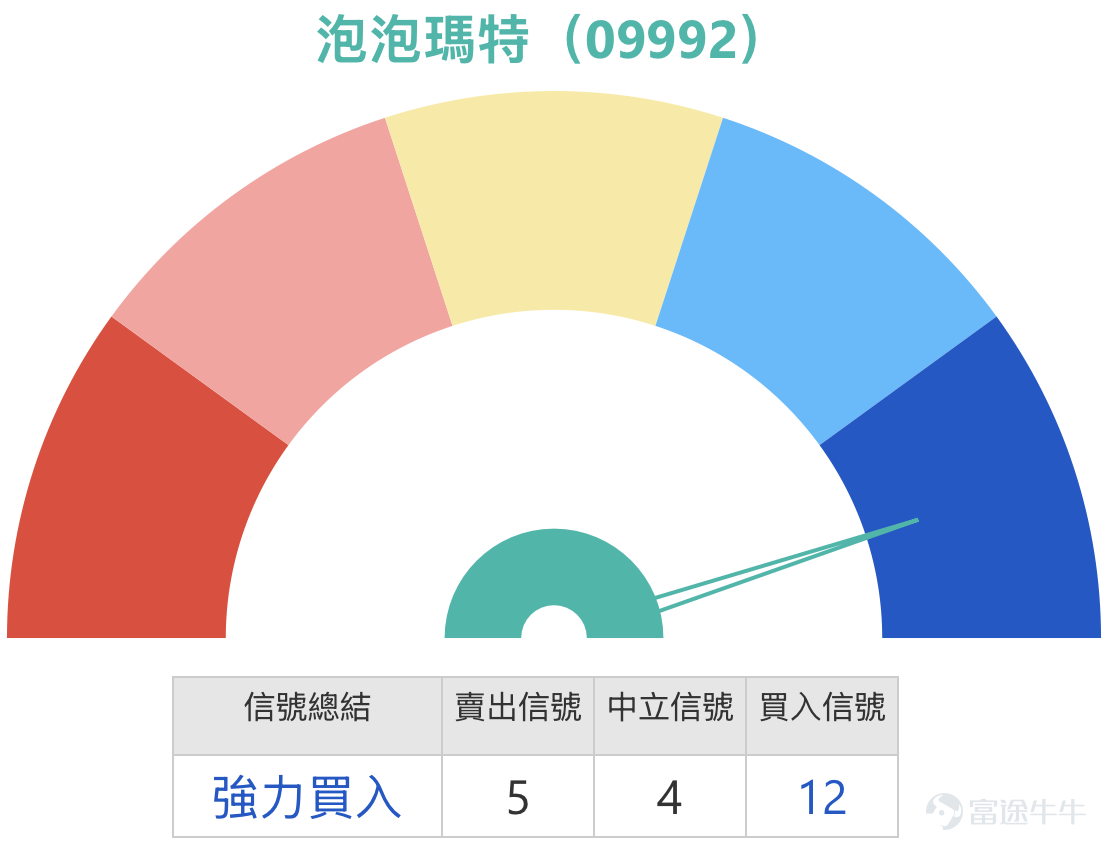
In terms of technical indicators, the overall signal suggests a 'Strong Buy,' with a total of 12 buy signals. The RSI is at 30, hovering at the edge of the oversold region. Multiple oscillation indicators show buy signals; both the Williams %R and Stochastic Oscillator have issued buy signals, while the CCI indicator shows neutral. At the same time, the Rate of Change (ROC) indicator shows neutrality, but the Bull-Bear Power indicator indicates buying. In summary, the current technical signals indicate a pattern of 'oversold bottom formation and rebound,' suggesting that in the short term, the stock may trade between HKD 139.3 and HKD 178.8. The oversold RSI provides conditions for a technical rebound.

Market News Integration
On the news front, Pop Mart has seen mixed bullish and bearish factors. Fundamentally, the company’s 2025 performance was impressive: revenue exceeded RMB 37.1 billion, representing a year-on-year increase of over 180%; net profit attributable to shareholders reached RMB 12.78 billion, marking an increase of more than 300%. Gross margin reached 72.1%, improving by 5.3 percentage points, with overseas sales continuing to rise as a proportion. However, management provided a growth guidance of 'no less than 20%' for 2026 during the earnings call, significantly slower compared to nearly doubling growth in 2025, which the market interpreted as a 'loss of speed' signal. On the day of the earnings announcement, the share price plummeted by 22.65%, wiping out over RMB 58 billion in market value in a single day.
Facing the stock plunge, Pop Mart's management quickly took action. Over six trading days from March 26 to April 2, the company continuously repurchased shares, accumulating a total of 9.32 million shares worth nearly RMB 1.4 billion, attempting to stabilize the stock price. On April 2, 700,000 shares were repurchased at prices ranging from HKD 140.9 to HKD 142.3 per share. Among major banks, Morgan Stanley believes the market has severely misjudged the company's business, while UBS Group pointed out concerns about the group's heavy reliance on a single IP and conservative growth guidance for 2026, leading to a downgrade in target price.
Warrant Product Review
In the review of warrant products, multiple Pop Mart-related derivatives mentioned on April 1, 2026, showed significant performance in the subsequent two trading days (up to April 3). During this period, the underlying stock Pop Mart rose by 5.51%, while related bullish products fully demonstrated the leverage effect: Societe Generale bull certificate (68300) increased by 25%, UBS bull certificate increased by 24%, and DBS call warrant (27649) rose by 8%.

Warrant product recommendations and comparisons
With the current Pop Mart share price at HK$153.3, combined with support levels at HK$139.3 and HK$101, as well as resistance levels at HK$178.8 and HK$206, investors can choose suitable products based on their own views.
For bullish strategies, two call warrants and two bull certificates can be considered:
BNP Paribas call warrant (27714), with a strike price of HK$180, offers approximately 1.7x leverage. The key advantage of this product is its lowest premium and implied volatility among similar products, making it cost-effective for bullish strategies. At the current share price, it is about 17.4% out-of-the-money, close to the first resistance level of HK$178.8, making it suitable for investors expecting the share price to break through HK$178.8. Societe Generale call warrant (27973), with a strike price of HK$180.1, provides about 1.6x leverage. This product has relatively ideal leverage and implied volatility, making it suitable for conservative strategies.
For bull certificates, consider Societe Generale bull certificate (67864) with a stop-loss level at HK$130.8 and actual leverage of 5x. This product has the lowest premium and relatively higher actual leverage. Another option is UBS bull certificate (54205) with a stop-loss level at HK$132 and actual leverage of 5x, offering relatively high-leverage pricing. When selecting bull certificates, note that the stop-loss level should be below the support levels of HK$139.3 and HK$101 to provide sufficient safety buffer. The stop-loss levels of HK$130.8 and HK$132 are slightly lower than the first support level of HK$139.3, providing acceptable margin of safety.
Two selected bullish products:
- BNP Paribas call warrant (27714) $BPPOMRT@EC2712A.C (27714.HK)$ : Lowest premium and implied volatility, most cost-effective, and a better choice for bullish deployment considering comprehensive terms.
- Societe Generale bull certificate (67864): Actual leverage of 5x, stop-loss level at HK$130.8 close to the support level, lowest premium, suitable for short-term rebound capture by investors.

For bearish strategies
Consider UBS put warrant (22558) with a strike price of HK$162.82 and leverage of 3.3x. This product has the lowest premium and implied volatility among similar products, making it suitable for bearish strategies. Another option is JPMorgan put warrant (23584) with a strike price of HK$162.82 and leverage of 3.2x, offering relatively low implied volatility. When choosing put warrants, note that the strike price of HK$162.82 is above the current share price, making it an in-the-money product. If the share price remains constrained by the HK$178.8 resistance, such products will perform more ideally.
For bear contracts, consider HSBC bear contract (68905) with a recovery price of 180 HKD, actual leverage of 4.9 times, and relatively high leveraged price; another option is the UBS Group bear contract (69183) with a recovery price of 180 HKD, actual leverage of 4.9 times, and the lowest premium, offering higher actual leverage. When choosing bear contracts, ensure that the recovery price is above resistance levels of 178.8 HKD and 206 HKD. A recovery price of 180 HKD is slightly higher than the first resistance level at 178.8 HKD, making it a close-range deployment choice suitable for investors expecting the share price to encounter resistance at 178.8 HKD and pull back.
Two selected bearish products:
- UBS Group put warrant (22558)$UBPOMRT@EP2607A.P (22558.HK)$: Lowest premium and implied volatility, leverage of 3.3 times, making it a good comprehensive option for bearish deployment.
- UBS Group bear contract (69183): Actual leverage of 4.9 times, recovery price of 180 HKD near resistance level, lowest premium, suitable for short-term bearish investors.
Overall, Pop Mart's share price is currently in a strong rebound phase following an oversold bottoming-out, successfully reclaiming the 150 HKD level, with the 178.8 HKD resistance determining short-term direction. Fundamentally, positive factors such as impressive earnings, intensive buybacks, hot-selling FIFA World Cup co-branded products, and support from Duan Yongping are concentrated, but the market remains divided on the growth guidance for 2026, with previous significant stock price corrections still reflecting concerns about slowing growth. Investors should strictly control risks when deploying, selecting appropriate derivatives based on key support levels of 139.3 HKD and 101 HKD, and resistance levels of 178.8 HKD and 206 HKD, while paying attention to the impact of out-of-the-money degrees on product performance.
Interactive Q&A:
Dear readers, do you think Pop Mart (09992) can stabilize above 150 HKD in the short term and break through the 178.8 HKD resistance?
A) Yes, benefiting from intensive buybacks and new product sales, further testing 206 HKD.
B) No, heavy resistance at 178.8 HKD requires retesting the support level of 139.3 HKD.
C) Fluctuating repeatedly within the range of 140 HKD to 178.8 HKD.
Feel free to share your views in the comment section!
Reminder: This article does not constitute any investment advice.
This article is for reference only and does not constitute any investment advice. The market data, opinions, and analysis contained herein may change at any time without prior notice. We are not responsible for any loss or damage caused by reliance on the information in this article. Technical analysis only shows whether certain technical conditions are met; a comprehensive assessment of asset performance should combine other data and should not solely rely on this article to make trading decisions. Please note that past performance is not indicative of future results. Follow Jenny's insights on Hong Kong stock warrants for more professional analysis.
#POP MART #09992 #Hong Kong Stocks #Technical Analysis #Support and Resistance Levels #Warrants #Bull/Bear Certificates #Call Warrants #Put Warrants #Trendy Toy Sector #Hong Kong Stock Warrants Jenny
Risk Disclaimer: The above content only represents the author's view. It does not represent any position or investment advice of Futu. Futu makes no representation or warranty.Read more


Comments
to post a comment
4